
Nigredo · Object · Chapter 31 of 48
1.3.7. Path Consciousness
If awakening cannot be manufactured by will, what can practice genuinely prepare—and what remains beyond control?
Watch the chapter discussion
Why You Can’t Force Enlightenment
The book
The chapter in brief
This chapter introduces path consciousness within a specifically Theravāda Abhidhamma map. A path moment (magga-citta) is described as a supramundane consciousness that takes nibbāna—the unconditioned cessation of suffering—as its object and marks a decisive change in relation to particular fetters. It is followed by fruition consciousness (phala-citta), the result of that path moment.
The chapter places this technical model inside Nigredo’s wider alchemical language of transformation. Its practical emphasis is not on claiming an attainment or producing an extraordinary state, but on cultivating ethical, attentive and wise conditions without imagining that willpower can command a breakthrough. The four paths, their fruits and their jhānic classifications are a traditional analytical scheme, not an externally measurable ladder of consciousness.
Visual orientation
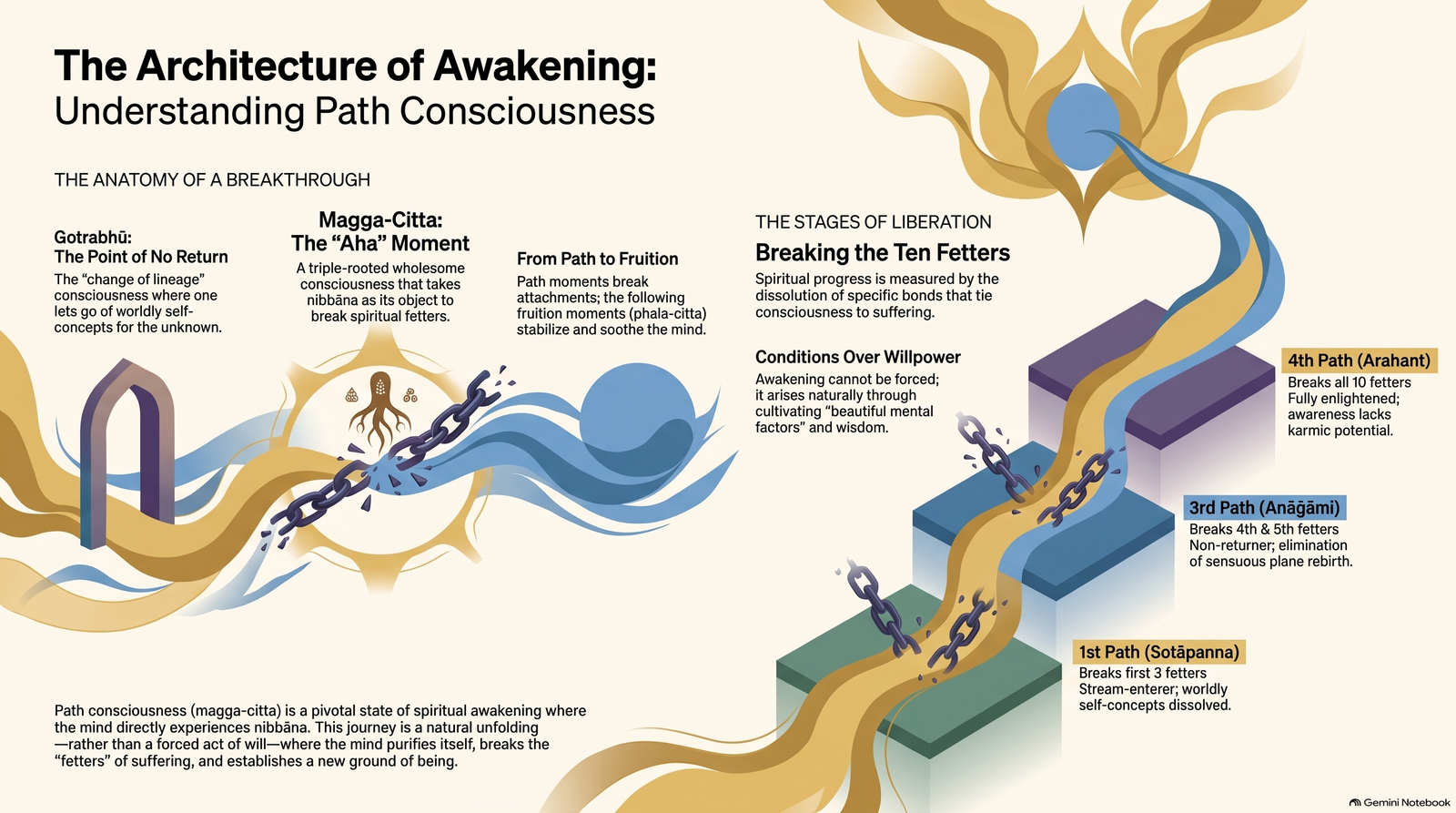
The architecture of awakening
Video guide
Preparation without possession
The recording opens with images of destruction and reconstruction. Fernando Pessoa’s language of “destroying” oneself and the alchemical image of a force acting upon the observer are read psychologically: an inherited account of self and world can lose its authority, allowing experience to be interpreted from a different ground. These are evocative metaphors within the video’s synthesis, not instructions for self-harm, claims about a measurable force field or historical definitions of alchemy.
The discussion then turns to the more exact language of Theravāda Abhidhamma. Ordinary cittas take conditioned sights, sounds, feelings, memories or concepts as their objects; magga-citta is said to take nibbāna as its object and to perform the function of abandoning fetters appropriate to a stage of awakening. Gotrabhū, or change of lineage, names a threshold in later Theravāda analysis. The video dramatises this threshold as discontinuity: not a better version of an established identity, but a change that the old identity cannot simply award itself.
From there, the recording follows the four paths and fruits. Stream-entry abandons identity view, doubt and clinging to rites and observances; once-return weakens sensual desire and ill will; non-return abandons those two lower fetters; arahantship abandons the five remaining subtle fetters. Fruition is presented as the settling or result immediately following the path. The expanded Abhidhamma classification counts forty supramundane consciousness types by relating four paths and four fruits to five jhānic levels. This is a scholastic taxonomy, not forty independently verified neurological states.
The final movement returns to the central paradox. Concentration, ethical conduct, mindfulness and wisdom can prepare the ground, but ambition cannot seize the result without strengthening the very project of acquisition being questioned. The lotus and the Rebis become images of cultivation and integration: difficulty can be met and understood without being romanticised, and conflicting aspects of personality can be held without turning any one of them into a final self. The challenge is therefore modest but exacting—to prepare carefully, release the demand to control the outcome, and avoid converting a traditional path map into a personal badge.
Argument map
How the recording develops
Disturb the inherited structure
Images of a shattered ground introduce awakening as a change in the framework of experience rather than the acquisition of a spiritual ornament.
Define the decisive object
Path consciousness is distinguished by its traditional object—nibbāna—rather than by intensity, bliss or unusual imagery.
Separate preparation from control
Beautiful mental factors and wisdom can condition clarity, while craving for status or certainty cannot manufacture release.
Cross the threshold
Change of lineage supplies the Abhidhamma image of a transition from an ordinary cognitive process towards the first supramundane path.
Relate paths to fetters
The four path moments organise awakening through the abandonment or attenuation of particular bonds rather than through a single undifferentiated revelation.
Let fruition follow path
Fruition consciousness is presented as the immediate result of the path, expressing release rather than performing the work of cutting the fetter.
Return to integration
The lotus and Rebis bring the technical map back to ordinary life: cultivate conditions, integrate conflict and relinquish ownership of the outcome.
Book, tradition and interpretation
Four layers in the discussion
Path and fruition THERAVĀDA ABHIDHAMMA
Magga-citta performs the path’s abandoning function; phala-citta is resultant. Both are classed as supramundane because nibbāna is their object.
Four stages and ten fetters BUDDHIST PATH MAP
Stream-enterer, once-returner, non-returner and arahant are related to a progressive weakening and abandonment of fetters in Theravāda teaching.
Forty consciousness types EXPANDED ANALYTICAL SCHEME
Eight paths and fruits are each associated with five jhānic levels in the 121-citta enumeration; the compact 89-citta scheme counts the eight together.
Lotus and Rebis AUTHOR’S SYNTHESIS
Alchemy, shadow language and psychological integration provide interpretive images. They do not establish that distinct religious maps describe one identical mechanism.
| Stage | Traditional relation to the fetters | Careful reading |
|---|---|---|
| Sotāpanna · stream-enterer | Abandons identity view, doubt and clinging to rites and observances | A doctrinal attainment category, not a label inferred from one experience or a personality description |
| Sakadāgāmī · once-returner | Has abandoned the first three and attenuated sensual desire and ill will | “Weakened” concerns the traditional fetter model; it does not mean ordinary anger can simply be renamed awakening |
| Anāgāmī · non-returner | Abandons the five lower fetters, including sensual desire and ill will | The rebirth consequence belongs to Buddhist soteriology and is not an empirical psychological diagnosis |
| Arahant | Abandons all ten fetters, including attachment to refined existence, conceit, restlessness and ignorance | The final liberation of this Theravāda map; it should not be reduced to calmness, charisma or self-description |
Recording outline
The route through the video
The first nine supplied markers fall within the stated 35:47 final runtime. The supplied 39:10 closing marker exceeds that runtime and is therefore omitted.
Key language
Glossary
Citta
Magga-citta · path consciousness
Phala-citta · fruition consciousness
Gotrabhū · change of lineage
Nibbāna · nirvāṇa
Lokuttara · supramundane
Saṃyojana · fetter
Tihetuka · triple-rooted
Sobhana cetasikas · beautiful mental factors
Paññā · wisdom
Jhāna
Rebis
Continue into the ideas
Related reading and reference points
Within this course
- 1.3.6. Different Worlds and JhānaThe preceding chapter distinguishes conditioned absorption and refined realms from liberation.
- 1.3.8. SotāpannaThe next chapter examines stream-entry, the first path and the abandonment of the first three fetters.
- 1.3.4 The Four Grades of RealisationIntroduces the complete four-stage structure within which path and fruition are located.
- 1.2.11. The Fetters that BindProvides the fuller course account of the ten bonds progressively weakened or abandoned on the path.
- 1.2.4 ConsciousnessEstablishes the course’s earlier account of citta, mental factors and momentary cognition.
- Object — Part Three of NigredoThe section index for the twelve chapters on paths, realisation and the apparent goal.
External reference points
- Stanford Encyclopedia of Philosophy — AbhidharmaScholarly context for the history, varieties and aims of Buddhist analytical systems, including momentary citta and world-transcending consciousness.
- Bhikkhu Bodhi, ed. — A Comprehensive Manual of AbhidhammaA recognised Theravāda manual explaining the paths and fruits, nibbāna as the unconditioned, and the compact and expanded enumerations of consciousness.
- SuttaCentral — AN 10.13, FettersA concise early Buddhist source for the ten fetters; the detailed moment-by-moment path process belongs especially to later Abhidhamma exegesis.
- NHS — Psychosis overviewPractical guidance on hallucinations, delusions, disordered thinking and when to seek prompt medical help rather than interpreting serious symptoms as spiritual attainment.
Question to carry forward
Where does preparation turn into control?
Think of one ordinary situation in which careful preparation matters but cannot guarantee the result—a conversation, a piece of work or an act of care. What can you responsibly cultivate, and what demand for certainty can you release? Keep the reflection at the level of daily life. It is not an attainment test or an invitation to induce an altered state.