
Dialogues I · Episode 04
The Garden of Eden in Your Mind
What if Eden is not a lost location, but a symbolic map of the moment awareness divides—and of the danger of mistaking that map for the mind itself?
The central question
Can the mind use division without becoming ruled by it?
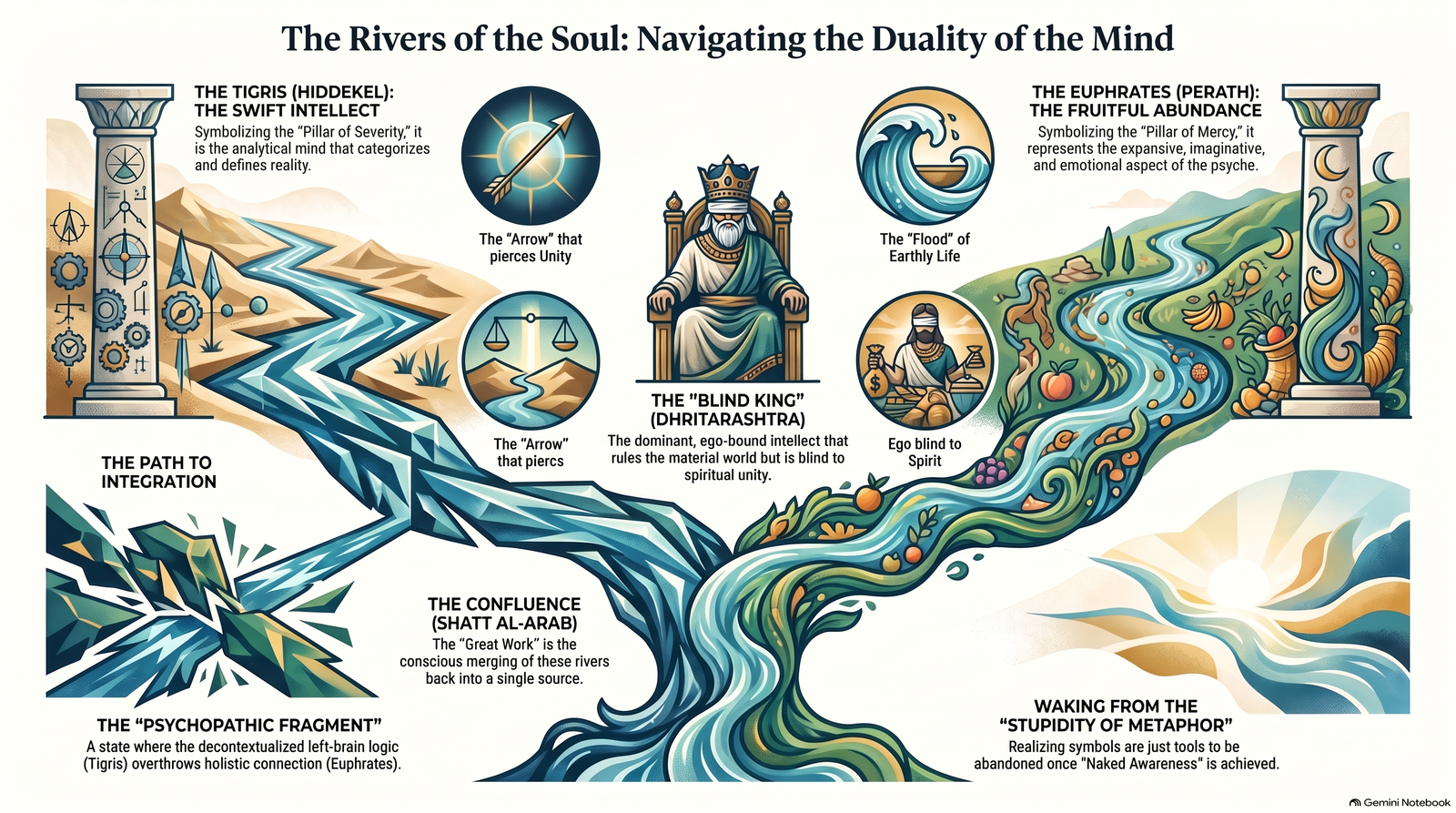
The episode reads the rivers of Eden as an imaginative map of two indispensable capacities: discrimination and connection. Its deeper concern is not which side should win, but how a useful distinction hardens into a separate ruler—and how even the most beautiful spiritual explanation can become another possession of that ruler.
The journey begins with a striking geographical image. The Tigris and Euphrates rise in the highlands of eastern Turkey, travel through a shared region and eventually join to form the Shatt al-Arab. They do not literally spring from one identical source, and Genesis describes one Edenic river dividing into four branches, not simply two. The episode deliberately transforms these features into symbolic anatomy: a single field of awareness differentiating into parallel currents of mind.
One current is made sharp, linear and classificatory; the other receptive, affective and connective. From there the discussion moves through Eden, the Tree of the Knowledge of Good and Evil, the Kabbalistic Tree of Life, alchemical sulphur and mercury, the two thieves at the crucifixion, Dhritarashtra in the Mahābhārata, cerebral lateralisation and the effects of literacy. The resulting image is the “blind king”: an analytical capacity that has forgotten it is one capacity within a larger organism.
The final movement turns the argument back upon its own elaborate symbolism. Rivers, trees, kings, wells, floods and rafts may orient attention, but none is naked awareness. The episode therefore performs a useful self-correction: it builds a rich conceptual vehicle, then asks whether awakening might require leaving even that vehicle behind.
Argument map
From one river to the flood
Eden becomes an inner landscape
The geography of rivers provides a mythic image for awareness before and after differentiation.
Two mental currents emerge
Tigris and Euphrates are assigned the contrasting functions of discrimination and connection.
The Fall permits participation
Separation is treated not only as loss but as the condition for language, choice, agency and relationship.
The useful servant becomes king
Writing, naming and abstraction sharpen cognition until the map appears more real than lived experience.
A god thinks with a slave’s knowledge
Grand entitlement collides with anxious, survival-bound calculation: power without context, information without wisdom.
Integration reveals a subtler trap
When analytic and receptive modes cooperate, beauty and coherence can return—along with a spiritual identity eager to own them.
The map enters its own fire
The closing argument releases rivers, kings and stages as metaphors that have served their purpose.
Editorial lens
How the traditions are being used
A river that becomes four
Genesis 2:10–14 supplies the source image and names the Hiddekel/Tigris and Euphrates as the third and fourth rivers. The episode narrows the fourfold account into a paired psychological drama.
Pillars, sephirot and paired principles
Hod, Netzach, severity, mercy, sulphur and mercury are combined into a modern correspondence. The specific river assignments should not be mistaken for a canonical Kabbalistic or alchemical table.
Blind kings and divided crosses
Dhritarashtra and the crucifixion scene are read psychologically. These analogies illuminate the episode’s argument but do not replace the Indian epic or Christian theological contexts from which they are drawn.
Asymmetry without two personalities
Language is often lateralised, and learning changes neural networks. The familiar left-logic/right-feeling story greatly exaggerates this into two self-contained styles of mind.
Storehouse and naked awareness
Ālaya-vijñāna is a Yogācāra account of conditioned continuity; rigpa belongs to Dzogchen discourse. The episode’s movement from one to the other is contemplative synthesis, not a standard doctrinal sequence.
The raft is not the shore
The metaphors remain valuable while provisional. The closing flood image refuses to let the explanation become a final metaphysical possession.
Chapter guide
Move through the episode
- 00:00Opening: Eden as an Inner Map
- 02:35The Single Source Before the Split
- 05:15Tigris and Euphrates: Logic and Feeling
- 08:10Why the Fall Was Necessary
- 11:25The Two Thieves and the Divided Mind
- 14:10The Blind King Takes the Throne
- 17:25The Kingdom of Shells
- 20:25Language, Literacy and the Left Brain
- 24:00The “Psychopathic Fragment”
- 26:50The Rivers Must Meet
- 29:20The Arrogance of a God, the Knowledge of a Slave
- 33:05The Golden Chain of Spiritual Ego
- 36:55Why Description Becomes Destruction
- 39:25The Stupidity of Metaphor
- 42:40The Flood Beyond the Map
- 45:10Final Reflection: Letting the Rivers Meet
Glossary
Terms carried by the conversation
Eden and the four rivers
Kether, Hod and Netzach
Pillars of Severity and Mercy
Sulphur and mercury
Dhritarashtra, the blind king
Cerebral lateralisation
Kingdom of shells (qlippot)
Ālaya-vijñāna
The ninth bhūmi: Sādhumatī
Rigpa and naked awareness
Bhagavad Gītā 2.46
Map, raft and metaphor
Continue within the website
Related pathways
The preceding episode asks how syntax repeatedly divides experience into subject, action and object.
Returns to the opening question of whether a useful mental interface has been mistaken for the whole organism.
A later treatment of naming, inner narration and the construction of an apparently continuous owner.
Places perceptual construction beside the limits of the claim that constructed experience is simply unreal.
Revisits the tension between indispensable abstraction and a world that exceeds its measurements.
Develops the later caution that precision, naming and metaphysical objects can conceal what they attempt to disclose.
Curated reading shelf
External reference points
The Hebrew and English source passage for Eden’s four rivers, including Hiddekel and Euphrates.
An early example of reading Eden’s rivers as qualities of the soul, useful context for distinguishing historical allegory from this episode’s modern map.
A concise scholarly review separating genuine cerebral asymmetry from the popular mythology of two opposed mental personalities.
A substantial guide to the philosophical setting of ālaya-vijñāna and why it should not be turned into an enduring metaphysical self.
The verse behind the episode’s reservoir-and-flood image, with access to several translations and commentarial traditions.
A grounded observation
Let both rivers report
Choose one ordinary, low-stakes decision. On paper, make two short notes: first, the facts, distinctions and practical constraints; second, the felt context, relationships and likely human consequences. Then write one sentence that honours both. The exercise is not designed to merge brain hemispheres or produce a special state. It simply checks whether one useful mode has silenced another. If introspection feels unsettling or disorientating, stop and return to an ordinary activity.