
Dialogues I · Episode 05
When the Shadow Looks Back
When a disturbing image returns the gaze, is it an enemy, a sleep-boundary event, or symbolic material asking to be met without recoil?
Central question
What changes when fear is met by sustained curiosity rather than immediate retreat?
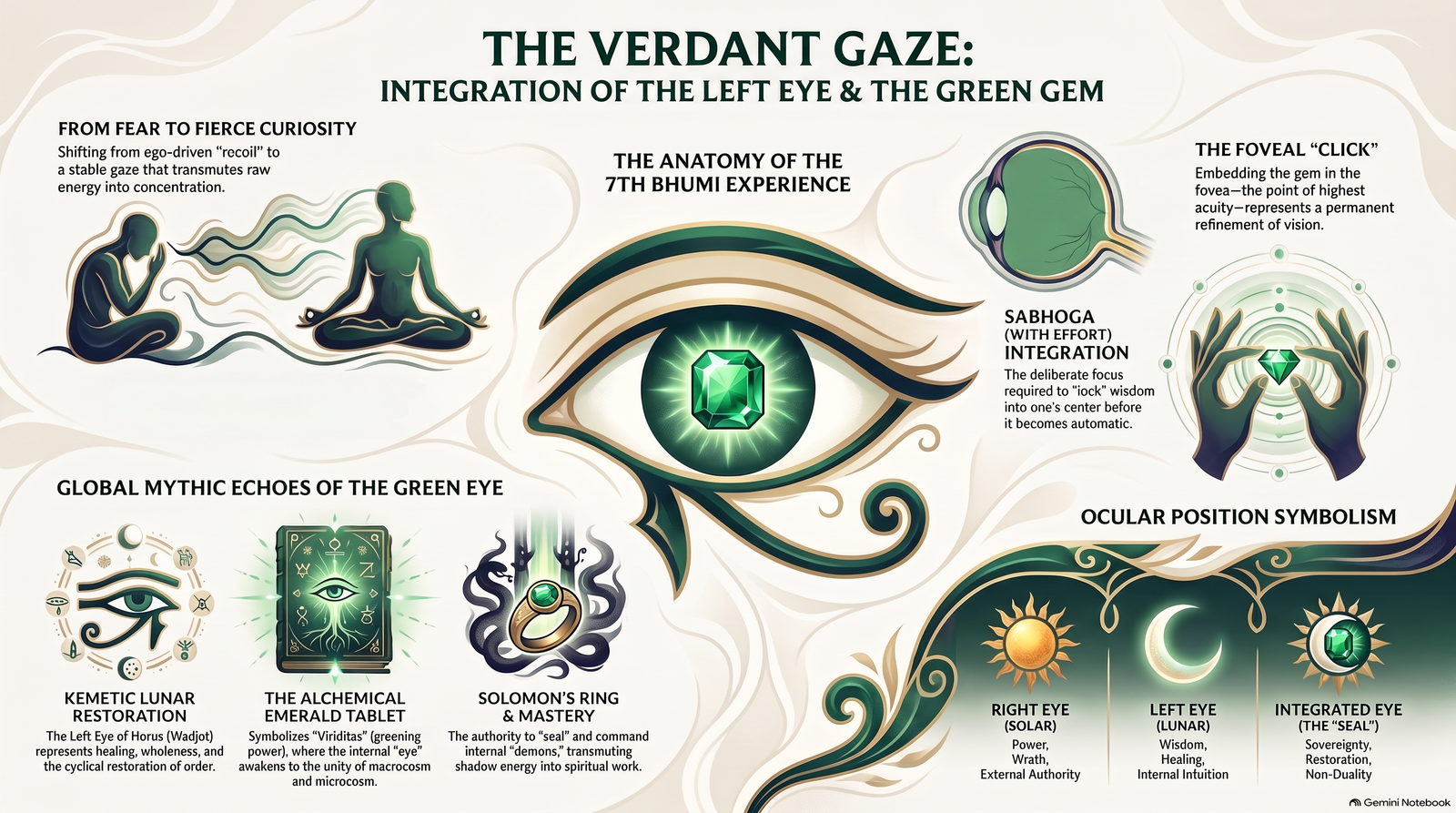
The episode begins at the threshold of sleep. A close, leathery face moves across the practitioner’s visual field; the gaze becomes mutual; fear flashes; and attention holds. A greenish gem then appears to move towards the centre of the left eye before the image fades. The recording treats this brief report as a seed from which several interpretive worlds unfold.
Its strongest psychological movement is also its simplest: fear does not vanish, but the automatic recoil is interrupted by what the practitioner calls “fierce curiosity”. The conversation reads that change as a transmutation of threat into concentration. It is a useful contemplative image, although the audio sometimes moves too quickly from a single experience to claims about trauma, the ego and the nervous system.
The green gem and left eye then gather a wide symbolic constellation: the restored eye of Horus, malachite eye paint, Solomon’s seal, the Emerald Tablet, the Buddhist grounds, trāṭaka, Japanese regalia and modern fictional eyes. The page preserves the imaginative force of this comparison while separating attested traditions from later association. Recurrence is not proof of a universal code, and several links are created by the episode itself.
The fading of the image supplies an important counterweight. Whatever meaning is found, the experience need not become a possession, diagnosis or spiritual credential. The episode is most valuable when read as an inquiry into how minds make meaning at the edge of sleep—and into whether a disturbing appearance can be observed without either literalising it or dismissing it.
Argument map
How the conversation moves
A face forms in darkness
The hypnagogic account supplies a compact sequence of proximity, mutual gaze, fear, concentration and disappearance.
Curiosity interrupts recoil
The biological flinch is contrasted with an attention that stays near the experience without immediately accepting or rejecting it.
The gem reaches the fovea
Central vision becomes a metaphor for an insight entering the very lens through which experience is organised.
Solomon does not merely banish
The ring legend is read psychologically: difficult material is questioned and put to work rather than expelled as wholly alien.
The wounded eye becomes whole
Horus, the wedjat and malachite bring together vulnerability, protection, green pigment and restored sight.
Alchemy gives vision a colour
Emerald and viriditas become images of life returning to matter, although the episode compresses distinct histories.
The image is allowed to fade
The closing movement asks whether meaning can be received without turning a transient event into a permanent spiritual identity.
Source map
What is attested, and what is interpretation?
The vision belongs first to phenomenology
The face, mutual gaze, fear, gem and fading are features of one first-person account. Their felt reality does not by itself decide their neurological, psychological or spiritual explanation.
The seventh ground has a scriptural setting
Dūraṃgamā, “Gone Far”, belongs to the ten bodhisattva grounds. Linking this particular vision to that ground is autobiographical interpretation, not a criterion supplied by the sūtra.
Eye, gem and seal are not one lineage
Egyptian, Solomonic, Hermetic, Indian and Japanese materials arose in different contexts. Their juxtaposition creates a comparative constellation rather than demonstrating transmission or identity.
The fovea is real; the embedding is symbolic
The fovea supports sharp central vision. No gem enters the retina, and the recording’s claims about forced eye stillness, brain-wave shifts and vagal effects exceed what the supplied account can establish.
Chapter guide
Move through the episode
- 00:00Opening: A Face in the Darkness
- 02:20When the Vision Looks Back
- 04:40The Green Gem in the Left Eye
- 06:50Advanced Practice, Fear, and the Seventh Bhūmi
- 09:40Demonic Camouflage and the Leathery Mask
- 12:20The Biological Flinch and Fierce Curiosity
- 15:10The Fovea, the Gem, and the Danger of Clinging
- 18:20Solomon’s Ring and Commanding the Demons
- 21:40The Left Eye of Horus and the Wound of Set
- 25:10Malachite, Healing, and the Green Eye
- 28:20Emerald Tablets, Alchemy, and the Verdant Gaze
- 31:10Eastern Traditions, Trāṭaka, and the Heart’s Vision
- 34:00Pop Culture, Magical Eyes, and the Cost of Seeing
- 36:00Closing: What Remains When the Body Fails?
Glossary
Terms carried by the conversation
Hypnagogia
Fierce curiosity
The flinch and nociception
The shadow
The seventh bhūmi: Dūraṃgamā, “Gone Far”
Fovea
Makyō and nyams
Solomon’s seal
Wedjat or Eye of Horus
Malachite eye paint
Emerald Tablet
Viriditas
Trāṭaka
Continue within the website
Related pathways
A later exploration of protective recoil, threat prediction and how avoidance can organise an experienced world.
Approaches difficult contemplative insight obliquely, without converting it into a new identity or object of possession.
Returns to the possibility of experience being known without the reflex to seize, reject or stabilise it.
A related warning about how charged spiritual meaning can harden into role, authority and identity.
The opening episode’s process-based account of selfhood provides a quieter frame for reading apparently autonomous inner material.
Examines how interpretation and language can turn an event into an owned story about the self.
Curated reading shelf
External reference points
A complete translation of the Daśabhūmika, including the scriptural context for the seventh ground called “Gone Far”.
A museum record of a wearable Egyptian eye amulet, grounding the episode’s symbolism in a surviving object.
A concise account distinguishing green malachite eye paint from black galena and its association with glare reduction.
The primary pseudepigraphal source for the engraved ring, authority over demons and their labour on the Temple.
An ancient textual source for claims about emeralds and rested sight, best read as Roman natural history rather than modern ophthalmology.
A grounded observation
Separate appearance, response and interpretation
With an ordinary, low-intensity experience—a sudden noise, an ambiguous shape or a moment of unease—notice three layers: what appeared, what the body did, and what story followed. Do not provoke fear, prolong sleep loss or recreate the episode’s vision. The aim is simply to see whether curiosity can make a little room between reflex and conclusion. Stop if the exercise increases distress or disorientation.