
Dialogues I · Episode 09
Shattering Intellectual Baggage
Pith instructions, pointing-out and the moment when another explanation becomes the very thing that prevents recognition.
Central question
What kind of instruction helps when knowledge itself has become the obstruction?
The episode opens with a provocation: after weeks of disciplined meditation, a teacher suddenly shouts. In ordinary life the act would be intrusive or alarming. Within the episode it becomes an image of instruction that does not add another concept, but interrupts the reflex by which the mind turns every experience into an explanation.
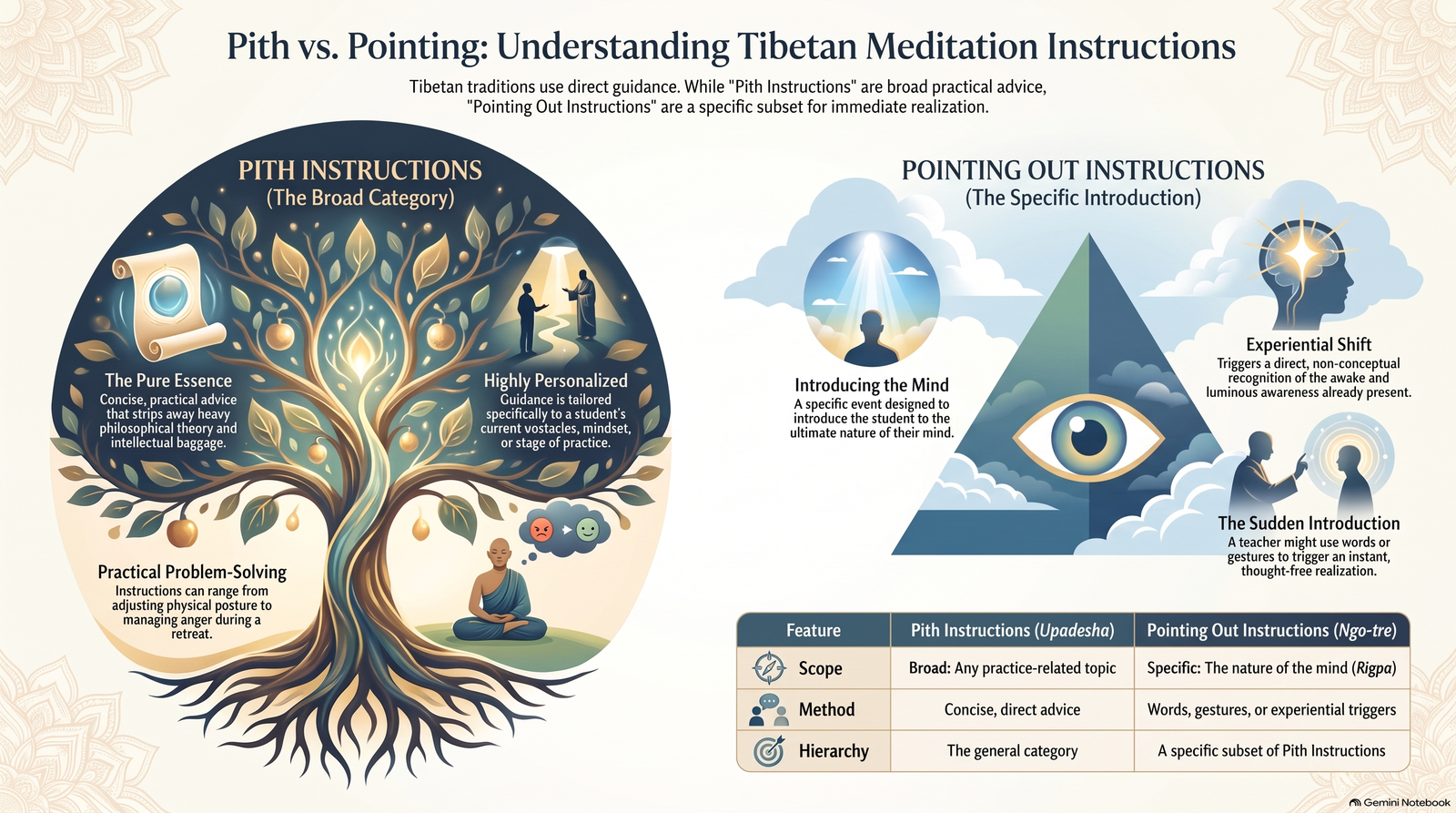
From there, the discussion distinguishes two related forms of guidance. Pith instructions are presented as concise, practical and responsive to a particular practitioner’s difficulty. They may concern posture, dullness, agitation or some other immediate obstacle. Their value lies not merely in brevity, but in timing and fit: the same advice need not be useful to every person in every circumstance.
Pointing-out instruction is then treated as a more specific introduction to mind’s nature, particularly in Dzogchen and Mahāmudrā settings. The episode’s recurring phone image clarifies the intended contrast. Thoughts, feelings and spiritual ideas are like the apps that occupy attention; pointing-out does not install a better app, but redirects attention towards the “screen” on which all content appears.
The discussion finally asks why direct guidance has traditionally been relational. A practitioner can study descriptions of awareness while remaining absorbed in the description. A teacher may notice habits invisible from within and respond at the moment when an instruction can be heard. Yet this dependence also requires discernment: a traditional teacher–student relationship is not permission for coercion, manufactured shock or the abandonment of ordinary judgement.
Argument map
From accumulating knowledge to recognising its medium
A shout breaks the expected lesson
The opening scene reverses the familiar model of learning. Instead of adding information, instruction interrupts the machinery that would convert the moment into one more possession.
The map begins to obscure the territory
Concepts are indispensable, but accumulated explanations can simulate understanding. Spiritual language then becomes another layer between experience and the person trying to reach it.
Advice is cut to the obstacle
Concise guidance responds to a practitioner, situation and stage. Its apparent simplicity rests on discernment rather than on the universal power of a memorable phrase.
Technique gives way to introduction
Practical advice changes what the student does. Pointing-out is framed differently: its purpose is to introduce what is said to be present before another state is constructed.
Attention turns from content to capacity
Thoughts and emotions occupy the display; awareness is compared to the transparent medium that permits them to appear. The metaphor clarifies the episode without defining rigpa exhaustively.
Surprise exposes a pause in narration
The episode interprets sudden sound as one possible interruption of conceptual momentum. The pause is not itself proof of awakening, and shock is neither necessary nor sufficient.
Another person may reveal a blind spot
The teacher is imagined as an external mirror whose response cannot be fully anticipated. The closing question asks what self-liberation means when the interpreting mind also hides from itself.
The interpretive lenses
Four levels of explanation operate at once
Concise guidance and direct introduction
The episode draws its main distinction from Tibetan Buddhist vocabularies of essential instruction and introduction to mind’s nature. Different lineages organise and transmit these materials in different ways.
Coach, map, phone and mirror
Modern images make the argument accessible: a coach corrects one movement, a map displaces the territory, apps conceal the screen and an external mirror reveals what self-observation misses.
Blind spots, resistance and pattern interruption
The discussion interprets dullness, anger and overthinking through psychological shorthand. These readings are possibilities within the episode, not diagnoses or universal explanations of behaviour.
Startle, attention and narrative processing
Brain-language lends the discussion mechanical vividness, but its claims are not a clinical account of meditation or awakening. The neural metaphors require more qualification than the spoken format permits.
Watch by chapter
Episode chapters
- 00:00Opening: The Shout That Breaks the Pattern
- 02:10Why More Knowledge Can Become the Problem
- 04:40What Is a Pith Instruction?
- 07:20Precision Advice, Not Generic Wisdom
- 10:30Anger, Sleepiness, and Spiritual Resistance
- 13:30From Doing to Recognising
- 16:00Pointing-Out Instructions and Rigpa
- 18:40The Screen, the Apps, and Awareness
- 21:10Why Shock Can Interrupt the Conceptual Mind
- 23:30The Teacher as External Mirror
- 25:20Can We Wake Ourselves Up?
Glossary
Terms and metaphors used in the discussion
Pith instruction
An essential, practical instruction that condenses a teaching for use. Tibetan man ngag and Sanskrit upadeśa occur in overlapping but context-dependent ways. Pith instruction is a broad genre and need not be cryptic, shocking or limited to a single sentence.
Pointing-out instruction
A direct introduction to mind’s nature, commonly discussed in Dzogchen and Mahāmudrā contexts. The Tibetan expression is generally transliterated ngo sprod. Its meaning depends on lineage, preparation and subsequent practice; a transient blankness or interruption is not automatically recognition.
Dzogchen
The Great Perfection, a body of teachings especially associated with the Nyingma tradition and also present in Bön. The episode emphasises immediate recognition, but Dzogchen transmission also includes view, preparation, ethical context, meditation and integration. It should not be reduced to sudden shock.
Mahāmudrā
Literally “great seal”, a family of teachings particularly associated with Tibetan Kagyu lineages, with related presentations in other schools. It includes both gradual and direct pedagogies. The phrase “ordinary mind” has a specialised contemplative meaning and does not simply mean whatever mental state happens to be present.
Rigpa
A Tibetan term whose Dzogchen usage is often translated as awareness, knowing or pristine awareness. In this context it refers to recognition of mind’s nature, not merely attention, alertness, a blank mind or a metaphysical object hidden behind experience. Translations and explanations vary.
Empty and luminous
A paired contemplative description: empty indicates the absence of fixed, independent essence; luminous indicates the capacity for knowing and appearance. The terms do not describe a physical light, a dead void or a permanent substance that contains thoughts like objects in a box.
Ngöndro
Tibetan for practices that “go before”: preliminary or foundational disciplines used in Vajrayāna lineages. They may prepare a practitioner for more advanced transmission, but ngöndro is not the standard name for pointing-out instruction itself.
Phaṭ
A forceful syllable used in some Tibetan contemplative and ritual practices. Its function and pronunciation belong to particular instructions and contexts. The episode uses a shouted syllable as its central dramatic image, but this is not a universal recipe for recognition and should not be imitated as a startling exercise.
Direct and gradual paths
Two broad pedagogical emphases rather than mutually exclusive religions. Gradual approaches cultivate conditions, understanding and stability over time; direct approaches emphasise recognition of what is already the case. In actual traditions, preparation, recognition and familiarisation often coexist.
Map and territory
A modern distinction between a representation and what it represents. The episode uses it to show how accurate concepts can become obstacles when the practitioner mistakes thinking about awareness for recognising or embodying what the teaching indicates.
The apps and the screen
The episode’s contemporary metaphor for the difference between mental contents and the knowing in which they appear. It is memorable but limited: awareness is not literally a separate substrate, and Dzogchen or Mahāmudrā should not be inferred from the engineering of a smartphone.
Startle response
A rapid, involuntary response to an abrupt stimulus, involving sensory, brainstem, attentional and autonomic processes. Surprise can interrupt an ongoing train of thought, but the episode’s claim that a loud sound simply halts the default mode network is too definite. Interruption alone is not spiritual realisation.
Default mode network
A group of interacting brain regions frequently associated with internally directed cognition, autobiographical memory and aspects of self-related processing. It is neither a single “ego centre” nor merely an internal-monologue switch, and it interacts dynamically with attentional and salience networks.
Teacher as mirror
An image for responsive guidance: another person may see habits that self-observation cannot. In a healthy teaching relationship, this is joined to competence, ethical conduct, consent and accountability. A claim of superior insight does not remove the student’s right to question, pause or leave.
Self-liberation
In Dzogchen vocabulary, liberation can refer to thoughts releasing without grasping when their nature is recognised; it does not simply mean a solitary individual achieving everything without instruction. The episode turns the phrase into a closing puzzle about whether the interpreting self can expose all of its own blind spots.
Continue within the website
Related pathways
The website’s earlier reflection on direct guidance, the movement from observed content towards observing awareness, and the limits of treating instruction as a written technique.
A companion essay on immediate feedback, teacher–student interaction and why direct introduction is difficult to reproduce as static information.
An earlier Dialogues I inquiry into silence, conceptual limits and the error of turning an absence of explanation into a final explanatory object.
The preceding episode follows language, symbolic representation and the tool-making self—the intellectual architecture that Episode 09 now asks direct instruction to interrupt.
A later exploration of the point at which analytical power begins to protect the structure it was recruited to investigate.
Places Dzogchen beside a distinct Indian tradition to examine action without ownership, while keeping comparison separate from claims of doctrinal identity.
External reference points
A small reading shelf
A brief translated Mahāmudrā instruction on mind’s nature. Its quiet and articulated form is a useful counterweight to the idea that pointing-out must depend upon shock.
A short Dzogchen text received in a pure-vision account, centred on emptiness, naturally arising bodhicitta and clear awareness.
A concise terminological entry identifying Tibetan man ngag as essential and practical instruction, often transmitted orally.
A collection of translated source texts that places the episode’s single contrast within a wider literature of songs, advice, aspiration and meditation instruction.
Question to carry forward
When does understanding become a way of postponing contact?
Recall a moment when an explanation was accurate but no longer useful. What did the explanation allow you to see, and what did it prevent you from noticing directly? The point is not to discard thought. It is to recognise when thought has completed its task and continues only because the mind prefers a description it can possess.
Now consider the difference between interruption and guidance. A surprising event may stop narration for an instant, but what makes an intervention trustworthy? Look for context, preparation, ethical restraint, responsiveness and the freedom to question. Directness without care is not depth; intellectual surrender without discernment is merely another way to become lost.