
Dialogues I · Episode 06
When the Mind Divides by Zero
A search for perfect silence becomes an inquiry into the listener, the conceptual mind and the identities that continue to echo after belief in them has gone.
Central question
If every echo disappears, what remains of the one who is listening?
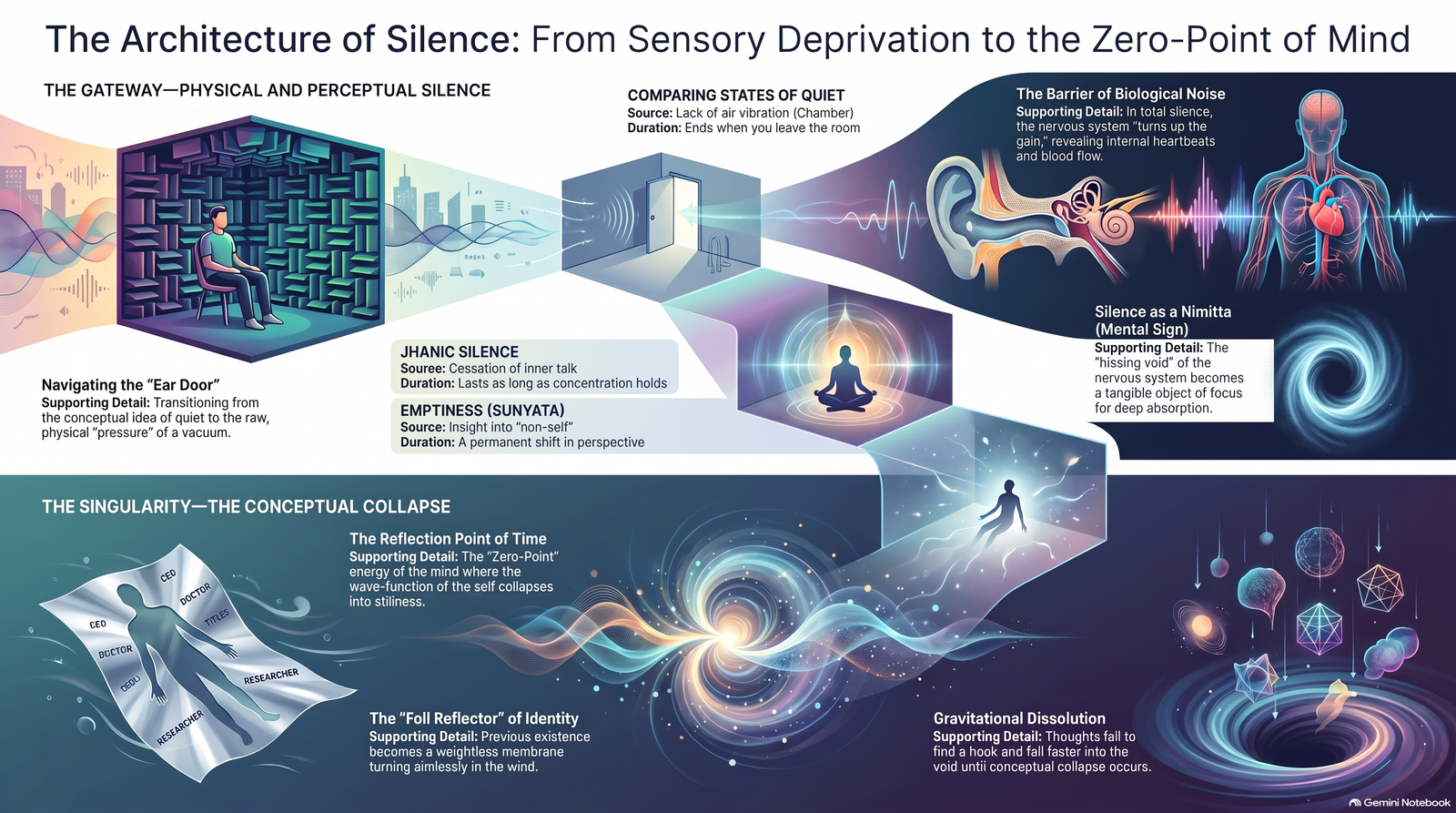
The episode enters through an acoustic thought experiment. An anechoic chamber removes reflections rather than creating a literal vacuum, leaving the visitor unusually exposed to sounds produced within the body. Could that engineered quiet become an object of concentration—perhaps even a gateway to the inward silence associated with meditative absorption?
The discussion carefully begins by separating three things that its metaphors later threaten to merge. External quiet is an acoustic condition. Jhāna is a family of cultivated absorptions. Emptiness is a doctrinal and experiential inquiry into the absence of independent essence or self. The chamber may change the field of experience, but it cannot manufacture insight, certify an attainment or turn physical silence into liberation.
From there, silence becomes less a destination than a mirror. The “ear door”, the inner hum, the reflection point and the mind “dividing by zero” are poetic models for attention losing its customary objects. The conversation is most compelling when it asks what conceptual thought does when it can no longer orient itself through contrast—and least reliable when the language of physics, neurochemistry or cessation is treated as a literal mechanism.
The final movement is autobiographical. The identity of “doctor” appears not simply as a private idea but as a role sustained by family, profession and authority. As its conceptual bonds loosen, the former life is compared to a foil reflector turning in the wind: still visible, occasionally catching light, but no longer carrying its former solidity. Silence has become an image for the exhaustion of identity rather than the absence of sound.
Argument map
How the inquiry changes register
Silence loses its echoes
The engineered room removes acoustic reflections while heartbeat, circulation and other bodily sounds may become newly prominent.
Quiet is not emptiness
Acoustic silence, cessation of inner discourse and śūnyatā belong to different explanatory levels and should not be collapsed into one state.
The word gives way to listening
The conversation moves from thinking “silence” to attending to the felt field of hearing and to the act of listening itself.
The ear turns towards its source
Avalokiteśvara’s ear faculty supplies a traditional image for reversing attention, though the episode freely modernises it.
The metaphor reaches its limit
Reflection points, singularities and division by zero name the failure of ordinary conceptual operations rather than a physical event in the brain.
The doctor becomes an echo
Professional identity is recognised as socially distributed: an inner belief may end while others continue to reflect the role back.
Concepts lose their adhesive force
Nibbidā is invoked as disenchantment, while thoughts are pictured arising and falling more quickly into dissolution.
A former life catches the light
The closing reflector image preserves memory without requiring a permanent owner behind it.
Evidence and source map
Four languages are speaking at once
An anechoic chamber suppresses reflection
Absorptive wedges and structural isolation create an exceptionally low-noise, low-reflection environment for measurement. The room does not remove the body’s internal sounds or create a physical vacuum.
Silence names several different practices
Second-jhāna descriptions concern the subsiding of vitakka and vicāra; the Śūraṅgama’s ear faculty, nāda practice and Dzogchen arise in distinct traditions.
Low input can alter perception
Experimental sensory deprivation can increase perceptual distortions or psychosis-like experiences in some participants. That finding does not make every inner sound a hallucination or every quiet room dangerous.
The strongest evidence is descriptive
The reflection point, gravitational dissolution and foil reflector communicate how identity and thought felt from within. They do not establish a neurological event or doctrinal attainment.
Chapter guide
Move through the episode
- 00:00Entering the Anechoic Chamber
- 02:20Is There a Jhāna of Silence?
- 05:10Noble Silence and the End of Inner Commentary
- 08:00Why Physical Silence Feels Aggressive
- 11:00Hallucination, Makyō, and the Brain Filling the Void
- 14:10Turning Silence Into a Meditative Object
- 17:20Nāda Yoga, Inner Sound, and the Dull Void
- 20:50The Reflection Point of Consciousness
- 24:10Horror Vacui and the Ego’s Sonar System
- 27:00Cessation: When the Mind Divides by Zero
- 30:10Dzogchen and the Joke of Seeking Silence
- 32:50The Doctor, the Medical Board, and Existential Integrity
- 35:20Nibbidā, Conceptual Collapse, and the Foil Reflector
- 37:10Final Reflection: Who Hears the Quiet?
Glossary
Terms carried by the conversation
Anechoic chamber
Jhāna
Vitakka and vicāra
Noble silence
Śūnyatā or emptiness
Nimitta
Nāda and anāhata nāda
Makyō
Charles Bonnet syndrome and “prisoner’s cinema”
The ear door
Nirodha-samāpatti
Dzogchen and rigpa
Nibbidā
Bindu
“Mohasandhi” and the dull void
The foil reflector
Continue within the website
Related pathways
A concise introduction to absorption, its progressive refinement and its relationship to insight.
Provides the immediate contemplative context for the episode’s discussion of inward or “noble” silence.
A later inquiry into what remains when mind cannot be located as a thing with a stable centre or boundary.
Returns to the limit of conceptual maps and to the possibility that the map-maker is part of the maze.
Develops the distinction between manufacturing a special state and ceasing to seize experience as an object.
The preceding episode also asks how unusual contemplative experience can be observed without being turned into certainty or identity.
Curated reading shelf
External reference points
An account of the extremely low sound floor in Microsoft’s anechoic chamber and its purpose as an acoustic testing environment.
Technical background on the measurement of Microsoft’s chamber at approximately −20.6 dB(A) SPL.
A controlled study supporting a cautious distinction between altered perception under reduced stimulation and spiritual interpretation.
A traditional translation and commentary on Avalokiteśvara’s cultivation of hearing and Mañjuśrī’s selection of the ear faculty.
An early Buddhist description of the four jhānas, useful for distinguishing textual formulas from the episode’s modern acoustic imagery.
A grounded observation
Notice what ordinary quiet reveals
In a familiar and safe place, allow one minute without media or deliberate sound. Notice external sounds, bodily sounds, inner speech and the urge to classify the experience. There is no need to suppress anything, seek an altered state or imitate an anechoic chamber. The useful question is simply whether “silence” is ever one thing. Stop if quiet increases distress, tinnitus awareness or disorientation.