
Dialogues I · Episode 12
Stop Micromanaging Your Own Relaxation
Why the effort to become calm can tighten the very knot it is trying to release—and why ordinary work may become lighter when the inner manager stops supervising it.
Central question
What if the strain of trying to control the mind is the distortion we are trying to remove?
The episode begins with a familiar paradox: trying so hard to relax that relaxation becomes another exhausting task. The sleepless person calculates how many hours remain; the meditator monitors the breath, jaw and shoulders; the inner manager attempts to supervise its own disappearance. In each case, the attempted remedy adds a second layer of work to the original experience.
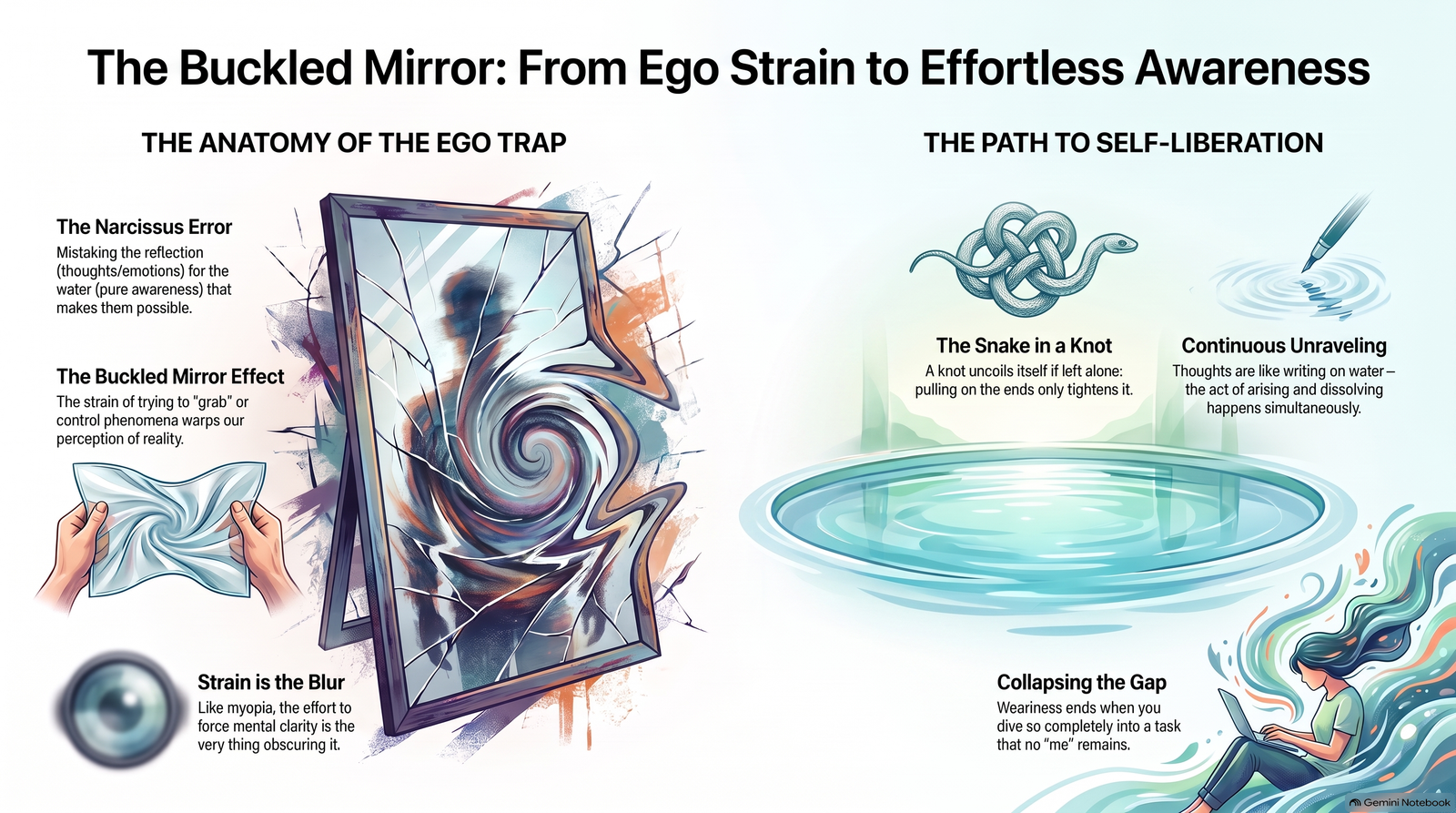
The “buckled mirror” gives this circularity its central image. Awareness is imagined as a mirror capable of reflecting any passing weather without being burned by fire or soaked by rain. Identification places pressure on its edges. Once thought, feeling, career, trauma or success is marked as mine, the mind tries to preserve a favourable reflection and repel an unfavourable one. The pressure warps the surface, so a delayed message becomes rejection and a transient mood becomes a permanent verdict.
Narcissus is therefore read less as a warning against vanity than as a category error: he mistakes the reflection for the water that permits reflection. The resulting self may be painful, but it is manageable. It has attributes to optimise, a future to secure and a story to defend. Boundless subjectivity offers no comparable control panel, so the mind repeatedly chooses the anxious certainty of being an object.
The proposed response is not to straighten the reflection. That would leave the same manager working on a more spiritual project. The episode turns instead to the relaxed gaze, the Dzogchen image of a snake that releases its own knot, and thoughts likened to writing on water: formation and disappearance are already one movement. Pulling at the ends makes the knot tighter; observing the motion without interference allows its impermanence to become visible.
This apparent ease carries its own fear. Through a Mahāyāna account of the eighth bhūmi, the recording explores hope and fear as signs of a seeker facing redundancy. The swimmer longs for dry land yet cannot imagine arriving without the identity built from swimming. The point is not to certify an attainment, but to illuminate a psychological threshold: effort can feel safer than the unguarded condition it claims to seek.
The final movement returns all of this to work. Weariness is described as “mechanical friction” produced by doing the task while simultaneously resisting it, narrating it or attempting to remain spiritually detached from it. “Total exertion without residue” does not mean working harder. It means the temporary collapse of the supervising gap: the email is written, the music is played, the washing is folded, and no second worker stands behind the action demanding proof of calm.
Argument map
From forced calm to action without a supervisor
Relaxation becomes another assignment
Monitoring breath, posture and sleep can turn presence into performance. The mind adds an evaluator to the experience and then becomes exhausted by the evaluation.
Pressure distorts the reflection
The mirror is not damaged by what it reflects; it is warped by pressure at its edges. The episode uses this to distinguish passing experience from the grasping and resistance organised around it.
The reflection replaces the water
Thoughts, roles and emotions become a manageable object called “me”. The category error offers apparent control while concealing the awareness in which the image appears.
The attempted correction becomes the blur
Once a distorted self is treated as the problem, a controller tries to improve it. The episode compares this circular effort to straining to see and thereby intensifying the felt obscurity.
Pulling the ends tightens the centre
The rational mind demands a complete account of letting go before it will let go. The snake image reverses the demand: release is discovered through non-interference, not guaranteed in advance by analysis.
Arising already contains disappearance
A word traced on water vanishes as it is written. Thoughts can appear solid when rapid activity is mistaken for a lasting object; the relaxed gaze notices their continuous alteration.
The swimmer fears the shore
Hope and fear preserve a distance between seeker and goal. Dry land threatens the identity whose purpose is to keep swimming, so effort may continue even when it has become the obstacle.
One task becomes two jobs
External work is accompanied by resistance, commentary and self-surveillance. The second job consumes energy without completing the first, like pressing accelerator and brake together.
Complete participation leaves no residue
At moments of absorption, action does not require a separate narrator to claim it. The episode calls this the collapse into function: not passivity, but work without the added burden of supervising a worker.
The interpretive lenses
Four registers that the episode brings together
Narcissus, mirror, water and swimmer
The classical story is reread as a confusion between experience and the condition that makes experience possible. This is a creative philosophical interpretation rather than the single authoritative meaning of the myth.
Self-liberation, bhūmis and non-interference
Dzogchen and Mahāyāna vocabulary frames the possibility that phenomena release without a separate controller. Distinct traditions and stages are placed in dialogue here; they should not be collapsed into one universal map.
Monitoring can interfere with the desired state
Insomnia arithmetic and forced relaxation resemble documented paradoxes of mental control: deliberate suppression and monitoring may keep unwanted material active. This resonance does not validate every metaphysical conclusion drawn in the episode.
Absorption reduces the second layer of labour
Music, writing and domestic tasks illustrate action with less self-commentary. The comparison touches flow and Zen accounts of complete function while remaining an everyday observation about divided attention.
Watch by chapter
Episode chapters
- 00:00The Exhaustion of Trying to Relax
- 02:10The Buckled Mirror of Awareness
- 04:55Narcissus and the Mistake of Identity
- 07:45Why We Prefer a Manageable Self
- 10:30Straining to Fix the Blur
- 13:00The Relaxed Gaze
- 15:20The Intellect Wants a Map
- 17:40The Snake That Unties Itself
- 20:10Thoughts as Knots Writing on Water
- 23:00Hope, Fear and Spiritual Nausea
- 26:00Dry Land and the Death of the Swimmer
- 29:00Burnout and Mechanical Friction
- 32:15Total Exertion Without Residue
- 34:45Looking Directly at Anxiety
- 36:40The Anxiety Shill and Final Reflection
Glossary
Terms and metaphors used in the discussion
Buckled mirror
The episode’s image for awareness distorted by the pressure of identification, grasping and resistance. The metaphor does not imply that the mind is a literal reflective surface or that perception would become infallible if psychological tension ceased.
Narcissus error
A creative reinterpretation of Narcissus as mistaking the reflected image for the water that makes reflection possible. In the episode it names identification with thoughts, feelings and roles rather than simple vanity or self-admiration.
Favouring phenomena
Granting selected experiences a privileged solidity and treating them as “me” or “mine”. The phrase points to attachment and aversion; it does not require indifference to consequences, responsibilities or other people.
Sedative of objectivity
The apparent comfort gained by turning oneself into a definable object that can be measured, managed and improved. “Sedative” is rhetorical: objectivity, self-knowledge and practical planning are not inherently numbing or harmful.
Relaxed gaze
An attentional attitude that receives experience without forcing immediate resolution. It is contrasted with mental straining, not with visual accommodation or medical treatment for eyesight.
Snake in a knot
A contemplative image of self-liberation: a living snake that has tied itself in a knot can uncoil through its own movement if it is not pulled from both ends. The metaphor describes non-interference, not passivity in dangerous or harmful circumstances.
Self-liberation (rang grol)
A term especially associated with Dzogchen accounts in which thoughts and perceptions are recognised and release without suppression or a separate act of correction. Its exact meaning belongs to a transmitted contemplative tradition and cannot be reduced to casual distraction.
Writing on water
An image for the inseparability of arising and vanishing. A mark disappears in the same movement by which it appears, suggesting that thoughts feel solid partly because their rapid change is overlooked.
Eighth bhūmi
The eighth of ten bodhisattva grounds in Mahāyāna literature, commonly called the Immovable. Traditions describe it through extensive doctrinal frameworks. The episode uses approach to this ground as a lens on effort and irreversibility, not as a verified personal assessment.
Hope and fear
In this contemplative context, paired movements that preserve a gap between present experience and a desired or dreaded future. This specialised use does not mean ordinary hope is always harmful or practical concern should be abandoned.
Spiritual nausea
The episode’s term for apprehension when familiar control strategies begin to feel unstable or unnecessary. It is contemplative rhetoric rather than a medical condition, and physical nausea or persistent distress should not automatically be spiritualised.
Mechanical friction
The energy consumed by doing a task while simultaneously resisting, narrating or monitoring oneself doing it. The metaphor distinguishes workload from secondary struggle without denying that workloads can themselves be unreasonable or harmful.
Yield point
In materials science, the point beyond which deformation is no longer fully elastic. The episode borrows the phrase for the collapse of sustained psychological resistance. This is an analogy, not a claim that minds obey the stress–strain behaviour of metal.
Total exertion without residue
A phrase used here for complete participation in an activity without a second, self-conscious worker standing apart to supervise it. It resonates with Dōgen’s language of total function; it means undivided activity, not maximal effort or limitless labour.
Anxiety shill
The episode’s deliberately sharp image of worry creating a threat and then selling further worry as the solution. It can expose circular rumination, but it should not be used to blame people for anxiety or deny real danger and clinical illness.
Continue within the website
Related pathways
The opening episode establishes the distinction between experienced identity and the processes that construct it. Episode 12 asks what happens when the self becomes a project managed by another layer of self.
Explores how linguistic structures shape the apparent division between subject, action and world. The present episode encounters a similar division between worker, work and internal supervisor.
Examines the point at which explanation ceases to assist recognition. Episode 12 turns this into the image of an intellect demanding a map of surrender before allowing surrender.
The preceding episode asks why insight may leave recursive selfhood feeling intact. Episode 12 follows that observer into its effort to correct, calm and supervise the mind.
A later examination of rapid bodily protection, prediction and the stories built around sensation—useful for distinguishing involuntary response from the secondary narratives placed upon it.
Returns to ordinary work as a test of integration, developing the present episode’s movement from spiritual self-monitoring towards unremarkable, complete participation.
External reference points
A small reading shelf
The classical literary setting for Narcissus. The episode’s “category error” is a modern contemplative rereading rather than a replacement for the poem’s historical and literary meanings.
A foundational psychological account of how deliberate attempts to suppress or control mental contents can help keep them accessible. It offers a limited empirical parallel to forced relaxation, not proof of the mirror metaphor.
A translation of the Mahāyāna scripture that describes the ten bodhisattva grounds. It supplies doctrinal context for the episode’s reference to the eighth ground, beyond the simplified psychological use made in the discussion.
Shohaku Okumura’s lecture places “total function” within Dōgen’s teaching on life, death and complete manifestation. This is richer and more specific than using absorption as a synonym for productivity.
Ordinary clinical context for anxiety that is persistent, difficult to control or disruptive. The episode’s contemplative inquiry should complement rather than displace appropriate assessment and support.
A three-second interruption
Look for the second job
During a manageable moment of strain, pause for three seconds. Do not attempt to become calm. Ask instead: what is the immediate task, and what extra work is the inner manager adding? The task may be one message, one paragraph or one plate. The second job may be rehearsing failure, monitoring whether you are relaxed, resisting the task or watching yourself perform it.
If it feels safe, locate what is actually present before naming the whole experience “anxiety”: pressure in the chest, warmth in the face, a future image, a remembered sentence, an urge to escape. Notice that these components change and do not by themselves form one permanent object. Then return to the smallest bounded action without requiring the concern to vanish first.
The experiment is not to defeat anxiety through inspection, nor to manufacture a state of flow. It simply tests whether some of the exhaustion belongs to the task and some belongs to supervising, resisting or judging the person doing it. If the pause increases distress, leave the inquiry and use familiar grounding or appropriate support.