
Dialogues I · Episode 11
Your Ego Is a Hardware Glitch
A recursive observer, a bubbling field of thought and the strange relief of discovering that some existential problems may be category errors.
Central question
Can the mind investigate the self without quietly recreating the investigator?
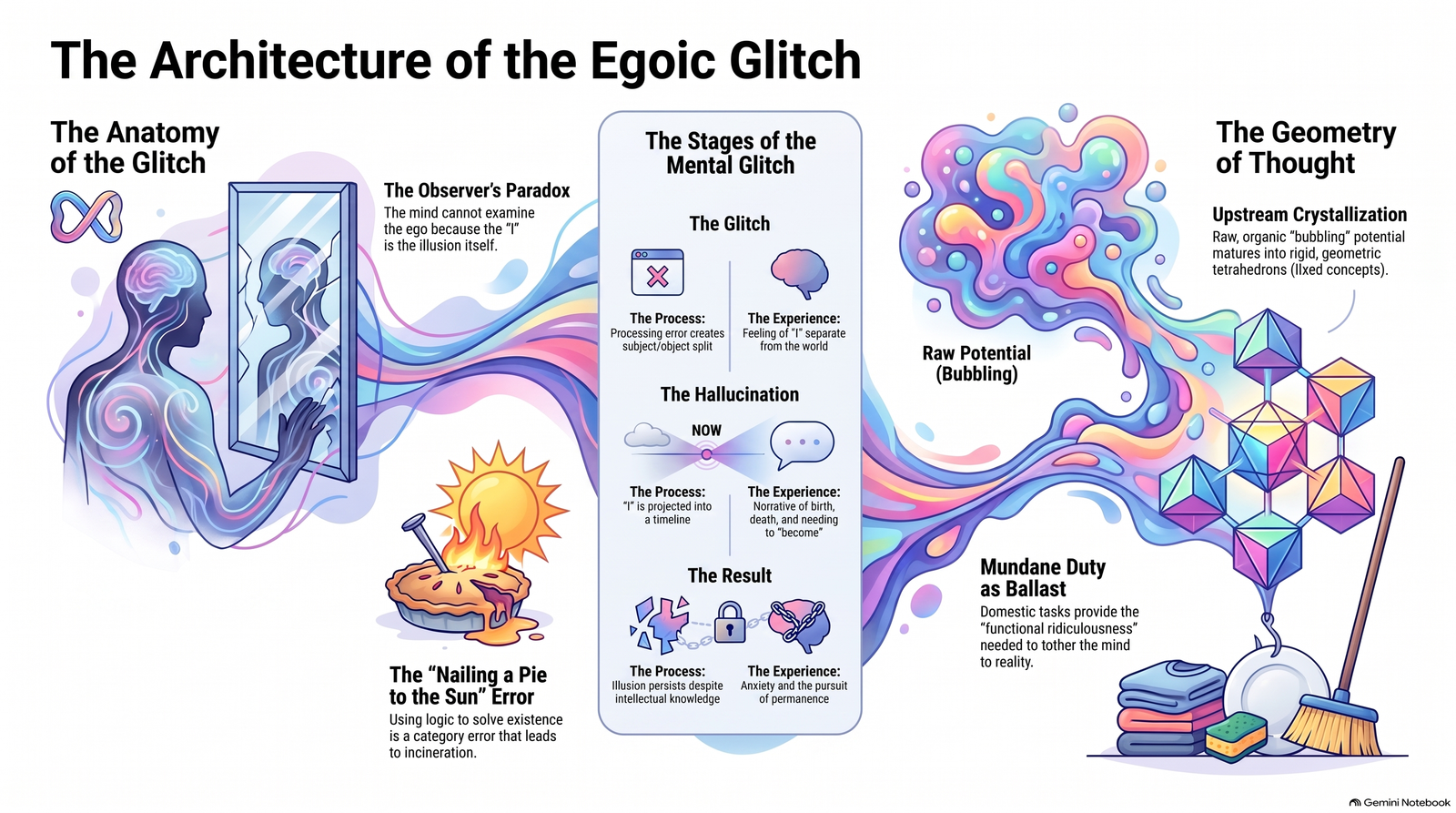
The episode opens with a knife asked to cut itself. This deliberately impossible image introduces a problem of recursive self-examination: when “I” set out to observe, improve or dissolve “my ego”, has the same structure simply divided into observer and observed? M. C. Escher’s Drawing Hands becomes the visual emblem of a loop in which each apparent origin is produced by the other.
Knowing that a perception is misleading does not necessarily make it look different. The Müller–Lyer illusion provides the episode’s bridge from intellectual recognition to embodied persistence: the lines may be measured as equal while continuing to appear unequal. From this, the discussion proposes its title metaphor. Perhaps the self is not merely a mistaken belief—“software” that better information can rewrite—but a deeply recurrent mode of organising perception, memory, anticipation and concern.
The inquiry then changes register. A remembered dream presents an upstream, bubbling field in which branching forms like old molecular models mature into regular tetrahedrons. The episode reads this as a symbolic crystallisation of thought: unformed potential becoming bounded concept. The tetrahedron becomes the smallest solid enclosure, then a pixel of an apparently stable world. This is dream interpretation and philosophical metaphor, not a report about neural events or the molecular structure of thought.
At the centre is a wonderfully disproportionate question: what is the best way to nail a Bakewell pie to the sun? Pie, nail and sun belong to incompatible scales and conditions. The image turns the project of securing a permanent conceptual self within living reality into a category error. Yet the answer is not withdrawal. Washing dishes, folding clothes and completing ordinary work become a “tight mesh of mundane duty”—not ultimate meaning, but ballast while larger interpretations loosen.
The final movement is restraint. An insight can harden into a new identity as quickly as any other thought. Rather than polishing the newest tetrahedron, the source dialogue ends by waiting to see what remains after the metaphor fades. The episode therefore arrives not at a theory of consciousness, but at a quieter discipline: use the image, allow it to work, and do not mistake it for the reality it was meant to illuminate.
Argument map
From the recursive observer to ordinary ballast
The knife cannot cut itself
The opening image questions whether the same conceptual operation can be both investigator and object. It establishes the episode’s recursive puzzle rather than proving that self-knowledge is impossible.
The observer returns in disguise
Escher’s mutually drawing hands model a self-improvement project that continually restores the one who is supposedly being dismantled: seeker and problem keep one another in circulation.
Knowing is not the same as seeing
The Müller–Lyer illusion separates propositional knowledge from perceptual appearance. The episode uses that gap to explain why an insight about selfhood may reduce conviction without immediately changing felt experience.
A character is projected through a story
Memory and anticipation give the self a past to defend and a future to secure. Concern then appears to confirm the reality of the character around whom the narrative is organised.
Thought begins as bubbling possibility
A remembered dream supplies a vivid phenomenology: dynamic forms arise before becoming regular solids. The discussion reads this threshold as the passage from unbounded potential into conceptual structure.
The tetrahedron becomes a unit of thought
Regular geometry stands for a stable name, identity or judgement. The metaphor asks what is gained when experience becomes manageable—and what is lost when the resulting form is treated as living reality itself.
The pie cannot be nailed to the sun
A fragile confection, a rigid tool and a nuclear star expose the absurdity of the proposed task. The metaphor releases the demand to secure a finite self against an immeasurable process.
Domestic duty returns scale and friction
Meals, laundry, bills and repairs provide finite problems with physical consequences. Their value here is not cosmic importance but orientation: a small workable task in place of an insoluble existential one.
Let the interesting thought fade
The last risk is converting the insight into doctrine, performance or identity. Waiting without embellishment allows the metaphor to dissolve rather than becoming another polished possession.
The interpretive lenses
Four registers that should remain distinct
Visual appearance can resist correction
The Müller–Lyer illusion is an empirical perceptual phenomenon. The episode’s extension from geometrical illusion to ego is a philosophical analogy, not an experimental conclusion.
Self-reference and the elusive observer
The knife, camera lens and drawing hands dramatise long-standing questions about reflexive awareness and self-knowledge. No single recognised “observer’s paradox” unifies Advaita, Buddhism and phenomenology.
Bubbling forms become fiery solids
The upstream vision is autobiographical material interpreted through molecular models, Platonic geometry and the contrast between flow and concept. Its value is phenomenological and poetic, not evidential.
Finite duties interrupt infinite rumination
The episode proposes domestic work as a tether and gyroscope. This belongs to the author’s practical synthesis: a way of changing scale, not a claim that productivity proves awakening or cures distress.
Watch by chapter
Episode chapters
- 00:00The Knife That Cannot Cut Itself
- 03:30The Ego as a Recursive Loop
- 07:20Escher, Self-Improvement and the Observer Trap
- 11:30Why Understanding the Illusion Is Not Enough
- 15:40The Müller–Lyer Illusion and Perceptual Hardware
- 20:10The Ego as a Temporal Hallucination
- 24:20Anxiety as Proof of Self
- 28:00The Dream of Fiery Tetrahedrons
- 32:10From Organic Thought to Rigid Concept
- 35:40Nailing a Bakewell Pie to the Sun
- 38:50Mundane Duty as a Grounding Tether
- 41:00Letting the Realisation Fade
Glossary
Terms and metaphors used in the discussion
Recursive self-reference
A process in which a system refers to or operates upon a representation of itself. In the episode, the self becomes both investigator and object of investigation. Recursion can expose a genuine conceptual difficulty without establishing that reflection is always circular or useless.
Observer’s paradox
A loose label used here for the difficulty of studying an observer with the observer’s own faculties. Related problems appear in several disciplines, but the phrase does not name one agreed argument shared unchanged by phenomenology, Advaita Vedānta, Buddhism and cognitive science.
Müller–Lyer illusion
A geometrical-optical illusion in which equal line segments can appear unequal when their ends carry differently oriented fins. Measuring the lines can correct judgement without fully cancelling appearance. The strength and explanation of the effect vary with presentation, context and experience.
Hardware glitch
The episode’s metaphor for a recurrent feature of perceptual and cognitive organisation that does not vanish when a person acquires a better proposition. It is not a claim that the ego is a damaged physical component or that human cognition divides neatly into computer hardware and software.
Temporal self
The experienced person understood through memory, anticipation and narrative continuity. The episode calls this a “temporal hallucination” to challenge its apparent solidity. This does not mean that memory, planning, biography or physical time are simply unreal.
Tetrahedron
A polyhedron with four triangular faces. It is the simplest polyhedron enclosing a volume and one of the five regular Platonic solids when all faces and edges are equal. In the dream image it represents a bounded, regular conceptual unit.
Methane geometry
A methane molecule, CH4, has a carbon atom bonded to four hydrogens in approximately tetrahedral geometry. The source dream recalls old ball-and-stick molecular models; its movement from branching form to solid tetrahedron is symbolic rather than a description of chemical change.
Platonic solid and fire
In Plato’s Timaeus, the tetrahedron is assigned to fire within an ancient geometrical account of the elements. Modern chemistry and physics do not retain this elemental theory. The episode uses the association poetically, linking fire, thought and crystallisation.
Category error
A mistake produced by treating something as if it belonged to a logical category that does not fit it. Nailing a Bakewell pie to the sun is physically absurd; in the episode it represents the attempt to make a temporary conceptual self permanently secure within an immeasurable process.
Witnessing
A contemplative term for noticing experiences without immediately identifying with, suppressing or elaborating them. Traditions use the language differently. It need not imply a permanent inner witness standing outside experience, and it is not a substitute for care when symptoms are severe.
Cessation
Ordinarily, stopping or coming to an end. Buddhist traditions also use cessation in precise doctrinal and meditative senses. Here the word refers mainly to ceasing the effort to solve the ego through further conceptual activity; the episode does not establish a formal attainment.
Mundane duty as ballast
The source dialogue’s proposal that cooking, cleaning, administration and practical work can restore scale, sequence and bodily contact when abstract thought becomes destabilising. “Ballast”, “tether” and “gyroscope” are complementary metaphors rather than clinical mechanisms.
Multiplication stage
An alchemical phrase used within Dr Simon Robinson’s wider synthesis for the return of insight into repeated, ordinary and embodied activity. On this page it identifies the source dialogue’s domestic imagery; it is not presented as a standard psychological stage or a universally agreed historical formula.
Letting a thought die on the vine
The episode’s image for refraining from turning every insight into a system, performance or identity. It recommends restraint in elaboration, not suppression of necessary thought, avoidance of communication or indifference to practical consequences.
Continue within the website
Related pathways
The opening episode introduces the computational vocabulary of selfhood. Episode 11 deliberately reverses its emphasis: some patterns may persist even after the conceptual “software” has been challenged.
An earlier exploration of recursive structure, the self-consuming problem of interpretation and the way an explanatory puzzle can reproduce the mind attempting to solve it.
Examines the point at which conceptual equipment stops assisting recognition. Episode 11 carries that concern into the felt persistence of the observer itself.
The preceding episode moves from constructed colour and perceptual boundaries to narrative continuity. Episode 11 asks why seeing through the construction may still leave its felt architecture in place.
A later account of rapid protective response, bodily prediction and the stories built around sensation—useful for distinguishing embodied reactivity from metaphysical claims about ego.
Returns to domestic activity as integration, asking how ordinary tasks can receive insight without being inflated into proof of attainment.
External reference points
A small reading shelf
A careful survey of pre-reflective and reflective self-awareness. It gives philosophical depth to the episode’s recursive problem without reducing every account to one observer paradox.
Historical context for Escher’s mature work and impossible constructions. Drawing Hands functions in the episode as an analogy for mutual production; the artwork itself should not be reproduced without permission.
Context for Plato’s geometrical cosmology and the assignment of regular solids to the elements. It helps separate the tetrahedron’s historical symbolism from modern accounts of matter.
Reference data for methane as a real chemical compound. The episode’s methane-like forms belong to a remembered dream; chemistry supplies context, not validation of the dream’s interpretation.
A brief experiment in scale
From the insoluble question to the next bounded task
When an abstract concern begins to repeat, write its question in one sentence. Notice whether it has a condition under which it could actually be answered. Does it ask for a concrete decision, evidence or action—or does it demand permanent certainty about who you are, what everything means or whether the future will finally be safe?
If there is a workable action, name the smallest honest next step. If there is not, do not force a spiritual conclusion. Turn for a few minutes towards one ordinary task with a visible boundary: wash one cup, water one plant, answer one necessary message or put away one object. Attend to weight, contact, sequence and completion.
Then check again. The question may still matter, or it may have changed scale. The exercise does not prove that the self is unreal and it is not a method for overriding distress. It simply tests the episode’s practical claim: a finite duty can interrupt the demand to solve an infinite problem.