
Dialogues V · Episode 04
Why You Can’t Think Away Anxiety | Dialogues V
The voice that helps us pause before acting can also keep us circling a danger that is not here.
The central question
When does the attempt to regain control become part of the loop?
Why can the body feel endangered while the thinking mind recognises no immediate threat—and why does another round of reasoning sometimes deepen the unease? This episode begins with that familiar gap between explanation and bodily urgency. Its question is about the use of thought: the same capacity that lets us consider consequences can become an arena in which danger is rehearsed repeatedly. The discussion follows this tension from intention and inner speech towards a different relationship with the sensations, stories and impulses that constitute an anxious moment.
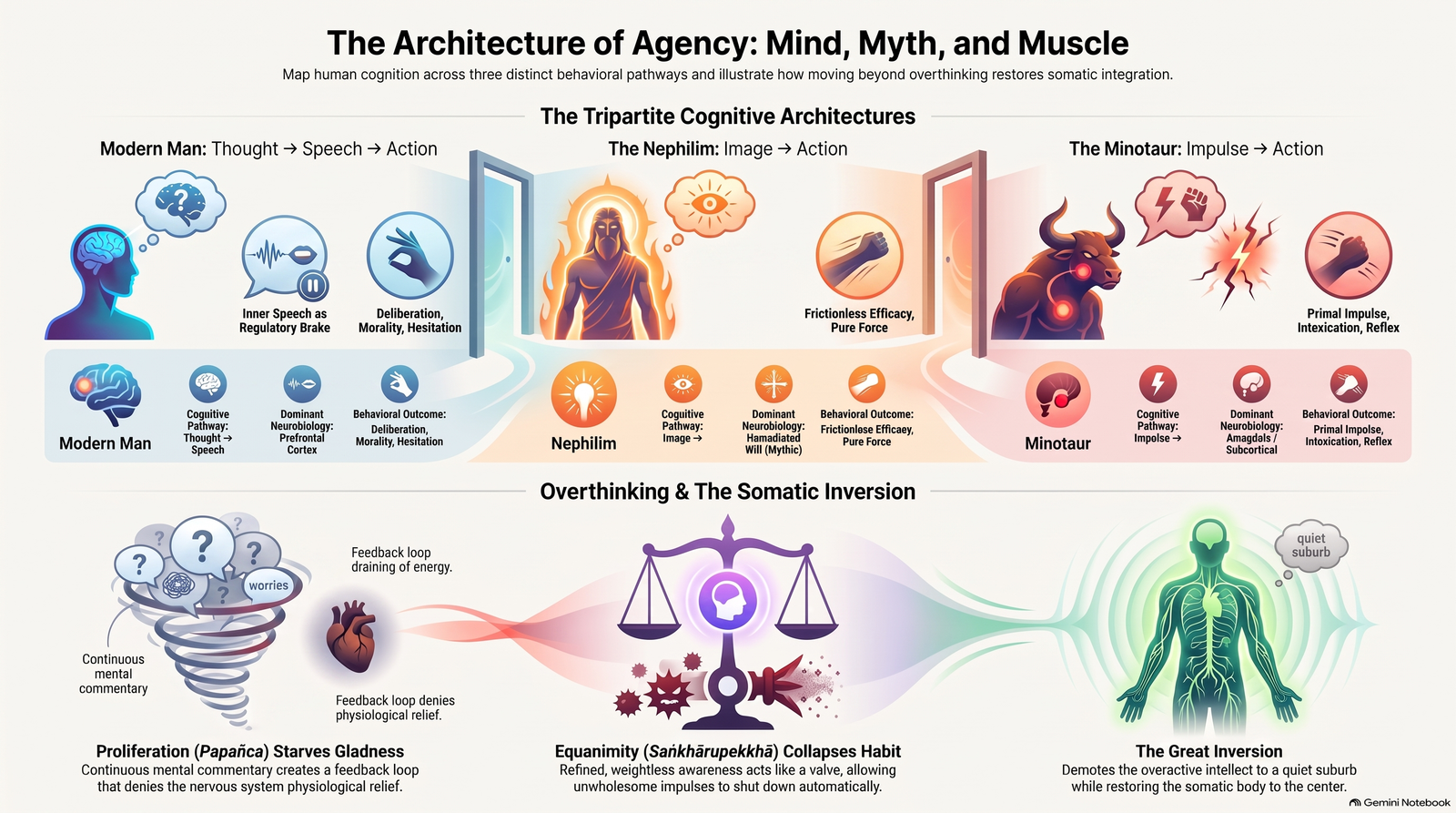
The opening draws on Buddhist accounts of body, speech and mind as avenues of action, then considers inner speech through Vygotsky and research on response inhibition. The hosts imagine language as a buffer between impulse and behaviour. Their Minotaur gives this enquiry a mythic form: powerful bodily reactions confined within a labyrinth of social expectation and shame. Evolutionary mismatch and the historical discussion of anaesthetic excitation broaden the comparison, but neither establishes a literal beast within the brain. The image matters because it permits compassion for urgency while preserving responsibility for what follows.
The argument changes direction with papañca, conceptual proliferation. A sensation becomes a problem about oneself; that problem invites analysis; further analysis supplies more material for unease. The episode calls this a starvation loop, an interpretative account of how relief can become harder to find. Buddhist teachings about gladness and tranquillity offer another orientation, before the discussion moves into disenchantment and equanimity. Sunlight on water, the edge of a feather and a check valve express progressively lighter ways of noticing habitual momentum. They describe possibilities of experience rather than a dependable mechanism that every reader should reproduce.
Finally, the plasma chamber imagines the burden of an intellect trying to contain reality. The Great Inversion asks whether thought can take its place within embodied life without occupying its centre. Within Dialogues V’s movement from illumination towards integration, the practical challenge becomes modest and exacting: recognise when useful consideration turns into repetitive self-monitoring, and explore whether attention can widen without making the demand for calm into another task.
Argument map
From mediation to embodied participation
A pause can make action possible
Inner speech may help us consider an impulse before acting, giving language a useful role in deliberation.
The pause becomes a labyrinth
The Minotaur and the old vehicle portray bodily urgency caught within social expectation, shame and the demand for control.
Thinking tries to repair thinking
The discussion turns to papañca: distress invites more interpretation, which can supply fresh material for repetitive worry.
Ease cannot be commanded
Gladness introduces a different direction of practice, where attention need not become another struggle to force the mind quiet.
Restraint becomes a lighter touch
The lake, feather and check valve describe noticing a habit’s beginnings without either wrestling with it or following it automatically.
Thought gives up the central throne
The Great Inversion asks whether intellect can serve embodied life without claiming responsibility for holding all experience together.
Navigate the recording
Chapters
Use these chapter points to revisit the discussion. Each link opens the individual video on YouTube.
- 00:00Why You Can’t Think Away Anxiety
- 01:55The Three Doors: Mind, Speech and Body
- 03:35Inner Speech and the Brain’s Brakes
- 06:10The Minotaur: Impulse Without Deliberation
- 10:35Evolutionary Mismatch and the Old Vehicle
- 13:55Papañca: When Thinking Feeds Thinking
- 15:45The Starvation Loop and the Search for Gladness
- 18:05Nibbidā, Disenchantment and Equanimity
- 19:50Straightening the Edge of a Feather
- 20:35The Check Valve: When Habits Collapse
- 23:50The Mind as a Plasma Chamber
- 24:40The Great Inversion
Terms and distinctions
A glossary for the enquiry
Kamma-dvāra: the three doors of action
In Theravāda analysis, body, speech and mind are three avenues through which intentional action occurs. They are not a compulsory sequence in which every thought must become speech before becoming movement. The episode’s thought–speech–action pathway is an interpretative model of deliberation, rather than the traditional definition of these doors.
Cetanā: intention or volition
A mental factor concerned with intention and the coordination of mental activity. Early Buddhist teaching gives intention a central place in kamma, or ethically significant action. It should not be equated with a single brain structure, a consciously spoken decision, or the claim that every experience requires deliberate choice.
Inner speech
Silent verbal activity, which may take the form of abbreviated words, an internal monologue or an imagined dialogue. Vygotsky’s account connects its development with social and private speech. It can assist planning and self-regulation, but varies between people and occasions; ethical behaviour and intelligent action do not require a continuous inner voice.
Response inhibition
The capacity to pause or stop a response. Research implicates the right inferior frontal cortex together with associated networks, rather than an isolated control centre. The episode’s email-delay analogy illustrates a possible pause before action; it does not establish that inhibition is identical to inner speech or the sole basis of morality.
The Minotaur and the superego
The Minotaur belongs to Greek myth; the superego is Freud’s concept of internalised prohibitions and ideals. Their combination here is an original psychological metaphor: powerful impulses enclosed by shame and expectation. Neither names a distinct brain system, a category of person, nor a diagnosis of someone who experiences anxiety.
Evolutionary mismatch
A framework for considering how features shaped under earlier conditions may function differently in present environments. The old vehicle on modern roads is the episode’s illustration. This does not establish one ancestral cause for all anxiety, nor show that social exclusion always meant certain death or that modern bodily reactions are inherently irrational.
Papañca: conceptual proliferation
A Pāli term often translated as conceptual proliferation, elaboration or objectification; its precise scope is debated. In early Buddhist discussions it concerns thought becoming entangled in patterns that foster conflict and attachment. Repetitive self-referential worry provides a contemporary analogy, but papañca is not simply all thinking, all language or a clinical diagnosis.
Pāmojja: gladness
Gladness or joy within a Buddhist account of conducive conditions for practice. A common sequence moves from gladness to rapture, tranquillity, happiness and concentration. It is a traditional account of cultivation, rather than a guaranteed physiological cascade. The recording compresses and rearranges parts of this sequence; ease need not arrive on demand.
Nibbidā: disenchantment
Often translated as disenchantment, disillusionment or becoming disenchanted: a loosening of fascination with conditioned experience within Buddhist practice. It is not defined simply by exhaustion or absence of enjoyment. A doctrinal distinction from depression does not allow the quality of a person’s mood to establish either spiritual progress or clinical wellbeing.
Saṅkhārupekkhā: equanimity towards formations
Equanimity towards conditioned processes; saṅkhārupekkhā-ñāṇa names an insight knowledge in Theravāda commentarial maps. These maps describe a tradition’s account of development, rather than a universal clinical scale. The feather and lake are the source dialogue’s illustrations of delicate attention, not tests by which a reader can certify a stage of attainment.
Default mode network
A set of interacting brain regions involved in aspects of internally directed cognition, including autobiographical remembering and imagining. It is neither the ego itself nor a literal cage that must be dismantled. The episode’s network language should not be read as evidence that its account of equanimity has a demonstrated neural mechanism.
The check valve and the Great Inversion
Two metaphors from the source dialogue. The check valve depicts a habit’s beginning losing momentum without an elaborate internal struggle. The Great Inversion shifts thought from sovereign controller to one capacity within embodied life. Neither establishes an automatic treatment for anxiety or proves that bodily awareness provides unmediated access to reality.
Continue exploring
Related reading within the website
- From Inner Speech to Artificial IntelligenceA wider examination of language, internal dialogue and the organisation of agency.
- From Willpower to Effortless ActionContinue the question of restraint, effort and action without a constantly struggling manager.
- GladnessThe place of pāmojja in the website’s account of Buddhist cultivation.
- Anxiety: The Way In. The Way Out.The book context for the bodily fear, shame and restraint passages discussed here.
- How Your First Words Shape Your Mind | Dialogues VThe preceding episode considers how language helps organise meaning and a sense of self.
A small reading shelf
External reference points
The discourses clarify traditional meanings; the research reviews help assess the scientific comparisons. Neither group verifies the episode’s complete synthesis.
- MN 18 · Madhupindika SuttaṬhānissaro Bhikkhu’s translation and discussion of papañca, interpretation and conflict.
- AN 6.63 · Nibbedhika SuttaThe early Buddhist account of intention and action through body, speech and mind.
- SN 12.23 · Upanisa SuttaA traditional sequence relating gladness, rapture, tranquillity, concentration and disenchantment.
- Alderson-Day & Fernyhough · Inner Speech (2015)A research review of inner speech’s development, functions, phenomenology and neurobiology.
- Aron, Robbins & Poldrack · Inhibition (2014)A research review of the right inferior frontal cortex and associated networks in response control.
A one-minute reflection
Give thought a smaller job
Choose an ordinary, mildly repetitive thought rather than a distressing memory. With your eyes open, notice that the sentence is present. Then include one neutral detail in the room: a colour, a nearby sound or the surface supporting your hand. There is no need to silence the words or produce a different feeling.
Ask gently: does this thought suggest a concrete action I can take, or is it asking me to repeat the same explanation? Let the question remain open. Return to an ordinary task when you wish. If the reflection increases unease, leave it and attend to something familiar around you.
Continue the series