
Dialogues II · Episode 02
From Willpower to Effortless Action | Dialogues II
Discipline may build the vessel, but the open water begins where the exhausted rower is no longer required.
The central question
Can effort prepare the mind for a form of action that no longer feels driven by an internal controller?
The episode opens with the image of pushing a boulder uphill: career, relationships, identity and anxiety compressed into one burden that must never be released. The strain is not merely physical. It comes from the conviction that a separate manager must hold the world together through constant willpower. Even conflict and ambition can become psychologically attractive because their resistance gives that manager something against which to feel real.
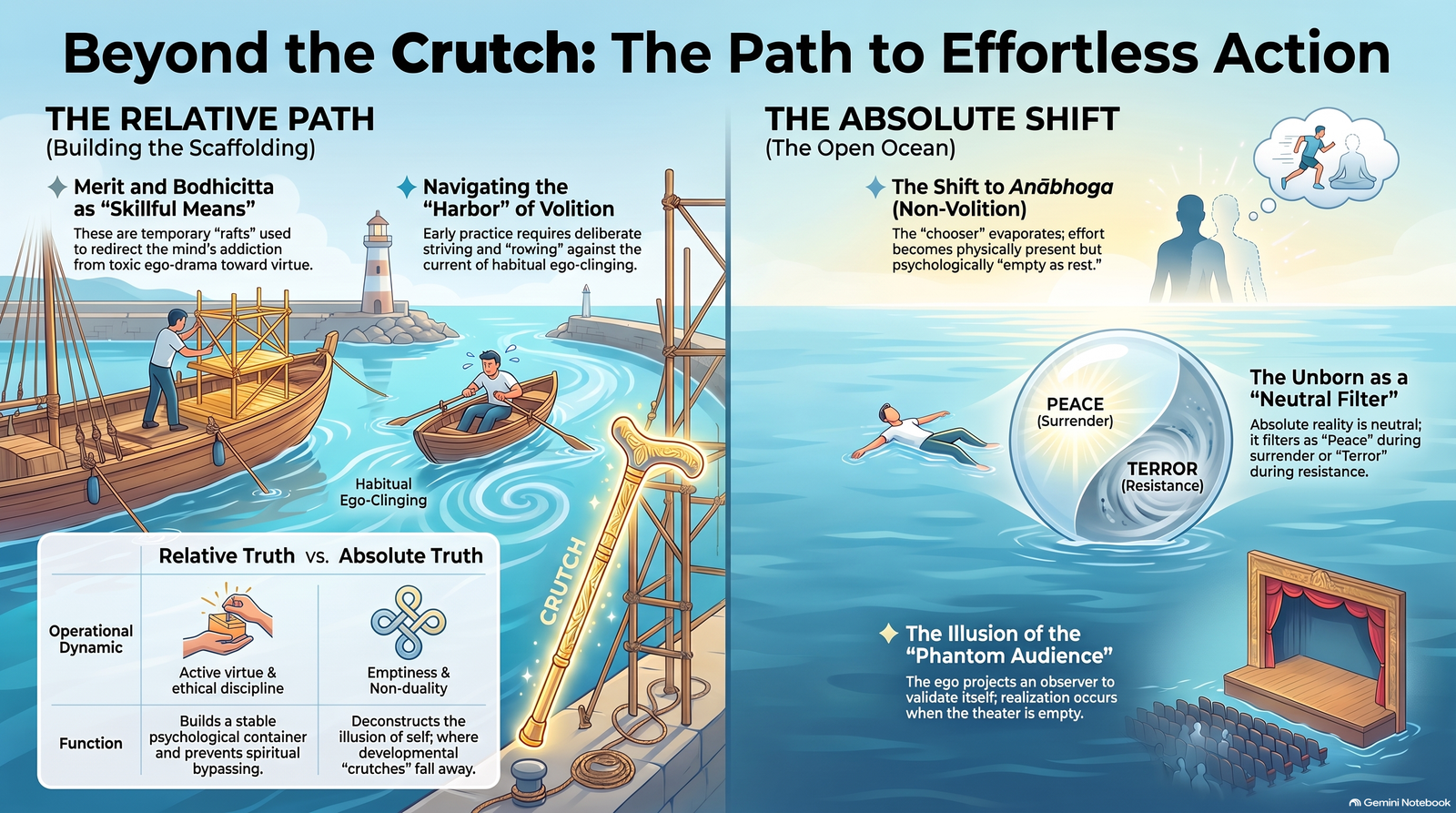
The discussion does not answer by telling the listener simply to let go. Instead, it treats merit, ethical discipline and bodhicitta as scaffolding within Mahāyāna practice: deliberate structures that redirect grasping before grasping itself can loosen. This brings the two truths into view. On the conventional level, conduct, consequences and compassion remain indispensable; emptiness cannot be used to cancel responsibility. On the ultimate level, neither agent nor action possesses the independent solidity ordinarily projected upon it.
The centre of the episode imagines the transition through the bodhisattva bhūmis. A ship is rowed laboriously through a dangerous harbour, then catches the wind in open water. Physical and cognitive activity continue, but their burden of authorship falls away. A garden makes the distinction concrete: muscles tire, weeds are pulled and stopping remains possible, yet the additional argument with the task may be absent. Identity becomes a temporary costume rather than a ruler.
From there the inquiry becomes more daring. The empty theatre of the imagined audience, Bankei’s teaching of the Unborn, Dōgen’s being-time, Tibetan imagery of clear light and a quantum-eraser analogy are drawn into one speculative arc. Its practical challenge is simpler than its metaphysics: necessary effort need not be confused with psychological self-coercion, and surrender must not become passivity, dissociation or escape from ordinary accountability.
The movement of the episode
From the harbour of cultivation to the open ocean
Friction confirms the manager
The mind repeatedly finds objects, projects and conflicts through which the effortful sense of “I am doing this” can renew itself.
The crutch has a purpose
Merit and bodhicitta redirect habitual striving towards ethical formation and concern for others instead of demanding premature detachment.
Two truths prevent collapse
Conventional responsibility and ultimate emptiness must be held together so that insight does not harden into nihilism or spiritual bypassing.
The ship catches the wind
The eighth-bhūmi image marks a doctrinal shift from constructed exertion towards spontaneous activity, not a licence to abandon training.
The costume becomes light
In the garden, work and fatigue remain while identity is used provisionally: a role can organise action without becoming an imprisoned self.
The luggage is put down
The empty theatre and the Unborn turn the inquiry from better self-management towards action without the added burden of a phantom audience.
How the sources are used
Tradition, experience and analogy kept distinct
Mahāyāna path literature
Merit, bodhicitta, the two truths and the ten bhūmis supply the episode’s developmental architecture. These are doctrinal and contemplative categories, not clinical scales or independently measurable stages.
Zen and Tibetan language
Bankei’s Unborn, Dōgen’s being-time and Tibetan clear-light imagery give several different traditions a voice. The episode’s synthesis should not obscure their distinct histories and practices.
Psychology and lived report
The phantom audience, the self as costume and physically demanding garden work describe a phenomenology of reduced self-monitoring. They do not by themselves confirm a doctrinal attainment.
Physics as a disputed analogy
The delayed-choice quantum eraser is recruited to imagine time flowing otherwise. The experimental result concerns quantum correlations; its use as evidence for retrocausal awakening is not supported.
Watch by theme
Clickable chapters
- 00:00Opening: Pushing the Boulder
- 04:10Why the Mind Is Addicted to Effort
- 08:25Interesting Objects and the Ego’s Need for Friction
- 12:40Why “Just Let Go” Does Not Work
- 16:20Merit, Bodhicitta, and Skillful Means
- 21:10The Two Truths: Relative and Absolute
- 25:45The Danger of Nihilism and Spiritual Bypassing
- 30:30From Volitional Effort to Effortless Action
- 35:10The Open Ocean: Action Without the Doer
- 39:00Chop Wood, Carry Water: The Garden Example
- 42:50The Ego as Costume: Cain the Tiller of Earth
- 45:40The Empty Theatre and the Phantom Audience
- 48:00The Unborn, the Train, and Putting the Luggage Down
- 50:10Closing Reflection: What Are You Still Carrying?
Study notes and routes onward
Terms, distinctions and reference points
Glossary
Interesting objects
The episode’s informal name for whatever repeatedly recruits grasping and self-definition: drama, ambition, grievance, intellectual puzzles or personal narratives. The phrase is a teaching device, not a standard Buddhist category. Interest and curiosity are not inherently pathological; the question is how an object becomes enlisted to maintain a defended identity.
Merit
In Buddhist traditions, merit refers to beneficial karmic potential associated with generosity, ethical conduct, devotion and other wholesome activity. The episode calls it a temporary “crutch” because it can redirect acquisitive energy. That is an interpretive framing: merit is not merely egoic point-scoring within traditional accounts.
Bodhicitta
In Mahāyāna Buddhism, bodhicitta is the aspiration and orientation towards buddhahood for the benefit of all beings. Traditions distinguish relative forms involving compassion and intention from ultimate bodhicitta associated with direct insight into emptiness. The episode uses it as the direction given to disciplined effort.
Upāya, or skilful means
Upāya is the adaptive use of teachings or methods suited to particular beings and circumstances, especially prominent in Mahāyāna literature. Calling a practice skilful means does not make it false or disposable at whim; its value lies in its capacity to lead without becoming another object of rigid attachment.
The two truths and emptiness
Madhyamaka sources distinguish conventional truth, through which persons, actions and consequences function, from ultimate truth, the absence of inherent or independent existence. The truths are not two separate realities. Emptiness does not mean nothing exists; it describes dependent existence and cannot coherently be used to cancel ethics.
Spiritual bypassing
A modern psychological expression for using spiritual beliefs or practices to avoid unresolved emotion, relationship, responsibility or practical difficulty. It is not a diagnosis. In this episode it names the misuse of emptiness or surrender to evade conventional consequences rather than meet them more clearly.
Bhūmi and Acalā
A bhūmi is a “ground” or stage in Mahāyāna accounts of the bodhisattva path. Acalā, “Immovable,” is the eighth of ten in the Daśabhūmika Sūtra. The map belongs to a demanding doctrinal path; resemblance to flow or reduced self-consciousness is not evidence that a person occupies that ground.
Ābhoga and anābhoga
Technical Sanskrit vocabulary translated in varying ways as exertion, deliberate application or effort, and its absence. Later Mahāyāna descriptions use non-exertion to characterise spontaneous bodhisattva activity. It does not mean inactivity, unconscious behaviour or freedom from ethical consequences.
Flow and dissociation
Flow is a psychological description of absorbed activity with reduced self-conscious monitoring; dissociation covers disruptions in the ordinary integration of awareness, memory, identity or perception. They are not interchangeable. The episode’s effortless garden work is presented phenomenologically, not as a diagnosis or a scientific identification of a Buddhist stage.
The phantom audience
The episode combines George Herbert Mead’s “generalised other” with Jacques Lacan’s “big Other” to describe an internalised audience for whom the self performs. The concepts come from different theories and are not identical, but both help ask how social recognition enters apparently private experience.
The Unborn
Bankei Yōtaku’s Zen teaching points to the unborn Buddha-mind that recognises and responds before discriminating thought is manufactured. The episode links this with unconditioned reality and the image of a train already carrying its passenger. That synthesis should not turn the Unborn into a cosmic mechanism or permission for passivity.
Clear light and the Bardo Thödol
Clear light is a term used in Tibetan Buddhist contemplative and death-related teachings; the Bardo Thödol is a cycle of Tibetan texts concerning intermediate states, known in English as the “Tibetan Book of the Dead.” The episode’s neutral-filter model is an interpretive simplification, not a full account of the texts.
Delayed-choice quantum eraser
A quantum-optics arrangement in which interference can be recovered within correlations between entangled detections when which-path information is unavailable. The unsorted signal detections do not change after a later event. The experiment does not permit messages to the past and does not validate spiritual retrocausality.
Related reading on this site
- VolitionA concise examination of intention and the felt authorship of action within the site’s wider model of consciousness
- EmptinessBackground for reading emptiness as dependent, non-inherent existence rather than absence, passivity or nihilism
- Finding Peace in the FreefallA later dialogue on surrender, groundlessness and the difference between ceasing resistance and escaping experience
- Why Enlightenment Looks Like Washing DishesThe ordinary-task continuation of this episode’s garden: action remains while the burden of spiritual theatre becomes lighter
- Why Goodness Becomes the Final AttachmentA later exploration of the point at which cultivated virtue can itself become an identity to defend
- When Awareness Stops GraspingA complementary account of non-appropriation, effort and the loosening of the internal owner
External reference points
- The Ten Bhūmis — 84000 translationA complete scholarly translation of the Daśabhūmika Sūtra, the primary textual setting for the ten bodhisattva grounds
- The Theory of Two Truths in India — Stanford Encyclopedia of PhilosophyHistorical and philosophical context for conventional and ultimate truth across Indian Buddhist traditions
- Japanese Zen Buddhist Philosophy — Stanford Encyclopedia of PhilosophyAcademic orientation to Zen accounts of action, nonduality and Dōgen’s inseparable treatment of being and time
- Delayed “Choice” Quantum Eraser — Physical Review LettersThe 2000 experimental paper behind the episode’s quantum analogy, reporting correlated wave-like and particle-like behaviour
- The “Delayed Choice Quantum Eraser” Neither Erases Nor DelaysA technical critique explaining why the experiment does not demonstrate retrocausation or temporal nonlocality beyond standard correlations
A two-minute observation
Put down one invisible suitcase
Choose a safe, ordinary task already in front of you: washing one cup, replying to a simple message or putting away an object. Do the task fully, without slowing it down or trying to manufacture a special state. Notice the physical work that is actually required. Then notice any additional commentary about who is doing it, how well it must be done or who might approve. For one moment, let that commentary remain unanswered while the task continues. Nothing needs to be proved: the question is simply whether action requires every layer of self-narration that accompanies it.
Continue the dialogues