
Dialogues V · Episode 08
Why Wisdom Needs Both Solitude and the World | Dialogues V
Stillness lets us hear ourselves; the world gives our understanding something to answer to.
A reflection on what solitude and experience can teach each other.Open on YouTube ↗
The central question
What does each way of learning leave out?
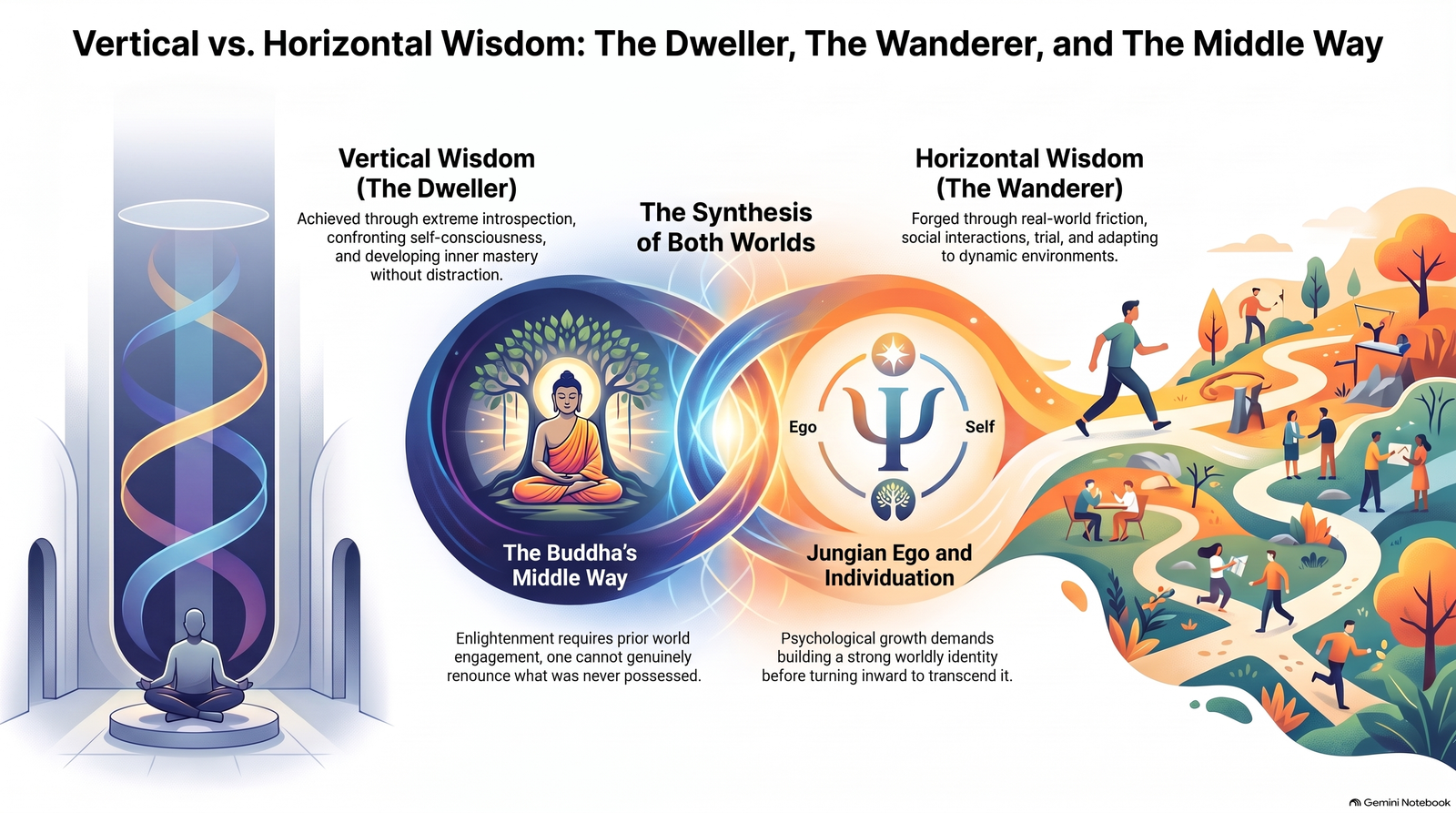
Who becomes wiser: someone who spends a lifetime in a windowless room, or someone who never stops moving through the world? The episode sets basic physical needs aside to isolate a deeper question: what can inward attention discover that experience cannot, and what can experience correct that inward attention misses? Its two figures, the Dweller and the Wanderer, are deliberately exaggerated. They give the discussion a way to examine the limitations of both withdrawal and constant involvement, without making either a complete model of a human life.
The opening account of Rabbi Yosef Yitzchak Schneersohn’s imprisonment introduces religious conviction as a source of inner freedom under external constraint. That freedom is a meaning carried by the narrative, not proof that consciousness escapes the body or that violence becomes harmless. The discussion then turns to hitbodedut, Hamlet’s unsettling inner world and Tibetan dark retreat. These examples bring different traditions into contact around a shared question: when external distraction recedes, do we gain clarity, encounter neglected difficulties, or simply become more absorbed in our own explanations? Solitude does not settle the answer by itself.
Milton’s Areopagitica supplies the counterweight. Judgement needs encounters with ideas and situations that resist our preferences. Other people, obligations and consequences can expose the distance between a reassuring self-image and the way we actually behave. Yet the Wanderer has a corresponding blind spot: constant adaptation can become constant reaction. A person can gather experiences without examining the assumptions that organise them. The episode’s imagery of vertical depth and horizontal breadth works best as a pair of questions about attention, rather than a ranking of people or a measurement of wisdom.
The closing movement draws on the traditional Buddha biography, Jungian psychology and the overflowing tea-cup story associated with Nan-in. Its useful challenge is to develop practical capacities while remaining willing to revise the identity built around them. These comparisons do not establish one necessary timetable for everyone. Neither prosperity nor conventional adult milestones determine who can relinquish attachment. Read in the context of Dialogues V’s movement towards integration and return, the inquiry becomes ordinary and demanding: can a quiet pause improve our next encounter, and can that encounter reveal what our quietness has overlooked?
Argument map
From separation to exchange
Separate the two lives
The windowless-room experiment asks what is missing when inward reflection and outward experience are kept apart.
Distinguish inner freedom from escape
The prison narrative introduces a freedom of conviction that physical constraint need not wholly extinguish.
Let solitude face its limits
The Dweller may meet neglected inner material, but withdrawal alone cannot guarantee clarity or wisdom.
Allow the world to answer back
Milton’s defence of tested judgement shows why other people and consequences matter to understanding.
Notice the cost of endless reaction
The Wanderer’s breadth becomes incomplete when experience leaves no space to examine motives and assumptions.
Return with a less rigid identity
Renunciation, individuation and the empty cup lead towards a repeated exchange between reflection and responsible action.
Navigate the discussion
Chapters
These chapter markers match the published YouTube description. Each opens this episode at the selected point.
- 00:00The Windowless Room
- 03:10The Boundless Mind
- 07:10Solitude and the Inner World
- 11:05The Dweller and Dark Retreat
- 14:45Milton and the Wisdom of Friction
- 18:25The Wanderer’s Blind Spot
- 21:05The Buddha and the Paradox of Renunciation
- 25:40Jung: Building and Loosening the Self
- 29:10Emptying the Cup
- 31:30Bringing Stillness Back Into the World
Terms for the enquiry
Glossary
Open a term for its meaning and the limits of the episode’s comparison.
Dweller and Wanderer
The two imagined lives in the opening experiment: one wholly secluded, the other wholly exposed to the world. They are contrasting figures devised for this discussion, not psychological diagnoses or established personality types. Their usefulness lies in making each life’s omissions visible, rather than predicting the outcome of actual lifelong isolation.
Vertical and horizontal wisdom
The episode’s metaphors for inward depth and outward breadth. Vertical wisdom concerns examining experience, motives and the sense of self; horizontal wisdom concerns learning through relationships, practical demands and consequences. These are organising images rather than scientific dimensions, and neither necessarily develops simply because someone is alone or busy.
Kabbalah and inner freedom
Kabbalah comprises diverse Jewish mystical teachings about God, creation and religious life. The episode reads a Chabad prison narrative through that mystical lens. Its “boundless mind” is an interpretation of spiritual freedom, not a literal guarantee against imprisonment, an empirical account of consciousness, or a single doctrine shared by all Jewish traditions.
Hitbodedut
A Hebrew term associated here with Rabbi Nachman of Breslov’s practice of personal seclusion and speaking with God in one’s own words. Its devotional character matters: it is not simply a technique for removing sensory input. The discussion’s image of switching on “internal senses” is an analogy, not an established physiological explanation.
Dzogchen and dark retreat
Dzogchen, often translated as Great Perfection, is a family of contemplative teachings found in Tibetan Buddhist and Bön traditions. Dark retreat occurs in particular advanced contexts within these traditions. The episode simplifies these contexts considerably; darkness does not remove every sense, and its descriptions do not constitute practice instructions or evidence that visions establish realisation.
Cloistered virtue
Milton’s image in Areopagitica of virtue sheltered from challenge. In a polemic against pre-publication licensing, he argues that judgement needs opportunities to discriminate. The episode extends this to the testing of character in daily life. That extension need not condemn every retreat or imply that people must deliberately seek temptation or danger.
Renunciation
In this discussion, the loosening of attachment rather than merely lacking possessions. Buddhist renunciation can involve leaving household life, but also concerns attitudes towards craving and clinging. The episode’s “filled cup” analogy is not a doctrinal requirement to become wealthy, accumulate pleasures or complete a prescribed life stage before letting go.
Middle Way — majjhimā paṭipadā
In SN 56.11, the Middle Way avoids sensual indulgence and self-mortification and is identified with the Noble Eightfold Path. The episode’s balance between solitude and worldly engagement is a contemporary application by analogy. It should not replace the teaching’s specific ethical, contemplative and liberative content with a general preference for moderation.
Ego and persona
In Jungian language, the ego concerns conscious identity; the persona concerns social presentation and adaptation. The episode pictures them as a vessel formed through life. This image can illuminate excessive identification with roles, but ordinary agency and social competence are not obstacles that must simply be destroyed.
Individuation and the Self
Jung’s individuation concerns becoming more aware of the relationship between conscious identity and the wider psyche, including unconscious contents. The Self names that wider psychic totality in his model. It is not synonymous with Buddhist liberation, and individuation involves relationships as well as inward attention; it does not require abolishing the ego.
Emptying the cup
The overflowing tea-cup story associated with Nan-in illustrates the difficulty of learning while defending every existing opinion. Here “emptying” means making room to reconsider, not erasing knowledge, memory or personality. Treat it as a teaching anecdote whose force lies in the question it poses, rather than proof of a verified historical encounter.
Continue within the catalogue
Related reading
- When Detachment Looks Like Enlightenment | Dialogues VDistinguish apparent withdrawal from the ethical and relational qualities of contemplative understanding.
- Why Escaping the World Never WorksFollow the question of retreat into the problem of returning to shared life.
- Why Enlightenment Looks Like Washing DishesExplore the movement from exceptional experience towards ordinary activity.
- 2.4.4. Inner WorldsContinue the enquiry into inward experience within the Albedo Subject sequence.
- 2.4.9. DojoConsider everyday encounters as a place where understanding is practised and tested.
- 3.2.12. Returning to SaṃsāraExtend the closing movement towards return, participation and responsibility.
External reference points
A small reading shelf
- John Milton: Areopagitica — Dartmouth’s Milton Reading Room ↗The annotated 1644 text puts the argument about tested virtue back into its debate over licensing printed works.
- SN 56.11: Setting the Wheel of Dhamma in Motion ↗Ṭhānissaro Bhikkhu’s translation gives the Middle Way’s specific meaning and its identification with the Noble Eightfold Path.
- Daryl Sharp: Jung Lexicon ↗A reference with citations to Jung’s works; consult ego, persona, individuation and Self to check the episode’s simplifications.
- Rabbi Yosef Yitzchak Schneersohn: Chapter I — The Arrest ↗A translated personal account of the 1927 arrest, published within Chabad; useful for context and provenance rather than independent proof of every retelling.
A two-minute reflection
Take one encounter into stillness—and back
- Pause in an ordinary, comfortable place, with your eyes open if you prefer. Put any screen aside for a moment.
- Recall a small, recent interaction: a conversation, a request or a minor disagreement. What did the other person reveal that you had not expected?
- Notice the explanation you first gave yourself. Can you allow one alternative explanation without deciding immediately which is right?
- Choose one modest response to carry back into the world: ask a clearer question, listen a little longer, or complete a small responsibility.
The point is to give reflection something concrete to examine, and let the next encounter test it. There is no special state to achieve; simply finish the pause and resume your day.
The sequence