
The Edge of Reality
If the self loses its apparent solidity, what keeps understanding connected to care?
Revised Edition (2026) · Catalogue reference 3.4.3
Watch the chapter video
The Illusion of Self Explained | No-Self & Emptiness in Buddhism
A dialogue on the chapter’s metaphors of scaffolding, suspended crystals, the innkeeper and the gravity of compassion.
The chapter in brief
The third chapter of Subject asks what happens when teachings cease to be possessions and begin to change how experience is understood. Robinson replaces the image of conquering a summit with standing at a precipice. Learning remains useful, but the identity of the successful climber becomes questionable. His central image changes too: the mind is clear water dazzled by suspended crystals, rather than water that must continually be purified.
The chapter then links the absence of a permanent controller with the Mahāyāna Path of Seeing and the emptiness of phenomena. A scene from The Matrix supplies its closing image: returning from sunlight into the storm, held by the “gravity” of compassion. These are the author’s contemplative and alchemical connections. Neither the optical imagery nor the comparison of arahant and bodhisattva establishes a physical mechanism or a single Buddhist account of liberation.
The central question: who holds the map?
The recording opens with a glowing, faceless silhouette framed by crystalline fragments. It asks how much of a seemingly solid identity is supplied by its surrounding stories. From there, the hosts contrast conquest with exposure: a summit rewards the successful seeker, whereas a precipice unsettles what the seeker thinks is known. Dharma becomes scaffolding. The challenge is to release possessiveness towards explanations while retaining what learning contributes to ethical judgement and everyday understanding. The opening appeal to mind as reality’s foundation is a philosophical premise, rather than a demonstrated conclusion about the universe.
The longest early movement develops the salt-crystal image through a disco ball, dust in sunlight and an email from a boss. Sensations, feeling tone, recognition and storytelling illustrate how experience acquires personal significance. The hosts organise the five aggregates into a rapid sequence and describe consciousness as its underlying canvas; that is their explanatory construction, not a standard definition of the aggregates. They also expand the chapter’s tapas and jñāna imagery into winds, channels and restraint. This extension is symbolic and traditional language, not verified nervous-system mechanics or a practice prescription.
The inquiry then turns back upon whoever seems to be watching. An innkeeper mistakes passing guests for an enduring identity; a supposed internal chief executive proves difficult to locate. Table 53 gives the argument its hinge: subject, object and relationship are each redescribed. A solid observer becomes open space, substantial objects become “holograms”, and desire, aversion or boredom give way to a shared emptiness. The hosts connect this shift with the Heart Sūtra. Their theatre and burning-building analogy conveys reduced identification, but overreaches when it suggests that biological fear simply evaporates. Actual danger, injury and other people’s needs retain practical force.
Finally, the dialogue asks why anyone would remain engaged if experience lacks the solidity attributed to it. The flight above the clouds in The Matrix becomes an image of relief followed by return. Robinson’s “golden chain” represents the bodhisattva’s compassionate resolve. The hosts sharpen the contrast with the arahant into escape versus service, even calling escape selfish; this is a sectarian simplification, not a fair account of Theravāda liberation. The useful closing challenge is the relationship between insight and conduct: can less possessiveness support more reliable care? Neither inhabiting an indestructible inner space nor suppressing fear is required to take that question seriously.
How the argument unfolds
Put the successful seeker in question
The opening replaces spiritual conquest with a precipice where cherished explanations no longer secure an identity.
Change the image of the troubled mind
Suspended crystals and a disco ball reframe attention as captivated by its own changing contents.
Ask who is watching
The email example and innkeeper story lead from passing experiences to the supposed controller who claims them.
Redescribe subject, object and relationship
Table 53 links a less solid observer with appearance-like objects and their shared lack of intrinsic existence.
Confront disengagement
The Heart Sūtra and burning-building analogy bring the danger of mistaking emptiness for meaninglessness into focus.
Return through care
The Matrix scene and golden chain make compassionate engagement the dialogue’s answer to withdrawal.
Book and recording
The chapter’s emphasis
A compact movement from releasing conceptual ownership to the Path of Seeing, then to compassion as the motive for renewed engagement.
The recording’s expansion
The hosts add the disco ball, email, inner chief executive and cinema analogies. Their aggregate sequence, energetic explanation and claims about fear go beyond what those metaphors establish.
A visual map of the chapter
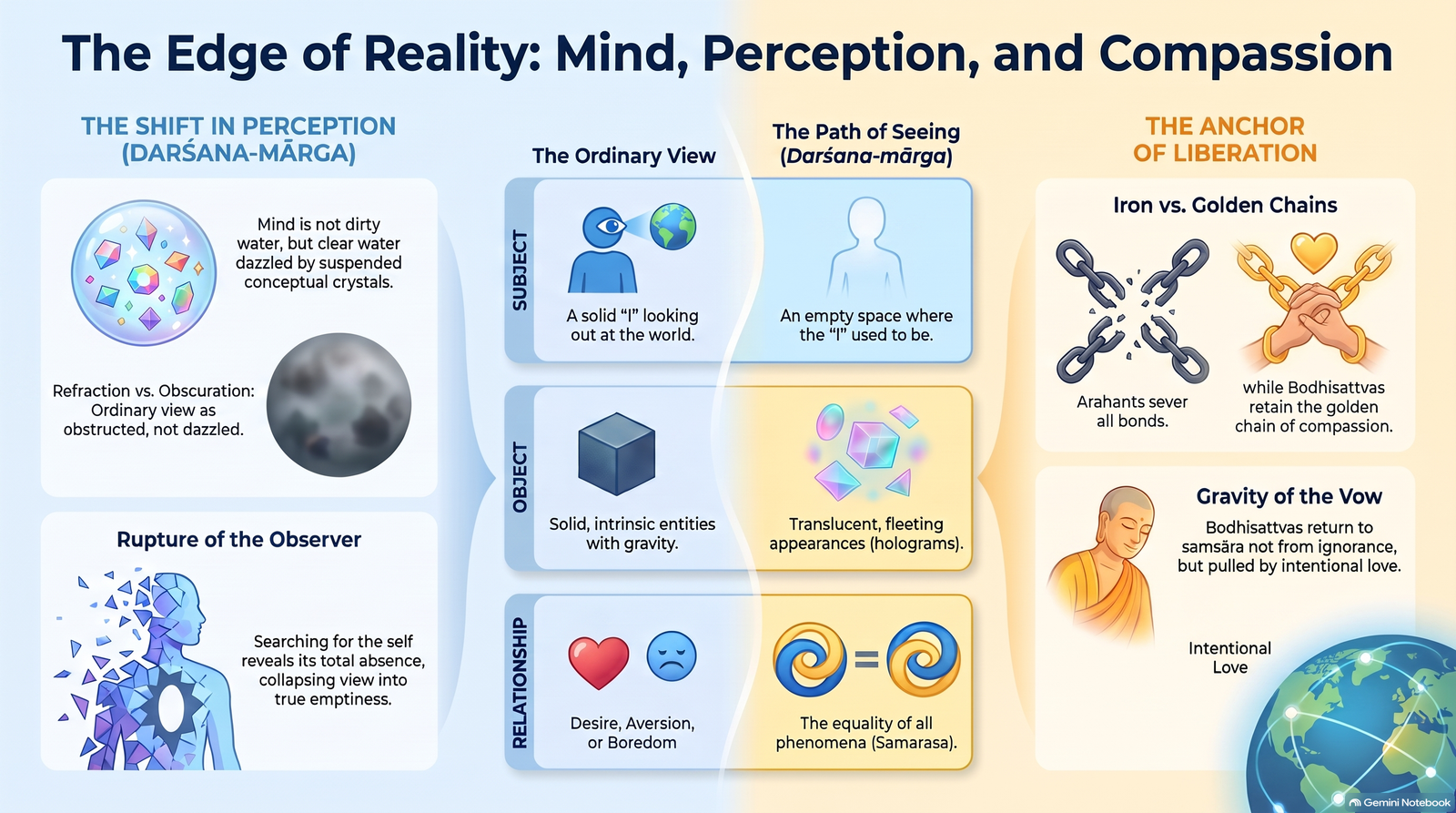
Explore the video
Supplied estimated chapter starts. These are approximate navigation aids, not independently synchronised boundaries in the final recording.
- 00:00 · Introduction: Standing at the Edge
- 02:20 · The Dharma as Scaffolding
- 05:50 · Muddy Water vs Crystalline Suspension
- 10:40 · Refraction, Concepts, and Mental Afflictions
- 15:30 · The Path of Seeing
- 20:10 · The Collapse of the Controller
- 24:40 · Form Is Emptiness
- 28:10 · The Matrix and the Gravity of Compassion
- 32:00 · Arahant vs Bodhisattva
- 36:20 · The Golden Chain of Bodhicitta
- 40:00 · Closing Reflections
Terms for careful reading
Dharma · teachings as tools
In this context Dharma means Buddhist teachings and the path they describe. Robinson’s scaffolding image asks whether explanations help understanding or become possessions. The Pāli raft simile in MN 22 provides a related primary-text comparison: teachings serve a purpose rather than becoming objects of attachment. This does not license abandoning ethics or dismissing careful study.
Anātman / anattā · not-self
Sanskrit anātman and Pāli anattā concern not-self. The recording explores the failure to locate a permanent internal controller. That inquiry does not deny ordinary persons, relationships or accountability. It also does not establish a larger, eternal self called awareness. Early Buddhist analyses and later Mahāyāna accounts have distinct contexts and should not be collapsed into one attainment claim.
Śūnyatā · emptiness
In the Mahāyāna context used here, emptiness means a lack of independent, intrinsic existence. It is not nothingness or a substance from which everything is made. The chapter distinguishes understanding emptiness conceptually from direct realisation. That distinction does not make a fleeting sense of openness a reliable attainment test, nor establish that appearances have no consequences.
Skandhas · the five aggregates
A Buddhist analysis of experience: form, feeling tone, perception, formations and consciousness. Feeling tone means pleasant, painful or neutral, rather than the whole range of emotion. The aggregates are not normally a five-step processing cascade with consciousness added last. Consciousness is itself conditioned; describing it as an indestructible canvas imports a different claim.
Kleśas · afflictions
A Sanskrit term for mental afflictions such as attachment, aversion and ignorance, understood differently across Buddhist systems. Robinson pictures afflictions and concepts as crystals captivating attention. Not every useful concept is an affliction. The dialogue’s desire, aversion and boredom are also not the usual three poisons: greed or attachment, hatred or aversion, and delusion.
Darśana-mārga · Path of Seeing
A technical path category with differing Buddhist explanations. In the Mahāyāna five-path account referenced here, it marks direct non-conceptual insight and entry to the first bodhisattva ground. Robinson’s “rupture of the controller” is his phenomenological presentation. A feeling of selflessness, an unusual perception or agreement with this account cannot certify that attainment.
Guest and dust · Śūraṅgama imagery
The Śūraṅgama Sūtra, influential in East Asian Buddhism, contains guest/host and moving-dust comparisons. Within the narrative, Kauṇḍinya explains these images in response to the Buddha. The dialogue’s innkeeper, chief executive and hotel guests are elaborations. Reading them as evidence for an eternal observer would introduce a further metaphysical claim; the textual provenance is distinct from the Pāli discourses.
Tapas and jñāna
Sanskrit tapas carries associations of heat, austerity and disciplined effort; “friction” is the author’s interpretive emphasis. Jñāna means knowledge or wisdom and is distinct from Pāli jhāna, meditative absorption. The transcript’s shifting pronunciation should not erase that distinction. The chapter’s heat-and-light imagery does not demonstrate a literal thermal process in attention or recommend enduring distress.
Nāḍī and vāyu · channels and winds
Terms used in Indian and Tibetan subtle-body traditions for channels and winds or motive energies. The hosts extend these into an explanation of attention and heat. Such contemplative physiology is not established nerve anatomy, and its images cannot verify nervous-system mechanics. This page offers terminology for study, without turning the dialogue’s account into instructions for manipulating breath, energy or attention.
Bodhicitta · awakening for others
In Mahāyāna traditions, bodhicitta is the intention to attain awakening for the benefit of beings, with further distinctions between aspiration, engagement and ultimate understanding. Compassion is central but does not exhaust its meaning. The “golden chain” expresses Robinson’s commitment to service; bodhicitta is not conventionally classified as a binding affliction that a bodhisattva deliberately preserves.
Arahant and bodhisattva
An arahant is liberated from the defilements in early Buddhist and Theravāda accounts; a bodhisattva pursues Buddhahood, centrally for beings’ benefit in Mahāyāna traditions. These ideals have different textual histories. Neither “selfish escape” nor permanent seclusion in bliss fairly defines arahantship. Robinson’s contrasting chains organise his synthesis rather than establish a neutral hierarchy between traditions.
Samarasa · one taste
A term associated with “one taste” or evenness in tantric and Mahāmudrā contexts, used here for phenomena’s shared empty character. It does not mean that pain and pleasure become indistinguishable or that kind and harmful actions are equivalent. The transcript’s “sameness or rasa” appears to render this term; the next book chapter develops Robinson’s use of sameness.
Related pathways
- 3.1.7. The Heart Sutra — Read the course treatment of the sūtra used to connect form and emptiness.
- 3.2.12. Five Paths — Locate the Path of Seeing within the author’s comparison of five-path models.
- 3.1.9. The Bodhisattva — Explore the bodhisattva orientation without treating compassion as an exclusive possession.
- 3.3.2. Solipsism — Distinguish a first-person account of experience from the claim that only one mind exists.
- 1.4.9. No-Self — Return to an earlier inquiry into identification and the person.
- Citrinitas – Part Three — Find the wider context of the four-section Citrinitas course.
External reference points
Supporting sources for the distinctions on this page; their inclusion does not imply that these editions are cited in the recording.
- The Heart of the Perfection of Wisdom, the Blessed Mother · 84000 — The Dharmachakra Translation Committee’s translation from the Tibetan canonical tradition, with an introduction to textual versions; context for form and emptiness.
- Alagaddūpama Sutta (MN 22) · Ṭhānissaro Bhikkhu — A primary Pāli discourse in English translation: grasping teachings carefully, the raft, and the danger of misunderstanding not-self.
- Patrul Rinpoche · A Brief Guide to the Stages and Paths of the Bodhisattvas — A Tibetan Mahāyāna presentation of the five paths and ten grounds, providing a specific traditional context for the Path of Seeing.
- Bhikkhu Bodhi · Arahants, Bodhisattvas, and Buddhas — A Theravāda scholar-monk’s account of the ideals’ textual histories, useful for questioning the recording’s escape/service contrast.
A question to carry forward
When an explanation makes a difficult situation feel less personal, does it help you respond more carefully to the people involved? What concrete need, consequence or boundary might your explanation otherwise overlook?