
Citrinitas · Dharma · Chapter 24 of 48
3.2.12. Five Paths
What distinguishes understanding a map of awakening from allowing insight to change how we live?
Revised Edition (2026). Catalogue notation 3.2.12 identifies Dharma’s twelfth chapter; the book heading is “24. Five Paths”.
Watch the discussion
Nigredo to Rubedo: The Five Paths Explained | Modern Alchemy
The chapter in brief
At the close of Dharma, Dr Simon Robinson draws the course’s four alchemical colours into conversation with five Buddhist paths: accumulation, preparation, seeing, meditation and no more learning. His proposed correspondence places Nigredo beside accumulation, Albedo beside preparation, the threshold of Citrinitas beside seeing, its stabilisation beside meditation, and Rubedo beside completion. Merit, wisdom, the two obscurations and the ten bodhisattva grounds provide the chapter’s organising vocabulary.
This is a comparative framework, not a correspondence established by either tradition. Its most useful distinction is between conceptual understanding, direct insight as described in Buddhist path literature, and sustained cultivation in life. The chapter ends by turning towards Poimandres and the Object section. Its furnace, voltage and solar language gives an imaginative shape to transformation; it does not supply a tested account of brain function or a scale for readers to certify themselves.
Guide to the video
The recording begins with a provocative question: if greed and hatred were absent, would anything still remain to be understood? It develops the Mahāyāna distinction between afflictive and cognitive obscurations through the images of iron and golden chains. A virtual-reality headset illustrates the proposed difference between making experience more comfortable and questioning its underlying division into observer and observed. This is the recording’s interpretive framing of liberation and buddhahood, not a neutral description of Theravāda arahantship or evidence that ordinary perception is a computer simulation.
The discussion then builds its furnace. Merit becomes fuel, wisdom a blueprint, and bodhicitta the commitment that brings new aspirations into conflict with old habits. Examples involving an irritating email or a crying toddler make that friction recognisable. The four foundations of mindfulness are recast as alchemical separation before preparation brings calm and insight together. Heat, summit, acceptance and the highest mundane stage become a sequence approaching “solar ignition”. These are traditional path categories interpreted through thermal imagery, not four measurable temperatures. The recording’s account of acceptance as terror of non-existence should not be adopted as a requirement: emptiness does not teach that a real person must be annihilated.
The path of seeing supplies the dramatic turning point. A high-speed-camera analogy presents sixteen moments of acceptance and knowledge concerning the four noble truths. Such moments belong to scholastic accounts of insight; the recording’s fractions of milliseconds and nanoseconds are not experimental measurements. Its next question is more ordinary: what happens the morning after a breakthrough, when shopping, family and taxes remain? Through the ten bhūmis, it explores the difference between a claimed insight and continued cultivation. Traditional accounts place the first ground at seeing and the remaining nine in meditation; the recording groups the whole sequence under habituation.
The final movement joins Rubedo to no more learning and interprets the Buddha’s three bodies as the relationship between wisdom and compassionate manifestation. The mirror that reflects a passing bird without grasping supplies its image of functional action, drawing the Theravāda term kiriya into a Mahāyāna and alchemical synthesis. The return to Poimandres opens the next chapter, while the closing “which chain?” question invites self-examination. Read that invitation as reflection on conduct, rather than diagnosis of a spiritual grade. The conclusion’s claim of a single universal science expresses the author’s comparative conviction; the parallels themselves do not establish it.
A map of cultivation, not a biological diagnostic
The five paths and bhūmis are traditional accounts of liberation and buddhahood. Robinson’s alchemical correspondences are a further interpretive layer. Merit is not demonstrated thermodynamic fuel; “voltage”, biological inevitability and the cooking of a nervous system are not verified mechanisms. Nor does the recording establish that psychosis results from exposing an insufficiently virtuous mind to emptiness.
The vivid language of rupture, annihilation and endurance is not an instruction to induce terror, disregard pain or dismantle identity. Distress is not proof of progress. If contemplation becomes destabilising, pause the destabilising activity and seek appropriate qualified support. Insight claims do not remove consent, accountability or the need to respond to bodily danger.
The movement of the discussion
01
Peace raises a further question
Iron and golden chains distinguish emotional affliction from subtler limitations on knowing.
02
A furnace needs foundations
Merit, wisdom and compassionate resolve supply the recording’s resources for transformation.
03
Preparation gathers intensity
Four traditional preparatory stages are retold as a progression towards solar ignition.
04
Seeing changes the relationship to the map
The sixteen-moment discussion contrasts conceptual knowledge with claimed direct insight.
05
A breakthrough still leaves a life to live
The bhūmis introduce sustained cultivation beyond a dramatic moment of recognition.
06
Completion must still function
Trikāya and the reflecting mirror express the ideal of compassionate action without grasping.
07
The map points beyond its own imagery
The turn towards Poimandres asks how different languages of transformation might illuminate one another.
Book, recording and traditions
The chapter’s emphasis
A systematic arrangement of five paths, preparatory stages, sixteen moments and ten grounds within the course’s colour symbolism.
The recording’s expansion
Dialogue, the headset and high-speed-camera analogies, and ordinary-life examples make the schematic material easier to follow, while adding unsupported biological certainty.
The source traditions
Mahāyāna path literature supplies the main structure; Yogācāra vocabulary, Theravāda functional consciousness and Hermetic imagery enter as distinct additional contexts.
Visual map: the five paths
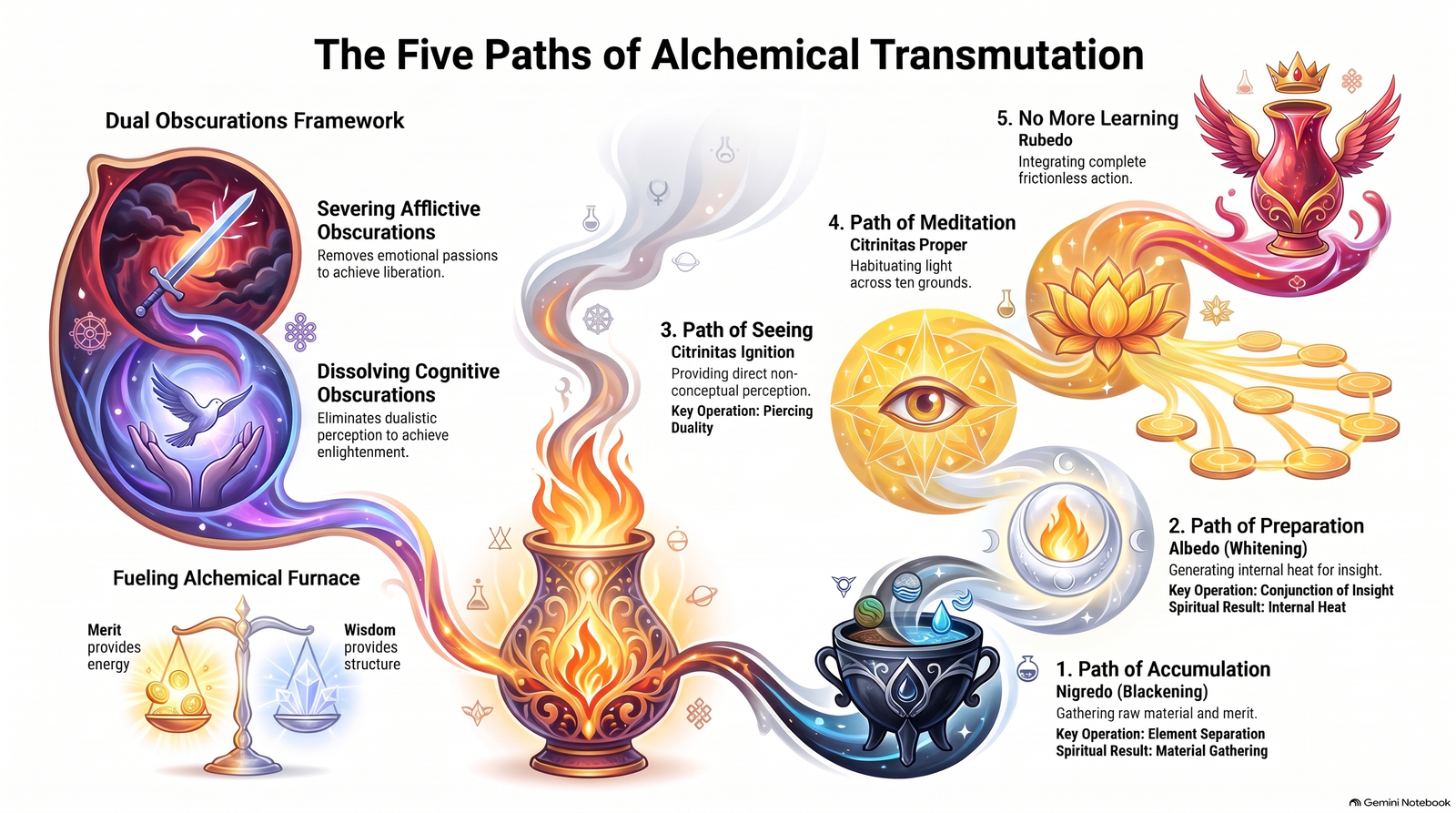
Terms and distinctions
Five paths: pañcamārga
A path framework developed in Buddhist scholastic traditions and adapted in Mahāyāna accounts of the bodhisattva’s progress: accumulation, preparation or joining, seeing, meditation and no more learning. Here the framework is read alongside four alchemical stages. The resulting correspondence is Robinson’s synthesis, not an official shared attainment system.
Merit, wisdom and bodhicitta
In Mahāyāna, merit and wisdom are two accumulations cultivated together. Merit concerns beneficial intentional activity and its results; wisdom concerns understanding reality, including emptiness. Bodhicitta is the resolve to attain buddhahood for the benefit of beings. The furnace’s fuel and blueprint are metaphors, not units of energy or a justification for treating kindness as spiritual currency.
Afflictive and cognitive obscurations
Kleśāvaraṇa concerns afflictions such as craving, hostility and ignorance; jñeyāvaraṇa concerns subtler obstructions to buddhahood’s knowing. Their precise content and removal vary by Mahāyāna system. They are not simply emotion versus intellect. The recording’s iron and golden chains are explanatory images; cognitive obscuration is not exhausted by spiritual pride or enjoyment of peaceful states.
The four aids to penetration
Nirvedhabhāgīya names preparatory factors commonly rendered warmth, summit, acceptance and highest mundane dharma. They lead towards seeing in particular scholastic path systems. Kṣānti here can signify acceptance or receptivity to truth, rather than merely waiting. Neither physical heat nor panic establishes a path attainment, and these categories are not an inner-heat practice protocol.
Seeing and the sixteen moments
Darśana-mārga is the path of seeing. Accounts describe direct insight through acceptance and knowledge related to the four noble truths, including subsequent forms that yield a sixteenfold analysis. Classification varies among systems. The recording compresses this into an instantaneous flash; these are doctrinal distinctions, not laboratory observations of sixteen events in a nanosecond.
Emptiness and the noble one
Śūnyatā, in the relevant Mahāyāna contexts, means the absence of inherent, independent existence. Ārya, “noble one”, names someone with direct realisation in a traditional path account. Emptiness neither annihilates a real self nor makes consequences unreal. A visual disturbance, a feeling of unreality or an impressive testimony cannot establish that designation.
Bhāvanā and the ten bhūmis
Bhāvanā means cultivation; the path of meditation develops familiarity with insight alongside compassionate activity. Bhūmis are bodhisattva grounds. In a common correlation, the first belongs to seeing and grounds two to ten to meditation; buddhahood is no more learning. Completion follows the culmination of the tenth, rather than simply being identical with entry into it.
Pāramitās and the grounds
Mahāyāna describes perfections such as generosity, ethical discipline, patience, diligence, meditation and wisdom. Tenfold presentations add skilful means, aspiration, power and knowledge. Their association with successive grounds expresses developed cultivation, not permission to ignore ethics after insight. The recording’s account of physically removing the capacity for malice is not demonstrated neuroscience.
Manas in Yogācāra
In the eight-consciousness model of Yogācāra, afflicted manas is the seventh consciousness, associated with self-grasping. Its transformation should not be confused with the destruction of all mental function or ordinary competence. The recording’s “death” language interprets this through the course’s framework; it is not an anatomical event or a test of eighth-ground attainment.
No more learning: aśaikṣa-mārga
The completion of the relevant liberating training, not an end to acquiring ordinary information. In this Mahāyāna scheme the destination is buddhahood; other Buddhist path systems apply no-more-training language to arhatship. Rubedo is Robinson’s comparative association. These uses do not make arahantship, buddhahood and alchemical completion interchangeable.
Trikāya: the three Buddha bodies
A Mahāyāna account of buddhahood: dharmakāya, the truth or Dharma body; saṃbhogakāya, the enjoyment body; and nirmāṇakāya, the emanation body. Descriptions vary among schools. Identifying these with a divine canvas, astral gold or an alchemical stone is interpretive. Pleroma language also has distinct Gnostic and later Western histories, not a single universal Hermetic meaning.
Kiriya and functional action
In Theravāda Abhidhamma, kiriya describes functional consciousness without the production of new kamma; some such consciousness also occurs in people who are not arahants. The recording extends the term through a mirror metaphor for awakened responsiveness. It is not a synonym for Mahāyāna buddhahood, the absence of every intention, or exemption from ordinary responsibility.
Related pathways
- 3.2.11. Returning to SaṃsāraThe preceding revised-book chapter connects insight with compassionate engagement; this newer page retains its exported URL ending in -2.
- 3.2.6. Afflictive and Cognitive ObstructionsA focused companion on the two kinds of obstruction used to organise this recording.
- 3.2.8. The Perfections (Pāramīs)Ethical and compassionate cultivation gives substance to the map’s language of progress.
- 3.1.10. The Three BodiesA closer introduction to the three bodies discussed towards the end of the video.
- 3.3.1. Poimandres, Shepherd of ManThe next revised-book chapter opens the Object section through a Hermetic text.
- Citrinitas – Part ThreeLocate the five-path comparison within the wider third part of the course.
External reference points
Supporting reading to clarify terminology and provenance; these editions are not identified as sources used by the recording.
- A Brief Guide to the Stages and Paths of the Bodhisattvas — Patrul RinpocheA Tibetan lineage presentation in English at Lotsawa House, useful for preparation, the sixteen moments and the correlation of paths and grounds. Its traditional attainment descriptions are not clinical measurements.
- The Ten Bhūmis — 84000Peter Alan Roberts’s translation from Tibetan with reference to Sanskrit, with an introduction explaining the ten grounds and their correlation with the five paths. A primary textual context, distinct from Robinson’s alchemical interpretation.
- The Abhidhamma in Practice — N. K. G. MendisA Theravāda exposition explaining functional consciousness, including its occurrence in ordinary cognitive processes and arahant activity. It clarifies the different doctrinal setting of kiriya.
Question to carry forward
Where might a useful map become another identity to defend? In one ordinary disagreement, what would show greater understanding: assigning yourself a stage, or listening carefully and making a responsible response?
This question concerns conduct and interpretation, not a test of attainment.