
Letting Go
When the wish for stillness becomes another demand, what kind of effort remains useful?
Revised Edition (2026) · Catalogue reference 3.4.6
Watch the chapter video
Why Trying to Awaken Keeps You Stuck | Modern Alchemy
The chapter in brief
The sixth chapter of Subject turns from the relationship between observer and observed towards the difficulty of releasing control. Robinson begins with a personal description of morning quiet, then considers phenomena as conditioned appearances whose apparent solidity can loosen. The dreamlike quality he reports leads to the “sweetness of defeat”: relief when the project of securing a victorious self loses its urgency.
The central paradox is that trying to manufacture effortlessness can renew the very striving it seeks to end. Muddy water settling illustrates release; “mind seeing mind” names the author’s account of a change in awareness. Table 56 places gradual cultivation beside sudden recognition. Its pairing of Mahāyāna bhūmis with Daoist wu wei is Robinson’s comparative synthesis, rather than an established common mechanism or an instruction to abandon discipline.
The central question: can release be forced?
The recording begins with a noisy engine and the familiar expectation that a problem requires intervention. That practical logic becomes its foil: what happens when the mind treats stillness as another repair job? The hosts turn to the chapter’s morning hush, then to an unsettling claim that the things we clutch are “echoes”. A difficult email supplies an everyday example. The event and its consequences remain, while a threatened identity can add further weight. The haunted-house analogy develops this distinction: noticing the tracks and costume changes the interpretation of a frightening appearance. This illustrates a possibility, not proof that real threats or persistent anxiety disappear through insight.
From here, the dialogue considers dreamlike experience, drawing on the Diamond Sūtra’s imagery of transient appearances. It distinguishes this intended vividness from feeling disconnected, but its confident clinical contrast is too simple to establish a reliable distinction. A dreamlike description cannot identify either attainment or a mental health condition. The “sweetness of defeat” then becomes the release of a heroic self-improvement story. A woven finger trap gives this turn its strongest image: pulling harder tightens the grip. The hosts read Paul’s language of strength in weakness alongside this yielding, as an interpretive comparison rather than an explanation of Paul’s original theological meaning.
The next movement exposes the recursion in trying to do non-doing. Udaya, arising, is introduced as the moment at which a thought begins; the dialogue adds a claim about catching it at an exact millisecond. That precision is neither established by the word nor supported here by empirical timing. Muddy water then shifts the emphasis from policing each thought to ceasing unnecessary disturbance. Wu wei supplies Daoist language for unforced action. The recording connects settling with “reflexive gnosis”, using a flashlight turning towards its own bulb and a mirror shattering. These are images for the author’s account of awareness, not literal optics or verified changes in brain architecture. Its reading of Psalm 46 as a collapse of duality is likewise a modern contemplative reinterpretation.
Finally, the hosts confront passivity. Table 56 offers concurrent approaches: gradual cultivation and sudden recognition, illustrated by walking mountain switchbacks while questioning the imagined distance to a destination. Ordinary commitments remain part of the argument. The closing Stoic comparison and question about suppression versus release return the inquiry to daily life. The recording’s claim that all these traditions give an identical mechanical instruction goes beyond its evidence. Its more useful challenge is narrower: can diligence continue without making calm another possession, while care, boundaries and responsibility remain intact?
How the argument unfolds
The repair instinct
The engine analogy asks whether forcing a solution is always the right response to inner strain.
From threat to interpretation
The email, haunted house and mirage explore how an appearance gains the weight of a personal threat.
The relief of losing the contest
Dream imagery and the finger trap recast defeat as loosening a struggle that keeps renewing itself.
Trying to stop trying
The paradox of effort leads through thought-arising to the image of muddy water settling.
Awareness and its own knowing
The turning flashlight and shattered mirror illustrate the author’s account of reflexive gnosis.
Cultivation alongside release
The concurrent approaches preserve ordinary diligence and end by questioning suppression disguised as silence.
Book, recording and comparison
The chapter’s emphasis
A first-person reflection moves from quiet and conditioned appearances through the effort paradox to Table 56’s concurrent strategies.
The recording’s expansion
The repair shop, workplace email, haunted attraction, finger trap, flashlight and mountain make the chapter conversational. They are explanatory additions, not independent evidence.
Video chapters · approximate starting points
These supplied chapter titles and times are estimates, not independently synchronised with the final recording. The opening includes the engine-repair analogy before the morning reflection; use these links as rough orientation.
- 00:00Opening: The Silence of the Morning
- 02:10The Hollow Nature of Phenomena
- 06:20Why Reality Begins to Feel Dreamlike
- 11:10The Sweetness of Defeat
- 15:40The Paradox of Effort
- 20:30Why Trying Prevents Stillness
- 25:20Wu Wei and Effortless Action
- 30:10Reflexive Gnosis: Mind Seeing Mind
- 34:50Gradual vs Sudden Awakening
- 38:20Letting Go and the Open Mind
A visual companion
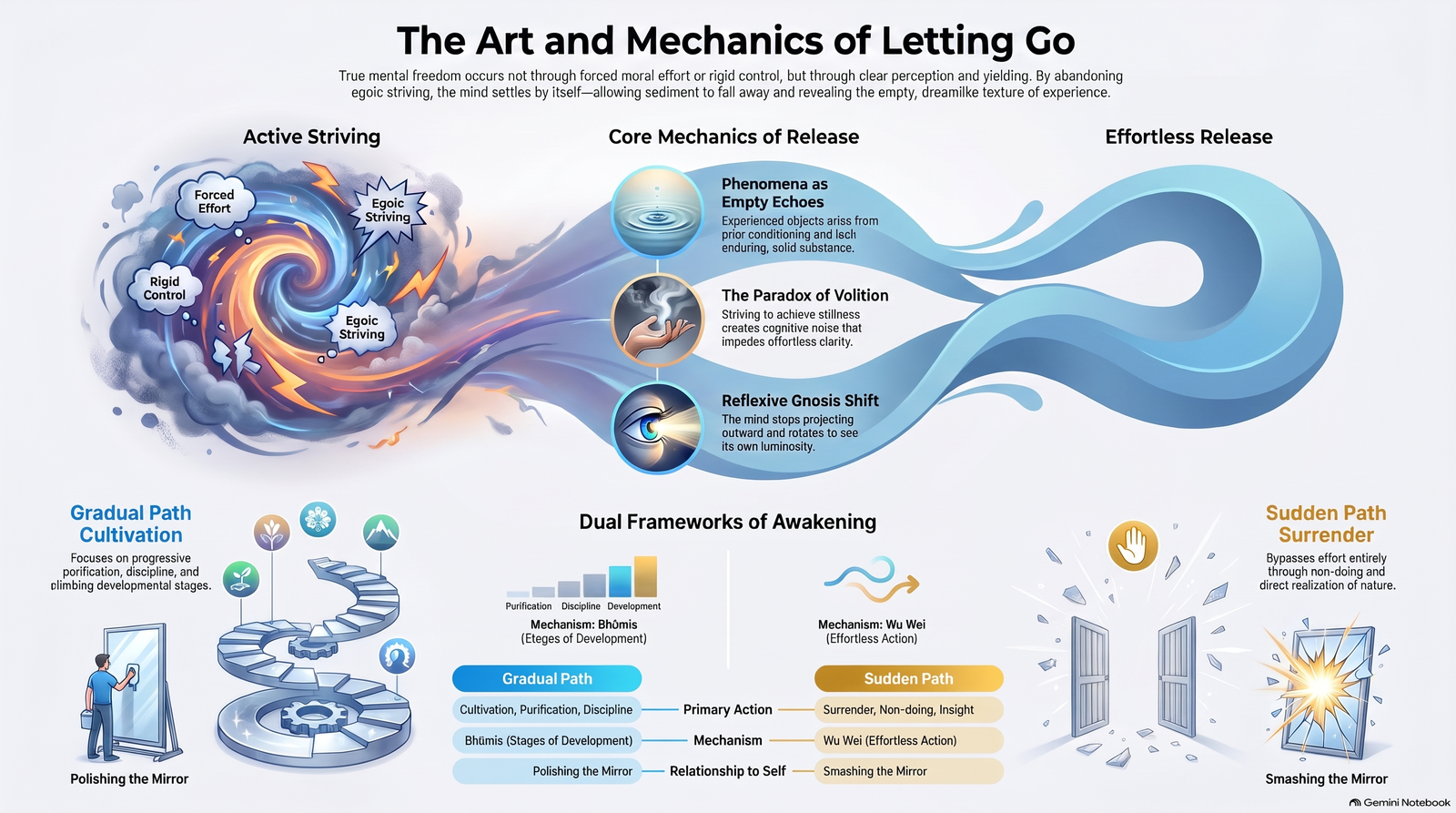
Terms and distinctions
Suñña, suññatā and śūnyatā
Suñña is Pāli for “empty”; suññatā is the Pāli noun, while śūnyatā is Sanskrit. In SN 35.85, sensory experience is described as empty of a self or what belongs to a self. Mahāyāna analyses of intrinsic nature develop related questions in distinct philosophical settings. The recording blends these formulations; emptiness does not mean that events have no consequences.
Conditioned phenomena
In Buddhist usage, conditioned phenomena arise in dependence on causes and conditions. The chapter’s “echo” is an image for such dependence and for habitual interpretation. It does not mean that every event is produced solely by personal memories, that the world is privately imagined, or that distress is merely an error a person should be able to correct.
Udaya
A Pāli and Sanskrit term for arising or emergence, used here for the inception of a thought. It does not by itself specify a measurable millisecond or require thought interception. The recording’s exact-instant account is an explanatory extension of the author’s model, not a definition or a necessary technique supplied by the term.
Wu wei
A Chinese expression associated with Daoist accounts of non-action or unforced action. It questions coercive interference rather than requiring complete inactivity. Robinson uses it to interpret release from self-conscious striving. That comparison does not make wu wei identical with Buddhist liberation or imply that ethical choices, learning and practical intervention should cease.
Reflexive gnosis
Here this names Robinson’s account of awareness recognising its own knowing, rather than acquiring a more elevated object. “Gnosis” means knowledge, often with a direct or experiential emphasis. The turning flashlight is metaphorical: no optical reversal is established, and the description neither proves a universal consciousness nor certifies a particular Buddhist attainment.
Luminosity
In contemplative language, luminosity can refer to the clear or knowing quality attributed to awareness. Its meanings differ across Buddhist traditions. The chapter uses it within the author’s account of “mind seeing mind”. It is not a physical light substance, electrical energy, brightness behind closed eyes or an independently measured neural mechanism.
Bhūmi and bodhisattva
Bhūmi is Sanskrit for “ground”. Many Mahāyāna presentations describe ten grounds of the bodhisattva path, concerned with wisdom and compassionate activity directed towards buddhahood. These are tradition-specific maps, not generic self-help stages. Table 56 recruits them into a comparison with sudden recognition; ordinary diligence does not establish that someone occupies a ground.
Gradual and sudden approaches
These terms distinguish cultivation over time from accounts emphasising direct recognition. Their relationship varies between traditions; recognition and subsequent cultivation need not exclude one another. The chapter’s two-column arrangement is a heuristic comparison. Its association of the gradual with bhūmis and the sudden with wu wei is not an authorised cross-tradition classification.
Polishing and smashing the mirror
The recording uses polishing for removing obstructions and smashing for questioning the imagined separation between seer and seen. These are metaphors in its comparative account, not literal tasks or historical proof that all traditions teach the same thing. The contrast should not diminish therapy, ethical development or the continuing importance of relationships.
Dreamlike texture and non-grasping
The chapter reports experience feeling less fixed as identification loosens. Non-grasping names less insistence on possessing or securing experience, not indifference to people. A feeling of unreality cannot establish contemplative insight, and clarity alone does not rule out distress or impairment. The page treats this as personal phenomenology rather than a recommended altered state.
Related pathways within the website
Read the Diamond Sūtra chapter alongside its distinct book title, The Diamond Solvent (chapter 11).
Locate the bhūmis within the broader path comparison rather than a generic ladder of self-improvement.
Revisit emptiness, practical differences and compassionate participation in Subject.
A Dialogues inquiry into the pressure created by trying to manage relaxation.
Find the wider course and its four-section organisation.
External reference points
These verified textual destinations supply context; they do not establish that these particular editions were used in the recording.
- Suñña Sutta · SN 35.85, translated by Ṭhānissaro Bhikkhu
An early Buddhist reference for the sense faculties and their objects as empty of self and what belongs to self; a useful correction to the recording’s language mix-up.
- Aggi-Vacchagotta Sutta · MN 72, translated by Ṭhānissaro Bhikkhu
The discourse linked to the chapter’s opening epigraph addresses speculative views, non-clinging and the extinguished-fire analogy. The epigraph’s exact English wording is not authenticated here and is not reproduced.
- Psalm 46 · New Revised Standard Version Updated Edition
Read verse 10 within a psalm about refuge, nations and the ending of war. This textual setting differs from the recording’s nondual interpretation; comparison does not establish historical identity.
Question to carry forward
In one ordinary responsibility, where might releasing the need to control every outcome make you more attentive—and what action would still be yours to take?
Consider the situation without monitoring every thought or trying to produce a special state. This is a question about care and proportion, not an attainment test.