
The Arahant
What becomes of the search for freedom when there is no longer a need to make it an achievement?
Revised Edition (2026) · Catalogue reference 3.4.10
Watch the chapter video
What Is an Arahant? | Liberation vs Enlightenment Explained
The chapter in brief
Late in Subject, Robinson returns to a figure introduced in Nigredo. The arahant, the fully liberated person in the Theravāda path, becomes the White Stone in his alchemical reading. The image marks the completion of Albedo, when the forces that sustain grasping have spent their fuel. The chapter uses the ten fetters and the image of an extinguished fire to explain why it speaks of liberation in terms of what falls away.
Robinson then asks what relates that freedom to a life of teaching. He reads the Buddha’s decision to teach as a turn from cessation towards service and imagines the arahant as an alchemist who has solved the equation of suffering and put down the chalk. Those are moves within his own synthesis. The chapter ends with māna, the habit of measuring oneself, and with the possibility of insight that has no need of an audience.
What happens when becoming someone ceases to be the goal?
The hosts begin with the familiar task of optimising a life. Better habits, more reading and a longer meditation can all become ways to keep score. Their treadmill image asks what happens when the pursuit of a better self perpetuates the strain it promises to relieve. A stone figure in a gold circle, with a sealed mouth and a third eye, gives them a visual language for the White Stone. They read the kiln-fired surface as an image of subtraction and distinguish the disappearance of ill will from the effort of suppressing it.
The discussion makes that contrast more specific through the ten fetters. The example of anger in traffic distinguishes an immediate reaction from the story that can feed it. The focus then moves to attachments that can survive a measure of calm, including attachment to refined meditative states. The recording’s talk of dopamine, disappearing neural pathways and spiritual physics borrows the language of science without establishing a biological mechanism. When one host asks whether extinguishing the fire amounts to dying, the other reaches for a virtual-reality headset. The analogy dramatises a change in identification. The account of cosmic gravity and a causal plane belongs to the speakers’ metaphysical framing. Its suggestion of someone outside the headset gives no grounds for positing a hidden, permanent witness.
The story of Brahmā Sahampati moves the discussion from liberation to teaching. The hosts take the Buddha’s initial hesitation as a way to ask what makes solitude different from self-absorption. Their “lesser vehicle” label reflects a polemical usage and is unsuitable as a name for Theravāda. The chapter’s image of the intellectual alchemist then raises a question about truth and moral credit. Giving becomes the test case, with a Diamond Sūtra comparison that asks whether giver, gift and recipient need to become fixed identities. The surgeon analogy brings the issue down to conduct. It illustrates the difference between being overwhelmed and responding steadily. Empathy and precision can coexist, and skilful help still depends on what the other person needs.
The conversation ends with silence and māna. At work, online or among fellow practitioners, comparison can persist even when the currency changes from money to mindfulness. The hosts revisit the chapter’s inquiry into ranking and ask what might become audible when a conversation is freed from the need to establish who stands where. The closing return to the treadmill makes spiritual achievement itself the final example.
How the argument unfolds
The treadmill of improvement
The hosts ask whether treating peace as another acquisition perpetuates the pressure to become someone.
The White Stone gives subtraction a form
The cracked stone figure and the sealed mouth give the hosts a way to picture what remains after purification.
The fetters bring the inquiry into focus
The conversation moves from anger in traffic to the subtler wish to hold on to extraordinary calm.
The extinguished fire prompts an objection
The headset analogy answers one host’s fear that the cessation of clinging would mean annihilation.
Silence turns towards teaching
Brahmā Sahampati’s request opens the hosts’ discussion of what a liberated person might owe to others.
Giving and surgery test the idea of care
The two examples ask how help might remain attentive without becoming a claim to goodness or an expression of overwhelm.
The measure of progress comes under question
The closing discussion of conceit brings the inquiry back to ranking and the wish to be seen as spiritually advanced.
Book, recording and companion graphic
The book’s starting point
The chapter looks back from Citrinitas to the completed Albedo and uses the White Stone to organise an inquiry into liberation, teaching and silence.
What the recording expands
The hosts work through the fetters individually and use the treadmill, traffic and virtual reality to test what the book calls cessation.
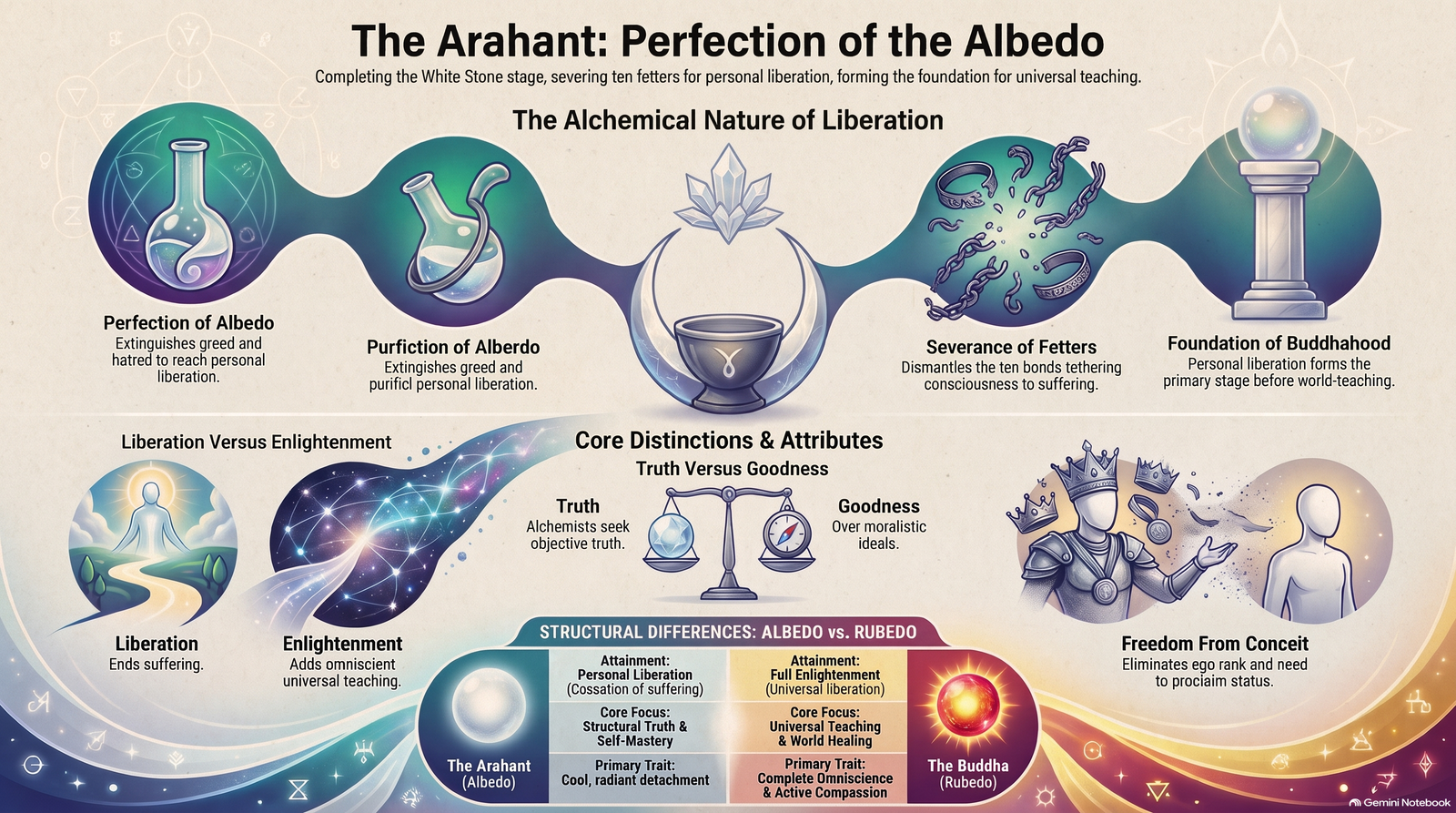
Read the infographic in words
Vessels and broken chains illustrate purification and release from the fetters. Scales connect the intellectual alchemist with truth, and falling crowns picture the loss of rank. A final panel pairs the White Stone with liberation and the Red Stone with teaching and compassion. This is Robinson’s course symbolism. The diagram’s hierarchy and its assignment of omniscience to the latter stage should be read within that framework. Compassion is also part of early Buddhist accounts of teaching.
Video chapters
These published YouTube markers are approximate listening cues. A label can name a theme that becomes explicit later in the discussion.
- 00:00Opening: The Noise of Becoming Ends
- 02:10What Is an Arahant?
- 06:20Liberation vs Enlightenment
- 11:10The Ten Fetters Explained
- 16:50The Final Five Fetters and Nibbāna
- 22:10Did the Buddha First Become an Arahant?
- 27:30The Intellectual Alchemist
- 33:20Compassion vs Skilful Means
- 38:40Why the Arahant Remains Silent
- 43:20The End of Measurement and Conceit
- 46:10Closing Reflections
Glossary
Arahant
Pāli for “worthy one”, with arhat as the Sanskrit form. In the Theravāda map, an arahant is fully liberated and has abandoned all ten fetters. Early discourses apply the title to the Buddha as well. “Destroyer of enemies” is a traditional wordplay about overcoming afflictions, distinct from the word’s derivation from worthiness.
Āsava (taint or effluent)
An early Buddhist category for deep currents that sustain bondage. Some Pāli discourses list sensuality, becoming and ignorance as the three āsavas. The hosts’ distinction between suppressing anger and no longer harbouring it illustrates their broader argument about uprooting a tendency. The term has its own canonical lists, distinct from the list of fetters.
Saṃyojana (fetter)
A bond tying beings to saṃsāra in early Buddhist teaching. AN 10.13 groups the ten into five lower and five higher fetters. The lower five are identity view, doubt, clinging to rules and observances, sensual desire and ill will. Robinson pictures the bonds as chains or structural supports.
Higher fetters
The latter five in AN 10.13 are attachment to form, attachment to the formless, conceit, restlessness and ignorance. The first pair concerns refined modes of existence or their corresponding meditative attainments. The hosts’ example of craving exceptional stillness gives an everyday entry to the distinction between an experience and attachment to it.
Saṃsāra
In Buddhist teaching, the ongoing round of birth and death, sustained by ignorance and craving. The recording uses running in place to connect this traditional account with the familiar recurrence of dissatisfaction and self-improvement. That everyday comparison brings one aspect of the teaching into view while the term retains its traditional connection to rebirth.
Nibbāna (nirvāṇa)
Pāli and Sanskrit forms of the Buddhist term for liberation, often explained through the image of a fire going out. In Itivuttaka 44, a living arahant still experiences what is pleasant and painful although greed, hatred and delusion have ended. The recording’s fuel image refers to what sustains clinging.
Māna (conceit)
This Pāli term concerns the habit of taking oneself as a measure. It includes judging oneself superior, inferior or equal. In the Khemaka Sutta, the residual sense of “I am” can persist after specific views about what counts as the self have fallen away. The recording gives this habit a social setting through work, online life and spiritual comparison.
Bodhisattva
In Mahāyāna, a bodhisattva aspires to buddhahood for the benefit of beings. In Pāli texts bodhisatta can refer to the Buddha before his awakening. The hosts’ image of someone remaining to help introduces the concern for others, while the Mahāyāna path itself is commonly described as seeking full awakening in order to help.
Upāya (skilful means)
In Mahāyāna, skill in means concerns adapting teaching and help to the capacities and circumstances of those receiving it. The surgeon analogy gives the recording a picture of steady action. The broader term leaves room for warmth, patience and consent alongside judgement about what will actually help.
Albedo and the White Stone
Albedo is the whitening phase in alchemical symbolism. Robinson uses the White Stone for the completion of clarification and pairs it here with the arahant. The figure who has put down the chalk brings the comparison into ordinary language. This pairing belongs to A Course in Modern Alchemy.
Related pathways
- 1.3.12. The Arahant. The earlier Nigredo treatment provides the course’s background to chapter 46.
- 3.1.9. The Bodhisattva. Follow the Mahāyāna strand of the comparison through a chapter devoted to its own aims.
- 3.2.11. Returning to Saṃsāra. An earlier Citrinitas inquiry into liberation, return and responsibility.
- Differences between the Arahant and Bodhisattva. Robinson’s separate treatment of how the two figures are compared.
- Citrinitas – Part Three. The course landing page gives the wider context for the Subject chapters.
External reference points
These Pāli discourses give early Buddhist context for the comparison. The translations linked here are by Ṭhānissaro Bhikkhu.
- Fetters (AN 10.13). The list of five lower and five higher fetters.
- Awakened (SN 22.58). The Buddha opens the path that disciples subsequently follow.
- The Noble Search (MN 26). The account of Brahmā Sahampati’s request that the newly awakened Buddha teach.
- About Khemaka (SN 22.89). Khemaka distinguishes residual “I am” from views that identify something specific as self.
- Unbinding (Iti 44). The passage distinguishes liberation during life from the account of final unbinding.
Question to carry forward
Think of a conversation where you wanted to appear knowledgeable or helpful. What might you have heard differently if you had felt less need to demonstrate either quality?