
Citrinitas
The chapter compares reflective understanding to moonlight and direct awareness to sunrise, then asks how far that comparison can take us.
Revised Edition (2026) · Catalogue reference 3.4.11
Watch the chapter video
Citrinitas Explained | The Dawn of Direct Awareness
The chapter in brief
In the penultimate chapter of the Subject section, Dr Simon Robinson gathers the book’s imagery around the copper light before sunrise. In his course, the moon of Albedo represents the clarity of a mind that can reflect on experience. The sun of Citrinitas represents awareness understood as immediate and self-luminous. Robinson reads Adam and Eve as figures of primal awareness and the conceptual mind, then places the alchemical yellowing alongside the third and fourth Mahāyāna bodhisattva grounds. These comparisons let him consider how ill will hardens the distinction between friend and enemy, and what diligence might feel like when it involves less inner friction. His account goes further by proposing a literal yellowing of the visual field. That proposal belongs to the author’s interpretation and remains distinct from the traditional language of copper dawn.
Video guide
Central question. What might change when the mind moves from reflecting on experience to meeting it directly, and what would count as evidence for that change? The hosts open with an X-ray of a broken arm and ask what gets lost when the same expectation of diagnostic certainty is brought to contemplative life. They then endorse the chapter’s claim that yellowing changes human optics. To explain the contrast between Albedo and Citrinitas, they imagine a muddy puddle becoming clear enough to reflect the moon. The reflection can be exceptionally clear, yet the hosts ask what it means to turn towards the source of light. Adam and Eve give that distinction a mythic form, with Adam standing for primal awareness and Eve for the mind that sorts experience into concepts. This is Robinson’s reading of the figures.
The dialogue turns to the third bodhisattva ground, Prabhākarī, and the image of a goldsmith refining gold. Ill will becomes the emotional counterpart to the impurities in the metal. The hosts describe how a person’s actions, our suspicions and our memories can accumulate into a fixed picture of an enemy. The boardroom example puts this idea to a practical test. Can someone recognise harm and set a firm boundary without rehearsing hostility? The hosts then move from this account of attention and judgement to a stronger claim about the eyes. They bring together the copper glow, subtle winds, the Veil of Isis and Dzogchen visionary language, and appeal to stress-related tunnel vision as an analogy. That analogy supplies no evidence for a copper visual field or the proposed mechanism.
A second illustration in the discussion imagines distilling the Yogācāra storehouse consciousness in an alchemical flask. Heat and rising vapour give the hosts a way to picture what insight might do with deeply ingrained habits. The diagram is their interpretive comparison, and its treatment of trauma does not establish a therapeutic process. The conversation then reaches Arciṣmatī, the fourth ground, and uses a pianist’s fluent improvisation and the Daoist term wu wei to describe diligence with less internal struggle. The comparisons draw on the felt ease of skilled performance. Arciṣmatī has a specific place in the bodhisattva path. The closing return to the phase table and to sunlight falling indiscriminately on what it illuminates brings the argument back to conduct. The question worth carrying out of the discussion is how to remain attentive and fair while acting firmly when harm is real.
How the argument unfolds
- 1
The demand for a sign
An X-ray frames the opening question about what it would take to recognise a change in awareness.
- 2
From reflection to source
The puddle and the Adam and Eve reading give the moon-to-sun contrast an experiential and a mythic form.
- 3
How an enemy takes shape
The third ground and the goldsmith image lead into a discussion of ill will, fixed judgements and firm boundaries.
- 4
The claim about sight
The dialogue connects the copper glow with subtle winds, Tögal and an analogy to stress-related changes in vision.
- 5
The distillation image
The flask and the example of desalination picture insight working with conditioned habits.
- 6
Diligence with less friction
At the fourth ground, the hosts use the image of a fluent pianist to explore how sustained activity may feel effortless.
- 7
Sunlight without favour
The closing comparison of phases leads to the ethical image of sunlight that falls equally on all.
Book, recording and companion graphic
The book’s emphasis
Chapter 47 puts the copper dawn at the centre of its comparison and sets out the correspondences in Table 59.
What the recording adds
The hosts extend the comparison with the X-ray, the boardroom, a separate distillation diagram and the pianist.
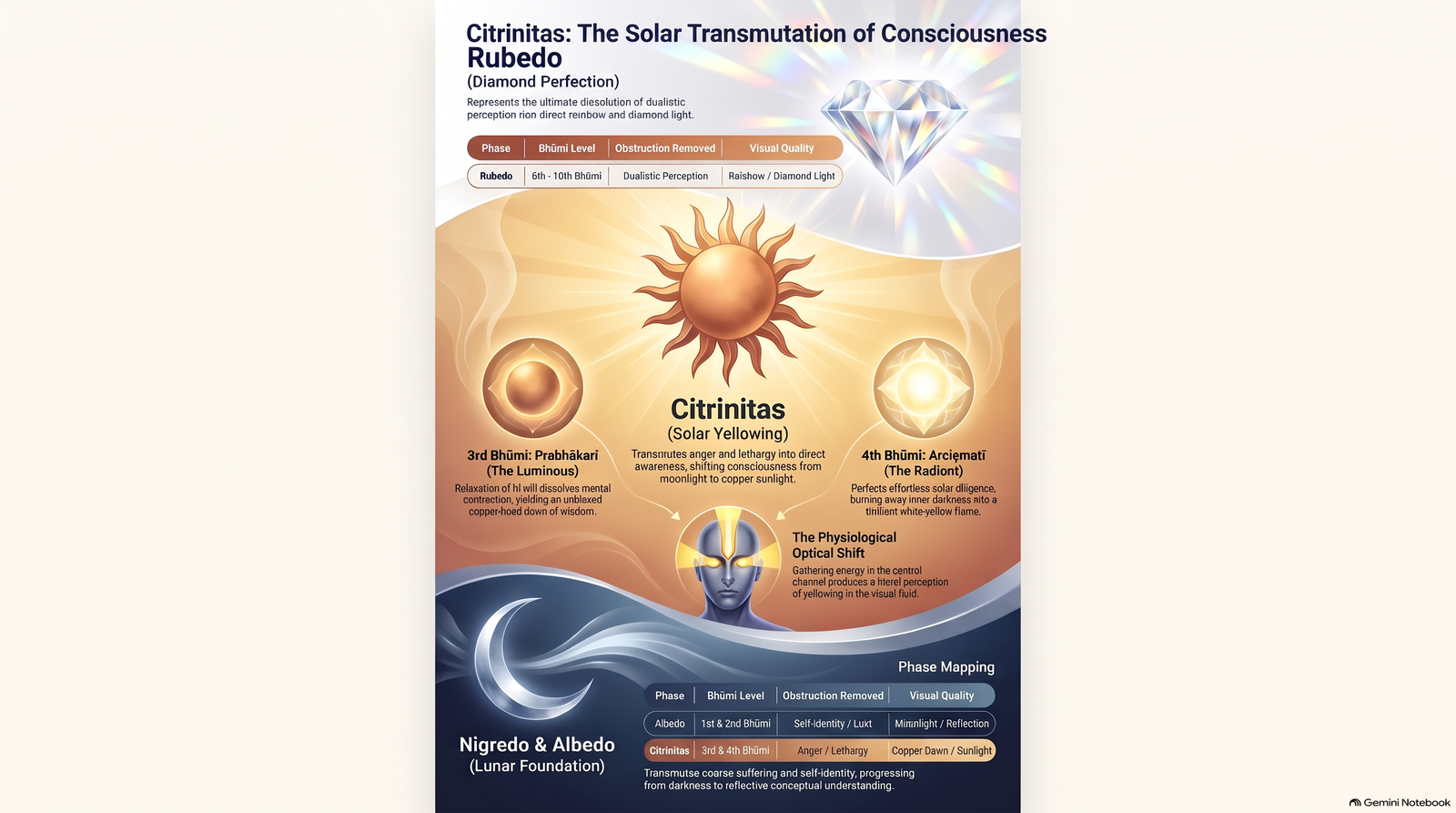
Read the infographic in words
The lower panel groups Nigredo and Albedo around a lunar image. The middle panel pairs Citrinitas with copper dawn, sunlight and the third and fourth grounds. The upper panel pairs Rubedo with rainbow and diamond imagery. The graphic places Rubedo at the sixth to tenth grounds, while Table 59 and the recording place it at the eighth to tenth. These correspondences belong to Robinson’s course. The arrows around the figure’s eyes picture the chapter’s proposed optical shift. The callout above explains the limits of that proposal.
Glossary
Citrinitas and the solar stance
Citrinitas means yellowing. Historical alchemical uses of yellow varied with the materials and the operation. In Robinson’s four-part course, Citrinitas follows Albedo. His “solar stance” names the movement from reflecting on experience to what he describes as direct or self-luminous awareness.
Bhūmi
The Sanskrit word means ground or level. In Mahāyāna Buddhism, the ten bodhisattva grounds describe the development of a person committed to awakening for the benefit of beings. The chapter selects two grounds for comparison with the alchemical yellowing. The pairing belongs to this course.
Prabhākarī and kṣānti
Prabhākarī is the third ground, translated as the Luminous or the Shining. The Ten Bhūmis foregrounds kṣānti, patience or forbearance, and uses a goldsmith simile. Candrakīrti brings in the copper-dawn image. Robinson uses both to consider how experience might change when ill will relaxes.
Arciṣmatī and vīrya
Arciṣmatī is the fourth ground, rendered as the Radiant or Brilliance. The associated perfection, vīrya, is energy, vigour or diligence in wholesome activity. The recording interprets it as sustained engagement with less internal friction, drawing on the sun and a musician’s fluency.
Vyāpāda
Vyāpāda means ill will or hostility and appears among Buddhist lists of hindrances. The discussion treats it as the urge to fix people in opposing camps and defend those judgements. Its account of the disappearance of hostility as the trigger of the copper glow is a separate interpretive claim.
Ālayavijñāna
In Indian Yogācāra thought, storehouse consciousness accounts for how dispositions left by actions can shape later experience. The hosts picture those dispositions as the contents of a flask. Distillation is the recording’s metaphor for transformation. The Yogācāra term belongs to a philosophical account of continuity and conditioning.
Dharmakāya
Commonly translated as Dharma body, dharmakāya is a Mahāyāna term associated with the dimension of buddhahood understood in relation to reality itself. In the recording’s distillation analogy, the rising vapour stands for wisdom. The flask gives the abstract comparison a physical image.
Winds and the central channel
In Tibetan Vajrayāna models, winds and channels are part of a traditional account of embodied contemplative experience. Different traditions give these models different names and structures. The book uses the central channel to explain its proposed optical shift. The comparison supplies no anatomical evidence about the eye or optic nerve.
Tögal
Tögal, often rendered as direct crossing or leap-over, is an advanced visionary practice in Tibetan Dzogchen. Traditional Dzogchen accounts place its appearances of light within a context of lineage transmission and qualified instruction. The video links them by analogy to the copper dawn and later rainbow imagery in Robinson’s map.
Wu wei
In Daoist philosophy, wu wei can mean action without forcing or contrivance. The hosts use it to evoke a kind of diligence that feels less like a battle of wills. Its presence in the dialogue is a comparison with the fourth ground’s emphasis on diligence.
Related pathways
- Citrinitas – Part Three situates the yellowing within the course.
- 2.1.7. The Moon supplies the earlier lunar imagery behind this chapter’s contrast.
- 3.1.2. Tögal and Rainbows develops the course’s discussion of Dzogchen and appearances of light.
- 3.2.8. The Perfections (Pāramīs) provides course context for the language of patience and diligence.
- 3.2.10. The Veil of Isis develops the image of a veil between appearance and what it is taken to reveal.
External reference points
- The Ten Bhūmis (84000 translation) gives the Mahāyāna account of the grounds, including the goldsmith simile and the third and fourth perfections.
- Candrakīrti, Entering the Middle Way, translated by Thupten Jinpa (PDF) gives the copper-dawn comparison at 3.1 and develops the fourth ground in the following chapter.
- Yogācāra, Stanford Encyclopedia of Philosophy explains what storehouse consciousness does in Indian Buddhist philosophy.
- Dilgo Khyentse Rinpoche, Vidyādharas’ Words of Truth (translated by Han Kop for Lotsawa House) places the four visions of luminosity within a Dzogchen aspiration text.
- Jennifer M. Rampling, Citrination and its Discontents traces different uses of yellowing in fifteenth- and sixteenth-century alchemy.
Question to carry forward
In a disagreement, what would a firm boundary sound like if you described the behaviour clearly and left room to revise your judgement of the person?