
Citrinitas · Mythos · Chapter 2 of 48
Tögal and Rainbows
What can an experience of inner light tell us about perception—and what does it leave unproved?
Catalogue reference: 3.1.2 · Revised Edition (2026)
Watch the chapter discussion
Tögal Explained | Seeing the Light of Reality in Dzogchen and Alchemy
The chapter in brief
The second chapter of Mythos follows the Philosopher’s Egg into a more difficult question: how should luminous experience be understood? Robinson introduces Tögal, an advanced Dzogchen teaching, through his alchemical language of light, containment and transformation. He describes a heart–eye channel, rainbow-like spheres, the four visions and a return to ordinary perception after extraordinary displays. His first-person account is central to the chapter, alongside comparisons with religious imagery and heroic myths. The chapter’s emphasis is on relinquishing fascination rather than collecting visions as spiritual possessions. Its description of an internal projector, however, is the author’s interpretive synthesis: neither testimony nor a traditional contemplative map establishes an optical mechanism that creates an external world. The chapter is best approached as material for study, with its experiential reports, doctrinal references and proposed explanations kept distinct.
Video guide: receiving a world, or projecting one?
The recording opens by reversing an everyday assumption: instead of receiving a scene through the eyes, might we be projecting it? The hosts use this provocation to move from Nigredo’s loosening of identity, through Albedo’s clarification, to the cracking of the Philosopher’s Egg. Their language then shifts emphatically from psychology to optics. A rainbow becomes an image of appearance dependent on conditions and a viewpoint. The central question is whether luminous experience reveals how a perceived world is assembled. This is an inquiry into the author’s model, not an experimental demonstration that overturns the reception of light by the retina.
Next, the hosts build the chapter’s projector analogy. The heart is the proposed source, storehouse consciousness the stained-glass filter of conditioning, and the Kati channel the connection to the eyes. Their computer hardware and HDMI comparisons make the proposal vivid, but do not validate its anatomy. A challenge about a solid desk prompts an important qualification: the discussion rejects the simple idea that objects vanish when someone stops looking. It shifts towards the structure of lived experience, although it continues to speak as if a literal outward projection had been established. Traditional subtle-body language, philosophical interpretation and physiological explanation need separating at this point.
The middle of the discussion describes retreat settings and luminous appearances, then introduces the Ganzfeld effect and Charles Bonnet syndrome as modern parallels. These comparisons are additions to the chapter’s inquiry, not evidence of a shared mechanism. Charles Bonnet syndrome concerns visual hallucinations associated with sight loss; it does not substantiate the claim that Tögal exposes reality’s pixels. The hosts then trace the four visions from initial appearances through expansion to dissolution. Their rendering-software and television-screen analogies convey a movement from fascination with the picture to questioning its apparent solidity.
The conclusion returns to ordinary sight, diminished attachment and the author’s report of prolonged light displays. Here the recording also makes unsupported claims about optic-nerve shutdown, inevitable completion and the diagnosis of psychosis. Neither fatigue nor visual intensity establishes the traditional fourth vision or liberation. The closing visual-reversal exercise is described in the recording but is not reproduced here. A more grounded challenge remains: can we acknowledge how expectation colours experience without claiming that our awareness manufactures the world, or dismissing the practical reality of other people?
The movement of the discussion
Invert the familiar picture
The opening question challenges passive reception and introduces the author’s projection hypothesis.
Move from identity to luminosity
The Egg links the preceding alchemical stages to a proposed encounter with inner light.
Construct the projector model
Heart, channel and conditioning are assembled into a traditional and symbolic explanation of appearance.
Test the claim against a solid world
The desk objection pushes the conversation towards experience rather than the disappearance of external objects.
Trace luminous appearances
Retreat descriptions and modern visual analogies lead into the expansion and dissolution of the four visions.
Return without collecting a new identity
The conclusion seeks ordinary life with less attachment, while leaving its biological and metaphysical explanations unproved.
Book, recording and interpretation
The chapter’s emphasis
A personal account of luminous appearances is framed through alchemy, subtle-body language and the traditional four visions.
The recording’s expansion
Computer displays, the Ganzfeld effect and Charles Bonnet syndrome provide new analogies; the optic-nerve explanation adds a claim the evidence does not establish.
The source traditions
Dzogchen visionary teachings and Yogācāra storehouse consciousness have different explanatory contexts. Their combination here is not a universal Buddhist anatomy.
The author’s synthesis
The alchemical sequence and mechanical projector language organise Robinson’s interpretation, rather than independently proving a mechanism or an attainment.
A visual map of the chapter
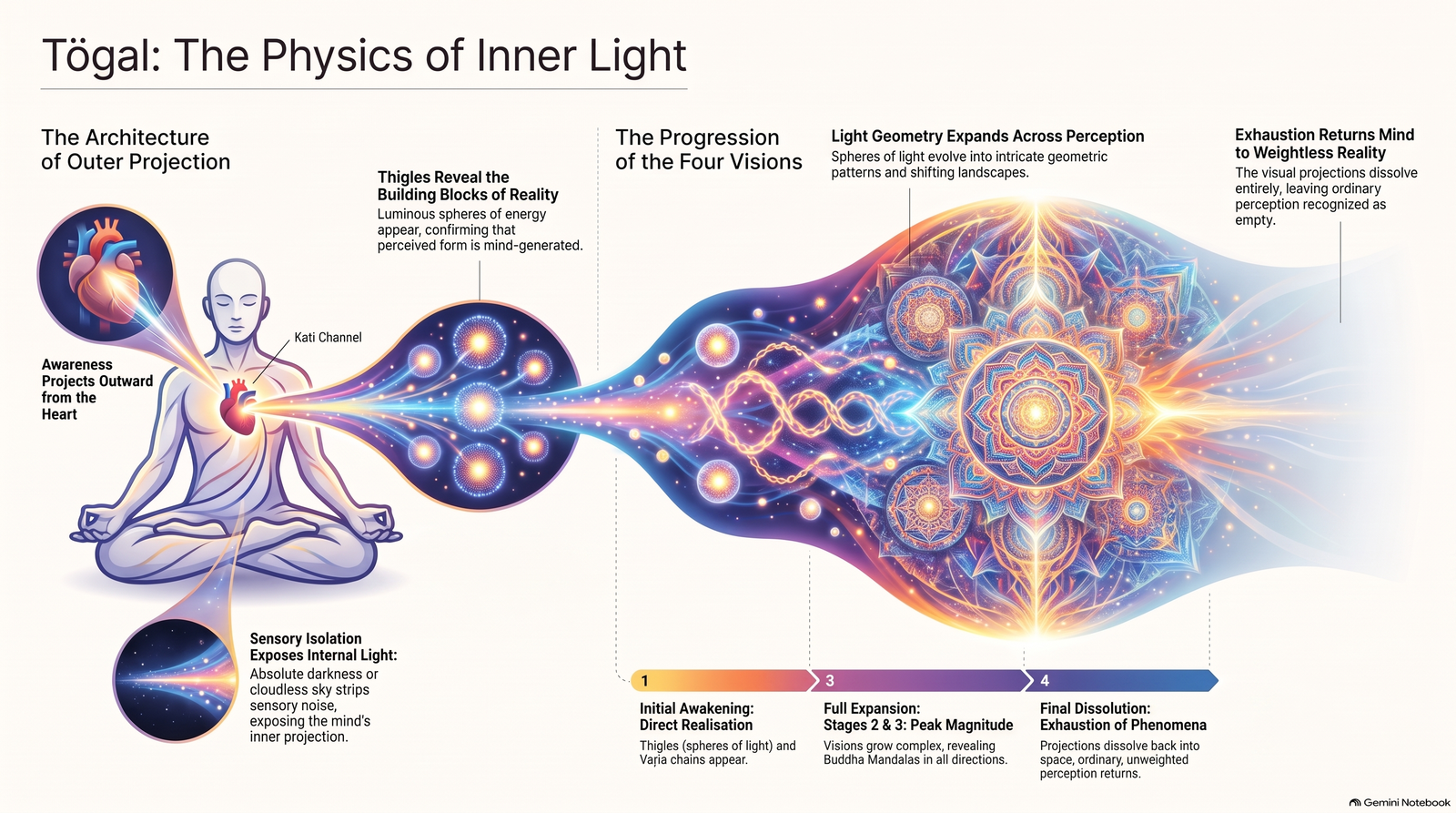
Explore the video
A glossary for this discussion
Tögal
An advanced Dzogchen teaching, often translated as “leaping over” or “direct crossing”. In Nyingma visionary traditions it is discussed in relation to spontaneous presence and the four visions. Robinson interprets it through alchemical light and perceptual transformation. This overview is neither a transmission nor a method for producing those experiences.
Trekchö and rigpa
In Dzogchen, Trekchö is commonly rendered “cutting through”, and rigpa refers to knowing or awareness in a specific liberative sense. Neither means simply relaxing or being conscious. These terms locate Tögal within a contemplative framework; the course’s earlier alchemical stages are not interchangeable with their lineage requirements.
Luminosity and clear light
Buddhist traditions use light language to discuss the clarity or knowing quality of mind, with meanings that vary by context. Dzogchen visionary teachings also describe luminous appearances. A report of seeing brightness does not establish that awareness is a physical light substance, or that a particular doctrinal realisation has occurred.
Dharmakāya
The “dharma body” or “truth body” is one aspect of buddhahood in Mahāyāna and Vajrayāna accounts of the three bodies. In Dzogchen explanations it is associated with the empty essence of awakened knowing. Robinson’s heart-projector imagery is an interpretive use, not a standard identification with the anatomical heart or a bulb.
Ālaya-vijñāna
Storehouse consciousness is a Yogācāra account of the continuity of conditioning and karmic tendencies, often explained through the image of seeds. The hosts use it as a filter that colours experience. It is not an eternal self or a physical hard drive, and it should not simply be equated with rigpa.
Kati channel
The chapter uses this name for a subtle heart–eye connection in its account of luminous appearance. Such channel language belongs to traditional contemplative physiology. The video’s cable analogy makes it easy to picture but does not identify a medically established structure or demonstrate the outward transmission of light from awareness.
Thigle and bindu
Thigle is a Tibetan term with uses including drops or spheres; bindu is a related Sanskrit term used in tantric contexts. Dzogchen visionary descriptions can speak of luminous circular appearances. Calling them “pixels of reality” is the book’s explanatory imagery, not a measurement of physical energy or an attainment test.
Winds, channels and drops
Prāṇa, nāḍī and bindu are Sanskrit terms used in traditional subtle-body accounts, with Tibetan traditions employing their own terminology and systems. They describe a contemplative physiology rather than validated anatomy. The chapter uses them to explain experienced appearance; they are not established equivalents of nerves, blood vessels or electrical signals.
The four visions
The recording follows the chapter’s sequence: direct realisation, increasing experience, awareness reaching full magnitude, and exhaustion of phenomena. Translations vary. Longchen Rabjam’s account places these within a Dzogchen path framework. They are not simply four escalating optical effects, and the final vision should not be reduced to boredom or physical exhaustion.
Vipassanā
Insight cultivation in Buddhist traditions concerns understanding experience, including impermanence, unsatisfactoriness and not-self. Methods and explanations vary. The recording contrasts it with Tögal as if it were chiefly intellectual analysis or thought management. That is too narrow: insight practice is experiential and should not be treated as an inferior software exercise.
Phenomenology and solipsism
Phenomenology examines how a world is experienced; solipsism questions or denies reality beyond one’s own mind. The hosts use the former to qualify their projection proposal. Recognising a role for expectation and conditioning in experience does not entail that objects or other people exist only because an individual perceives them.
Ganzfeld and Charles Bonnet syndrome
The recording uses both as comparisons with luminous experience. Ganzfeld concerns perception under relatively uniform sensory input; Charles Bonnet syndrome involves visual hallucinations associated with sight loss and is not itself a mental-health disorder. Neither comparison establishes that Tögal reveals reality’s architecture or supplies a diagnosis for an individual’s visions.
Related pathways
- 3.1.1. The Philosopher’s Egg
The preceding book chapter supplies the Egg image and its concern with subtle attachment. - 3.1.12. Trekchö
The same section’s later chapter provides another Dzogchen point of reference. - 3.2.4. An Introduction to the Subtle Body
This older public page introduces subtle-body models; it is not a confirmed one-to-one match for a revised chapter number. - 3.2.9. The Metaphor of the Film Projector
A neighbouring course inquiry develops the projector metaphor used throughout this recording. - 3.3.2. Solipsism
A philosophical neighbour helps distinguish experience shaped by mind from the denial of other minds. - Citrinitas – Part Three
Return to the wider organisation of Part Three and its four sections.
External reference points
- Longchen Rabjam, Analysis of the Profound
Adam Pearcey’s 2024 translation, based on the 1975 Sherab Gyaltsen Lama Tibetan edition, situates Trekchö, Tögal and the four visions within a Nyingma Dzogchen path account. A traditional textual reference, not independent scientific validation or practice instruction from this page. - National Eye Institute: How the Eyes Work
An accessible account of incoming light, retinal photoreceptors and signals travelling to the brain; it supplies the physiological distinction needed to assess the projector analogy. - NHS: Charles Bonnet syndrome
Explains visual hallucinations associated with sight loss and why they do not in themselves indicate a mental-health disorder. This limits the recording’s comparison; it does not diagnose contemplative experiences.
Question to carry forward
When expectation colours your understanding of another person, what helps you remain curious about their actual circumstances rather than treating your interpretation as the whole reality?