
Citrinitas · Subject · Chapter 48 of 48
The Pathless Path
The final chapter asks what happens when the effort that steadied attention begins to get in the way.
Revised Edition (2026) · Catalogue reference 3.4.12
Watch the chapter video
Why Awakening Cannot Be Forced | The Pathless Path Explained
The chapter in brief
The closing chapter of Subject revisits the role of discipline across the course. Dr Simon Robinson describes the work as a spiral, returning to familiar habits and experiences with a changed understanding. He gives the chapter three movements. Jhāna represents the steadiness of absorption. Emancipation turns attention to habits that sustain grasping and to the welfare of others. The Great Seal, or Mahāmudrā, gives him a language for recognising experience without trying to manufacture a special state. Table 60 reads the four yogas of Mahāmudrā through the changing role of effort. This sequence is Robinson’s alchemical reading across several traditions. The book closes the yellowing with a question that carries into Rubedo, the reddening. How might what becomes clear in contemplation take shape in the body, in relationships and in ordinary work?
Video guide
Central question. When does a method that helps us attend become another way of trying to control experience? The hosts open with the familiar frustration of trying to force sleep. They pair the example with the chapter’s account of Nigredo and imagine a scaffold built high enough to see the sky. The scaffold makes a view possible. The sky was there already. In the first movement, music and a child absorbed in play illustrate how self-commentary can quieten. These are comparisons with formal jhāna, which has specific descriptions in early Buddhist texts. The hosts then picture muddy water settling and discuss a pastel glow reported at the edge of sleep. Their identification of that glow with bhavaṅga is an interpretation of experience. The distinction that drives the discussion is between a welcome state of calm and an enduring change in how we respond when calm breaks.
The alchemical vessel now goes from stabilising to heating. The hosts single out ill will and conceit among the fetters, using resentment over a promotion to make the discussion concrete. The focus then widens from personal relief to service. When one host questions the danger of casting oneself as a saviour, the other imagines one hand helping the other without a claim to rank. Robinson’s use of Poimandres gives this change of purpose a Hermetic image. His pairing with the Mahāyāna ideal of awakening for the benefit of beings is part of the course’s synthesis. The recording’s suggestion that all beings share a single luminous substrate goes beyond what the analogy can establish.
The third movement invokes the Third Turning and the seven topics of the Uttaratantra Śāstra before bringing in Mahāmudrā. Their proposed restriction of the Third Turning to people who have reached the Path of Seeing is the chapter’s framing. The hosts imagine turning away from a film to see the beam that makes every scene visible. They use the projector to picture storehouse consciousness, a concept from Indian Yogācāra, and bring it into their account of recognising the nature of experience. Their identification of this image with the Theravāda life-continuum and a shared source of all experience crosses distinct teachings. The black paint image then returns the discussion to effort. Scrubbing a window with paint only obscures the view. A passing shower that becomes a chain of grievances illustrates papañca, the proliferation of thought.
Table 60 carries that question through one-pointedness, simplicity, one taste and non-meditation. The hosts use the raft left on the shore to describe a method that has served its purpose. They then turn towards Rubedo and ask how contemplative clarity might enter ordinary life. The closing return to the sleep example gives the listener a practical distinction to consider. What calls for sustained care, and where has the demand for a result become a source of friction?
How the argument unfolds
When effort gets in the way
Trying to force sleep introduces the paradox, and the scaffold shows how discipline can still serve a purpose.
The limits of absorption
The image of settled water frames the difference between temporary calm and a change that carries beyond it.
Who benefits from freedom?
The discussion moves from fetters and self-concern to the Poimandres image of service, with a detour through the risk of saviourhood.
Seeing the projector beam
The hosts use the cinema to explain what they mean by recognising the Great Seal across both calm and agitation.
Black paint on the window
The window and rain examples show how trying to suppress or control experience can add further thinking.
The changing role of effort
The hosts read the four yogas through Table 60 and use the raft to explain why attachment to a method can outlast its purpose.
Back into ordinary life
Rubedo introduces the question of embodiment before the hosts return to the listener’s own habits of striving.
Book, recording and companion graphic
The book’s emphasis
The chapter gives the three movements their alchemical frame and uses Table 60 to compare the changing role of effort across the four yogas.
What the recording adds
The hosts develop the argument through the sleep example and the cinema analogy, and ask whether the idea of becoming a guide can feed the very self-concern it is meant to loosen.
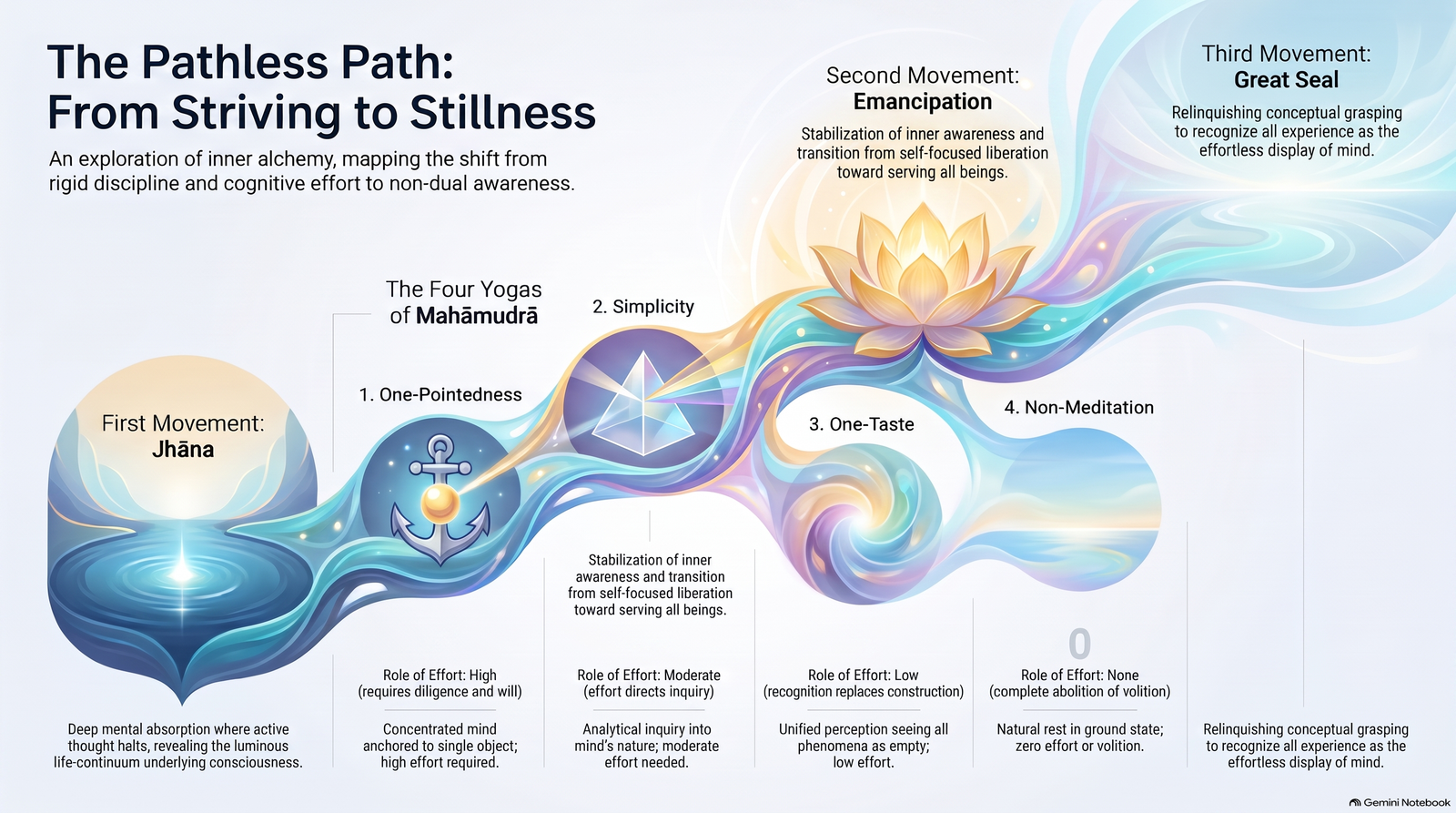
Read the infographic in words
A luminous pool represents absorption. A lotus marks the turn towards service, and the current opens out under the Great Seal. The anchor, prism, swirl and open horizon mark one-pointedness, simplicity, one taste and non-meditation. Table 60 describes the effort across these as high, moderate, low and none. That scale describes the course’s reading of contemplative effort. The current brings both schemes into one picture. The four yogas belong to the Great Seal discussion, and the three movements organise the chapter as a whole.
Glossary
Jhāna
In the Pāli discourses, the four jhānas are distinct states of meditative collectedness. They have different qualities, and the first can include directed thought and evaluation. The chapter compares absorption in music or play with moments of reduced self-commentary. Such experiences alone do not establish a formal jhāna.
Bhavaṅga
The Pāli term is commonly rendered “life-continuum”. In Theravāda Abhidhamma and its commentarial tradition it describes a function of moments of consciousness between active cognitive processes. The book’s identification of this function with visible pastel radiance or a universal luminous substance is Robinson’s interpretation.
Saṃyojana and saṃsāra
In the familiar Pāli list, the ten saṃyojanas are fetters that bind beings to saṃsāra, the Buddhist cycle of conditioned existence and rebirth. They include ill will, conceit and ignorance. The discussion uses career comparison to make the grip of one such habit recognisable in everyday life.
Mahāyāna and the bodhisattva
Mahāyāna names diverse Buddhist traditions that give central place to the bodhisattva’s commitment to awakening for the benefit of beings. The book uses the historical polemical label Hīnayāna to stage a change of motivation. The label is an unsuitable synonym for present-day Theravāda, with its own teachings on compassion and generosity.
Poimandres
Poimandres is the revelatory figure encountered in the first treatise of the Corpus Hermeticum. Robinson draws on the traditional shepherd rendering to picture a widening of concern. The analogy between this Hermetic figure and the bodhisattva expresses the author’s synthesis, without establishing a shared doctrine or conferring authority to guide others.
Third Turning and the Uttaratantra Śāstra
The Third Turning is a Mahāyāna way of classifying teachings, interpreted differently across Buddhist schools. The Uttaratantra Śāstra, also called the Ratnagotravibhāga, is an Indian treatise on Buddha-nature. Its seven vajra points are organising topics, encompassing the Buddha, teaching, community, element, awakening, qualities and activity.
Ālayavijñāna
In Indian Yogācāra, “storehouse consciousness” accounts for continuity and how dispositions left by past activity can condition later experience. The projector is the hosts’ analogy. Yogācāra’s account has a distinct history from the Theravāda use of bhavaṅga, and the image supplies no evidence that the world is projected by an individual mind.
Papañca
A Pāli term commonly translated as conceptual proliferation, papañca points to elaboration that can multiply judgements and entanglements. In the recording a shower leads to thoughts about ruined shoes and then to a remembered insult. The example describes a sequence in experience, with no measurement of what happens to neural pathways.
Mahāmudrā and the four yogas
Mahāmudrā means “Great Seal” and has a range of meanings in Indian and Tibetan Buddhism. In Tibetan Kagyü presentations, one-pointedness, simplicity or non-elaboration, one taste and non-meditation describe deepening recognition. The book’s gloss of mudrā as personal subjective experience and its graded effort scale are readings within Robinson’s course.
One taste and non-meditation
In the four-yoga framework, “one taste” refers to recognising the same empty nature across different experiences. Pleasure and pain retain distinct consequences in ordinary life. “Non-meditation” describes recognition that no longer depends on contrived meditation in this tradition. The terms concern contemplative understanding and do not remove the need for ethical judgement.
Related pathways
- Citrinitas – Part Three places the yellowing within the four-part course.
- 3.2.5. Papañca develops the account of a perception elaborating into a story.
- 3.2.9. The Metaphor of the Film Projector gives the cinema image a fuller treatment.
- 3.3.1. Poimandres, Shepherd of Man provides the course’s extended reading of the Hermetic figure.
- When Spiritual Effort Finally Collapses revisits the limits of effort in the Dialogues.
External reference points
- Mahā Assapura Sutta (MN 39), translated by Ṭhānissaro Bhikkhu describes the four jhānas within the wider Pāli training.
- Rupert Gethin, Bhavaṅga and Rebirth According to the Abhidhamma (PDF) examines the term in Theravāda accounts of consciousness.
- Corpus Hermeticum I, in Brian P. Copenhaver’s Hermetica identifies the historical text behind the Poimandres comparison.
- Yogācāra, Stanford Encyclopedia of Philosophy situates storehouse consciousness within Indian Mahāyāna philosophy.
- The Four Yogas of Mahāmudrā, from Dharmakīrti’s oral instructions, translated by Ina Bieler (PDF) presents a lineage account of the four yogas and their subdivisions.
Question to carry forward
In a conversation you care about, what would it look like to take responsibility for your part while leaving the other person free to respond in their own way?