
Citrinitas · Dharma · Section overview · Chapters 13–24 of 48
Dharma: Why the Mind Won’t Let You Rest
When the obvious disturbances subside, why does the mind still need to compare, explain, anticipate and become someone?
Watch the Dharma overview
Why Your Mind Won’t Let You Rest | Citrinitas: Dharma
Open the overview on YouTube · 46:06
The twelve chapters in brief
The Dharma section of Citrinitas asks what remains when obvious habits of craving and aversion are no longer the main problem. Chapters 13–24 of the 2026 revised edition progress from the five higher fetters and the six knots of perception into the tantric vocabulary of winds, channels, drops and chakras. They then investigate papañca, obstructions to understanding, the perfections, the metaphor of projection, and ways of describing compassion and the Buddhist path. These are related but not identical traditions or methods. Dr Simon Robinson draws them into a modern alchemical account of identity and liberation, treating the movement from self-concern to engaged compassion as a central tension. His comparisons are an interpretive synthesis, not a single doctrine shared by Theravāda, Mahāyāna and Vajrayāna, nor a scientific description of mind or physiology.
Video guide: from restlessness to responsibility
The conversation begins with an ordinary scene: the house is finally quiet, work is done, yet the mind cannot stop reaching for another task. Its opening question is not how to become better at relaxation, but why the sense of being someone seems to depend on ongoing mental activity. The hosts turn to the five higher fetters in the Theravāda framework. They pay particular attention to māna, the reflex of comparison that can persist even when the comparison makes us feel inferior. The video connects this measuring impulse with uddhacca, restlessness, and with the deeper problem of ignorance. Its portrayal of form and formless craving as wanting to exist or disappear is the author’s interpretive framing, rather than a literal translation of the canonical terms.
The next movement enters the six knots of the Śūraṅgama Sūtra. The metaphor of one cloth tied into six knots permits a question about how distinct sensory and mental experiences are organised. A kitchen example brings perception, appetite and judgement into one scene. The metaphor is a teaching about awareness in a particular Buddhist textual setting; it does not establish that all senses have identical neural functions, nor is the Yogācāra account of eight consciousnesses simply interchangeable with the six knots.
At its midpoint, the discussion moves from mental stories to the Vajrayāna subtle body: mind as rider, wind as horse. The five root winds, three channels, chakras, seed syllables and sacred geography are presented through striking hardware and engineering analogies. The hosts go further, suggesting that traditional channels describe actual neural pathways, and comparing paternal and maternal drops with cellular components. Those claims are not demonstrated by the traditions or by modern biology. The historical tantric frameworks are complex and vary by lineage; the material is best read here as an account of contemplative symbolism and inherited esoteric physiology, not practical instruction in manipulating winds or inner heat.
The conversation then returns to ordinary cognition through papañca, mental proliferation. An unanswered text message becomes its vivid example: sparse information is amplified into a distressing story about rejection. Drawing on the Madhupiṇḍika Sutta, the hosts trace contact, feeling, perception, thought and proliferation, but add stronger claims about suppressed muscular energy and cerebral hemispheres that should not be mistaken for established neuroscience. Finally, the dialogue contrasts cessation with the bodhisattva’s orientation towards others. Its sharp opposition between the arahant as a private escape and the bodhisattva as compassionate return is an alchemical interpretation, not a fair universal judgement on either Buddhist ideal. The most useful concluding challenge is ethical: what changes when insight ceases to be another possession of the self?
The argument in seven movements
Quiet reveals the remaining motion
The opening image of a peaceful room exposes a mind still leaning towards its next occupation.
Comparison sustains a subtle self
The higher fetters, especially conceit and restlessness, recast identity as a continuing act of measurement.
Six knots on one cloth
The sensory metaphor asks how apparently competing facets of experience are differentiated.
Mind rides upon wind
The discussion shifts into tantric contemplative physiology and the relationship of mind, body and energy.
Channels become a sacred landscape
Side channels, a central channel, drops, chakras and mantra are introduced as elements of particular esoteric maps.
A message becomes a world
Papañca shows how an ambiguous signal can become an elaborate story about oneself.
Liberation returns to relationship
The closing discussion asks whether freedom culminates in disengagement or responsible compassion.
Visual guide: deconstructing the self
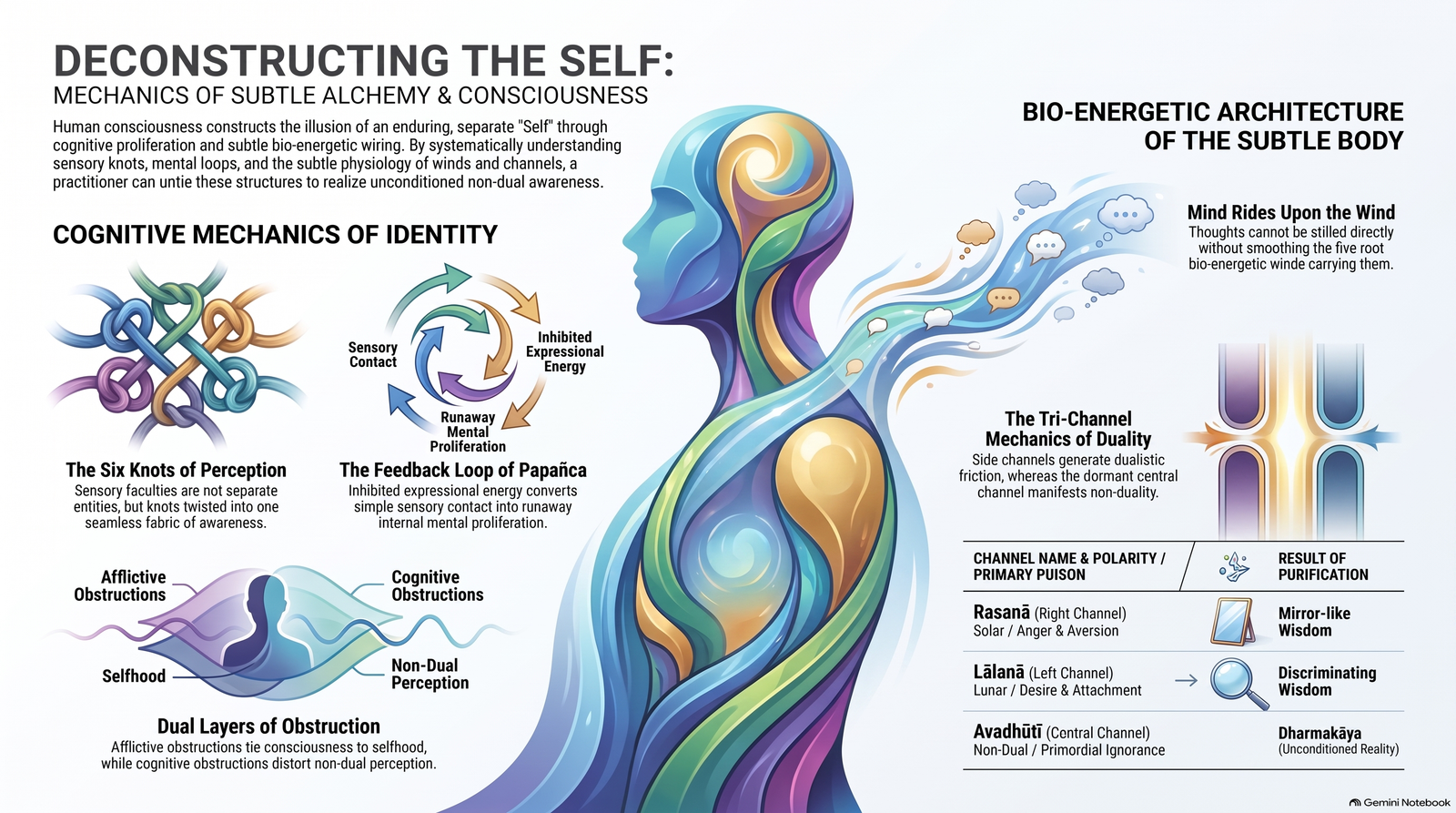
Jump to a moment in the video
Chapter times supplied with the final edited 46:06 recording.
Glossary
Anāgāmī
In the early Buddhist four-stage liberation model, a non-returner who has abandoned the five lower fetters. The video correspondence with the alchemical whitening stage is the author’s comparison, not a canonical identification.
Five higher fetters
In Theravāda lists: attachment to form existence, attachment to formless existence, conceit, restlessness and ignorance. The first two concern refined forms of becoming, rather than simply wanting a worldly identity or wishing to vanish.
Māna
Pāli for conceit or self-comparison. The classic formulation includes imagining oneself superior, equal or inferior to others; thus the term is broader than arrogance.
Uddhacca
Restlessness or agitation of mind in Pāli Buddhist analysis. This technical mental factor should not be equated with an objectively measured energy vibration.
Avijjā
Ignorance or unknowing in early Buddhism, particularly failure to understand the Four Noble Truths and conditioned experience. It does not merely mean insufficient information.
Six knots
The cloth-and-knots teaching in the Śūraṅgama Sūtra, used to explore differentiation and release. This text belongs to an East Asian Mahāyāna scriptural environment, not the Pāli canon.
Eight consciousnesses
A Yogācāra-related framework distinguishing five sensory consciousnesses, mental consciousness, afflicted mentation and storehouse consciousness. Interpretations of the eighth vary; calling it the physical substrate of reality is misleading.
Vajra body
An esoteric Tibetan Buddhist presentation of embodied contemplative processes. Its winds, channels and drops belong to tantric theory and practice, not to a single established anatomical map.
Prāṇa / rlung
Sanskrit and Tibetan terms for vital wind or current in traditional contemplative physiology. Five principal winds are sometimes distinguished. These are not identical to oxygen, electrical currents or measured nerves.
Nāḍī and avadhūtī
Traditional subtle channels and, in some systems, the central channel. Side-channel names and correspondences vary among tantric systems. Their depiction is contemplative and symbolic, not a verified map of the spinal cord.
Bindu and chakra
Drops or vital essences, and channel centres or wheels, in tantric systems. Different lineages place and describe them differently; they are not interchangeable with cells, glands or anatomical structures.
Papañca
Conceptual or mental proliferation in early Buddhist discussion, particularly the Madhupiṇḍika Sutta. It describes elaborative processes through which interpretation expands into contentious stories, not a scientifically established feedback circuit.
Afflictive and cognitive obscurations
Commonly differentiated in Mahāyāna systems: obstacles linked to affliction, and subtler obscurations to comprehensive knowing. Their meaning and relation to arahantship vary by doctrinal school.
Bodhicitta
In Mahāyāna Buddhism, the resolve to awaken for the benefit of sentient beings. It is not proof that Theravāda liberation excludes kindness or concern for others.
Explore the twelve Dharma chapters
The sequence below follows the 2026 revised book. Links retain the existing published website titles and numbering, which do not correspond exactly in every case. In particular, the older website places the subtle fetters, subtle-body introduction and closing chapters differently. These links are existing archive pages, not an approved remapping of their contents to the revised edition.
Dismantling the Subtle Fetters
The five higher fetters and the refined persistence of self-reference.
The Six Knots
The Śūraṅgama Sūtra’s cloth-and-knots analogy for perceptual differentiation.
The Winds and Channels
Traditional Tibetan accounts of the five winds and mind–body relationships.
The Bindus and Chakras
Drops, channels, chakras and mantra within traditional tantric maps.
Papañca
How contact and interpretation turn into proliferating stories.
Afflictive and Cognitive Obstructions
Distinguishing emotional afflictions from subtler obstacles to knowing.
The Treasury of Precious Jewels
Meditative traps, fixation, and the discrimination needed when investigating awareness.
The Perfections
The cultivation of qualities associated with the bodhisattva ideal.
The Metaphor of the Film Projector
A cinematic analogy for the construction of apparently solid experience.
The Veil of Isis
The veil as a symbol for how cognition frames appearances.
Returning to Saṃsāra
The question of returning to ordinary life with compassion.
Five Paths
A Mahāyāna-oriented five-path framework, distinct from the ten-fetter map.
Published Dharma chapter archive
- 3.2.1. The Threshold of Non-Return
- 3.2.2. The Six Knots
- 3.2.3. The Subtle Fetters
- 3.2.4. An Introduction to the Subtle Body
- 3.2.5. Papañca
- 3.2.6. Afflictive and Cognitive Obstructions
- 3.2.7. The Treasury of Precious Jewels
- 3.2.8. The Perfections (Pāramīs)
- 3.2.9. The Metaphor of the Film Projector
- 3.2.10. The Veil of Isis
- 3.2.11. The Wheel of Sharp Weapons
- 3.2.12. Returning to Saṃsāra
External reference points
- Aṅguttara Nikāya 10.13: Fetters — an accessible translation of the standard lower and higher fetter lists.
- Majjhima Nikāya 18, Madhupiṇḍika Sutta — early Buddhist context for perception and conceptual proliferation.
- 84000: Equal to the Sky — a translated Tibetan tantric text whose introduction discusses winds, channels, drops and internal sacred geography.
These are supporting references for distinctions on this page; their inclusion does not imply that the recording quotes these particular editions.
Question to carry forward
When the mind starts measuring its own progress, can the same question be turned outward: does this understanding make ordinary speech, disagreement and care for other people more honest and responsible?