
The Winds and Channels
When an emotion takes hold of the body, how far can thought alone explain what we experience?
This discussion accompanies Chapter 15 in the 2026 revised book. The existing website page retains its earlier title and catalogue position, 3.2.4. An Introduction to the Subtle Body.
Watch the chapter discussion
What Carries the Mind? Winds, Channels & Consciousness
Open the 41:27 video on YouTube
This AI-generated, two-host discussion interprets the chapter; it is not a verbatim reading, clinical explanation or authoritative presentation of a particular tantric lineage.
The chapter in brief
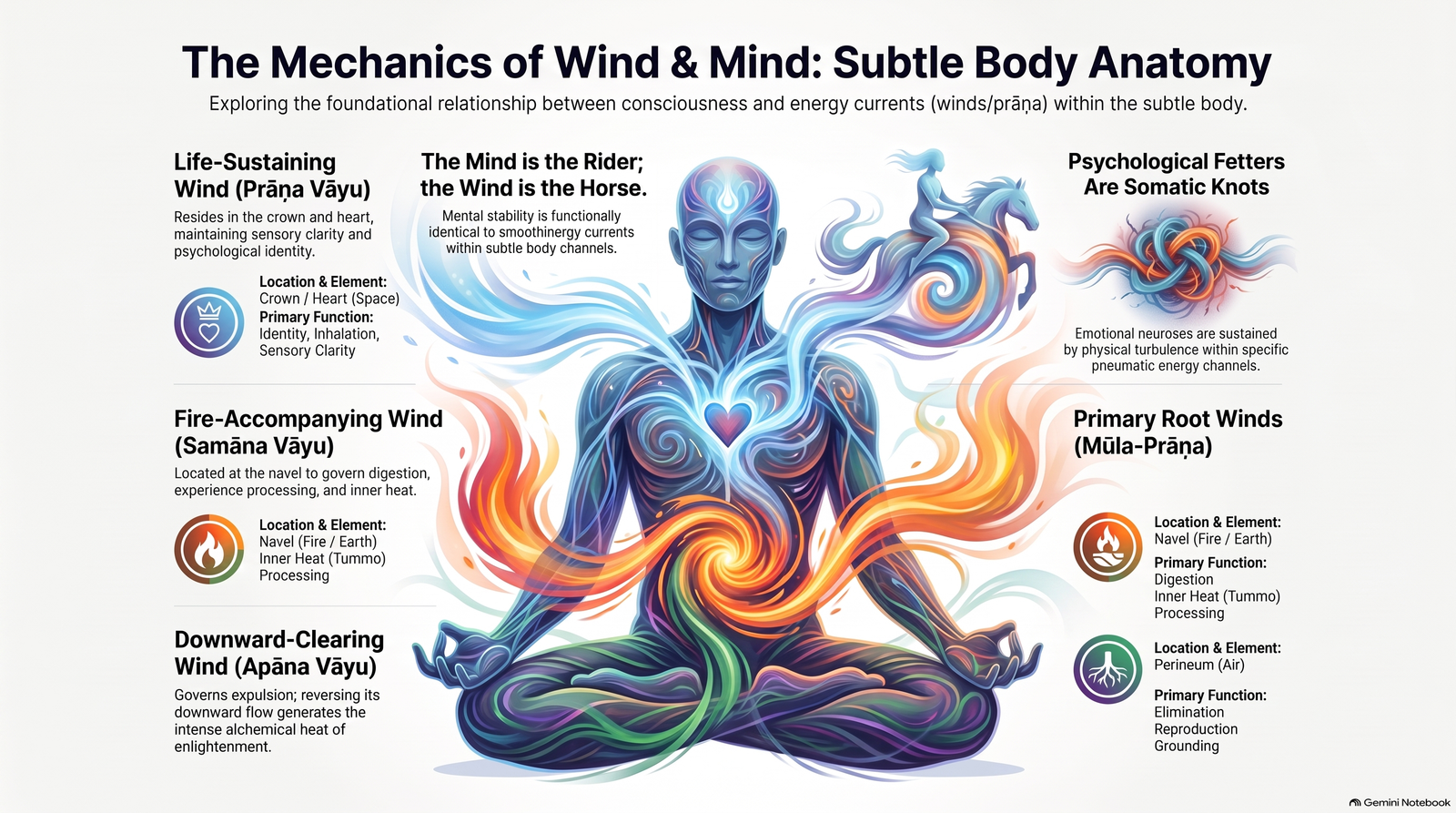
Chapter 15 moves the Dharma section from the discussion of fetters and the six senses towards the traditional subtle-body model of Vajrayāna. Dr Robinson proposes that the apparent stability of the mind depends not only upon concepts and beliefs, but upon patterns of embodied feeling. His guiding image is simple: mind is the rider and wind the horse. A vocabulary of winds (prāṇa), channels (nāḍī) and subtle centres then becomes a way of thinking about identity, speech, movement, digestion and release.
The chapter describes five root winds, five branch winds and their symbolic associations, while drawing an alchemical parallel between inner change and transformation. Its engineering language should be read as the author’s explanatory synthesis of tantric imagery, not as established physiology or evidence that mental illness originates in invisible anatomical knots. The closing concern is the lived feeling of a division between observer and world.
The video guide
The recording begins with a deliberately provocative example: an anxious person cannot always reason away the frightening sensations of panic. The speakers contrast the experience of a racing heart and bodily alarm with an overly narrow picture of cognition as software to be debugged. They then introduce the rider-and-horse metaphor: thought is the rider, subtle wind the horse. This prompts a useful question about embodiment, although the discussion overstates its case when it implies that talking treatments such as cognitive behavioural therapy are intrinsically incapable of addressing panic. Psychological and bodily approaches are not mutually exclusive.
The inquiry then turns to a tantric account of the vajra body. Seventy-two thousand channels provide the image of a vast internal network, and repeated reactions are likened to currents wearing grooves into a riverbed. The discussion connects this to the strong claim that emotional patterns become knots in channels. Such language may be phenomenologically suggestive, but the supposed knots are neither independently demonstrated physical structures nor diagnostic explanations for trauma, anxiety, dissociation or psychosis. Its first detailed example, the life-sustaining wind, links the continuity of identity to a downward-moving current. The upward-moving wind follows, becoming a picture of speech, assertion and the conversion of grasping into aspiration.
The middle of the discussion examines three more root winds. Pervasive wind is compared with physical coordination and the turbulence of restlessness; fire-accompanying wind connects digestion with the metaphorical processing of experience; downward-clearing wind evokes elimination, relinquishment and fear of loss. The hosts are unusually vivid here, comparing depression with undigested experience and jealousy with a cold inner furnace. These are the recording’s interpretive analogies, not reliable causal accounts of complex mental health conditions. The subsequent depiction of inner heat and reversing downward flow includes forceful descriptions of advanced tantric methods. They are not appropriate instructions for independent experimentation, and the page intentionally does not restate those techniques.
In the final movement, five branch winds are associated with sensory activity, leading to a discussion of pratyāhāra, the withdrawal of the senses, and the language of inner light. The hosts then return to their governing thesis: changing the conditions of bodily experience can change how thoughts are encountered. The conclusion presses further, suggesting that the subject–object distinction is created by movements in left and right subtle channels. That final claim is a speculative tantric-alchemical interpretation rather than a neurological explanation of perception. The enduring value of the episode is its invitation to question simplistic separations of mind and body without replacing one certainty with another.
How the argument unfolds
Thoughts and bodily alarm
A panic-attack scenario introduces the inadequacy of treating distress as thought alone, before advancing the rider-and-horse image.
A different map of embodiment
The conversation introduces the vajra body, its 72,000 channels and the claim that mental habits have a subtle somatic pattern.
Identity and expression
Life-sustaining and upward-moving winds become images for the felt continuity of self and the outward expression of intention.
Movement and emotional processing
The pervasive and fire-accompanying winds organise analogies of restlessness, coordination and digesting experience.
Release and reversal
The downward-clearing wind leads to images of relinquishment and advanced inner-heat practice, where description must not become instruction.
The sensory branches
Five secondary winds introduce sensory input and the contested interpretation of withdrawal as a gateway to inner light.
A divided world
The conclusion shifts from emotional weather to a speculative account of subject and object in the lateral channels, ending with a question rather than proof.
Book and video: two emphases
In the revised chapter
A compact taxonomy of root and branch winds, with Tibetan and Sanskrit terms, functional correlations and a study guide.
In the recorded discussion
An extended sequence of examples involving panic, speech, envy, emotional processing and the psychological feeling of being a separate self.
In the author’s synthesis
Tantric descriptions are interpreted alongside Western alchemical separation, transformation and the metaphor of an internal machine; these parallels are not shared doctrines proven to be identical.
Visual guide: wind and mind
Video chapters
These are the supplied timed chapter estimates, not independently frame-checked final edit points.
- Why You Cannot Think Your Way Out of Anxiety
- The Vajra Body: 72,000 Channels and Subtle Energy
- Understanding the Five Root Winds
- Prāṇa: The Life-Sustaining Wind and the Sense of Self
- Udāna: The Upward-Moving Wind, Speech and Desire
- Vyāna: The Pervasive Wind, Restlessness and Integration
- Samāna: The Inner Furnace and Digesting Experience
- Apāna: The Downward-Clearing Wind and Letting Go
- The Five Branch Winds and Sensory Perception
- Pratyāhāra: Withdrawing the Senses and Inner Light
- Changing the Mind by Changing the Wind
- The Left and Right Channels: How Duality Arises
Glossary of terms
Vajra body
A subtle-body model found in some Vajrayāna tantric traditions. It organises experience through channels, winds and centres. It is contemplative physiology, not an alternative description of organs that can be identified through dissection.
Prāṇa / rlung
Prāṇa is Sanskrit for breath or vital energy; Tibetan rlung means wind. Tantric systems use these terms for subtle movements associated with mind and body. They should not be equated with measurable gases or an established physical energy field.
Nāḍī / rtsa
Nāḍī (Sanskrit) and rtsa (Tibetan) refer to subtle channels in yoga and tantra. Descriptions vary by text and lineage, including the frequently cited figure of 72,000. They are not verified anatomical structures.
Five root winds
A traditional functional grouping: life-sustaining (prāṇa), upward-moving (udāna), pervasive (vyāna), fire-accompanying (samāna) and downward-clearing (apāna). Locations, colours, element associations and mappings differ among systems.
Prāṇa vāyu
The life-sustaining wind, linked in the chapter and video with breath, sensory clarity and continuity of identity. This is an interpretive contemplative association, not a proven explanation of dissociation, vertigo or psychosis.
Udāna vāyu
The upward-moving wind is associated with expression, speech and effort. The recording extends this into a metaphor of directed desire and spiritual aspiration; it does not establish an energetic cause of communication difficulties.
Vyāna vāyu
The pervasive wind is represented as distributing activity throughout the body. The recording compares its turbulence with restlessness and panic, a symbolic comparison rather than a clinical mechanism for anxiety.
Samāna vāyu
The fire-accompanying wind is associated with digestion and bodily warmth. Here, digestion also becomes a metaphor for making sense of experience; depression and trauma are not simply failures of an inner furnace.
Apāna vāyu
The downward-clearing wind is traditionally associated with elimination and release. The account moves from bodily processes towards relinquishment and highly specialised tantric imagery; that does not justify attempting to reverse bodily processes.
Five branch winds
A secondary classification associated with sensory and bodily functions. The chapter names nāga, kūrma, kṛkara, devadatta and dhanañjaya. Their proposed functions belong to textual models, not validated neurophysiology.
Pratyāhāra
In classical yoga, withdrawal or restraint of the senses. The video interprets this through subtle-body imagery and inner luminosity. This is not an instruction to deprive oneself of sensory input or pursue extreme visual effects.
Central and side channels
Some tantric visualisations distinguish a central channel from left and right channels. The video uses them to picture the subject–object division. This symbolic arrangement is not evidence that lateral bodily currents physically produce duality.
Tummo / gtum mo
Inner-heat practices in Tibetan tantric contexts. They involve advanced methods traditionally studied with qualified lineage instruction. This page explains references in the recording but intentionally gives no breath-retention, muscular-lock or heat-generation protocol.
Dhyāni Buddhas
A conventional label for the five wisdom Buddha families in some Vajrayāna systems. Correspondences between winds, elements, disturbing emotions and Buddha families vary, so the video’s particular pairings should not be taken as universal doctrine.
Explore related pages
- 3.2.2. The Six KnotsEarlier Dharma chapter: perception, the senses and the knot metaphor.
- 3.2.3. The Subtle FettersSeparate older page on enduring attachments; not the chapter-15 destination.
- 3.2.5. PapañcaHow conceptual proliferation reinforces the stories attached to experience.
- Dharma — Part Two of CitrinitasThe established section index for related lessons.
- Citrinitas – Part ThreeReturn to the wider course catalogue.
- The Subtle BodyA separate thematic essay for further reading.
External reference points
- NHS: Panic disorderClinical distinction: panic symptoms, evidence-based assessment and treatment.
- NHS: Anxiety, fear and panicContemporary, evidence-based context for bodily anxiety and seeking appropriate support.
- Study Buddhism: Six Yogas of Naropa and the subtle bodyA lineage-specific presentation of root and branch winds, 72,000 channels and central and side channels.
- Study Buddhism: Energy-wind terminologyExplains rlung and prāṇa within the tantric conceptual vocabulary.
Question to carry forward
When someone describes distress in bodily images such as heat, pressure or turbulence, what might those images communicate well, and what would be lost if we mistook them for a diagnosis or a proven hidden mechanism?