
Citrinitas · Mythos · Chapter 10 of 48
Revised Edition (2026) · Catalogue 3.1.10
The Three Bodies
If awakening is not the possession of a separate self, how can it still speak, teach and act compassionately?
Watch the chapter discussion
The Three Bodies of the Buddha Explained | Trikāya, Awakening & Compassion
A two-host, AI-generated discussion interpreting the chapter; its analogies and textual attributions warrant critical reading. Open this video on YouTube.
The chapter in brief
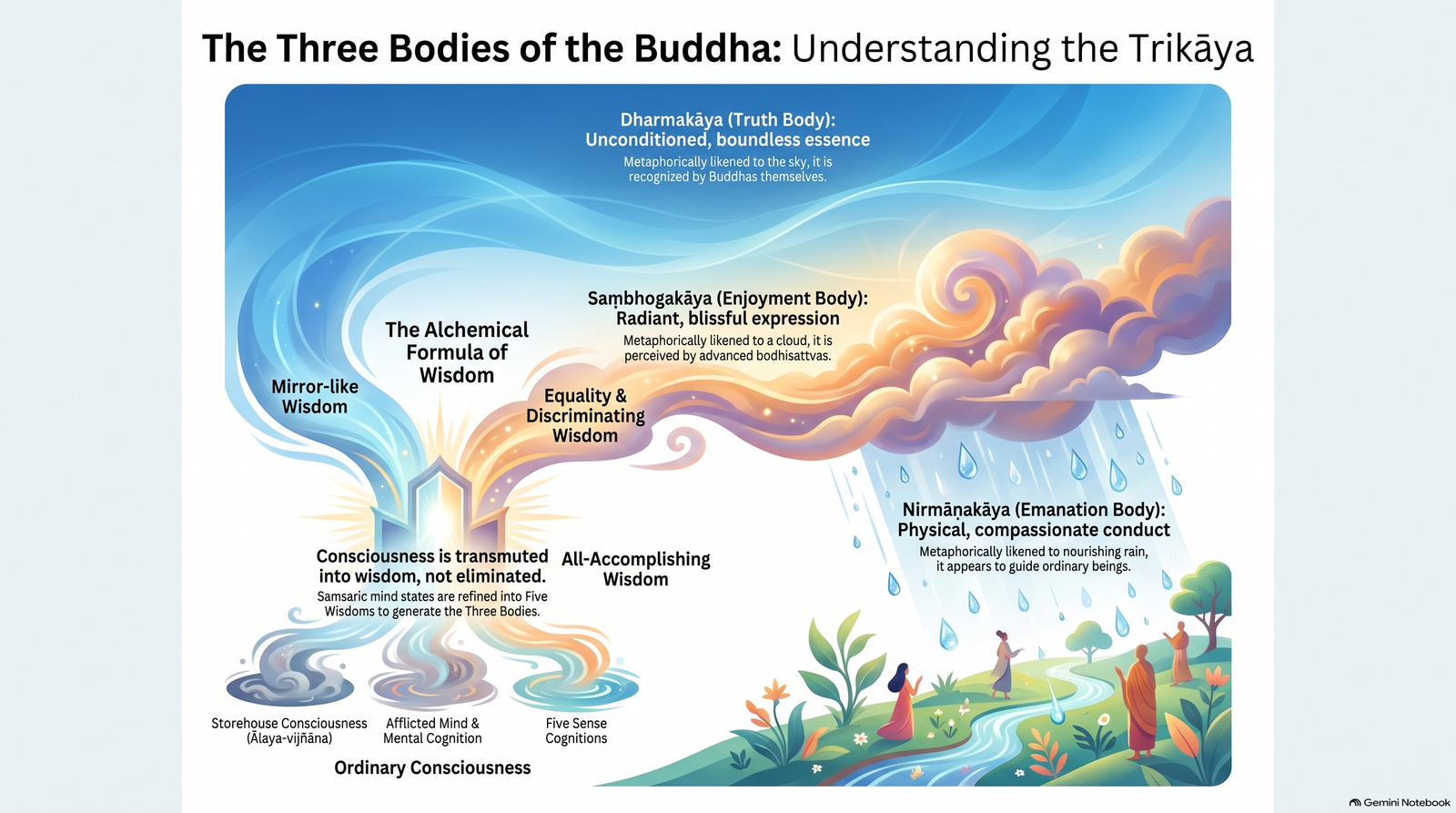
Chapter 10 of the revised Citrinitas introduces the Mahāyāna doctrine of the trikāya, the three dimensions of buddhahood. Dr Simon Robinson presents the dharmakāya as open reality, the saṃbhogakāya as luminous expression and the nirmāṇakāya as compassionate manifestation. His memorable sequence of sky, cloud and rain portrays these not as three isolated beings, but as related ways in which awakening is understood and communicated.
The chapter then relates the eight-consciousness model associated with Yogācāra Buddhism to wisdom, through an alchemical image of lead refined into gold. Rather than rejecting thought, perception and embodiment, this account emphasises transformation without erasure. The chapter closes by turning the reader from abstract metaphysics towards the bodhisattva commitment to benefit others. Its table of correspondences is the author’s condensed synthesis, not a universally agreed Buddhist chart.
Video guide: what is a Buddha’s body?
The conversation begins with an everyday habit: we want boundaries. A medical image, a building specification or a computer component can be inspected and located. But what does the word body mean when Buddhist writers discuss an awakened Buddha? The speakers introduce the question through a scene attributed by the chapter to a “Trikāya Sūtra”, in which Kṣitigarbha asks whether the Buddha has a body. That narrative provides the discussion’s dramatic opening. Its precise scriptural provenance remains unverified, so it is safer to understand the framing here as the chapter’s reported textual account, while the three-body doctrine itself is well established in Mahāyāna Buddhism.
The next movement develops the chapter’s sky, cloud and rain metaphor. Dharmakāya names the dimension of truth or reality; saṃbhogakāya the luminous enjoyment or communicative form; nirmāṇakāya the manifestation accessible to beings in the world. The recording asks whether these are separate entities or different dimensions of the same buddhahood, and shifts towards the recipient’s perspective: how a teaching appears depends, in its account, on the kind of perception attributed to its audience. This is a religious and philosophical explanation, not a demonstration that perception changes external physics or operates through literal bandwidths or frequencies.
A distinctive middle section takes the analogy beyond Buddhism. The hosts use dream imagery and offer comparisons with the Kaṭha Upaniṣad and the Dao De Jing. These parallels are imaginative, but they must remain comparisons: an Upaniṣadic teaching about ātman, a Daoist description of the Dao, and Mahāyāna accounts of emptiness have different textual histories and philosophical commitments. The conversation then pivots from seeing the three bodies to its alchemical question: if there is wisdom, what happens to ordinary consciousness?
The answer proposed is refinement rather than obliteration. The recording works through four transformations: storehouse consciousness into mirror-like wisdom, self-grasping mind into equality wisdom, mental cognition into discriminating wisdom, and sense cognition into all-accomplishing wisdom. Although the narration speaks of the Five Wisdoms, it does not separately develop the fifth, the wisdom of the dharmadhātu, to the same depth. Nor are these transformations established neural or psychological mechanisms. The conclusion resists the image of a private retreat into transcendence: the bodhisattva vow supplies an ethical orientation, culminating in a return to practical care. The final clouds-and-sky reflection asks whether thought necessarily obstructs openness, rather than offering a test of spiritual attainment.
The argument in seven movements
01
The problem with a body
An opening comparison with diagnosis and physical boundaries introduces why “body” changes meaning in the teaching.
02
Three expressions, not three creatures
The sky, cloud and rain become images for truth, luminous communication and nourishing action.
03
The standpoint of the observer
The hosts explore how different capacities to receive a teaching shape their account of the three bodies.
04
A comparative widening
The recording ventures analogies with dreams, the Kaṭha Upaniṣad and Daoist cosmological language.
05
Mind as material for transformation
Its alchemical pivot replaces the destruction of thought or sensation with the transformation of grasping.
06
From consciousness to wisdom
Storehouse, afflicted mind, mental cognition and the senses are paired with four named wisdoms.
07
Compassion brings the model back to earth
The bodhisattva vow, a Stoic comparison and a final sky-and-cloud question return the discussion to everyday conduct.
Book and video: two different emphases
The chapter’s map
The compact chapter uses the sky, cloud and rain image, two schematic tables and a bodhisattva conclusion to place the three bodies within Citrinitas.
The recording’s expansion
The dialogue adds lengthy comparisons with everyday categories, dreams, the Upaniṣads, Daoism and Stoic ethics, alongside illustrative psychological metaphors.
The interpretive boundary
Neither the cross-tradition parallels nor the consciousness-to-wisdom correspondences constitute evidence that all schools share one doctrine or mechanism.
Video chapters
These chapter starts are supplied timed estimates, not independently checked against the final edit. Total video duration: 34:16.
A glossary for careful reading
Trikāya
In Mahāyāna Buddhist thought, the “three bodies” or dimensions of buddhahood. The three are not separate biological organisms. The tradition describes the relation between awakened reality, its communicative expression and its manifestation for the benefit of beings.
Dharmakāya
The “dharma body” or “truth body”: a dimension of buddhahood associated with ultimate truth and the absence of inherent, fixed identity. The recording uses an open sky to evoke it; the sky is a metaphor, not a spatial or physical container.
Saṃbhogakāya
The “enjoyment body”, often portrayed in Mahāyāna and Vajrayāna sources as a radiant form of buddhahood communicating teachings to advanced bodhisattvas. The recording calls it the cloud: a symbolic image for expressive luminosity, not a measurable frequency.
Nirmāṇakāya
The “emanation” or “manifestation body”: buddhahood appearing in forms accessible within ordinary experience, classically including the historical Buddha as a teacher. Rain, nourishing the ground, is the video’s image for compassionate activity.
Bodhisattva
In Mahāyāna Buddhism, one oriented towards buddhahood for the benefit of all beings. The recording uses the bodhisattva vow to connect insight with service. This is a religious ethical commitment, not a licence to ignore risk, consent or everyday duties.
Kṣitigarbha
An important Mahāyāna bodhisattva associated especially with compassionate vows and assistance to suffering beings. The book portrays Kṣitigarbha asking the opening question in a text it calls the Trikāya Sūtra; the precise textual attribution has not been independently established here.
Ālaya-vijñāna
“Storehouse consciousness”, a concept in Yogācāra Buddhist philosophy used to explain continuity of karmic dispositions and experience. It should not be equated literally with a computer hard drive, a comprehensive memory database or a scientifically proven unconscious structure.
Kliṣṭa-manas
The afflicted, self-grasping mental faculty in an eight-consciousness Yogācāra scheme. The video treats its transformation as equality wisdom; that is a doctrinal transformation metaphor rather than a claim that ordinary individuality disappears.
Manovijñāna
Mental consciousness, concerned with thoughts and conceptual objects in the Yogācāra classification. Its refinement towards discriminating wisdom means recognising differences without grasping at them, not losing the ability to distinguish danger from safety.
Five wisdoms
In Tibetan Buddhist presentations, mirror-like, equality, discriminating, all-accomplishing and dharmadhātu wisdom. The recording principally traces four consciousness-to-wisdom transformations and gives limited attention to the fifth, wisdom of the dharmadhātu. Correspondences vary by system.
Saṃsāra
In Buddhist teachings, cyclic existence shaped by ignorance, craving and karma. The author also uses it to evoke recurrent patterns of identification. The psychological analogy does not exhaust the traditional teaching about rebirth.
Upaniṣads and Daoism
The video compares its Buddhist model with the Kaṭha Upaniṣad and the Dao De Jing. The comparisons are suggestive philosophical analogies: the Upaniṣadic self, Daoist Dao and Buddhist emptiness should not be treated as identical doctrines.
Continue within the course
Reference points beyond this course
Question to carry forward
When you understand something more clearly, what changes in how you respond to another person? Where does helpful, accountable action begin without requiring a grand story about the person taking it?