
Catalogue reference 3.1.12 · Revised Edition (2026)
Trekchö
If the seeker is trying to end striving, does the project of seeking survive in its final disguise?
Watch the chapter discussion
What Remains When the Seeker Falls Away? | Trekchö Explained
Open on YouTube · A two-host AI-generated interpretation of the chapter, not a direct teaching or initiation.
The chapter in brief
Chapter 12 closes Citrinitas’s Mythos section at a deliberately paradoxical threshold. Having explored symbols, meditation, emptiness and bodhisattva ideals, it approaches Trekchö, a Dzogchen term often rendered as cutting through rigidity. The question is no longer simply how to refine the mind, but whether the seeker’s determination to refine it can itself become another fixation.
The chapter compares the aims and methods associated with different Buddhist vehicles, describes Vajrayāna ritual and visualisation, then turns towards Buddha-nature and the tension between gradual cultivation and immediate recognition. In Dr Simon Robinson’s alchemical interpretation, this becomes a transition from the stories of Mythos towards the analysis of conditioning in Dharma. The comparison is his explanatory framework: Buddhist traditions differ considerably in how they describe liberation, practice, compassion and recognition.
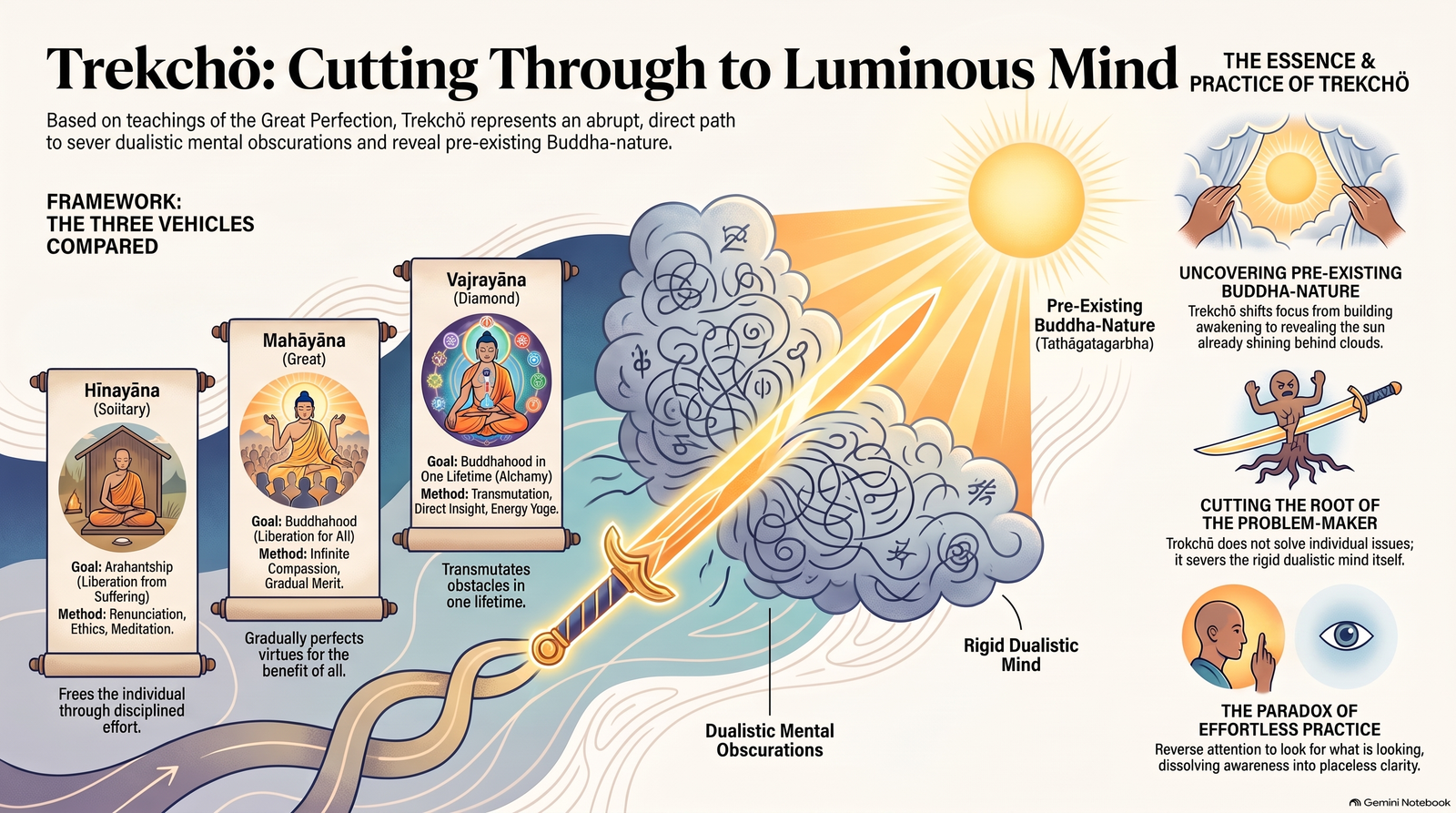
Video guide: what is being cut through?
The recording begins with an arresting analogy: a broken bone can be located on an X-ray, but a troubling sense of self or stream of thought cannot be isolated in quite the same way. The two hosts use that difficulty to introduce a familiar demand of modern self-improvement: identify the defect, repair the machinery, and emerge as someone better. The chapter asks whether this problem-solving model becomes circular when the supposed problem is the compulsion to keep constructing and managing an identity.
The conversation next presents a deliberately simplified account of three Buddhist vehicles. It contrasts disciplined renunciation, the bodhisattva’s compassion and the Vajrayāna aspiration to rapid transformation. This is a map within the book rather than a reliable historical ladder: Hīnayāna is not a neutral name for Theravāda, and Mahāyāna commitment does not mean that practitioners invariably postpone awakening until everyone else is liberated. The hosts then explore Chöd through its disturbing symbolic imagery and discuss deity-and-maṇḍala visualisation using virtual reality and software metaphors. These comparisons help dramatise the malleability of experience; they cannot demonstrate that physical reality is fabricated by individual minds, nor establish a particular neural mechanism.
The centre of the recording is the traditional story of Asaṅga, the suffering dog and the appearance of Maitreya. Its bodily sacrifice is discussed as a dramatic narrative about compassion, not an action for viewers to imitate. From there the discussion reaches the Uttaratantra and the image of Buddha-nature as a sun obscured by clouds. That teaching has diverse interpretations, and does not by itself establish an eternal personal soul or that everyone is already enlightened in the ordinary sense. The recording’s language of a pre-existing perfection should be heard within this interpretive setting.
Only after this long excursion does Trekchö itself come into view. The hosts distinguish the attempt to fix individual thoughts from a recognition that undercuts the apparent solidity of the one doing the fixing. Their central puzzle is that striving to become effortless can reproduce the very identity it hopes to release. The closing segment includes a step-by-step “backward step” inquiry from the book’s study guide; this webpage treats that portion as material for understanding, not as unsupervised Dzogchen instruction or an attainment test. Finally, the video contrasts Tögal’s imagery of display with Trekchö’s emphasis on the nature of awareness, then turns towards the Dharma section’s investigation of how experience is conditioned. Its strongest question is not how quickly one may awaken, but what becomes of compassion, discernment and ordinary responsibility when the identity of the spiritual achiever is questioned.
The argument in seven movements
The repair model
An X-ray for a fracture becomes an analogy for why the sense of self resists simple diagnosis.
Why paths differ
The hosts contrast traditional approaches to liberation and introduce the tension between gradual cultivation and sudden recognition.
Transformative imagery
Chöd and maṇḍala visualisation are used to question how experience can be shaped and interpreted.
The compassionate turning
The Asaṅga and Maitreya story moves the emphasis from heroic spiritual achievement to concern for another being.
Buddha-nature uncovered
The Uttaratantra and sun-behind-clouds image prompt the question of whether clarity is made or recognised.
The paradox of the seeker
Trekchö is introduced as cutting through fixation, including the effort to become an effortless practitioner.
From myth to inquiry
The backward-step discussion and the Tögal contrast lead into the next section on the conditioning of experience.
Book and recording: different emphases
In the revised chapter
A compact transition from vehicle comparison and Vajrayāna imagery to Buddha-nature, the paradox of effort and the opening of Dharma.
In the finished recording
The hosts considerably expand the medical X-ray, software, VR and film-projector analogies, and discuss the traditional Asaṅga story at length.
Interpretive boundary
The author’s analogies connect alchemy and Buddhism; neither the analogies nor the AI conversation replace textual scholarship, direct instruction or empirical investigation.
Video chapters
Supplied working timestamps for the 43:37 final edit. These are estimates, not independently verified frame-accurate chapter starts.
- 00:00 — Introduction: Cutting Through
- 02:20 — What Trekchö Means
- 06:00 — The Paradox of Effort
- 10:20 — The Three Vehicles Explained
- 15:10 — Vajrayāna as Alchemical Acceleration
- 20:00 — Controlled Hallucination and Mandala Practice
- 25:30 — Buddha-Nature and the Uttaratantra Śāstra
- 30:40 — Seeing Mind with Mind
- 35:20 — Gradual vs. Sudden Awakening
- 39:10 — Closing Mythos: Into the Engine Room
Glossary of terms
Trekchö
Tibetan Dzogchen term often translated as cutting through rigidity or solidity. Within Dzogchen it concerns recognition of primordial purity, not an ordinary technique for suppressing thoughts. The video uses it as the culmination of its critique of spiritual striving.
Dzogchen (Great Perfection)
A body of Tibetan Buddhist teachings especially associated with Nyingma and also present in Bön traditions. Its accounts of the ground, awareness and spontaneous display are embedded in distinct philosophical and instructional lineages, not simply interchangeable with the book’s alchemical model.
Rigpa
In Dzogchen, a term for knowing or awareness as understood within direct recognition of the nature of mind. It is not synonymous with ordinary attention, a blank mental state, visual light or scientifically measurable consciousness.
Tögal
A Dzogchen teaching commonly discussed alongside Trekchö, concerning spontaneous presence and visionary display. The chapter and video contrast the two symbolically. This page does not supply optical, gaze or retreat instructions.
Hīnayāna
Literally lesser or inferior vehicle, a historically situated Mahāyāna polemical category. It should not be used as a neutral synonym for living Theravāda Buddhism; the recording’s three-vehicle diagram compresses histories and doctrinal differences.
Mahāyāna and bodhisattva
The Great Vehicle comprises diverse Buddhist movements that emphasise the bodhisattva orientation toward awakening for the benefit of beings. The vow is not adequately described by a universal rule that one must delay one’s own liberation.
Vajrayāna
A family of Buddhist tantric approaches grounded in particular transmissions, ethical commitments and ritual contexts. Descriptions of accelerated awakening are traditional aspirations rather than verified comparative timescales or a literal alchemical technology.
Chöd
A Tibetan contemplative and ritual tradition often translated as cutting through. Its dramatic offering imagery is symbolic and lineage-based. It is not physical cannibalism and should not be translated into self-injury or an unsupervised exposure exercise.
Skandhas (aggregates)
The five categories used in Buddhist analysis of experience: form, feeling tone, perception, formations and consciousness. Their changing interplay challenges the idea of a fixed independent self; the categories do not prove the non-existence of the body or the world.
Maṇḍala and deity visualisation
In Buddhist tantra, a maṇḍala can structure sacred space, symbolism and contemplative representation. A vivid imagined scene is not evidence that everyday external objects are made of exactly the same substance as an image in the mind.
Tathāgatagarbha (Buddha-nature)
A Mahāyāna family of ideas about the possibility or presence of awakening. Schools interpret its positive language differently, often in relation to emptiness. It need not posit an eternal individual essence.
Uttaratantra Śāstra
Also known as the Ratnagotravibhāga, an influential Indian treatise systematising Buddha-nature teachings. Tibetan tradition associates it with Maitreya and Asaṅga, but its historical authorship is disputed. It is not itself a Dzogchen pointing-out manual.
Āsaṅga and Maitreya
Asaṅga is a major figure associated with Yogācāra scholarship. The story of a wounded dog and the revelation of Maitreya is a traditional hagiographical narrative about compassion, not independently verified history or permission for self-harm.
Kleśas and obscurations
Kleśas are afflictive factors such as greed, aversion and ignorance. Certain Mahāyāna presentations distinguish afflictive from cognitive obscurations. The video’s debugging and cloud metaphors illustrate these concepts without proving a computer-like mental mechanism.
Related pathways within the course
- 3.1.11. The Diamond Sutra (Part One)The preceding public chapter page; the revised book calls its chapter The Diamond Solvent.
- 3.1.2. Tögal and RainbowsCompare the earlier discussion of visionary display with this chapter’s account of cutting through.
- 3.1.10. The BodhisattvaOlder website numbering: a useful companion to the recording’s discussion of compassion.
- Mythos — Part One of CitrinitasReturn to all twelve chapters of the Mythos section.
- Dharma — Part Two of CitrinitasContinue into the next section’s enquiry into conditioning and subtle fetters.
- Citrinitas – Part ThreePlace this chapter within the complete four-section course.
External reference points
- Rigpa Wiki — TrekchöA tradition-based account of Trekchö and its relationship to Dzogchen.
- Tsadra Foundation — Ratnagotravibhāga / UttaratantraText history, Buddha-nature context and the debated attribution to Maitreya and Asaṅga.
- Encyclopedia of Buddhism — RatnagotravibhāgaHistorical and interpretive context for the Buddha-nature treatise.
A question to carry forward
When a wish to be wiser or more compassionate becomes another image of the kind of person you ought to be, how might you recognise that tension without abandoning kindness, discernment or responsibility to other people?