
Citrinitas · Mythos · Chapter 1 of 48
The Philosopher’s Egg
When the obvious struggles quieten, can the wish to become someone spiritually special remain?
Catalogue reference: 3.1.1 · Revised Edition (2026)
Watch the chapter discussion
What Happens After Awakening? | The Philosopher’s Egg Explained
The chapter in brief
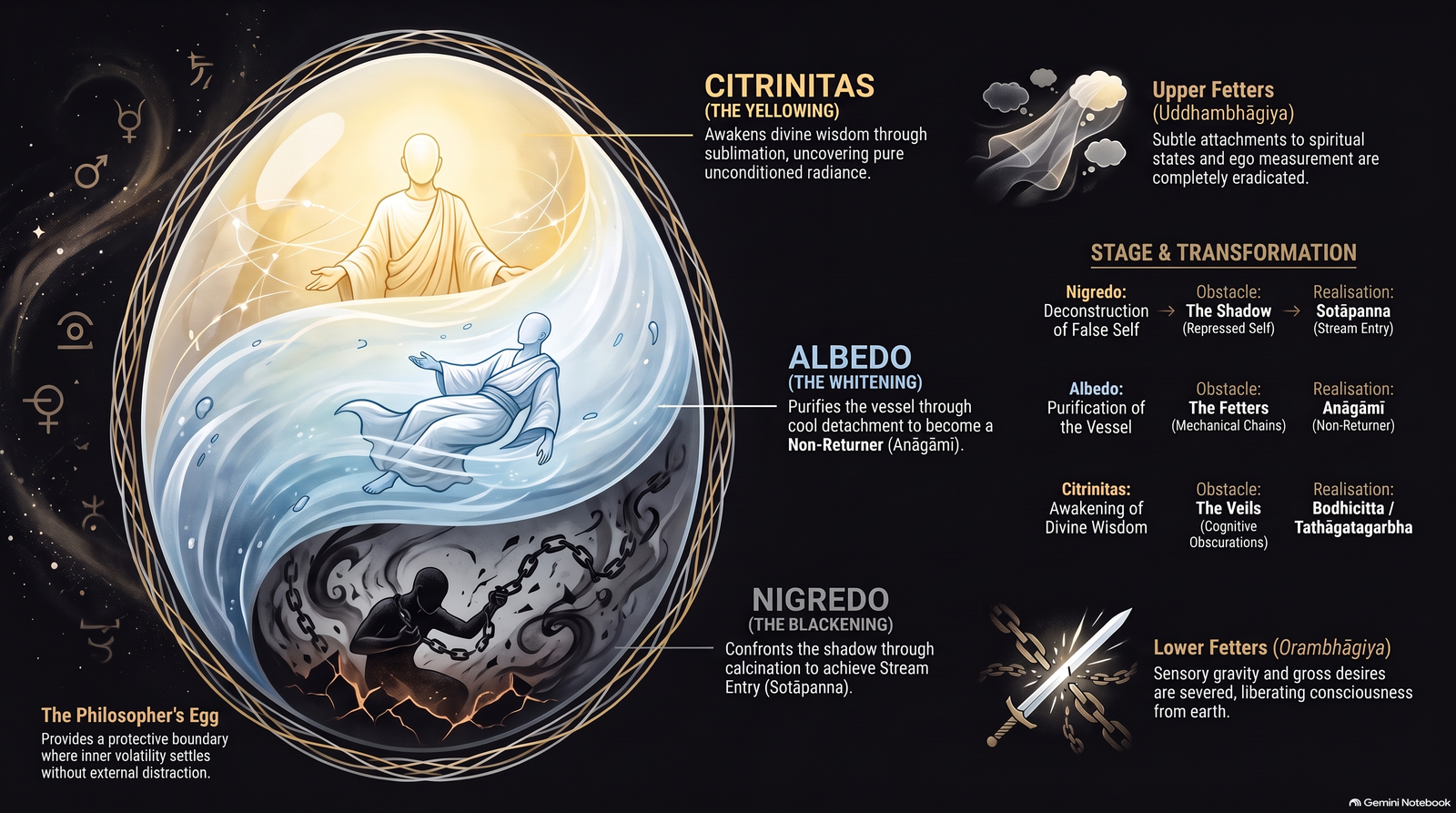
The opening chapter of Mythos places Citrinitas at a threshold: the conspicuous struggle with desire and aversion has quietened, yet subtle attachment can remain. Robinson’s Philosopher’s Egg is a symbol of containment and ripening. An outward life of work and responsibilities continues while the inner demand for identity, escape or spiritual reward comes under scrutiny. The chapter draws on the Buddhist ten-fetter map, especially the distinction between anāgāmī and arahant, and combines it with alchemical fixatio, disenchantment and the image of golden chains. Its solar language prepares the wider inquiry of Citrinitas. These connections belong to the author’s comparative model; they do not establish that Buddhist attainments, alchemical stages and Dzogchen teachings describe identical events. The Egg is a literary orientation, not a prescription for isolation.
Video guide: what remains after the struggle?
The recording begins with Douglas Harding’s image of having no head and the disappearance of an imagined inner manager. It uses this provocative opening to ask whether spiritual development is principally an acquisition of a better identity or a loosening of identification itself. The hosts then enter the chapter’s transition from Albedo to the Egg: a clearing that can be mistaken for completion. Their float-tank comparison adds a modern image of containment, but neither this analogy nor the opening comparison with psychosis provides a clinical account of contemplative experience. A frightening or disruptive loss of self is not thereby evidence of awakening.
Next comes the practical objection: if striving stops, what enables someone to work, pay bills or care for others? The discussion distinguishes compulsive demands for a different experience from ordinary functioning. It introduces the five lower fetters and Robinson’s fixatio image, in which the outward persona becomes a protective shell. An autopilot analogy makes this vivid. Its claim of flawless functioning should be read as idealised imagery; relinquishing attachment does not remove the need for attention, deliberate decisions or accountability. The stage-prop metaphor then explores disenchantment: familiar rewards can lose their authority without everyday life having to lose its value.
The inquiry turns from the iron chains of sensory attachment to the golden chains of spiritual reward. A heavenly future or permanent bliss can become another possession. The hosts contrast this with a wish for oblivion, asking whether both can express craving. Here an important correction is needed: attachment to formless existence, arūparāga, is not craving for annihilation, vibhava-taṇhā. The video then presents māna as an operating system that continually divides experience into self and other. This is Robinson’s expanded interpretation; the early Buddhist term includes the residual conceit of being and comparative judgements about oneself. Restlessness and ignorance complete the discussion of the upper fetters.
The ending returns to the Egg cracking, reviews the Nigredo–Albedo–Citrinitas comparison and questions whether even learning about freedom can become spiritual ambition. It also describes Tögal as a perceptual short circuit and proposes a day-long search for the doer. This page treats those passages as material to assess, rather than instructions to follow: Tögal belongs to advanced Dzogchen teaching, and the recording supplies no evidence for a neural reboot mechanism. The useful challenge to carry forward is quieter: can inquiry support care and understanding without becoming another claim to special status?
The movement of the discussion
Unbecoming rather than acquisition
The opening challenges the assumption that awakening supplies a more impressive identity.
A clearing becomes an Egg
Albedo’s quiet is reframed as a threshold where subtler attachments can ripen into view.
Non-striving meets daily life
The lower fetters and fixatio image address how responsibilities might continue with less compulsive self-concern.
The stage loses its spell
Disenchantment shifts attention from winning worldly rewards to the meaning of participation itself.
Golden chains and oblivion
Spiritual rewards and the wish for disappearance are examined as distinct ways of seeking an escape.
The remaining sense of “I”
The operating-system analogy connects conceit, restlessness and ignorance with the Egg’s eventual cracking.
The map questions its reader
The closing asks whether studying liberation can itself become a project of spiritual self-improvement.
Book, recording and interpretation
The chapter’s emphasis
The Egg, fixatio and golden chains organise a transition from obvious attachments to subtle identification.
The recording’s expansion
Float tanks, autopilots, stage props and computer software turn the chapter into a series of practical objections and replies.
The Buddhist reference
The ten fetters provide a named early Buddhist framework; they are not clinical symptoms or a checklist for self-certification.
The author’s synthesis
Alchemical colours, Theravāda attainments, Mahāyāna language and Dzogchen are placed alongside each other without establishing doctrinal equivalence.
Terms for thoughtful listening
Open a term for its meaning and the distinction that matters here.
The Philosopher’s Egg
In this chapter’s alchemical symbolism, the Egg holds a period of inward ripening while ordinary life continues. Its protective shell represents containment, not a literal psychological structure. Robinson uses it to explore the subtle attachments that can remain after conspicuous conflict has quietened; the image does not require retreat or sensory deprivation.
Nigredo, Albedo and Citrinitas
These alchemical colour terms mean blackening, whitening and yellowing. Robinson organises his course around descent, clarification and a solar inquiry into awareness. The video compares them with Buddhist terms and esoteric archetypes. Those correspondences express his framework; they are not universally recognised stages of psychological development or Buddhist attainment.
Anāgāmī and arahant
In the Theravāda four-attainment map, an anāgāmī is a non-returner who has abandoned the five lower fetters; an arahant has abandoned all ten. Non-return refers to the traditional rebirth model, not an inability to experience the senses. Neither quietness nor detachment establishes these attainments, and ordinary bodily needs are not abolished.
The five lower fetters
The early Buddhist list names identity view, doubt, grasping at rules and observances, sensual desire and ill-will. Identity view concerns treating the bodily and mental processes of experience as self or belonging to self. Doubt here is religious uncertainty within the path’s framework, not a ban on careful questioning; observances become a fetter when mistaken for sufficient liberation.
The five upper fetters
The list continues with attachment to form existence, attachment to formless existence, conceit, restlessness and ignorance. The chapter calls these subtler or golden chains. The list is a traditional account of bondage and release; its presence in the discussion does not turn the author’s alchemical comparison into a diagnostic instrument.
Rūparāga and arūparāga
In the Theravāda explanation of the upper fetters, these concern attachment to form and formless existence or their associated meditative attainments. Formless does not mean annihilated. The recording’s move from formless existence to oblivion therefore conflates different categories; neither term is simply an exact translation of wanting to be or wanting not to be.
Bhava-taṇhā and vibhava-taṇhā
These Pāli expressions name craving for becoming and craving for non-becoming, also rendered as existence and non-existence. They belong to the Buddhist analysis of craving. The chapter uses them to question both spiritual reward-seeking and a wish for oblivion. This is a doctrinal distinction, not a judgement that exhaustion or distress reveals a reader’s spiritual status.
Māna: conceit
In early Buddhist usage, conceit includes measuring oneself as superior, equal or inferior and the lingering sense of “I am”. It can remain when explicit identity view has gone. Robinson expands it into a structural division between observer and observed; the video’s operating-system metaphor helps illustrate that interpretation without proving a computer-like mechanism in the mind.
Fixatio
Fixation is an alchemical operation associated with making something volatile stable. Robinson applies it metaphorically to an outward persona that continues handling responsibilities while inward grasping quietens. The hosts’ autopilot expands this image. It is neither validated anatomy nor evidence that behaviour becomes infallible, involuntary or exempt from ethical responsibility.
Disenchantment
In Buddhist discussion, disenchantment can describe losing fascination with conditioned experiences rather than hating life. Robinson’s stage-prop image expresses that change symbolically. It cannot reliably distinguish contemplative insight from depression or other difficulties. Care, functioning and context matter; an attainment claim does not establish immunity from illness.
Aggregates and no-self
The five aggregates are form, feeling, perception, mental formations and consciousness: a Buddhist way of analysing experience. No-self questions their identification as a permanent, independently controlling self. It does not erase persons in ordinary language, consent or moral responsibility. Robinson’s language of intrinsic emptiness brings another philosophical emphasis into this account rather than supplying a literal translation.
Tögal and luminosity
Tögal is an advanced Dzogchen teaching, distinct from the Theravāda fetter map. Here it appears briefly in the proposed cracking of the Egg. Luminosity is contemplative terminology, not established physical light or a verified neural short circuit. The discussion is for study; this page supplies no optical methods or practice instructions.
Related pathways
2.1.8. The White Stone
Return to Albedo’s image of purification before the Egg’s inward ripening.
1.2.11. The Fetters that Bind
Revisit the earlier course introduction to the language of fetters.
1.3.10. Anāgāmī
Compare the non-returner theme with its treatment earlier in the course.
3.2.3. The Subtle Fetters
Follow the theme of remaining attachments; this link retains the older public website numbering.
Citrinitas – Part Three
Locate this chapter within the wider course catalogue.
Mythos — Part One of Citrinitas | Spiritual Alchemy Course | Dr Simon Robinson
Explore the opening section’s symbolic and contemplative reference points.
External reference points
These sources help distinguish the page’s underlying categories. They are supporting references, not a claim that the hosts consulted these particular editions.
- AN 10.13 · Sanyojana Sutta: Fetters — Ṭhānissaro Bhikkhu’s Pāli translation, archived at Access to Insight; the concise lower and upper lists.
- SN 22.89 · Khemaka Sutta — Ṭhānissaro Bhikkhu’s translation; distinguishes relinquished identity view from the remaining conceit of “I am”.
- SN 56.11 · Setting the Wheel of Dhamma in Motion — Ṭhānissaro Bhikkhu’s translation; separates craving for sensual pleasure, becoming and non-becoming within the four noble truths.
- NHS · Causes of depression in adults — explains why depression cannot be reduced to a single cause such as aversion.
- NHS · Depression in adults: overview — describes symptoms and seeking support, providing a clinical reference separate from the chapter’s spiritual imagery.
Question to carry forward
When I learn about awakening, what helps me become more attentive and considerate in ordinary relationships, and what feeds a wish to be seen as spiritually exceptional?
You can consider this as a question about motivation and conduct. It requires no search for a missing self and offers no test of attainment.