
Citrinitas · Mythos · Chapter 4 of 48
The Path of Tranquility
A steadier mind can support understanding—but does stillness itself amount to freedom?
Catalogue reference: 3.1.4 · Revised Edition (2026)
Watch the chapter discussion
Samatha & Jhāna Explained | The Path to Inner Stillness
The chapter in brief
Following the chapter on mantras, tantras and deities, Robinson returns to the steadiness needed to examine experience carefully. He introduces samatha through the image of a quiet pond, then traces the five hindrances, the fivefold Abhidhamma account of jhāna, the four formless attainments and the traditional forty meditation subjects. The study guide makes a useful distinction between hindrances temporarily subsiding in concentration and their roots being relinquished through wisdom. The chapter also interprets extraordinary powers and cessation through the language of cognitive engineering. Those explanations belong to the author’s synthesis: they do not establish a technology for changing physical reality. Its wider religious comparisons remain comparisons, rather than a single shared doctrine. The chapter offers a map for study; neither its absorption sequence nor its engineering metaphors should be treated as a clinical protocol or an attainment test.
Video guide: the laboratory of silence
The recording opens with the provocative image of an administrative password to reality. Behind that claim lies its central question: why might steadiness matter when exploring perception? The hosts contrast ordinary relaxation with samatha, using a pond reflecting the moon and a telescope held on a stable mount. Their argument makes tranquillity the necessary first step before insight. The relationship is less rigid in early Buddhist sources: AN 4.170 also describes insight preceding tranquillity and their development together. The hosts’ comparisons with the Bhagavad Gītā and other traditions belong to Robinson’s synthesis, rather than proof of a universal mechanism.
The discussion then examines the five hindrances as leaks in a pressure vessel: sensual desire, ill will, sloth and torpor, restlessness and worry, and doubt. This imagery can make distraction understandable without shaming the person experiencing it. It does not remove Buddhist ethics, or turn doubt into a prohibition on careful questioning. A challenge about suppression produces an important distinction: concentration can temporarily quiet hindrances without permanently removing their causes. The hosts then amplify that distinction into language about deleting trauma. The recording does not provide clinical evidence for that claim, and the page does not present absorption as treatment.
The middle follows five grades of absorption through the singing-bowl analogy: striking, resonance, rapture, happiness and equanimity. These are the chapter’s explanatory images for a fivefold Abhidhamma scheme; the usual fourfold sutta enumeration remains a different way of analysing the sequence. The hosts then move into infinite space, infinite consciousness, nothingness, and neither perception nor non-perception. These are traditional categories of contemplative attainment, not astronomical locations or quantum states. Nothingness here is not a cosmic substrate or a synonym for Mahāyāna emptiness. Equanimity is likewise a conditioned quality, rather than proof that someone has become permanently immune to circumstances.
The final movement surveys forty meditation subjects and their traditional relation to temperament, before turning to mastery, iddhis and cessation. The hosts extend the chapter’s cognitive-software model into claims about walking on water and overriding solidity. Altering perception does not establish that water can support a person’s weight. Their descriptions of neurochemical pressure, default-mode networks and a complete biological shutdown are also unsupported explanations in this recording. Cessation is approached here through its traditional designation, the cessation of perception and feeling, without equating it with brain death. The conclusion asks whether everyday solidity is a shared projection and assigns an exercise to widen gaps between thoughts. This page retains the inquiry into steadiness while offering an ordinary reflective question instead of that exercise.
The movement of the discussion
Ask why steadiness matters
The reality-hacking opening leads into the pond and telescope images, presenting tranquillity as support for clear seeing.
Name the disturbances
The five hindrances turn diffuse distraction into recognisable patterns of craving, resistance, dullness, agitation and uncertainty.
Separate temporary quiet from change
A challenge about suppression distinguishes a stable contemplative state from the longer work of relinquishing its underlying causes.
Trace refinement rather than accumulation
The singing-bowl analogy follows the fivefold absorption scheme as increasingly subtle factors fall away.
Extend the map beyond form
The four formless categories and forty meditation subjects broaden the inquiry into the objects and conditions of attention.
Examine mastery and its claims
Powers, cessation and the closing shared-projection hypothesis bring the discussion to the limits of what its metaphors establish.
Book, recording and interpretation
The chapter’s map
Tables 5 and 6 organise hindrances and the fivefold jhāna factors. The chapter brings these together with formless attainments, meditation subjects and an alchemical interpretation of mastery.
The recording’s expansion
The hosts add telescope mounts, pressure vessels, singing bowls and computer-administration imagery. Their neuroscience, therapeutic and reality-hacking explanations go beyond a descriptive traditional map.
The distinction to retain
The study guide separates temporary suppression from lasting transformation. That distinction concerns hindrances within a Buddhist framework; it is not evidence that concentration cures trauma.
Religious resonances
Buddhist, Christian, Hindu, Stoic, Daoist and Sufi material is placed in conversation. Similar imagery does not erase differences in doctrine, purpose or historical setting.
Reading the fivefold map
The revised chapter uses the Theravāda Abhidhamma fivefold scheme. Its second and third levels distinguish the dropping of vitakka and vicāra separately; in the common fourfold sutta scheme both are absent from the second jhāna. The fifth level here therefore corresponds to the fourth in that fourfold scheme, rather than an extra rung beyond it.
First form jhāna
Vitakka, vicāra, pīti, sukha, ekaggatā
Application, sustained engagement, rapture, pleasure and unification.
Second form jhāna
Vicāra, pīti, sukha, ekaggatā
Initial application is absent in this fivefold analysis.
Third form jhāna
Pīti, sukha, ekaggatā
Sustained engagement also falls away.
Fourth form jhāna
Sukha, ekaggatā
Rapture is absent; pleasure and unification remain.
Fifth form jhāna
Upekkhā, ekaggatā
Equanimous feeling and unification replace pleasure.
Companion infographic
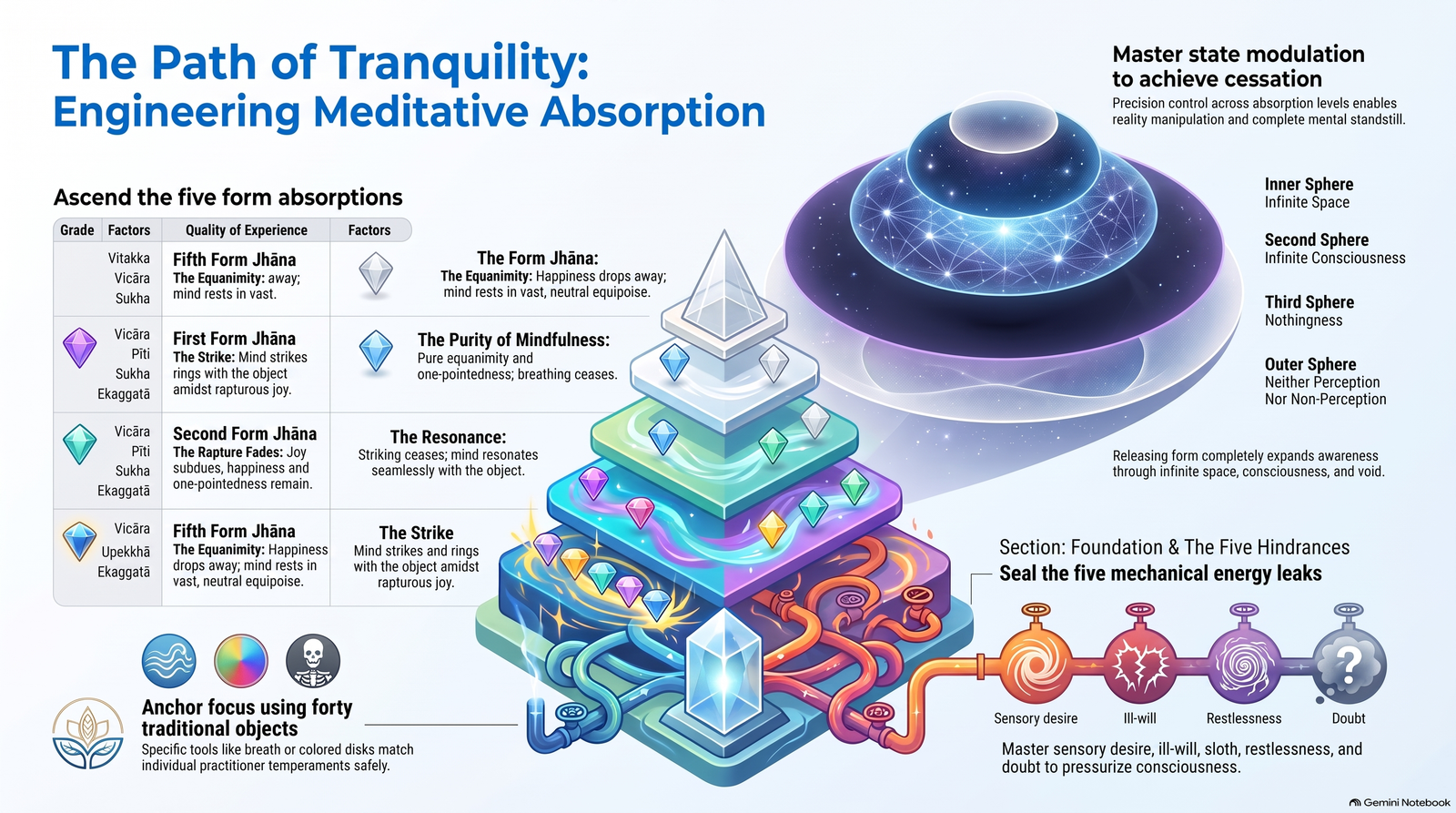
Terms for a careful reading
Samatha and vipassanā
In Pāli Buddhist vocabulary, samatha concerns tranquillity and vipassanā insight. Robinson foregrounds their complementary roles through the steady instrument and clear seeing analogy. Their relationship is not universally sequential: AN 4.170 describes several possibilities. Intellectual analysis alone is not a complete definition of insight, and stillness alone does not guarantee wisdom.
The five hindrances: nīvaraṇa
The traditional list is sensual desire (kāmacchanda), ill will (vyāpāda), sloth and torpor (thīna-middha), restlessness and worry or remorse (uddhacca-kukkucca), and doubt (vicikicchā). They obstruct collectedness and discernment. Robinson describes them as energy leaks; this is his metaphor, rather than a measured pressure system or a judgement that every tired or uncertain person is spiritually failing.
Suppression and abandonment
The commentarial term vikkhambhana-pahāna refers to temporary suppression through concentration. The chapter contrasts this with lasting abandonment through wisdom. “Suppression” here does not prescribe repressing emotion, denying distress or trying to force thought to stop. A peaceful interval does not by itself demonstrate that craving or ill will has been uprooted.
Jhāna and samādhi
Jhāna denotes meditative absorption or deep unification in the Theravāda framework used here. Samādhi is the broader language of concentration or collectedness. The chapter explains absorption through decreasing disturbance, but “physical training” is the hosts’ analogy, not a literal definition. Neither a diagram nor a compelling subjective report certifies a particular attainment.
Vitakka and vicāra
Often rendered as initial and sustained application in commentarial concentration accounts, or directed thought and evaluation in sutta translations. Robinson’s striking and ringing imagery makes their distinction memorable. These are explanatory renderings with context-dependent meanings, rather than literal muscular actions, sounds inside the body or a neuroscience account of attention.
Pīti and sukha
Pīti is commonly rendered as rapture or joy, while sukha can mean pleasure, ease or happiness. The chapter distinguishes their places in the fivefold factor analysis. A singing bowl’s vibration illustrates the hosts’ account, but does not measure either factor; their claim of a particular neurochemical rush is not established by the supplied recording.
Ekaggatā and upekkhā
Ekaggatā is commonly translated as one-pointedness or unification of mind; upekkhā as equanimity. In the final fivefold level, the latter names equanimous feeling. Equanimity is not dullness, indifference or exemption from care. The recording’s immovable foundation is a metaphor, not a promise of permanent freedom from every emotional response.
Arūpa: the four formless attainments
The traditional categories are infinite space, infinite consciousness, nothingness, and neither perception nor non-perception. Here they identify contemplative states, not physical places reached by leaving the body. Neither perception nor non-perception is distinguished from complete cessation. The state called nothingness does not establish that the universe is nothing or that emptiness is a substance.
Kammaṭṭhāna and the forty subjects
Kammaṭṭhāna names a meditation subject or field of practice. The forty-subject classification belongs especially to Theravāda commentarial literature, including the Visuddhimagga. The chapter relates selection to temperament. Calling this “spiritual pharmacology” or “targeted cognitive therapy” is the hosts’ analogy, not a validated prescription system or a clinical treatment recommendation.
Kasiṇa, ānāpānasati and asubha
Kasiṇa names a concentration support; ānāpānasati mindfulness of breathing; asubha contemplation of unattractiveness, including the corpse subjects in this classification. Robinson contrasts these objects, but their traditional descriptions do not establish universal safety or clinical suitability. This page supplies no gaze, breath or death-contemplation routine, and no ranking of practices for a reader.
Iddhi and the cognitive-software analogy
Iddhi is the Pāli term for extraordinary capacities described in Buddhist sources. Robinson interprets them as changes to reality-rendering software; the hosts extend this to walking on water. These are traditional claims and the author’s proposed explanation, not demonstrated physical abilities. Changing a perception of solidity does not demonstrate a change in water’s ability to bear weight.
Nirodha-samāpatti: cessation
The attainment of cessation is traditionally described as cessation of perception and feeling. Theravāda commentarial accounts associate it with non-returners and arahants who also possess the requisite absorption mastery. It is not compulsory for every arahant. It should not be identified with sleep, death, unconsciousness from illness, or a verified cessation of all neural activity; no entry method is supplied here.
Related pathways
- 3.1.3. Mantras, Tantras and Deities
The preceding revised-book chapter explores attentional anchors, spiritual ambition and subtle-body interpretation. - 3.1.5. The Path of Insight
The following revised-book chapter shifts emphasis to insight; steadiness and understanding remain distinct themes. - Mythos — Part One of Citrinitas | Spiritual Alchemy Course | Dr Simon Robinson
Return to the twelve-chapter Mythos catalogue. - Citrinitas – Part Three
Place this discussion within Citrinitas, Part Three of the course. - 1.3.6. Different Worlds and Jhāna
A Nigredo connection for distinguishing meditative states from liberating understanding. - 2.3.10. Thaumaturgy
An Albedo connection for approaching extraordinary-power claims without mistaking explanation for evidence.
External reference points
These references supply doctrinal context, not confirmation of the hosts’ neuroscience or reality-hacking explanations. They are supplementary sources; their particular editions are not claimed to have been used in the recording.
- AN 4.170 · Yuganaddha Sutta: In Tandem
Ṭhānissaro Bhikkhu’s translation: tranquillity and insight may develop in more than one relationship. - AN 5.51 · Āvaraṇa Sutta: Obstacles
Ṭhānissaro Bhikkhu’s translation identifies all five hindrances and their effect on discernment. - Henepola Gunaratana · The Jhanas in Theravada Buddhist Meditation
A traditional Theravāda exposition of fourfold and fivefold schemes, meditation subjects and the distinction between absorption and liberation. - MN 111 · Anupada Sutta: One After Another
Ṭhānissaro Bhikkhu’s translation traces absorptions and the examination of their changing qualities, including the formless attainments. - MN 43 · Mahā Vedalla Sutta: The Greater Set of Questions & Answers
Ṭhānissaro Bhikkhu’s translation includes jhāna factors and a traditional distinction between cessation of perception and feeling and death.
Question to carry forward
In an ordinary disagreement, how would you recognise the difference between being temporarily calm and understanding the reaction that disturbed you?
Consider the question through everyday conduct and relationships. It requires no interruption of thought, manipulation of breathing, pursuit of unusual states or assessment of spiritual attainment.