
Citrinitas · Object · Chapter 30 of 48
3.3.6. On Having No Head
Does the feeling of being a watcher behind the eyes tell us everything about the experience of seeing?
Citrinitas, Revised Edition (2026), chapter 30: On Having No Head. The reference 3.3.6 is catalogue notation. Video duration and publication month are supplied by the author.
Watch the discussion
Douglas Harding’s Headless Way Explained | Modern Alchemy
The chapter in brief
Within Object, On Having No Head turns from the meanings attached to difficult experience towards the apparently obvious person to whom experience happens. Douglas Harding’s account provides the starting point: the familiar image of a face is different from what is immediately visible from a first-person perspective. The chapter asks how a presumed observer becomes the organising centre of a divided world.
Robinson connects this question with the ten fetters, Yogācāra accounts of consciousness, language and the image of a moon reflected in water. His solar and lunar imagery contrasts direct seeing with conceptual representation. The resulting account is an alchemical synthesis, rather than a single Buddhist teaching. Its central challenge is to question identification without making another identity out of “being nondual”, and without discarding the practical intelligence needed for ordinary life.
Video guide: who is looking?
The recording opens with the image of a passenger behind the eyes, looking through the face as though through a windscreen. Its central question is whether this familiar picture accurately describes immediate experience. Harding’s Himalayan account shifts attention from a remembered bodily image to the field of seeing. The hosts discuss his pointing experiment and the difference between knowing about a colour and seeing it. These are first-person and philosophical considerations; the opening language of a “literal neurological” trick goes beyond the evidence presented. Harding’s book appeared in 1961; the recording incorrectly places his earlier discovery in that year. Its added story about oxygen deprivation is not established by his account.
The discussion then moves from description to explanation. It links the presumed watcher with avijjā, and introduces manas and ālaya through Yogācāra’s eight-consciousness model. The recording’s distinctive addition is a cinema analogy: a restless figure with a label maker tags parts of the screen as “me” and “not me”. This makes appropriation easy to picture, but it remains an analogy within Robinson’s interpretation. The identification of headlessness with breaking the tenth fetter, or with the eighth consciousness knowing itself, does not establish an attainment or a consensus account of Buddhist psychology.
Next comes a proposed developmental story: pattern recognition, language and the demands of adulthood gradually reinforce identification. The hosts raise a useful objection. Naming a hot stove, reporting pain or managing a responsibility requires concepts. Their reply distinguishes the functional use of language from treating its categories as final truths. The moon-in-the-lake image then gathers the argument together: becoming absorbed in a representation is different from understanding what it represents. Claims about an infant’s undivided awareness are part of this interpretive story, rather than demonstrated developmental science; innocence is also explicitly distinguished from wisdom.
The closing movement considers nirodha, the risk of turning emptiness into another slogan, and the paradox of using language to question conceptual fixation. It connects cessation, the three Buddha bodies, jhāna and nibbāna more closely than their different doctrinal contexts warrant. The worthwhile question is how grasping shapes experience, rather than how to switch off cognition. The recording ends with a perceptual exercise; this companion page instead carries the inquiry into ordinary judgement and responsibility. Its practical challenge is to hold a useful description lightly enough to hear what another person is actually saying.
Headlessness, cessation and evidence
Not seeing one’s own face directly is a feature of perspective. It does not prove that the body is unreal, that an individual mind creates the world, or that consciousness has no relationship to the brain. A change in the felt observer–observed relationship is a phenomenological report, not a neurological demonstration or a test of liberation.
Nirodha means cessation, but its object and context matter. The cessation of suffering, the meditative cessation of perception and feeling, and the loosening of self-referential thought must be distinguished. A vivid, continuing sensory field is not thereby the cessation of perception and feeling described in early Buddhist texts. Nor do the three kāyas literally replace the sense organs. “Unplugging” the mind is the recording’s metaphor, not a practice instruction or a physiological mechanism.
The movement of the discussion
Question the passenger
The opening challenges the assumed geography of a watcher inside and a world outside.
Separate perspective from body image
Harding’s account distinguishes immediate seeing from the remembered appearance of a face.
Give appropriation a picture
The tenth-fetter discussion leads into manas, ālaya and the hosts’ label-maker analogy.
Follow the growth of identification
Language and adulthood are presented as reinforcing division, before an objection restores their practical value.
Distinguish reflection from wisdom
The moon image separates conceptual representations and childhood innocence from the chapter’s ideal of insight.
Question the last spiritual label
The conclusion explores cessation and the limits of explanation, while risking another concept of a finished self.
Book and recording
The chapter’s emphasis
Harding’s first-person account anchors Robinson’s account of duality, the tenth fetter, language and cessation. The moon image connects these strands to Citrinitas’s solar symbolism.
The recording’s expansion
The windscreen, cinema screen and label maker make the argument conversational. The hot-stove and medical examples also clarify the difference between practical naming and rigid identification.
Different sources, distinct claims
Harding’s approach, early Buddhist liberation language, Yogācāra psychology and Mahāyāna Buddha-body teachings have different histories. Their alignment here belongs to Robinson’s framework.
An illustrated map of the interpretation
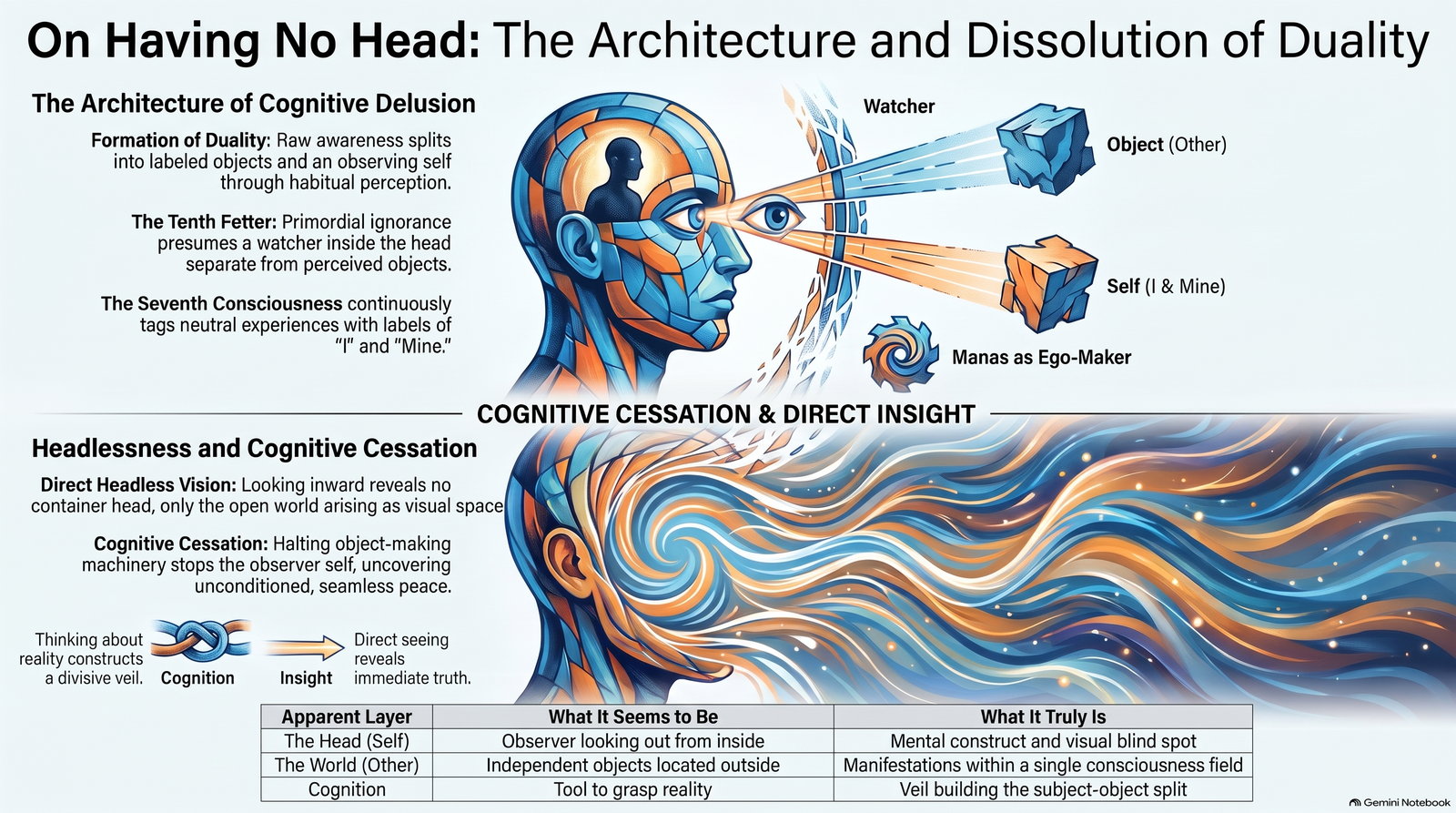
Read the diagram as an illustration of the author’s model. Its upper half represents appropriation through a watcher–object division; its lower half represents the loosening of that division. The table contrasts a presumed inner observer, an external world and conceptual cognition with the chapter’s nondual interpretation. Its headings “What It Truly Is” and “Cognitive Cessation” express that interpretation; they do not establish a single consciousness field as scientific fact, or equate headlessness with a recognised cessation attainment. The image’s “blind spot” is figurative, rather than the anatomical retinal blind spot.
Terms for careful reading
Headlessness
Douglas Harding’s term for a first-person approach to identity, contrasting the face known through mirrors and other people with the immediate perspective of seeing. It does not deny the biological head. Robinson uses it to question the presumed separate observer; that extension does not certify Buddhist liberation.
Phenomenology
The description and study of how things appear in experience. Here it distinguishes a report about the felt location of the observer from a claim about anatomy or the universe’s ultimate composition. A compelling description can open a philosophical question without resolving its scientific or metaphysical explanation.
Nonduality and emptiness
Nonduality can name an experience or philosophical account in which subject and object are not treated as independently existing poles. In Buddhist contexts, emptiness concerns the absence of inherent existence, rather than nothingness. Neither term licenses solipsism, a permanent cosmic self, or the denial of ordinary consequences.
Avijjā and the tenth fetter
Avijjā is Pāli for ignorance; avidyā is Sanskrit. In the Theravāda ten-fetter scheme it is the final fetter. Early texts relate ignorance to not understanding suffering, its origin, cessation and path. Robinson’s emphasis on a separate watcher interprets this broader category; a perceptual shift alone cannot verify its removal.
Yogācāra
A diverse Mahāyāna Buddhist philosophical tradition associated with Asaṅga and Vasubandhu. Its influential eight-consciousness model is a traditional account of experience and conditioning. It is not a division of the brain into eight anatomical layers, and the recording’s comparisons with cognitive science do not validate it experimentally.
Manas
In the eight-consciousness Yogācāra model, the seventh, afflicted mental function is associated with self-grasping. The recording pictures it as a label maker appropriating experience. This is an explanatory image, rather than a literal inner agent, and should not recreate the little observer the discussion is questioning.
Ālaya-vijñāna
Often translated as storehouse or substratum consciousness in Yogācāra, this accounts for continuity and karmic dispositions. It is conditioned, not simply an eternal pure awareness. Robinson’s illuminated field and the hosts’ cinema screen are interpretive renderings; neither makes the eighth consciousness equivalent to a universal self or final awakening.
Saññā and saṅkhāra
In Pāli Buddhist analysis, saññā concerns perception or recognition; saṅkhāra has several contextual meanings, including volitional formations. The chapter combines them in its account of naming. Recognition is not inherently a clinical hallucination, and perception is broader than explicit words or labels. Useful discrimination need not amount to rigid self-identification.
Papañca
A Pāli term commonly rendered as conceptual proliferation: the elaboration through which experience becomes entangled with craving, views and self-reference. The recording illustrates it with replayed arguments and anxious stories. It should not be used to dismiss every concern as imaginary or to reduce real adversity to faulty thinking.
Nirodha
Pāli for cessation. The cessation of suffering in the noble truths and the meditative attainment called cessation of perception and feeling have distinct contexts. Robinson also uses cessation for the ending of divisive object-making. These senses require separation; ordinary awareness without inner commentary is not sufficient evidence for the formal attainment.
Trikāya: the three Buddha bodies
In Mahāyāna Buddhist traditions, dharmakāya, sambhogakāya and nirmāṇakāya describe dimensions of Buddhahood. The recording’s empty essence, radiant nature and manifestation language is a particular interpretive presentation. It does not mean that Buddha bodies replace eyes, ears or other sense organs, or demonstrate that Harding’s experience is the same attainment.
Jhāna, nibbāna and saṃsāra
In early Buddhist usage, jhāna concerns meditative absorption; nibbāna concerns liberation, and saṃsāra the round of rebirth. These are not interchangeable terms for a pleasant pause in thinking. Robinson’s account of the same world without fabricated meanings is his synthesis; a radiant appearance or bodily “glow” cannot establish any of these attainments.
Related pathways
- 3.3.5. The Transmutation of SufferingThe preceding book chapter connects interpretations of adversity with compassion.
- 3.3.2. SolipsismTests the difference between a first-person account and claims that only one mind exists.
- 3.2.9. The Metaphor of the Film ProjectorDevelops the cinema imagery used to discuss perception and identification.
- 3.2.2. The Six KnotsA related inquiry into the construction of the perceiver–perceived relationship.
- Object — Part Three of Citrinitas | Spiritual Alchemy Course | Dr Simon RobinsonPlaces this chapter in the wider Object section.
External reference points
These sources clarify provenance and terminology. Their inclusion does not imply that the recording follows their interpretations throughout.
- Douglas Harding: extract from On Having No HeadHarding’s own account, hosted by the Headless Way; primary testimony rather than independent proof of its metaphysical implications.
- Stanford Encyclopedia of Philosophy: YogācāraScholarly context for the eight-consciousness model and the diversity of mind-only interpretations.
- SN 12:2: An Analysis of Dependent Co-arisingṬhānissaro Bhikkhu’s translation; defines ignorance through the four noble truths and distinguishes the factors of dependent arising.
- MN 43: The Greater Set of Questions & AnswersṬhānissaro Bhikkhu’s translation; a primary reference for perception, feeling and their meditative cessation.
Question to carry forward
When a disagreement becomes a story about “the sort of person I am”, what specific fact, responsibility or other person’s concern might that story be obscuring?
The invitation is to reconsider an interpretation in an ordinary relationship. Boundaries, consent, practical judgement and responsibility remain relevant even when a rigid self-description loosens.
Continue through Citrinitas
This follows chapters 29–31 of the Revised Edition (2026). The next chapter is linked as a video because a current matching Cave webpage is not established by the supplied export.