
Citrinitas · Object · Chapter 31 of 48
The Allegory of the Cave
Revised Edition (2026) · Catalogue reference 3.3.7
When an interpretation feels like reality itself, what would it mean to recognise the difference?
Watch the chapter dialogue
Plato’s Cave Explained: The Prison of Perception
The chapter in brief
In the Object section, this chapter uses Plato’s cave to examine the difference between experiencing something and taking one’s interpretation of it as final. Robinson associates the fire inside the cave with Albedo’s clarifying intellect and the sun outside with Citrinitas’s solar imagery. These associations belong to his modern alchemical reading, rather than to Plato’s stated teaching. The chapter then brings Buddhist accounts of mental proliferation into the picture: perception becomes entangled with stories of ownership, threat and identity. Its comparison of arahant liberation and the bodhisattva path extends that synthesis towards Rubedo, while drawing on traditions that retain different aims and explanations. The practical tension is whether a useful map can loosen habitual certainty without becoming another claim to possess reality.
Video guide · What makes a shadow convincing?
The recording opens with the shock of a theatre’s house lights coming on: a compelling drama suddenly becomes a performance one has been watching. It uses that change of context to introduce Plato’s prisoners, their shadows and echoes, and the difficulty of recognising a representation as a representation. A terse message from a boss gives the discussion its everyday anchor. A few words become a feared dismissal, financial ruin and a threatened identity. The useful question is how much of that conclusion the message actually establishes; it is not whether jobs, financial pressures or other people are imaginary.
The dialogue next reads the cave’s fire as Albedo and its sun as Citrinitas. It values intellectual clarification while asking whether explaining one’s patterns necessarily changes one’s relationship to them. The painful ascent is presented through the author’s language of a “dark night of the spirit”, followed by the returning prisoner’s difficulty communicating with those who remain. This is a contemplative analogy, not evidence that loss of meaning, alienation or distress demonstrates insight. Likewise, the recording’s “phase shift” and nervous-system language should be heard as figurative explanation, rather than an established account in physics or neuroscience.
From there, the conversation turns to maps of consciousness and their limits. Its reference to 89 or 121 classes of consciousness belongs specifically to Theravāda Abhidhamma systematisation. The main explanatory movement, however, is towards papañca: a phone buzz becomes a story of disrespect, insecurity and impending disaster. The Veil of Isis supplies Robinson’s image for the separation between an inner observer and an outer world. These examples make the chapter more concrete, while the claim that suffering is entirely narration goes beyond what they establish. Pain, mistreatment and practical problems still require attention.
The final movement contrasts freedom from grasping with an image of the cave itself dissolving into nondual awareness. The dialogue associates these respectively with the arahant and the bodhisattva, then returns to the difficulty of releasing familiar dramas. That pairing is the author’s comparative model, not a shared Buddhist hierarchy. Arahant liberation is realised during life, and bodhisattva commitment does not by itself mean completed Buddhahood. The closing question asks what becomes of the would-be escapee if that identity is also part of the story. It can remain an open philosophical question, without demanding thought suppression, self-erasure or a claim of attainment.
An allegory, not a universal mechanism
Plato’s account concerns education, knowledge and the Good. Robinson’s fire–Albedo and sun–Citrinitas correspondence is a later interpretive use of that account; it does not establish that Plato encoded an alchemical process. “Light” here does not name a measured substance of awareness.
The Buddhist comparison also needs limits. Early Buddhist texts describe an arahant’s ending of greed, hatred and delusion while the senses remain active. This is not incomplete liberation awaiting death. Mahāyāna bodhisattva teachings provide a different framework of wisdom and compassion; neither framework is interchangeable with Rubedo. Nonduality does not remove responsibility, boundaries or the need to respond to harm.
The movement of the argument
The familiar world becomes a performance
The theatre opening and Plato’s prisoners ask how a convincing appearance acquires the authority of reality.
A message becomes a threatened self
The boss’s email shows interpretation expanding beyond the information actually received.
Clearer shadows still have limits
The fire and sun become Robinson’s comparison between conceptual clarification and a changed relationship to experience.
A map cannot do the seeing
Detailed classifications of consciousness are valued, then distinguished from the freedom they describe.
Narration builds the dividing wall
The buzzing phone illustrates papañca, while the Veil of Isis pictures the imagined separation of observer and observed.
Two images of freedom are compared
The dialogue contrasts ungrasped appearances with a nondual dissolution of the cave within the author’s synthesis.
The escapee becomes the question
The conclusion asks whether the identity seeking release is itself another appearance taken as solid.
Book and recording
The chapter’s emphasis
The complete revised chapter, including Table 44 and its study guide, supplies the cave, solar imagery, proliferation and contrasting liberation models.
The recording’s expansion
The theatre, workplace email, buzzing phone and listening-to-music examples translate the chapter’s abstractions into recognisable situations.
The page’s distinction
Plato’s philosophy, Theravāda analysis, Mahāyāna ideals and Robinson’s alchemical correspondences are read alongside one another without being declared identical.
Reading the alchemical cave illustration
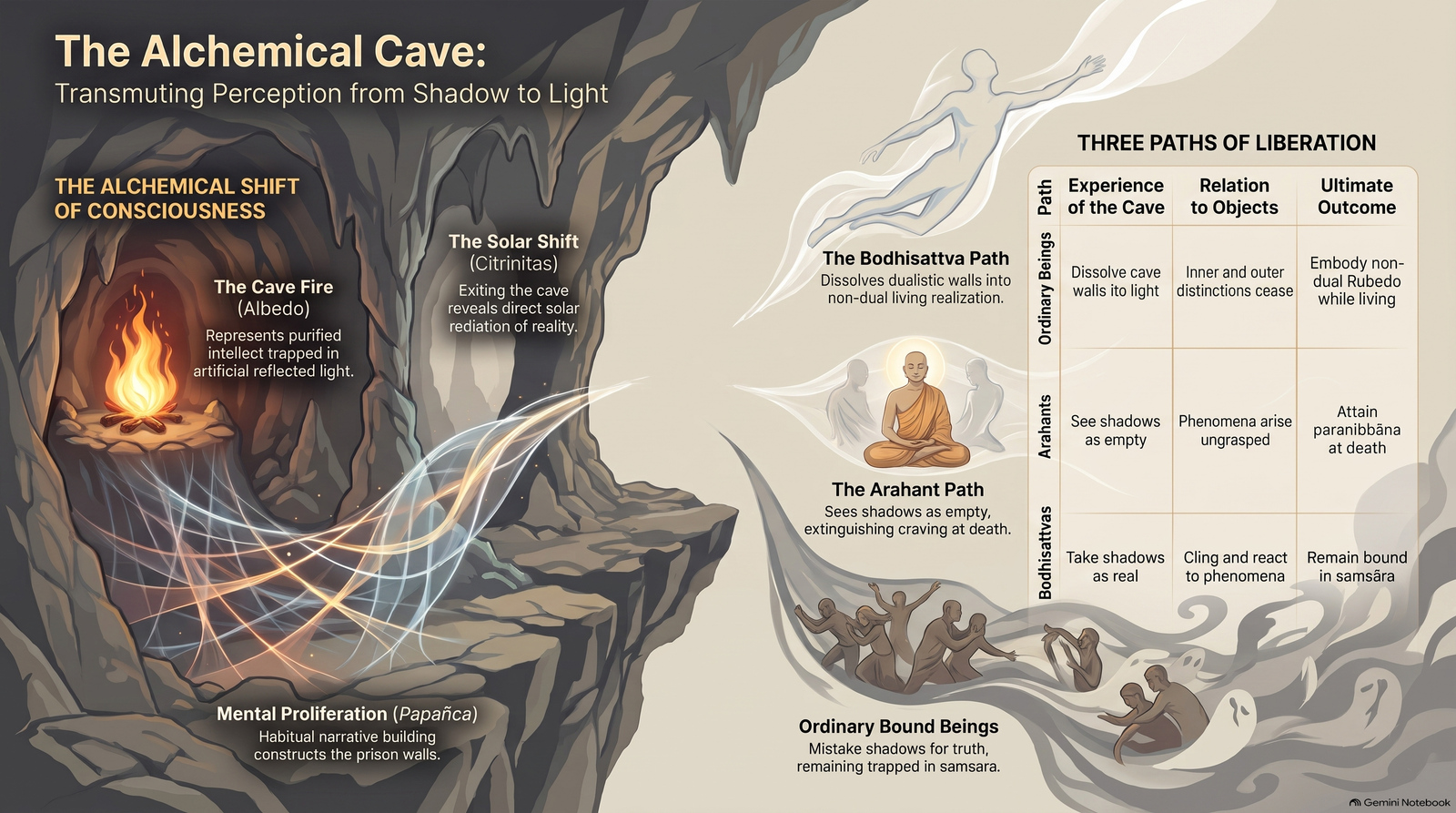
Text alternative and interpretive limits
The cave fire stands for clarified conceptual understanding; the sunlight represents Robinson’s solar imagery of insight. Threads across the cave stand for habitual narrative-making. The intended comparison is between taking appearances as unquestionable, experiencing them without grasping, and the author’s image of nondual living. These are illustrative categories, not three universally recognised Buddhist stages. In the image’s table, the top row’s content concerns the bodhisattva model and the bottom row’s content concerns ordinary beings, despite their reversed labels.
Terms for this chapter
Allegory of the cave
In Plato’s Republic, Book VII, prisoners mistake shadows for what is real; release requires a difficult reorientation. Plato relates the ascent to education and the intelligible Good. Robinson reuses the image for contemplative interpretation, rather than offering a historical reconstruction of Plato’s intentions.
Albedo and Citrinitas
The white and yellow stages of alchemical colour symbolism become stages in Robinson’s account of transformation. Here the cave’s fire represents intellectual clarification and the sun represents solar insight. This is a symbolic correspondence, not a physical conversion of thought into light.
Papañca
Often translated as conceptual proliferation or objectification, this Pāli term concerns thought becoming entangled with divisions, conflict and self-reference. MN 18 describes relations among contact, feeling, perception, thinking and proliferation. The dialogue’s anxiety cascade is an illustration; papañca is not simply a synonym for all thinking.
Contact, feeling and perception
In the early Buddhist account used here, contact involves a sense faculty, its object and the corresponding consciousness. Feeling concerns an experience’s pleasant, painful or neutral tone; perception recognises or marks features. These distinctions are contemplative analysis, not experimentally measured fractions of a neural processing sequence.
Abhidhamma and citta
Theravāda Abhidhamma and its explanatory literature analyse consciousness, or citta, through detailed classifications. The familiar 89- and 121-fold enumerations belong to that systematisation, not to every Buddhist school. The supramundane category concerns liberating paths and fruits; it is not another cosmological place alongside sensual, form and formless realms.
The Veil of Isis
In this chapter, a Western esoteric image becomes a metaphor for treating an inner observer and an outer world as intrinsically separate. This particular cognitive reading belongs to Robinson’s synthesis. It should not be mistaken for an established ancient Egyptian theory of perception or a scientifically identified barrier.
Arahant and parinibbāna
In early Buddhist and Theravāda accounts, an arahant has ended the defilements responsible for continued bondage. Liberation is realised while alive, with sensory experience continuing. Parinibbāna commonly names final nibbāna at death; it does not mean that craving survives until then. The source’s spelling “paranibbāna” is regularised here.
Bodhisattva
In Mahāyāna Buddhism, a bodhisattva is committed to Buddhahood for the benefit of beings, cultivating wisdom and compassion. The term includes a path of development, not only its completion. The chapter’s association with dissolving the cave and embodying Rubedo is Robinson’s interpretation rather than a definition shared by all traditions.
Nonduality and emptiness
Nonduality can describe experience without a rigidly separate observer and observed. Buddhist emptiness concerns the absence of independent, intrinsic existence. Neither establishes that one’s private mind creates the world, that appearances are worthless, or that conventional differences and ethical responsibilities disappear. The meanings depend on the tradition being discussed.
Buddha-nature
A family of Mahāyāna teachings concerning Buddhahood and beings’ capacity or basis for awakening, interpreted differently across texts and schools. Robinson invokes it as something overlooked amid habitual fascination with objects. It should not automatically be identified with a permanent personal self or a universal luminous substance.
Dark night of the spirit
Language associated with Christian mystical theology is used here for the painful reorientation pictured by the ascent. That comparison does not equate Christian purification with a Buddhist attainment. Distress, disorientation or loss of meaning are not tests of insight, and do not need to be cultivated.
Rubedo
The red stage of alchemical symbolism is Robinson’s image of integration within embodied, ordinary life. The recording connects it with the bodhisattva ideal and nondual awareness. That connection remains an authorial synthesis: Rubedo is not a standard Buddhist category, a clinical outcome or a certificate of completed awakening.
Related pathways
- 3.2.5. PapañcaFollow the Buddhist analysis behind the dialogue’s examples of proliferating narratives.
- 3.2.10. The Veil of IsisExplore the chapter’s image of a boundary between observer and observed.
- 3.2.9. The Metaphor of the Film ProjectorCompare another authorial metaphor for perception and interpretation.
- 3.3.2. SolipsismKeep first-person experience distinct from claims that a private mind creates reality.
- Object — Part Three of Citrinitas | Spiritual Alchemy Course | Dr Simon RobinsonLocate this inquiry within the Object section.
- Citrinitas – Part ThreeReturn to the wider scope and organisation of Part Three.
External reference points
- Plato, Republic, Book VIIUniversity-hosted text: see 514a–521b for the cave, education, the Good and the return to civic life. These concerns differ from the later alchemical reading.
- MN 18 · The Ball of HoneyṬhānissaro Bhikkhu’s translation and introduction clarify papañca, its connection with conflict and the limitations of simple English equivalents.
- Itivuttaka 44 · The two nibbāna-elementsJohn D. Ireland’s translation distinguishes liberation while sense faculties remain from the element without residue. It helps correct the idea that craving ends only at death.
- Marcus Aurelius · Meditations, Book XIIGeorge Long’s translation provides a check on attribution: section 36 concerns departure from life, not the unfailing inner-light sentence attributed to it in the recording.
These texts provide context and checks; they do not independently establish a single teaching shared by Plato, Buddhist traditions and modern alchemy.
Question to carry forward
When an ordinary message feels threatening, what is actually known, what has been inferred, and what practical response would remain considerate and proportionate if the inference were mistaken?
The question allows for real difficulties as well as mistaken assumptions. It does not require dismissing harm, silencing thought or treating distress as spiritual progress.