
Nigredo · Dharma · Chapter 24 of 48
1.2.12. The Eightfold Noble Path
If awakening cannot be forced, what kind of life prepares the conditions in which a genuine change of perspective can occur?
Watch the chapter discussion
The Path Out of Suffering
The book
The chapter in brief
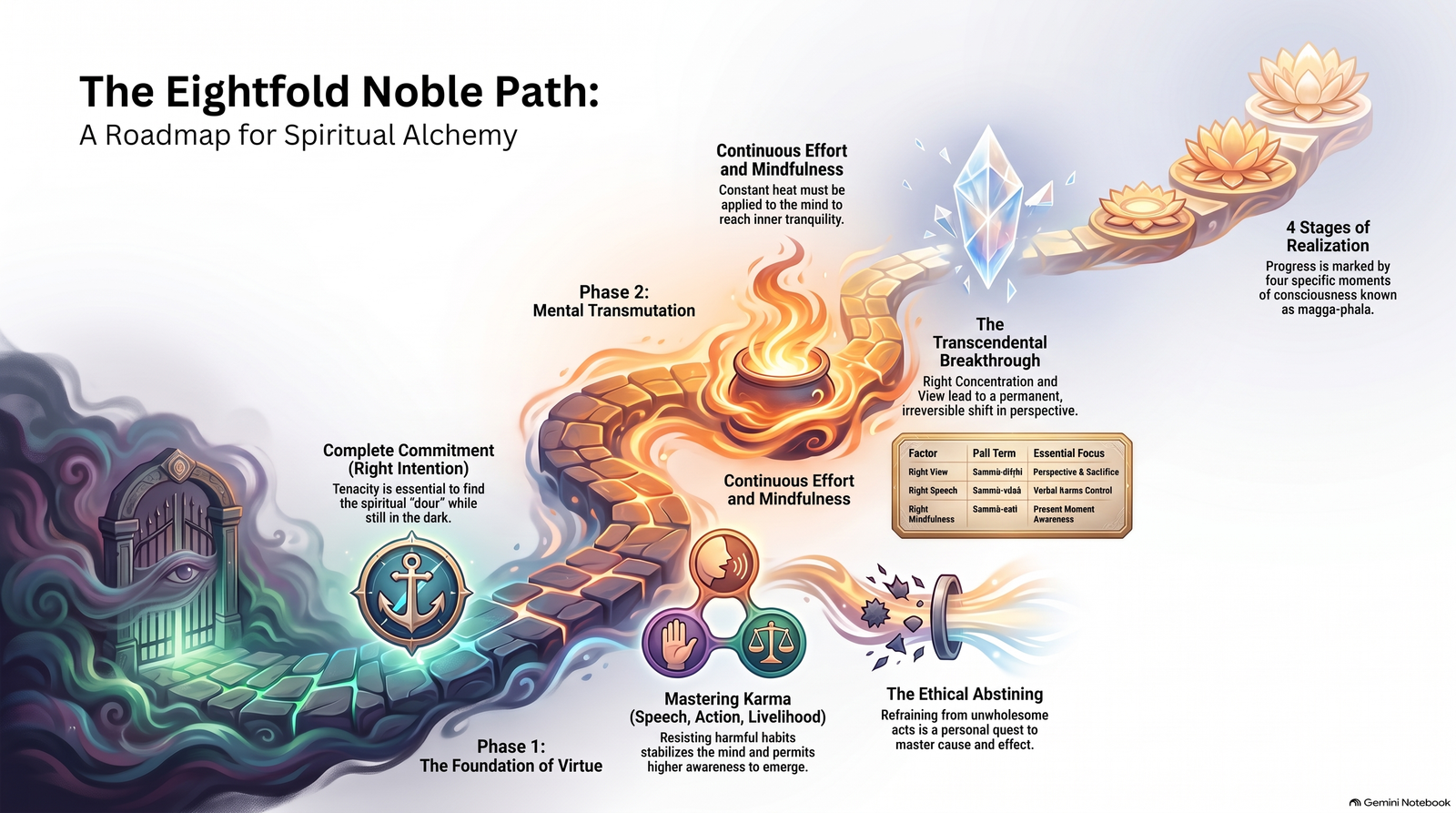
This final Dharma chapter presents the Noble Eightfold Path as an interconnected training through which intention, conduct, attention and understanding support one another. The practitioner cannot command a transcendental breakthrough; the practical task is to prepare the conditions through commitment, ethical restraint, sustained effort, mindfulness, concentration and view.
The chapter then reads this Buddhist framework through the course’s alchemical imagery. Ethical discipline steadies the vessel; Right Effort supplies heat to the retort; consciousness is the material undergoing transformation. This is Dr Robinson’s modern synthesis, not a claim that early Buddhist teaching and Western alchemy historically formed a single system.
Visual orientation
A road discovered through practice
Video guide
Preparing the ground without trying to manufacture awakening
The recording begins with the image of an ancient road leading to a forgotten city. The path is not another identity to construct or a programme for polishing the personality. It is something to uncover beneath habitual perception. The video names the ordinary condition “spiritual blindness”: identification with a vulnerable body in a threatening world produces a life organised around defence, acquisition, pleasure and avoidance. That is the chapter’s spiritual diagnosis, not a denial of the body, material conditions or the practical realities of danger.
The trainee’s difficulty is that the destination cannot yet be known directly. One can prepare the “raw material,” but not schedule insight. The discussion therefore makes faith less a demand for unexamined belief than a provisional confidence in the training. Even without a dramatic breakthrough, the path may still offer a more truthful and less harmful way of living. The metaphor of searching for a door in darkness captures both commitment and uncertainty: perseverance need not pretend to possess the conclusion in advance.
The middle of the recording treats Right Speech, Right Action and Right Livelihood as the cleaning and sealing of an alchemical vessel. False or divisive speech, harmful action and work based upon deception or injury do not merely break rules; they generate conflict, remorse and mental disturbance. This functional account is useful, though ethics should not be reduced entirely to the seeker’s tranquillity. The welfare and dignity of other beings matter in their own right, not only because harming them agitates the practitioner.
Right Effort becomes the heat applied continuously to the retort. Right Mindfulness is distinguished from bare attentiveness: a thief or a person planning revenge may be intensely attentive, so “right” mindfulness is placed within an ethical and liberative orientation. The video describes a progression from recognising a state after it has passed, to noticing it while it arises, to a less entangled observation of changing experience. Its language of becoming “the screen, not the movie” is a metaphor for non-identification, not a reason to withdraw from responsibility or dismiss emotions as unreal.
Right Concentration introduces jhāna, while the recording also describes the debated possibility of “dry insight” and loosely associates it with Zen and Chan. Buddhist traditions do not agree uniformly about the required depth of concentration, and Zen or Chan cannot simply be reduced to a concentration-free alternative. The broader point is sounder: tranquillity and discernment support investigation, while unusual absorption is not itself proof of awakening.
The video places Right View last, treating it as the perspective that completes the path and feeds back into every other factor. Traditional presentations ordinarily list Right View first, followed by Right Intention, but the factors are not an eight-rung ladder. View guides conduct and cultivation; conduct reduces avoidable agitation; cultivation makes clearer view possible. The chapter’s alchemical reading is therefore cyclical: preparation, heat and insight continually condition one another.
The eight factors
One path, eight mutually supporting dimensions
The cards below follow the traditional order. The book and video begin pedagogically with Right Intention and return to Right View as completion; neither arrangement means that one factor is permanently finished before the next begins.
Right View Sammā-diṭṭhi
Understanding action and consequence, suffering and its cessation, and the orientation that gives the remaining factors their purpose.
Right Intention Sammā-saṅkappa
Intentions of renunciation, goodwill and harmlessness: the direction of travel before speech or action gives intention outward form.
Right Speech Sammā-vācā
Refraining from false, divisive, harsh and purposeless speech while cultivating communication that is truthful and timely.
Right Action Sammā-kammanta
Embodied conduct shaped by non-harming, respect for what is not given and responsibility in sexual behaviour.
Right Livelihood Sammā-ājīva
Earning a living without making deception, exploitation or injury the practical basis of one’s work.
Right Effort Sammā-vāyāma
Preventing and abandoning unwholesome states, and cultivating and sustaining wholesome qualities.
Right Mindfulness Sammā-sati
Clear recollection and observation of body, feeling, mind and patterns of experience within the path’s ethical and liberative frame.
Right Concentration Sammā-samādhi
The unification and stability of mind associated in early Buddhist formulations with the four jhānas.
A second way to read the map
The threefold training
The path is often gathered into three interdependent trainings. This makes its structure easier to see without turning eight factors into isolated commandments.
| Training | Factors | Function within the chapter |
|---|---|---|
| Wisdom · paññā | Right View; Right Intention | Establishes direction, discernment and the intention to relinquish harm. |
| Ethical conduct · sīla | Right Speech; Right Action; Right Livelihood | Reduces conflict and remorse while giving wisdom a lived, relational form. |
| Mental cultivation · samādhi | Right Effort; Right Mindfulness; Right Concentration | Develops steadiness, observation and the capacity to investigate experience without habitual capture. |
Argument map
How the recording develops
Discover rather than construct
The ancient-road image recasts transformation as uncovering a path obscured by habit rather than building a superior personality.
Diagnose defensive perception
Identification with a vulnerable body in a hostile world is presented as the structure that keeps attention bound to reaction.
Prepare what cannot be forced
The trainee cannot manufacture transcendental awareness, but can cultivate the conditions in which clearer understanding becomes possible.
Steady the ethical vessel
Speech, action and livelihood are treated as practical sources of either agitation or stability rather than as external moral policing.
Apply effort and attention
Continuous effort supplies alchemical heat, while mindfulness notices mental states without immediately becoming their story.
Unify the mind
Concentration steadies attention and supports insight, though the status of jhāna and “dry insight” varies across Buddhist interpretations.
Let view inform the whole
Right View completes the video’s sequence and begins it again, turning the eight factors into a self-reinforcing training.
Return to ordinary practice
The closing invitation is practical: align communication, work, attention and intention even without claiming extraordinary attainment.
Book, video and context
Four layers of the discussion
The written chapter
Introduces the eight factors as preparation for path and fruit consciousness, emphasising commitment, ethical abstinence, effort, mindfulness, concentration and a transformed view.
The video’s expansion
Adds the ancient road, door in the dark, high-voltage transformer, sealed vessel, reduced drag, heated retort and feedback-loop metaphors.
The early Buddhist framework
SN 45.8 defines the eight factors; MN 117 distinguishes ordinary and noble dimensions of Right View and explains how factors support one another; SN 56.11 places the path within the Four Noble Truths.
The course synthesis
The language of lead becoming gold, consciousness as alchemical material, and the retort as Subjective Reality belongs to the author’s interpretive project.
Recording outline
The route through the video
The supplied catalogue markers conflict with the verified 26:36 final duration: the 27:10 and 32:20 markers cannot occur in this cut. To avoid publishing false links, the page preserves the supplied topic sequence without attaching unverified times.
- 01Opening: You Cannot Force Awakening
- 02What Is the Path?
- 03Right Intention and Commitment
- 04Speech, Action and Livelihood
- 05Effort and Mental Discipline
- 06Mindfulness and Awareness
- 07Concentration and Stability
- 08Right View and Completion
Key language
Glossary
Ariyo aṭṭhaṅgiko maggo
Abhiññā
Saddhā
Citta
Kamma / karma
Jhāna
Vipassanā
Magga-phala
Pañcindriya / the faculties
Manas
Continue into the ideas
Related reading and source texts
Within this course
- 1.2.9 The Four Noble TruthsEstablishes suffering, its conditions, cessation and the path within which the eight factors belong.
- 1.2.10 The Cycle of BecomingExamines the conditioned process that the path is intended to understand and interrupt.
- 1.2.11 The Fetters that BindMaps the bonds associated with progressive awakening before this chapter turns to training.
- 1.3.1 The Great WorkThe next course chapter expands the alchemical process to which this page repeatedly points.
- Dharma — Part Two of NigredoThe section index for the twelve Dharma chapters completed here.
Early Buddhist reference points
- SN 45.8 — Analysis of the Eightfold PathA compact early Buddhist definition of each of the eight factors.
- MN 117 — The Great FortyA fuller account of Right View and the interdependence of view, effort, mindfulness and the remaining factors.
- SN 56.11 — Rolling Forth the Dhamma WheelPlaces the Noble Eightfold Path within the early Buddhist formulation of the Four Noble Truths.
Grounded reflection
Where does the path become visible today?
Choose one ordinary situation involving speech, work, desire, irritation or distraction. Which intention is operating? What consequence is already being produced? Can clearer attention change the next response without requiring a claim about attainment? The path becomes practical when view, ethics and cultivation meet in one actual choice.