
Dialogues V · Episode 17
Is Reality a Shared Hallucination? | Dialogues V
We make sense of the world together, and the world can still prove us wrong.
The central question
If perception is constructed, what makes it answerable to a shared world?
Suppose that calling a claim true meant only that someone held it sincerely. The opening thought experiment asks what would become of cooperation and disagreement if we lost the means to establish what happened. An engineer can test how a bridge bears a load, and two people can look for records when they dispute a boundary. The further difficulty is that we make such checks through senses and instruments that select and organise information. How can a limited view still disclose something others can check?
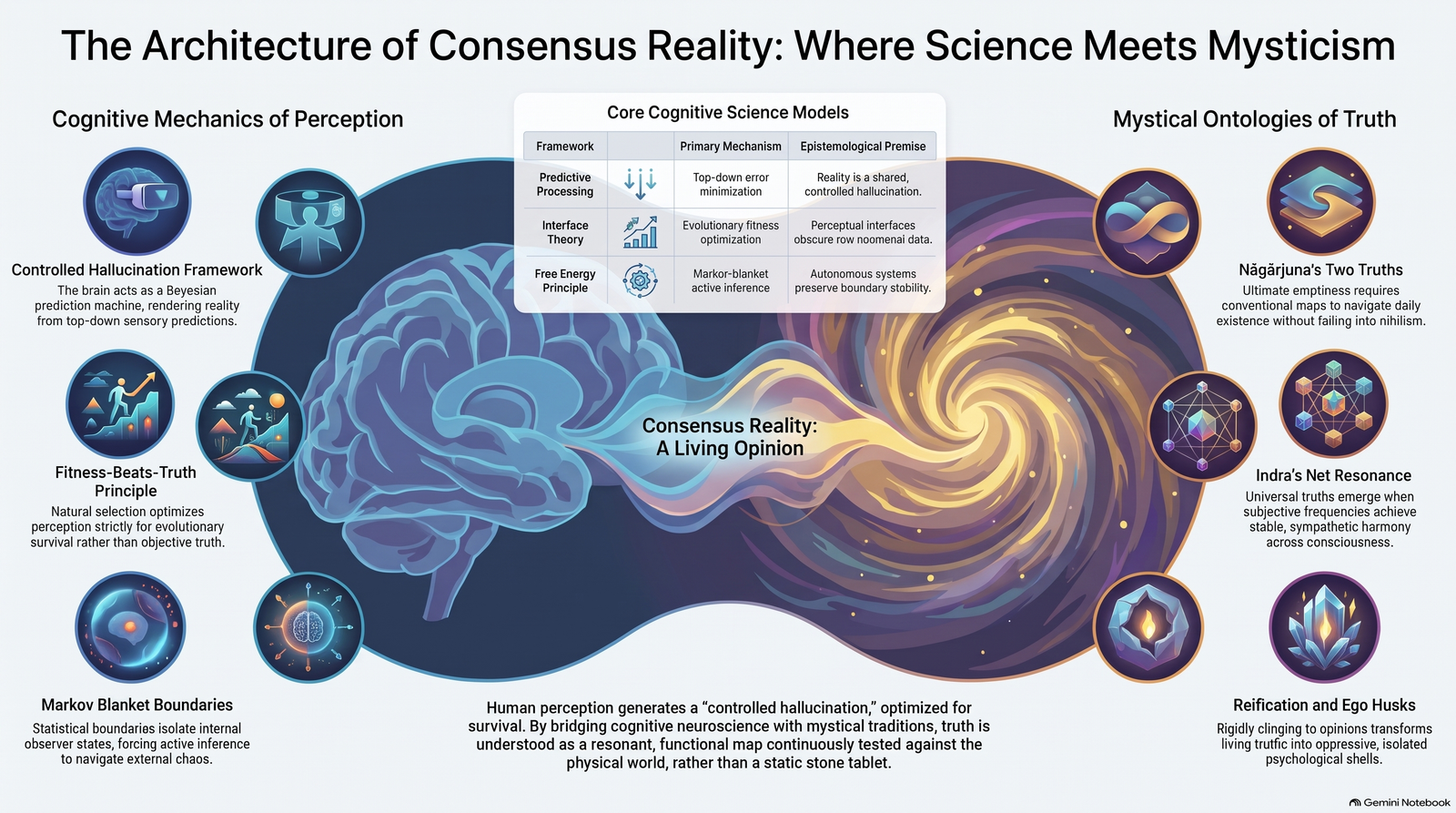
Predictive processing gives the hosts a way into the problem. A shape glimpsed at dusk looks like a snake until a clearer view reveals a stick. The example shows how an expectation can shape experience and how fresh information can alter it. Donald Hoffman’s desktop analogy then asks how much a perceptual interface needs to reveal. The episode tests that proposal with a piece of wood whose weight, shape and dryness matter for different purposes. The flexible-goals research asks when a system that serves several purposes might benefit from preserving aspects of the world’s structure. Markov blankets and active inference then bring the discussion to the relation between a system and its surroundings.
The Buddhist turn shifts the inquiry from perception to the status of the distinctions we use. In Nāgārjuna’s Madhyamaka, things can function conventionally while being empty of independent existence. The swimmer still has to swim. The reflection of Narcissus becomes a way to ask how a working description turns into an identity. The early Buddhist analysis of the five aggregates brings that question to bodily form, feeling, perception, mental formations and consciousness.
Huayan’s Indra’s net and the shattered vessels of Lurianic Kabbalah close the episode with distinct images of mutual dependence and repair. Their place in the dialogue is symbolic. The practical challenge at the end is to keep a belief usable and open to correction, especially when it feels like part of who you are. What would count as sufficient reason to change it?
How to read this episode. “Controlled hallucination” is a metaphor for perception shaped by expectation and constrained by sensory input. Hoffman’s interface claim and the flexible-goals reply depend on their modelling assumptions. A Markov blanket describes a statistical relation. The Buddhist and Kabbalistic comparisons work by analogy, and “resonance” here is a figure of speech. People can agree and still be mistaken.
Argument map
From shared facts to revisable beliefs
Keep the friction of being wrong
The opening thought experiment asks what becomes of cooperation and accountability when factual disagreements have no shared way of being tested.
Let the senses correct the guess
A shape first seen as a snake becomes a stick as clearer sensory information revises the initial prediction.
Ask what a useful interface must preserve
Hoffman’s desktop analogy is tested against the example of wood whose different properties matter as an organism’s goals change.
Model the boundary
The amoeba introduces Markov blankets and active inference as ways of modelling how a system exchanges signals and acts within its environment.
Keep conventions usable
Nāgārjuna’s two truths allow ordinary distinctions to do their work while exposing the mistake of granting them an independent essence.
Notice identification
Narcissus and the five aggregates raise the question of how passing experiences and views acquire the felt authority of “this is me”.
Return to a revisable map
Indra’s net and the shattered vessels offer different images of interdependence and repair before the dialogue returns to beliefs that can change under scrutiny.
Chapters
Chapter times are estimated from the edited transcript. Each link opens YouTube at the indicated time.
- 00:00What happens when truth becomes opinion?
- 04:50Predictive processing and “controlled hallucination”
- 09:00Shared maps and a world that pushes back
- 10:40Hoffman’s evolutionary interface
- 12:30Why flexible goals need an accurate map
- 14:50Markov blankets and active inference
- 16:50Emptiness, nihilism and the two truths
- 19:35When useful concepts become dogma
- 21:10Narcissus, the aggregates and self-view
- 24:05Indra’s net and mutual reflection
- 27:30Kabbalah: shattered vessels and repair
- 30:50Let the map breathe
Glossary
Predictive processing
A family of accounts in which the brain anticipates sensory input and uses mismatches between expectation and incoming signals to revise what it infers. The episode’s snake-and-stick example shows how the same ambiguous shape can be perceived differently as more information becomes available.
Controlled hallucination
Anil Seth’s metaphor for how perception depends on expectations constrained by sensory signals. The word “controlled” matters because new information can correct an interpretation. The phrase describes a way of thinking about ordinary perception and carries no clinical implication in this context.
Evolutionary interface
Donald Hoffman and colleagues compare perception to a desktop interface that presents information in a form useful for action. Whether a useful interface must preserve some structure of the world remains disputed. The flexible-goals challenge asks what happens when the same perception has to serve several different purposes.
Markov blanket
In a statistical model, a set of variables that makes the internal and external variables conditionally independent. Roughly, once the blanket variables are known, the external variables add no further statistical information about the internal ones in that model. A cell membrane illustrates mediated exchange, while the blanket itself is a mathematical relation.
Active inference
A framework in which an agent both updates its expectations in response to sensory information and acts in ways that change the information it receives. Moving to get a better look at an unfamiliar object illustrates this coupling of action and perception.
Emptiness (śūnyatā)
In Madhyamaka, the absence of inherent, independent existence. A thing can arise through conditions, be named and have effects without having a self-sufficient essence. The same analysis applies to emptiness itself, which can become another object of attachment if treated as a final substance.
The two truths
In Nāgārjuna’s Madhyamaka, conventional truth concerns how things function and are spoken of in ordinary dealings. Ultimate analysis discloses their emptiness of inherent existence. Indian Buddhist schools develop this distinction in different ways. The episode’s swimming analogy illustrates why recognising dependence leaves ordinary consequences in place.
Reification
Treating a distinction, category or model as if it were an independently existing thing or a final account of reality. A common example is turning a judgement about one encounter into a fixed verdict about a person. The episode applies the same scrutiny even to the concept of emptiness.
Five aggregates (khandhas)
An early Buddhist grouping of experience into bodily form, feeling tone, perception, mental formations and consciousness. The discourse on the characteristic of non-self (SN 22.59) examines whether what changes and cannot be fully commanded is fit to be regarded as “mine”, “I” or “my self”.
Identity view (sakkāya-diṭṭhi)
An early Buddhist term for taking one or more of the five aggregates to be the self, to belong to the self, or to stand in a containing relation to it. The episode’s reading of Narcissus illustrates identification with a reflection. That reading is an interpretation of the myth.
Indra’s net
An image used in Huayan Buddhism to illustrate interdependence and interpenetration. A jewel at each crossing reflects every other jewel, so that each reflection includes further reflections. The episode’s tuning-fork analogy extends the image poetically. Agreement among people can still leave the underlying claim open to question.
Shattering of the vessels and tikkun
In the Jewish mystical tradition associated with Isaac Luria, the shattering of the vessels disperses divine sparks among the shells or husks (qelippot). Tikkun, or repair, includes the restoration of those sparks through religious practice. The episode adapts these images to reflect on rigid beliefs and their loosening.
A one-minute reflection
Give one judgement room to change
Choose a low-stakes judgement you made today, such as “this room is too dim to read in”. Take a moment to recall what you observed and what you inferred. Ask what you could check that might change your mind. If it is easy to do, try the check and notice whether the original judgement still fits.