
Dialogues V · Bonus Episode 01
A Map of the Mind — And What Lies Beyond | Dialogues V Bonus
A library can teach us to read the maps we use to understand the mind, and to see where they leave us.
The central question
How can a map of experience make us more attentive to what it leaves out?
This bonus episode begins with a personal inquiry into consciousness that gradually became a public library. Dr Simon Robinson’s years in medicine and his study of Buddhist and Western esoteric traditions explain why the library brings such different kinds of material together. The hosts ask how those backgrounds inform the questions the project can pose, and what kind of evidence would be needed to support the answers. Their image of a navigation screen on a rain-soaked night makes the distinction tangible. The screen can show where to turn, while the driver still has to judge the road.
The episode then tests that principle against the design of A Course in Modern Alchemy. Four alchemical colour stages give the course its overall shape. Within each stage, Mythos, Dharma, Object and Subject bring stories, Buddhist analysis, contemplative frameworks and the reader’s own involvement into view. The four perspectives give readers ways to question a first interpretation. The hosts press on an awkward possibility, though. A planned 192-lesson structure could itself become something to defend. Its value depends on whether moving between perspectives helps a reader see what any one of them leaves out.
Dialogues gives that testing a looser form. Text exchanges can remain unresolved, and a language model can offer a reading that the next question exposes as premature. The discussion then turns to The Way In. The Way Out. and the language people use for distress, relief and changes in identity. These are circumstances in which an elegant explanation can miss what a person actually needs. The website walkthrough shows what study can look like in practice, using The Golden Middle Path as a place to move between a video, a glossary and an argument map.
The closing phrase, “evanescent crescendo”, names the direction of travel into Dialogues VI. An inquiry can become more exact even as the pressure to arrive at a definitive answer fades. What would you notice if you returned to a familiar question and let your favourite explanation wait a little longer?
How to read this episode. Clinical experience is biographical context. The alchemical sequence organises this course, and Buddhist accounts of mind come from particular traditions. Claims about physiology, clinical benefit or spiritual attainment require evidence of their own. The 192 lessons describe the planned curriculum, with Rubedo presented in the episode as work in development.
Argument map
Seven movements through the episode
Start with the inquiry
A personal investigation into consciousness becomes a public library, with clinical experience and contemplative study bringing different questions to the work.
Give the map a limited job
The navigation analogy asks us to use a model for orientation and to notice when defending it takes precedence over examining experience.
Read the course from four angles
Mythos, Dharma, Object and Subject bring symbolic, analytical, contemplative and personal perspectives to each of the four alchemical stages.
Put ideas under pressure
The Dialogues use language models to generate counter-readings and questions that can unsettle a tidy interpretation.
Keep suffering in view
The Way In. The Way Out. brings the inquiry back to lived distress and to the boundary between educational reflection and professional care.
Study an example in context
The website walkthrough shows how a course page can bring a video, a chapter list, an argument map and a glossary into the same reading session.
Let the question stay open
The turn towards Dialogues VI asks whether inquiry can deepen as the pressure to settle it eases.
Navigate the discussion
Chapters
Each chapter opens at its listed time on YouTube in a new tab.
- 00:00From personal inquiry to a public library
- 01:20Medicine, consciousness and contemplative traditions
- 04:40Why clinical credentials are not spiritual authority
- 06:30Map. Not Master.
- 08:45A Course in Modern Alchemy: four stages
- 12:50The 192-lesson architecture
- 19:30Dialogues: the philosophical laboratory
- 20:30AI as mirror, not spiritual authority
- 25:30The Way In. The Way Out.
- 30:15Exploring the website and study resources
- 34:20Dialogues VI: the evanescent crescendo
Key language
Glossary
Map
A map selects features of experience for a particular purpose. A model of attention might help someone notice a habit while leaving out the circumstances in which it arose. “Map. Not Master.” names the project’s invitation to keep the purpose and limits of a model in view.
Alchemical colour stages
Nigredo, albedo, citrinitas and rubedo mean blackening, whitening, yellowing and reddening. Historical writers used colour changes in varied accounts of alchemical work. The course adapts those names as an organising sequence for questioning assumptions, clarifying patterns, examining perception and returning to ordinary life with what one has learnt.
Mythos, Dharma, Object and Subject
The four perspectives that recur across the course. Mythos reads symbols and stories. Dharma brings in Buddhist analyses of mind and suffering. Object considers what is encountered or described in contemplative practice. Subject brings the inquiry back to the person doing the interpreting and to the circumstances of ordinary life.
Abhidhamma
The Pāli name for the Theravāda tradition of systematic analysis of mental and material phenomena. It offers categories for examining what arises in experience and how phenomena are conditioned. The broader Sanskrit term Abhidharma covers several Buddhist scholastic traditions whose accounts differ in important respects.
Non-dual awareness
A phrase used in several contemplative settings with differing meanings. Here it points to an inquiry into how the distinction between a watcher and what is watched figures in experience. Reports of that distinction changing can be considered on their own terms, while claims about the ultimate nature of reality require a separate argument.
Dzogchen
Often translated as “Great Perfection”, Dzogchen names traditions of teaching and practice transmitted in Tibetan Buddhism and also in Bön. The episode introduces the theme of recognition in broad outline. Its treatment belongs within those traditions, where instruction and ongoing practice provide the context for how recognition is understood.
Reification
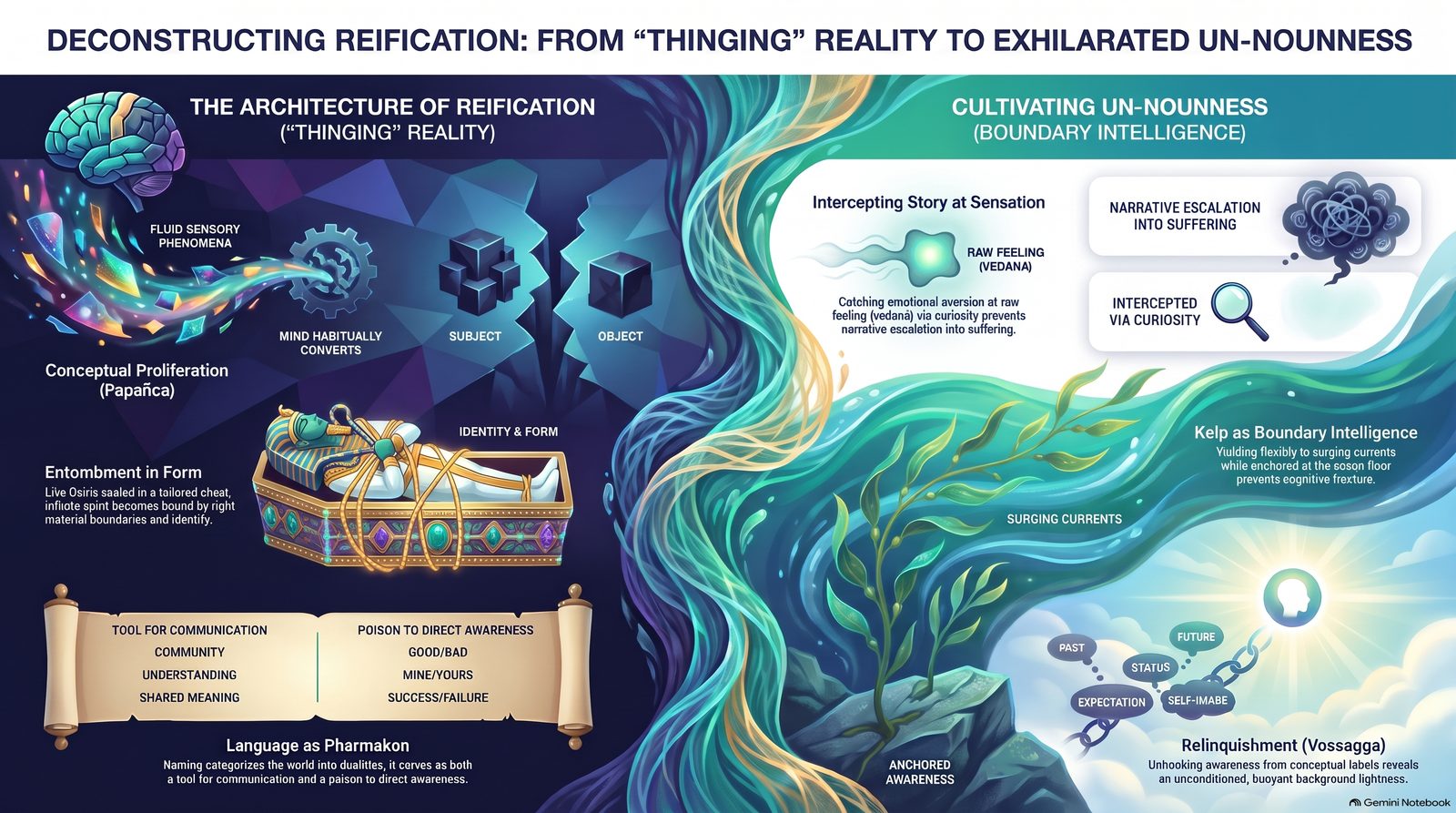
Treating an abstraction or a provisional label as if it were a fixed thing. A description such as “I’m impatient” can help identify a pattern. It becomes reifying when it makes a particular response seem like an unchanging property of the person. This distinction connects the companion graphic to the episode’s account of maps.
Feeling tone and conceptual proliferation
In Pāli Buddhist vocabulary, vedanā is the pleasant, unpleasant or neutral tone of experience. Papañca, often translated as “conceptual proliferation”, points to the elaboration of experience in thought. The infographic brings them together to ask how an immediate impression can become a story with which we identify.
AI as a mirror
The mirror metaphor describes how a language model can reflect, recombine and question what has been expressed in words. It can surface a presupposition or produce a persuasive error. Readers can treat each generated comparison as an interpretation to examine against texts and context, even when the hosts sound confident.
Evanescent crescendo
The episode’s phrase for an inquiry that grows more searching as the need for a conclusive answer fades. “Crescendo” suggests increasing intensity and “evanescent” suggests something passing away. Here what fades is the demand for the final answer, while attention to the question can become more exact.
A one-minute reflection
Notice what a label leaves out
Choose a familiar object such as a mug or a key. Say its name silently and notice what the name helps you recognise. Spend a few moments looking closely. Is there a mark, a reflection or a detail of its shape that the name leaves unspecified? Let the name remain available and see what else you notice when it has done its first job.