
Dialogues VI · Episode 05
Dust, Relics and the Boundaries of the Self
A name helps us find our place among other people, yet it can also give them a way to put us on the defensive.
When does defending an identity make us more vulnerable?
The hosts begin with a fortress and an address on its door. A name lets others find us and links a child and an older adult across decades of change. It can also make a living person sound like a finished description. The hosts turn to Adam naming the animals, Moses at the burning bush and the named Watchers of 1 Enoch. Their reading of the Fall as individuation asks whether a name produces a separation or picks out a difference already there. The river they imagine meeting the sea makes that question concrete. Where exactly would we draw the line?
A barber’s sweepings move the inquiry from language to the body. Early modern sympathetic medicine supplies an example of the belief that shed blood could still be connected to a wound. Frazer’s later distinction between resemblance and contact lets the hosts ask whether a likeness and a bodily trace point to a person in different ways. One host then asks whether the sense of ownership supplies the link in either case. Christian self-emptying, Sufi fanāʾ and Buddhist non-self enter at this point as comparisons. In the Akkosa Sutta, the Buddha answers an insult with the example of food a guest declines. The food stays with the host. The Buddha still speaks and acts in the encounter, and the simile gives him a way of doing so without taking up the quarrel.
The same discarded fragment could be revered as a relic. Does its significance arise from a change in matter, from devotion and communal practice, or from something the contrast leaves out? The discussion carries that unresolved question into Dzogchen accounts of rainbow body and the story of Milarepa and the yak horn. The mirror then offers an image of reflecting an encounter without holding it. The ending returns to job titles, digital profiles and political labels. The hardest question is when setting a limit protects a person or a responsibility, and when we are spending that same energy defending a description of ourselves.
Argument map
A name gives others an address
The opening fortress has a marked door, and the hosts ask whether the label that makes us recognisable also gives people something to use against us.
From names to things once touched
After reading the Watchers’ rebellion as a story about individuation, the hosts turn to bodily traces and Frazer’s distinction between resemblance and former contact.
Ask what makes a trace mine
The barber’s discarded hair raises the question of whether vulnerability resides in the remnant or in the act of claiming it.
Leave the gift with the giver
The Buddha’s exchange with Bhāradvāja illustrates a refusal to return abuse while ordinary personhood and its responsibilities continue.
Turn a remnant into a relic
The hosts ask whether a revered fragment has changed in itself or whether its significance comes from the way a community relates to it.
Stretch the image of a body
Rainbow-body accounts, Milarepa’s yak horn and the reflecting mirror give the hosts different ways to imagine a person without a fixed perimeter.
Return to the labels we defend
The closing question moves from imagined curses to the everyday pressure to defend a job title, public image or group identity.
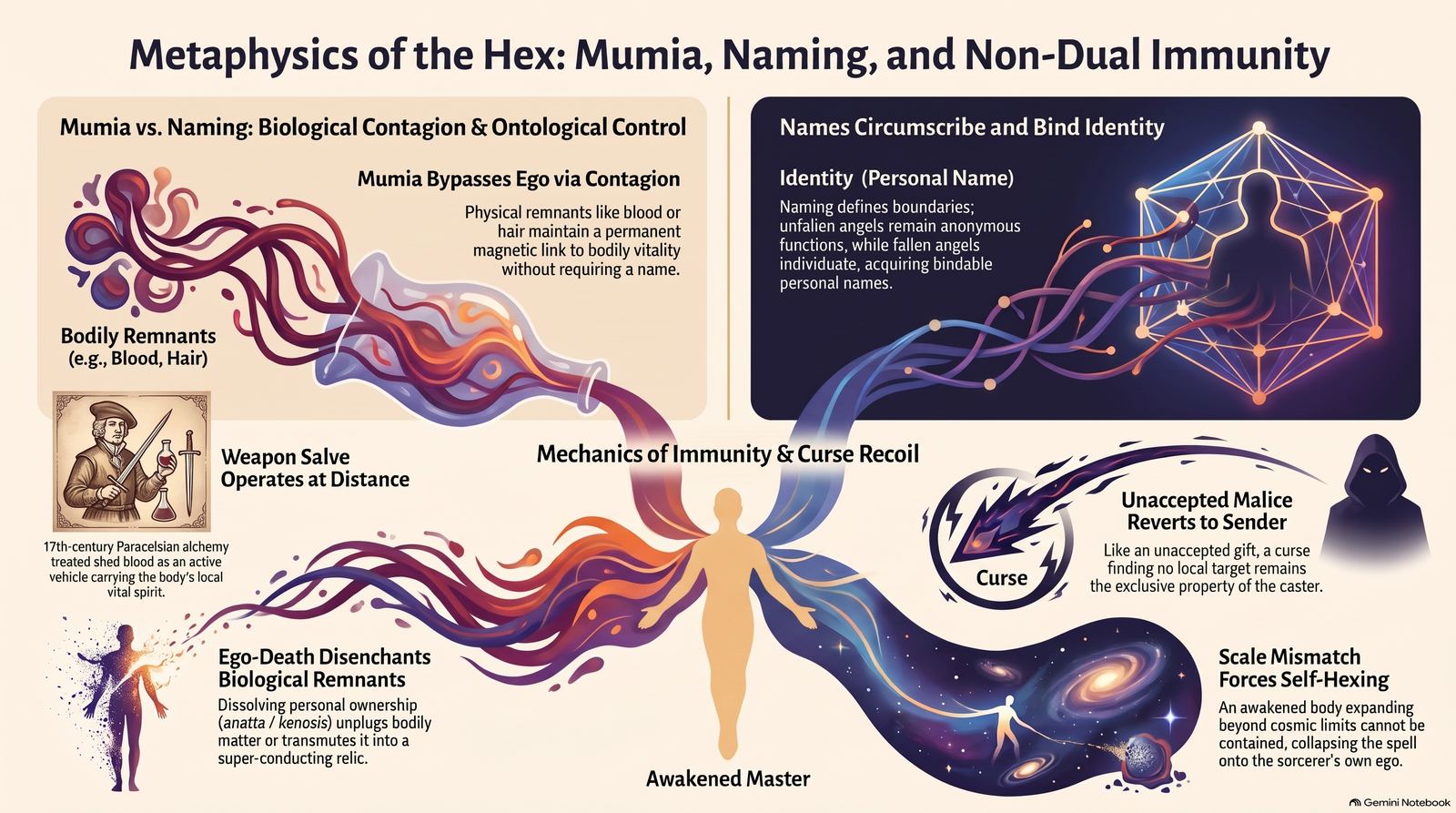
Infographic in words
The left panel depicts an early modern belief that a bodily trace retains a link to its source. The right uses a name and the symbolism of the Fall to picture a fixed identity. Below, the discussion imagines three outcomes when ownership loosens. A remnant loses its supposed hold or becomes a relic. Malice stays with its sender like a declined gift. A body imagined as limitless escapes containment. These are the image’s historical and speculative propositions.
Chapters
Published YouTube chapter markers. Start times are approximate. Each link opens YouTube in a new tab.
- 00:00Identity, protection and vulnerability
- 02:56Names, language and conceptual boundaries
- 06:06Angels, naming and the symbolism of the Fall
- 09:31Mumia and Renaissance sympathetic magic
- 12:52Frazer: similarity and contagion
- 15:38Self-emptying, ownership and non-self
- 17:11The Buddha and the unaccepted gift
- 19:21Conventional identity and ultimate reality
- 20:28From bodily remnants to sacred relics
- 22:44Relics: transformed matter or collective devotion?
- 24:20Dzogchen, luminosity and “frozen light”
- 26:07Rainbow-body narratives
- 27:48Siddhis and Milarepa’s yak-horn story
- 30:05The non-dual mirror and curse-recoil metaphor
- 33:15Everyday labels and practical vulnerability
Glossary
Naming and individuation
Individuation here means becoming distinguishable as a particular person or agent. Adam’s naming of the animals, the answer to Moses at the burning bush and the named Watchers supply different literary examples. Reading the Fall as the emergence of separate ego is the dialogue’s proposal. The Watchers’ story and later grimoire catalogues come from different bodies of literature. Exodus 3:15 also gives Moses a name to use, which qualifies the hosts’ emphasis on refusal. Michael and Gabriel in Daniel provide familiar examples of named heavenly messengers.
Mumia
An early modern term with several uses. Here it refers to bodily traces such as shed blood or hair, imagined in a Paracelsian framework to retain a sympathetic connection with the living person. The hosts use a haircut to ask when something ceases to count as part of us.
Sympathetic magic
In The Golden Bough, James George Frazer grouped magical practices by the associations they presuppose. Similarity works through resemblance, as with an effigy. Contact or contagion assumes a continuing association between things once in contact. The treatment of a name as a form of similarity is the hosts’ extension of Frazer’s classification.
Kenosis
From Greek for “emptying”, the term draws on Philippians 2:7, where Christ empties himself and takes the form of a servant. The episode brings it into conversation with Meister Eckhart’s emphasis on detachment. Its Christian theological setting is the relation between the human and the divine.
Fanāʾ
A Sufi term often translated as “passing away” or “annihilation”. Its meanings vary across authors, and can involve the passing away of self-regard or of awareness of one’s own attributes in relation to God. The hosts mention al-Junayd of Baghdad and compare this language with Christian self-emptying and Buddhist non-self.
Anattā
Pāli for “not-self” or “non-self”. In the discourse on the characteristic of non-self (SN 22.59), bodily form, feeling, perception, volitional formations and consciousness are examined as unsuitable to regard as mine, I or my self. People still act and answer to names. The hosts’ rented-car image risks suggesting an independent driver behind experience.
Śarīra and ring sel
Śarīra can mean body or bodily remains and, in Buddhist relic contexts, refers to revered remains. The episode focuses on pearl-like relics reported among cremation remains, called ring sel in Tibetan. Enshrinement and veneration give relics religious and communal significance. The hosts debate how to understand that significance.
Dzogchen and luminosity
Dzogchen (Tibetan rdzogs chen, “Great Perfection”) names traditions of teaching and practice found in Tibetan Buddhism and Bön. Luminosity belongs to their contemplative and doctrinal vocabulary. The episode’s picture of grasping as freezing light is a way of imagining fixity. Its physical language about atoms and holograms would require independent evidence.
Rainbow body
Tibetan ’ja’ lus. Some Dzogchen accounts describe the body diminishing or disappearing into light at death, sometimes with hair and nails remaining. These narratives express understandings of realisation within their traditions. The episode invokes a modern report alongside traditional accounts and speculates about what such a body would mean for its inquiry.
Siddhi, aṇimā and mahimā
Siddhi is Sanskrit for an accomplishment or attainment. Here the hosts invoke powers described in Indian yoga traditions, including aṇimā (becoming minute) and mahimā (becoming great). They juxtapose them with the Tibetan story of Milarepa sheltering in a yak horn, using the story to unsettle ordinary ideas of size and containment.
Melong and dharmakāya
Melong (Tibetan me long) means mirror. The hosts use a reflection that leaves no mark as an image of awareness without grasping. Dharmakāya, often translated “Dharma body” or “truth body”, is a Mahāyāna term for a dimension of Buddhahood. The idea of a master’s physical body occupying the cosmos is the episode’s speculative extension.
Related reading
- Why Your Mind Turns Everything Into a Thing
The opening episode asks how naming turns a changing process into something that seems fixed.
- Your LinkedIn Profile Is a Lego Castle | Dialogues V
The professional profile makes a concrete companion to Episode 05’s closing question about job titles and public identity.
- Conditionality and non-self
This essay examines what happens to the idea of a fixed self when experience is understood through conditions.
- The great mirror of wisdom
The mirror appears here in a wider inquiry into what it means for experience to be reflected.
- Dzogchen: Recognition Is Only the Beginning | Dialogues V
This episode develops the Dzogchen thread by asking how recognition relates to familiar habits and their persistence.
External reference points
- Exodus 3:13–15 (USCCB)
The burning-bush passage includes both the reply to Moses and the name he is told to give Israel.
- Elizabeth Hedrick, Romancing the Salve
A historical study of the argument and reception of Digby’s 1658 account of the sympathetic powder.
- The Golden Bough, chapter III, § 1
Frazer’s own account distinguishes resemblance from former contact in his classification of sympathetic magic.
- Akkosa Sutta (SN 7.2), translated by Ṭhānissaro Bhikkhu
The whole exchange places the unaccepted gift in a teaching on meeting anger without returning it.
- David Germano, The Funerary Transformation of the Great Perfection
A historical study of the development of death and funerary themes in Dzogchen literature.
Reflection
Take a minute to recall a low-stakes correction about a task you did. Put the practical point into one sentence, then put what you felt it said about you into another. How might you respond to the practical point while keeping any limit you need?