
Dialogues VI · Episode 07
Prometheus, Chiron and the Divided Self
The foresight that helps us prepare for tomorrow can consume the energy we need to live today.
When does foresight become a burden?
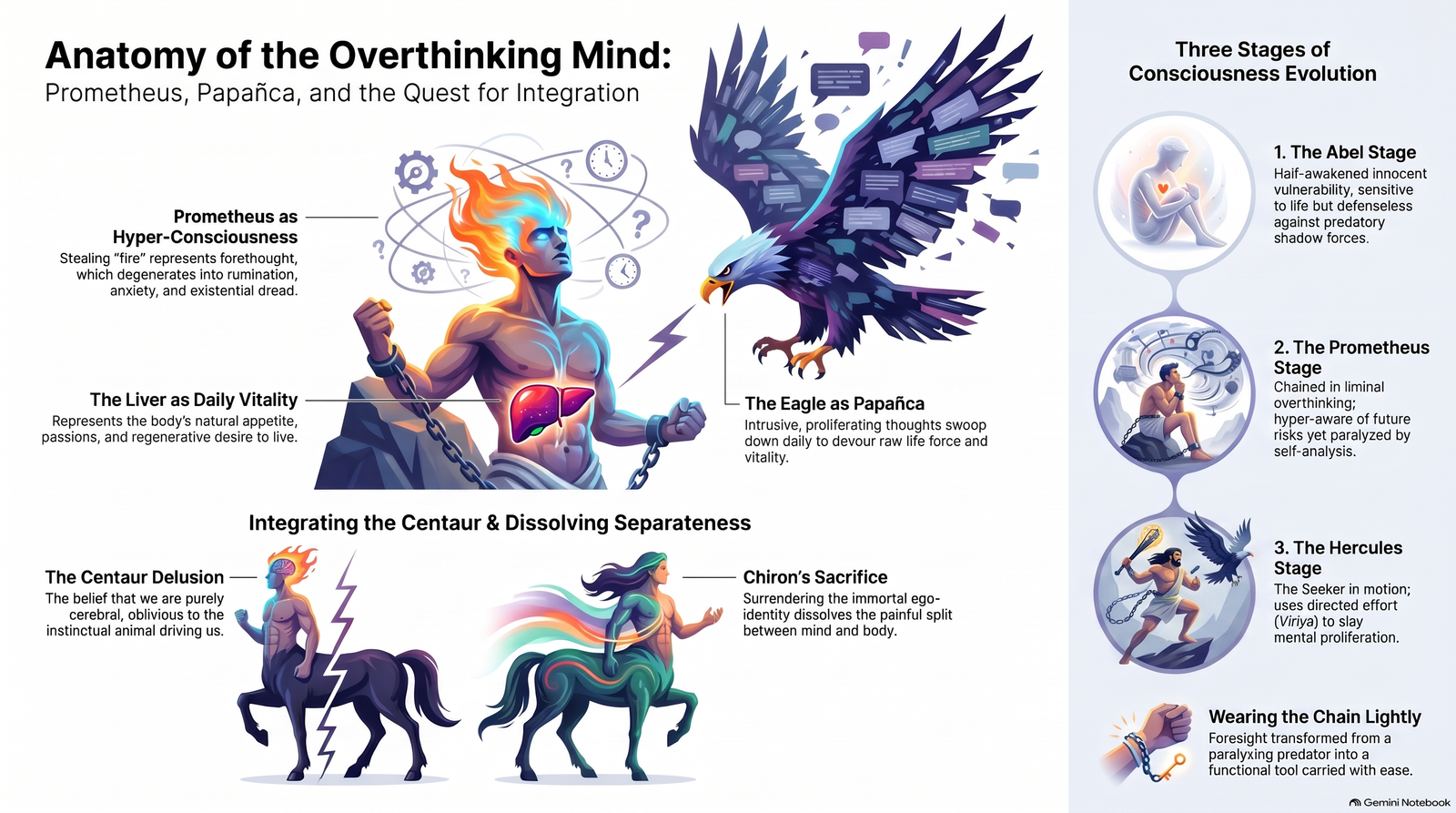
The episode opens in the seconds after waking. Light comes through the blinds and an email sent three days ago suddenly demands an answer in your head. The hosts hear an echo of Prometheus in that abrupt return of unfinished business. In the story, an eagle feeds on his liver, which grows back by night. In the episode’s reading, the liver stands for appetite and the capacity to engage with the day. The eagle gives shape to the fears and rehearsals that can seize that capacity before you get out of bed. Kafka’s weary version of the myth gives the hosts a way to ask whether a reprieve bought through numbness would count as freedom.
An ambiguous Slack message makes the comparison more precise. A manager asks to talk in the morning. A sinking feeling becomes a prediction of dismissal, then a lost home and finally a verdict on the recipient’s worth. The hosts borrow the Pāli term papañca for this proliferation. The Madhupiṇḍika Sutta follows experience through contact, feeling, perception and thinking to the elaborations that can beset us. The separate discourse on the two arrows distinguishes bodily pain from the mental distress that may accompany it. Together they sharpen the question of what a thought adds to an experience, especially when the added story feels as immediate as the event.
The conversation then treats Abel, Prometheus and Hercules as three figures for vulnerability, paralysis and directed effort. The hosts’ bicycle example makes the turn towards action tangible: calculating how to balance and setting off are different tasks. The centaur complicates the rescue. The human torso takes credit for steering while the horse supplies the motion. Chiron’s wound leads the hosts to ask what happens when reason claims to stand outside the very body whose life it is trying to organise.
The ring of Prometheus brings the discussion back to ordinary responsibilities. You still answer to your name, buy groceries and plan the week. The hosts imagine carrying identity and foresight as lightly as a ring made from the old materials of captivity. Their final challenge goes beyond the individual: what kind of discipline would we practise, at work or at home, if bodily needs were part of what guides a decision?
Argument map
Wake to the eagle
The return of unfinished business at dawn makes Prometheus’s recurring wound an image of foresight feeding on renewed vitality.
Watch a message become a verdict
The Slack example shows how a request for a meeting can grow into a story about one’s whole future, while the two arrows distinguish pain from the distress that can accompany it.
Move into the quest
The hosts progress from Abel’s vulnerability through Prometheus’s paralysis to Hercules’s directed effort, using the moving bicycle to show what action adds.
Question the rider’s account
The centaur shifts the problem from recurrent worry to the assumption that a rational rider governs an alien body.
Release the divided identity
The hosts read Chiron’s relinquishment of immortality as giving up the premise that mind and appetite belong to rival selves.
Wear the ring lightly
The ring preserves a place for identity and practical foresight, while the closing question asks how that change might reshape a culture of self-discipline.
Chapters
Chapter links open on YouTube in a new tab.
- 00:00 The morning ambush of thought
- 02:40 Prometheus and the burden of forethought
- 04:40 The liver, the eagle and renewed vitality
- 09:40 Papañca: mental proliferation
- 10:35 How a sensation becomes a story about me
- 13:55 The two arrows: pain and our response
- 17:15 Abel and Prometheus: a proposed map of the seeker
- 20:15 Hercules: the quest and directed effort
- 22:35 Centaurs, Chiron and the divided human
- 28:35 Separateness and Chiron’s sacrifice
- 32:20 The ring: carrying identity lightly
Glossary
Prometheus, fire and the eagle
In the myth retold here, Zeus binds Prometheus after the theft of fire and an eagle returns to feed on his regenerating liver. The hosts associate the fire with self-awareness and the eagle with recurrent worry. In their reading, the bird makes visible a cost of being able to think ahead.
Papañca
A Pāli term often rendered as conceptual proliferation or mental elaboration. In MN 18 it concerns the ways thinking ramifies and the resulting perceptions and categories can beset a person. The hosts pick out self-involving worry as an example. The discourse also connects proliferation with interpersonal conflict.
Phassa, vedanā and saññā
Phassa is contact. In the visual example in MN 18 it is the meeting of eye, visible form and visual consciousness. Vedanā is feeling in the sense of pleasant, painful or neutral tone. Saññā is perception or recognition. The notification illustrates these distinct aspects of experience.
Vitakka and nirodha
Vitakka can mean thinking or applied thought, depending on context. In MN 18 thinking follows perception and can give rise to proliferation. Nirodha means cessation. The hosts’ image of stopping the eagle at contact is their application of this vocabulary. The discourse itself allows contact, feeling, perception and thinking into its account of how elaboration arises.
The two arrows
The Sallattha Sutta (SN 36.6) likens mental suffering accompanying painful bodily feeling to a second arrow. Its well-instructed disciple still experiences bodily pain. The hosts extend the image through the example of back pain and feared loss of mobility. That distinction can be considered without assigning blame for either experience.
Abel, Prometheus and Hercules
Abel is the shepherd killed by his brother Cain in Genesis 4. Hercules is the familiar Latin name of the Greek hero Heracles. The episode places them on either side of Prometheus to trace a movement from vulnerable attentiveness through immobilising foresight to directed effort. This ordering comes from the dialogue.
Viriya and magga
Viriya is Pāli for energy or effort, corresponding to Sanskrit vīrya. Magga means path and can refer to the Buddhist path of practice. The hosts borrow these terms for Hercules’s exertion and his quest for the golden apples. His journey supplies an analogy for putting effort to use.
The centaur and Chiron
The hosts use the composite figure to question the image of intellect perched on instinct. In the Library attributed to Apollodorus, Heracles accidentally wounds Chiron, who cannot recover and agrees to relinquish immortality in connection with Prometheus’s release. The episode’s divided-self reading is a modern interpretation of the wound.
Sakkāya-diṭṭhi and asmimāna
Sakkāya-diṭṭhi is identity view, a way of taking the five aggregates of experience as or in relation to a self. Asmimāna is the conceit “I am”. The Khemaka Sutta (SN 22.89) distinguishes the lingering conceit from explicit identification. The hosts connect this conceit with proliferation; MN 18 itself describes a sequence from contact to elaboration.
Anattā and the ring
Anattā is Pāli for not-self, corresponding to Sanskrit anātman. In early Buddhist teaching, it bears on whether changing aspects of experience can rightly be taken as self. The hosts’ ring is an analogy for retaining names, memory and practical responsibilities while loosening the sense of an owner standing apart from experience.
Related reading
- 3.2.5. Papañca
The Citrinitas chapter develops the account of how an ordinary encounter can generate an extended, self-involving story.
- Cain, Abel and the Psychology of Shame
The earlier dialogue gives the brothers’ relationship and the experience of comparison room to develop in their own right.
- Conditionality and non-self
Explores the link between the dependence of experience on conditions and the way a sense of self forms.
- Your LinkedIn Profile Is a Lego Castle | Dialogues V
Extends the ring’s question to the identities we build for use in public and professional life.
- Rubedo and the Red Work of Ordinary Life
Connects the episode’s closing concern with embodiment and responsibility to Rubedo, Part Four of A Course in Modern Alchemy.
External reference points
External references open in a new tab.
- The Ball of Honey (MN 18)
Ṭhānissaro Bhikkhu’s translation and introduction locate papañca in the account of contact, feeling, perception and thinking.
- The Arrow (SN 36.6)
The discourse distinguishes painful bodily feeling from the mental distress that can accompany it.
- About Khemaka (SN 22.89)
Khemaka uses the scent of a flower to explain how a residual sense of “I am” can linger without an explicit identification with a part of experience.
- Apollodorus, Library 2.5.4 and 2.5.11
J. G. Frazer’s translation gives Chiron’s wound and the release of Prometheus. His notes also trace the iron-and-stone ring to a separate strand of the tradition, including Hyginus’s Astronomica 2.15.
Reflection
Take a minute with an everyday, low-stakes message. Make a note of what it actually says and one prediction you found yourself making. What would be a proportionate reply or next step if you let that prediction stay open?