
Dialogues VI · Episode 10
Is There a Mind Behind Your Thoughts?
Stepping back can help us notice a thought, but does noticing require somebody standing behind it?
Does experience need an inner spectator?
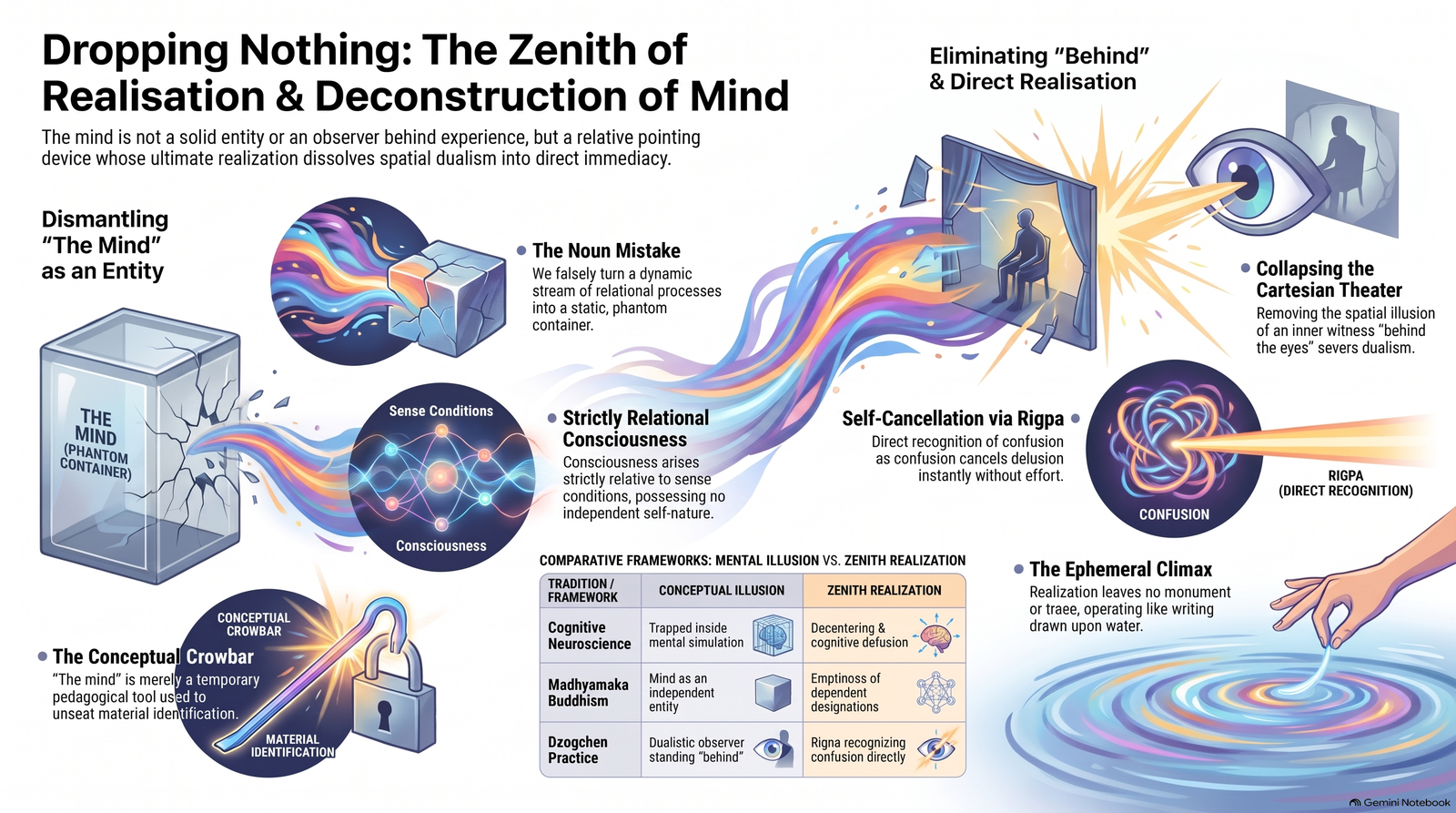
The hosts ask you to imagine a listener inside your head who hears the words the podcast is saying. Gilbert Ryle’s university visitor makes the problem easier to see. Someone who has toured the libraries and laboratories still asks to be shown the university, as though it were another building on the list. Daniel Dennett’s Cartesian theatre poses a different problem. If a spectator inside the brain has to watch an inner screen for seeing to occur, how does that spectator see? A second spectator would inherit the same problem. The hosts bring the question back to a headache and a worry about an electricity bill. Both are real experiences. What explanatory work would the extra spectator do?
The sound of a twig snapping becomes a story about a bear, a fatal encounter and a family left grieving. The hosts use the eagle that returns to feed on Prometheus as an image of papañca, the elaboration by which a perception can become an absorbing story. Chiron’s divided form gives them a picture of the rational rider and the animal body. Hercules in Omphale’s court raises a further difficulty. The will that can restrain an impulse may also defend the pleasure of feeling spiritually accomplished. Their reading of Sophia and Yaldabaoth moves that problem into mythic terms. Trying to stand apart from the whole in order to know it produces a figure who mistakes his own limited view for the whole.
In the early Buddhist discourse MN 38, fire is named for the fuel on which it depends. The hosts use the simile to ask what makes a particular act of seeing or hearing possible. They then turn their scrutiny on the episode’s own teaching device, the “conceptual crowbar”. A person who can regard a thought as a thought gains some room to respond, but the image of stepping back can be taken literally. The rainbow and the thief in an empty house bring the argument to its most difficult point. Can there be recognition without a further witness who owns it?
The closing image of a bird whose flight leaves no track gives way to paying a bill, having a conversation and growing a tomato. In A Course in Modern Alchemy, Rubedo is the fourth phase, the Red Work. The episode uses it to ask how insight shows up in ordinary conduct. Its strongest challenge comes after the argument against the inner witness. What would count as a change in how we live if the feeling of occupying a privileged point of view can itself become another refuge?
Argument map
Look for the listener
Ryle questions the search for a separate container, and Dennett asks how an inner spectator would itself see.
Watch forethought multiply
Prometheus’s eagle and the snap of a twig illustrate how interpretations can come to dominate the person who makes them.
Examine the wish to stand apart
Chiron, Hercules and Sophia give the hosts three ways to examine detachment, mastery and the desire to know the whole from outside it.
Ask what seeing depends on
The fire simile in MN 38 makes room for an account of consciousness in terms of the conditions under which it arises.
Put down the crowbar
Taking a step back from a thought can be useful, and the episode asks when that perspective becomes an identity of its own.
Question the space behind experience
The rainbow and the empty house help the hosts ask whether recognition requires a second vantage point.
Bring the question into ordinary life
The trackless bird and the return to the garden carry the argument into Rubedo, where conduct matters more than a claim to attainment.
Chapters
Times are approximate. Chapter links open on YouTube in a new tab.
- 00:00The imagined listener inside your head
- 02:50Ryle and the missing university
- 05:50Dennett’s Cartesian theatre
- 08:15Prometheus and mental proliferation
- 13:00Chiron: surrendering the divided self
- 14:45Hercules and the limits of willpower
- 17:10Sophia and the subject–object split
- 19:35Dependent consciousness and the fire analogy
- 22:05Dropping the conceptual crowbar
- 24:20Is there anyone behind experience?
- 26:40The brain, awareness and the inner observer
- 28:20A thief in an empty house
- 29:00Towards Rubedo: a realisation that leaves no monument
- 31:15Embodiment and returning to ordinary life
Glossary
Category mistake
A mistake about the logical kind of thing a term denotes. In Ryle’s example, a visitor expects to find a university as one more building among those already visited. The episode asks whether imagining a separate container for thoughts makes a comparable mistake.
Cartesian theatre
Dennett’s name for an imagined centre where the brain presents its work to an inner audience. The regress starts when that audience needs another process of seeing that is explained in the same way. The episode uses the image to question the familiar feeling of looking out from behind the eyes.
Papañca
A Pāli term variously rendered as proliferation, elaboration or objectification. In MN 18, Mahā Kaccāna’s sequence moves from contact and feeling through perception and thinking to proliferating perceptions and categories that beset the person. The active-to-assailed turn follows Thanissaro Bhikkhu’s reading. Prometheus’s eagle is the hosts’ illustration of it.
Pleroma and demiurge
Pleroma means fullness and can denote divine fullness in Gnostic texts. Demiurge means maker or craftsman. In the Secret Book of John, Sophia brings forth Yaldabaoth, who is ignorant of the higher realm. The Buddhist faculty sometimes rendered “I will know the unknown” enters the story through the episode’s comparison.
Conditioned consciousness and MN 38
In the Mahātaṇhāsaṅkhaya Sutta, the Buddha disputes Sāti’s view that the very same consciousness wanders through rebirth. A fire is identified by its fuel, and consciousness is classified by the conditions on which it arises. Eye and visible form are the pair in the discourse’s example of eye-consciousness.
Conceptual crowbar
The episode’s image for a provisional teaching tool. Treating thoughts as events one can notice may loosen their grip. The same image can encourage an assumption that a silent observer exists independently of what is noticed. The episode’s critique applies to that assumption, including when it is expressed through the image of a projector.
Emptiness and svabhāva
In Madhyamaka, emptiness concerns the lack of intrinsic nature, or svabhāva. The episode’s rainbow illustrates how something can appear vividly and depend on conditions. The early Buddhist fire simile and the later Madhyamaka analysis belong to distinct textual settings. The hosts use them to approach a related philosophical question.
Dzogchen, rigpa and marigpa
Dzogchen, or the Great Perfection, is a Tibetan contemplative tradition. In this setting rigpa is often rendered as intrinsic awareness or knowing, and marigpa as ignorance or non-recognition. The hosts use the thief in an empty house as an image for the liberation of thought. Its setting is a tradition of contemplative teaching and transmission.
The trackless bird
Dhammapada verses 92–93 compare the course of liberated practitioners to that of birds in the sky and pair the image with empty and signless liberation. The episode takes the bird’s flight as an image for realisation that leaves no monument. The verses supply the image and its Buddhist setting.
Kiriya and writing on water
In Theravāda Abhidhamma, kiriya can classify functional consciousness, distinct from consciousness that produces a karmic result or is itself a result. The hosts extend the idea to responsive action that need not become a story about the person acting. Writing on water is their closing image for that extension.
Rubedo
Literally reddening, Rubedo is the Red Work and the fourth phase of A Course in Modern Alchemy, following Nigredo, Albedo and Citrinitas. The hosts describe it here through embodiment and everyday conduct. Their proposed reunion of Elohim and Edem is an alchemical reading of the estrangement in Justinus’s Book of Baruch.
Related reading
- The Inner Observer
A companion inquiry into the apparent division between experience and the one who seems to observe it.
- Prometheus, Chiron and the Divided Self
Follows the two myths that Episode 10 uses to explore mental proliferation and the divided self.
- Can Hercules Teach Us the Limits of Willpower?
Develops the reading of Hercules and Omphale that underlies the discussion of heroic effort.
- 2.2.9. The Cognitive Series
The Albedo chapter gives course context for the sequence of mental moments mentioned in the crowbar discussion.
- Emptiness
Continues the question of how something can appear vividly and lack independent substance.
- Rubedo and the Red Work of Ordinary Life
Continues the episode’s final turn towards embodiment and everyday action.
External reference points
External references open in a new tab.
- Gilbert Ryle, Stanford Encyclopedia of Philosophy
Sets Ryle’s criticism of the Cartesian account of mind in the context of his work on language and logical categories.
- Time and the Observer
Daniel Dennett and Marcel Kinsbourne set out the Cartesian theatre model and explain their objection to it.
- Madhupiṇḍika Sutta, MN 18
Thanissaro Bhikkhu’s translation and introduction show the passage from perception and thinking to the categories that come to beset the thinker.
- Mahātaṇhāsaṅkhaya Sutta, MN 38
The exchange with Sāti and the fire simile supply the episode’s textual basis for conditioned consciousness.
- Dhammapada 92–93, Arahantavagga
The verses place the image of birds in the sky in the context of empty and signless liberation.
Question to carry forward
Recall a small task from today, such as replying to a message or making a cup of tea. If you caught yourself judging how well you were doing it, what changed when your attention returned to what the task needed?