
Dialogues VI · Episode 12
Can Trying to Quiet Your Mind Make It Noisier?
The effort to keep thoughts out can become another disturbance, even when the mind seems quiet.
What happens when we try to guard stillness?
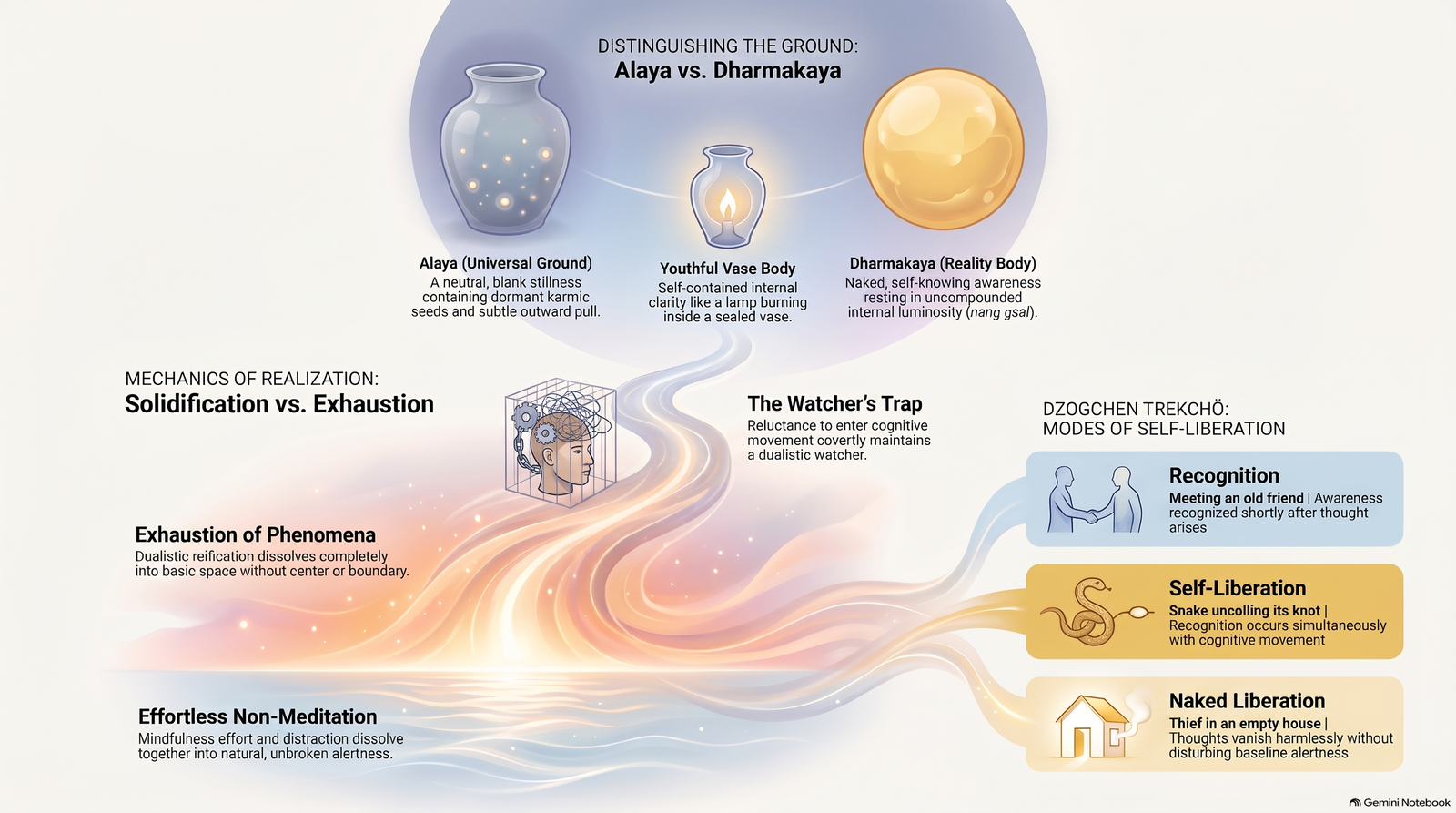
Someone shouts for silence at a crowded party. The room quietens for a moment, then fills with noise again. A friend in the corner seems at ease throughout. In the hosts’ opening scene, both people hear the same room, but only one has taken on the job of quietening it. The written exchange UnPathing asks what happens when we take on the same job with our thoughts. The hosts try out a second image, a lamp burning in a sealed vase. They read its inward light as a way of talking about knowing without having to reach out and seize what is known. One host hears a risk in the image. If the vase sounds like a shelter from the sensory world, it can make withdrawal seem like the point.
A beach ball held under water brings the problem closer to experience. The surface can look calm while the hand underneath is still working. The hosts use this to distinguish blank stillness from wakeful clarity in the Dzogchen framework they are discussing. They turn next to tantric imagery of the vajra body and a contemplative account of time. The crucial turn comes when one host objects that “crystallisation” makes awareness sound rigid. The discussion shifts to the habit of making experience solid. The watcher at the door is an example of that habit in action. As soon as there is a quiet state to defend, a thought about taxes can look like an intruder.
A mirror can reflect fire without catching alight. A line drawn on water needs no one to rub it out. With these images, the hosts ask what happens to a thought when the person having it neither pursues it nor tries to erase it. The old friend, the snake and the empty house develop this question through Dzogchen accounts of self-liberation. The hosts then compare that movement with non-meditation in Mahāmudrā. They return to a crowded room and a question about hearing. Can we tell the difference between a moment of clear, unforced attention and simply drifting, without setting up another watcher to check? That distinction matters as the series approaches Rubedo, Part Four of A Course in Modern Alchemy, where ordinary life is the setting in which insight has to find expression.
Argument map
Shouting for silence
The noisy party shows how the act of trying to secure quiet can add to the commotion.
What the quiet contains
The lamp in the vase suggests inward clarity, while the submerged beach ball asks whether a calm surface can conceal effort and latent tendencies.
What gives way?
Vajra-body imagery and the fourth moment raise questions about form and experienced time, and the crystal prompts the hosts to examine the habit of making experience solid.
The watcher takes up position
Guarding stillness sets up a division between the state being protected and the watcher who treats each thought as a threat.
A reflection and a vanishing line
The mirror and the water ask whether a thought can arise and pass without being carried forward or actively erased.
Recognising without retrieving
Familiarisation recasts returning as recognition, with the old friend, the snake and the empty house tracing different ways thoughts are said to release.
When returning serves its purpose
The closing discussion asks how deliberate correction might become unnecessary and tests that idea against the simple act of hearing a sound in the noisy room.
Chapters
Chapter links open on YouTube in a new tab.
- 00:00 Trying to silence the noisy mind
- 03:30 The lamp inside the vase
- 08:05 Blank stillness and wakeful awareness
- 13:10 Vajra body, subtle winds and time
- 17:10 Crystallisation or the loosening of grasping?
- 19:25 The watcher guarding stillness
- 23:10 The mirror and writing on water
- 26:50 Familiarisation without dragging the mind back
- 29:35 The old friend, the snake and the empty house
- 34:45 Non-meditation and the effort of returning
- 39:20 Returning to the noisy room
Glossary
Ālaya, kun gzhi and ālayavijñāna
In the Dzogchen distinction used here, the conditioned all-ground (kun gzhi) is associated with latent tendencies, and mental quiet can conceal their persistence. In Indian Yogācāra, storehouse or substratum consciousness (ālayavijñāna) accounts for continuity and the fruition of karmic dispositions. The episode’s blank room is a teaching image for the first discussion. The Yogācāra account applies across ordinary experience.
Dharmakāya
Often rendered “Dharma body” or “reality body”, dharmakāya is a Mahāyāna Buddhist term presented in different ways across traditions. In the Dzogchen reading at issue here, it concerns the empty essence of awakened knowing. The hosts’ phrase “inward-facing” describes their reading of non-projection. The image of a lamp gives the hosts a way to ask how knowing can be clear without being directed towards an object.
Rigpa
The Tibetan word rig pa can mean knowledge or awareness. In the Dzogchen teachings discussed here, it refers specifically to knowing or recognising the nature of mind. The hosts bring this close to the experience of ordinary alertness so listeners can follow the question. The tradition gives recognition a more specific meaning than being awake, attentive or aware of a sound.
Youthful vase body and inner luminosity
A Dzogchen image of intrinsic clarity. Yukhok Chatralwa compares subtle wisdom to a lamp and habitual obscuration to the vase around it. Nang gsal, here rendered “inner luminosity”, belongs to this doctrinal vocabulary. In the episode, the vase prompts a question about how language such as “inside” can make knowing sound like retreating to a place.
Vajra body and subtle winds
Tantric Buddhist systems describe subtle channels, winds and drops, with details that vary by system. Winds are called rlung in Tibetan and prāṇa in Sanskrit. The hosts use the model to connect distraction, grasping and the experience of sequence. These terms describe a traditional contemplative physiology. Anatomical and physiological claims would need evidence of their own.
The fourth moment
A contemplative expression the dialogue uses for knowing beyond the conceptual divisions of past, present and future. Calling it “fourth” points beyond the three familiar divisions rather than adding a fourth point to a timeline. The episode moves from that doctrinal vocabulary to a question about how experience is felt when we stop tracking one mental event after another.
Trekchö and Tögal
Distinct approaches in Dzogchen’s pith-instruction traditions. Trekchö, often translated as “cutting through”, concerns recognition of the nature of mind. Tögal involves a distinct set of visionary contemplative practices. The podcast mentions both near its discussion of luminosity and rainbow body. Its later images of thoughts releasing are best read alongside the Dzogchen teachings it draws on for that topic.
Exhaustion of phenomena
A technical expression in Dzogchen with a specific use in accounts of the culmination of Tögal’s visionary sequence. The hosts also use “exhaustion” more loosely for the wearing out of the habit of treating experience as fixed. That looser use is how the episode turns the crystal image around. The two registers carry different claims.
Self-liberation
In the Dzogchen sense at issue, rang grol refers to the release of thought without applying an antidote to it. Patrul Rinpoche’s similes concern liberation upon recognition, release by itself and release without benefit or harm. The hosts recast them as a narrowing gap between distraction and noticing. The images are an account within a path of practice and give no timing test for ordinary thoughts.
Familiarisation
The Tibetan term sgom means meditation and is often explained through becoming familiar with something. In UnPathing, familiarisation changes what “returning” means. Discovering that the mind has wandered can itself be a moment of noticing. The hosts ask how this might become less effortful over time and what happens to the felt need to steer every mental event.
Non-meditation
Sgom med names the fourth yoga in the four-yoga presentation of Mahāmudrā. Dzogchen also has its own presentations of uncontrived awareness. The hosts bring them together around one question about how deliberate effort becomes unnecessary. In this setting the term describes maturation within training. Being inattentive or giving up an established practice would tell us little about that maturation.
Related reading
- Can Thoughts Return Without Losing Stillness?
Begins at the edge of sleep and asks what survives when familiar thoughts and concepts return.
- Is There a Mind Behind Your Thoughts?
Asks whether noticing a thought requires an inner spectator, a different route into the problem of the watcher.
- Dzogchen: Recognition Is Only the Beginning | Dialogues V
Distinguishes a moment of recognition from the gradual changes that may follow it.
- When Detachment Looks Like Enlightenment | Dialogues V
Explores the difference between stillness that permits engagement and stillness used to keep experience at a distance.
- 3.4.12. The Pathless Path
The final chapter of Citrinitas asks when the effort that steadies attention starts to interfere with it.
- Rubedo and the Red Work of Ordinary Life
Continues the course inquiry into what ordinary responsibilities ask of us as the effort of self-perfection loosens.
External reference points
- Patrul Rinpoche, The Special Teaching of the Wise and Glorious King
The translated commentary gives the source context for the friend, snake and empty house.
- Yukhok Chatralwa, How Liberation and Delusion Develop
Places the lamp and youthful vase body within a Dzogchen account of intrinsic clarity and habitual obscuration.
- Longchenpa, Treasury of the Supreme Vehicle, chapter 14
The Tsadra presentation maps several senses of the all-ground and their distinction from dharmakāya.
- Stanford Encyclopedia of Philosophy, “Yogācāra”
The section on store consciousness explains karmic seeds and their role in continuity.
- Karl Brunnhölzl, “The Uttaratantra and Mahāmudrā”
Sets out Tibetan accounts of the four yogas and explains why non-meditation is the fourth.
Question to carry forward
For half a minute during an ordinary pause, let a sound such as a clock or passing traffic be part of what is happening. If you notice yourself waiting for silence, see whether you can tell what that waiting adds. Did hearing the sound require you to step back from it?