
Dialogues VI · Episode 14
How Do We Live Through a Dark Age?
When gloom starts to feel like the climate, can inward steadiness help us stay available to other people?
Can stillness make us more available to others?
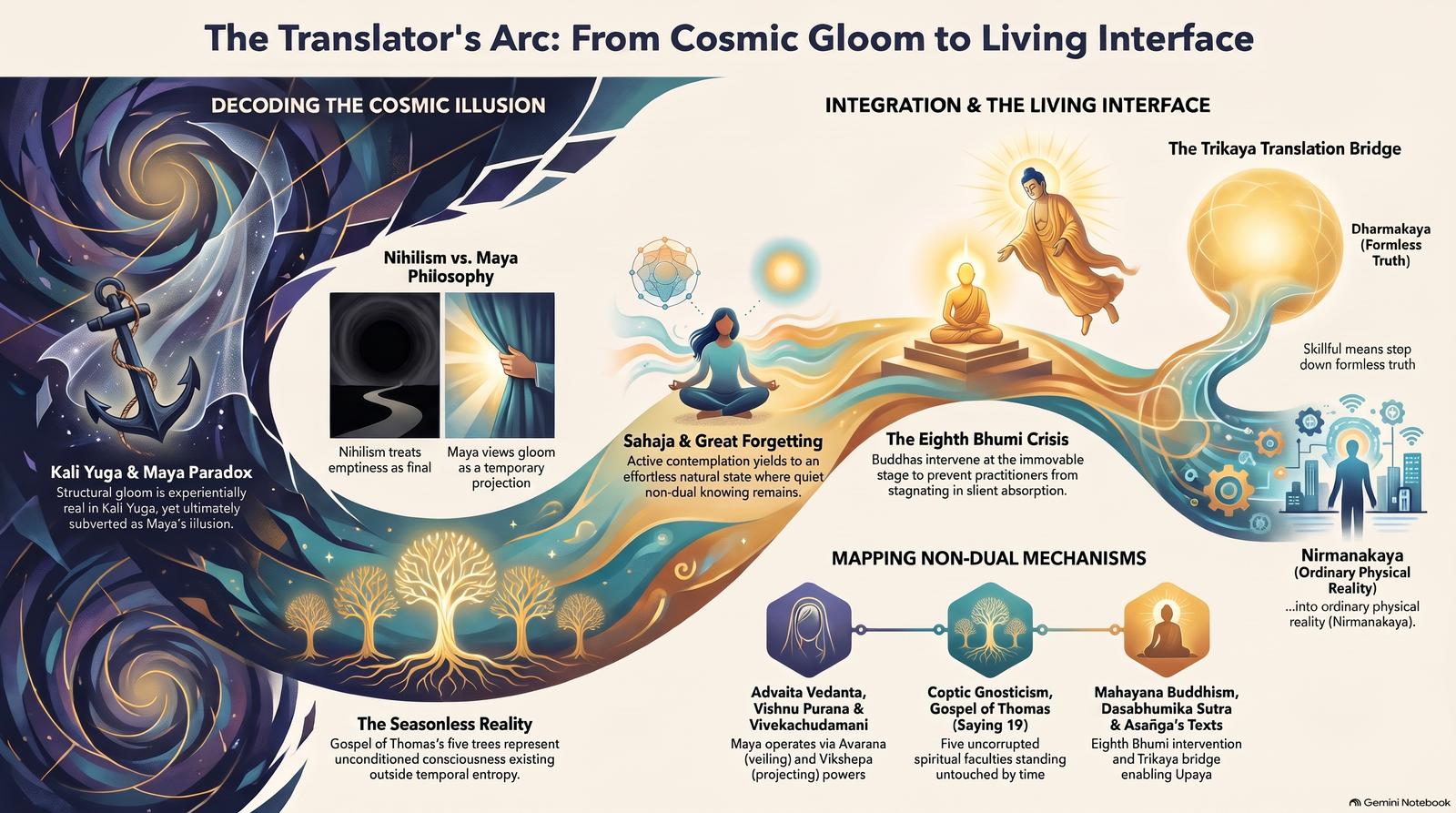
A storm is bearable partly because we expect it to pass. The hosts ask what happens when isolation, anxiety and outrage begin to feel more like a climate than a spell of bad weather. They turn to the Kali Yuga, the last age in a four-age cycle described in Hindu Purāṇic literature. They then bring in the Advaita Vedānta idea of māyā and imagine a virtual-reality headset. A landscape can feel all-encompassing while we are in it. The analogy asks how far that feeling entitles us to decide what reality is, or whether anything can matter within it.
From there the hosts turn to the Gospel of Thomas. Saying 19 describes five trees whose leaves stay on through summer and winter. Saying 113 places the kingdom on earth, unseen by those around it. The hosts read the trees as an image of a presence untouched by change, then ask whether identifying with the witness could become a way of standing aside. Kelp offers another image. Its holdfast anchors it while the blades move with the water. The hosts pair that flexibility with learning to drive a manual car, where keeping track of every movement eventually gives way to a skill that needs far less conscious rehearsal. That is their way into the question of what it might mean to forget a recognition while still living from it.
The eighth ground of a Mahāyāna bodhisattva path puts the value of peace to a different test. In The Ten Bhūmis, buddhas remind the bodhisattva of earlier aspirations and beings who still suffer. The hosts take this as the point where the witness must become a translator. Their software analogy leads to upāya, the use of skilful means suited to the person and situation, and to an imaginative reading of the Buddha’s three bodies. The episode ends with laughter, art and shared grief as possible forms that translation might take. In the context of A Course in Modern Alchemy, that movement into ordinary life is a Rubedo theme. The hardest question is whether we can hear what another person needs while letting go of our own wish to explain what the encounter means.
Argument map
When weather becomes climate
Kali Yuga gives the hosts a religious image for gloom that seems to outlast any single event.
Question what the gloom tells us
The headset analogy asks whether a convincing experience can settle what is real or meaningful.
Test the shelter of the witness
The five trees suggest steadiness amid change and raise the possibility that witnessing might become withdrawal.
Let effort recede
The kelp holdfast and the manual gearbox give two images of steadiness that allows movement without continual self-monitoring.
Remember who still suffers
The eighth ground turns the appeal of silent peace into a question about the bodhisattva’s earlier commitments.
Find a form another person can receive
Skilful means and the hosts’ reading of the three bodies lead to a final speculation about laughter, art and shared grief.
Chapters
Chapter links open on YouTube in a new tab.
- 00:00 When gloom feels like the climate
- 03:45 Kali Yuga and spiritual ignorance
- 05:15 Maya, nihilism and the VR metaphor
- 08:35 The Gospel of Thomas: seasonless trees
- 11:30 Witnessing or withdrawing?
- 14:10 Kelp, flexibility and the holdfast
- 17:10 Forgetting the effort: sahaja samadhi
- 20:45 The eighth bhumi and the pull of peace
- 24:15 Becoming a translator
- 25:50 Upaya: meeting people where they are
- 27:15 Trikaya: the three bodies as a metaphor
- 29:55 Bringing the inquiry into ordinary life
Glossary
Kali Yuga
The fourth and last of the recurring ages in Hindu cosmology. Book Six of the Viṣṇu Purāṇa describes it through the decline of virtue and changes in social and religious life. The hosts borrow this picture to describe the feeling that gloom has become pervasive.
Avidyā, māyā and brahman
In Advaita Vedānta, avidyā is ignorance or misapprehension, especially about the self. Māyā helps account for the appearance of plurality, and brahman names non-dual reality. The hosts’ virtual-reality comparison dramatises taking appearance as final. Its imagined designer and headset belong to the analogy. The hosts use “nihilism” narrowly here for the conclusion that life has no inherent meaning.
The five trees in Thomas
Saying 19 of the Gospel of Thomas describes five trees in paradise unaffected by summer and winter. Saying 113 describes the kingdom as already spread over the earth. The hosts’ phrase “seasonless reality” joins the two sayings in a contemplative reading. The sayings leave the trees’ precise meaning open.
Witness and holdfast
The witness is an Advaita image for awareness in relation to changing experience. Kelp’s holdfast is its anchoring structure, which attaches it to a surface such as rock. The episode brings the images together to ask how someone can feel the force of events while staying responsive to them.
Sahaja samādhi
Sahaja means natural or innate. In modern Advaita teaching associated with Ramana Maharshi, sahaja samādhi points to natural, abiding absorption or realisation. The familiar experience of driving without rehearsing every movement illustrates the hosts’ distinction between explicit recall and unforced knowing. It supplies a comparison with learning a skill.
Bodhisattva and the eighth bhūmi
A bodhisattva aspires to buddhahood for the benefit of beings. A bhūmi is a ground or stage on that path. In The Ten Bhūmis, the eighth is Acalā, the Unwavering or Immovable. The buddhas call attention to qualities of buddhahood still to be developed and recall the bodhisattva’s earlier aspirations.
Anutpattika-dharma-kṣānti
Often rendered as acceptance of the non-arising of phenomena. The sūtra links it to entry into the eighth ground. The hosts compare it with being outside time. The Buddhist phrase concerns how phenomena are understood and provides no warrant for dismissing the suffering that the sūtra explicitly asks the bodhisattva to consider.
Upāya, or skilful means
In Mahāyāna Buddhism, methods of teaching and helping adapted to the needs and capacities of beings. The hosts’ software comparison asks how a listener might receive something expressed in a form they can use. Humour, art and listening are the episode’s ordinary examples.
Trikāya, or the three bodies
A Mahāyāna framework for modes of buddhahood. Dharmakāya is the Dharma or truth body. Saṃbhogakāya is the enjoyment body. Nirmāṇakāya is the transformation or emanation body. Calling the enjoyment body a software interface that converts a signal into physical form is the episode’s own analogy.
Rubedo
Rubedo, or reddening, names the fourth part of A Course in Modern Alchemy. It provides a context for the episode’s movement back towards the body, relationships and everyday obligations. The connection across the course and the episode is a thematic one about how insight is lived.
Related reading
- The Gospel of Thomas (Part 4)
Read Dr Robinson’s commentary on Saying 19 and its five trees.
- The Bodhisattva
The Citrinitas chapter explores how compassion shapes the decision to return to ordinary life.
- Can Thoughts Return Without Losing Stillness?
Follow the kelp image back to the question of whether stillness can coexist with the movement of thought.
- What If Awakening Means Refusing to Ascend?
Episode 11 asks how the aspiration to transcend ordinary life might give way to a commitment within it.
- Rubedo and the Red Work of Ordinary Life
Follow the course’s account of integration into work, relationships and practical life.
External reference points
- Viṣṇu Purāṇa, Book Six
McComas Taylor’s translation places the age of Kali within the four-age cycle and gives its account of decline.
- Śaṅkara, Stanford Encyclopedia of Philosophy
Explains how Advaita understands non-duality, ignorance and the apparent plurality of the world.
- Gospel of Thomas, translated by Thomas O. Lambdin
Read Sayings 19 and 113 in the same translation.
- The Ten Bhūmis, 84000 translation
Read the eighth-ground account of non-arising, the buddhas’ encouragement and the bodhisattva’s continuing work.
- Three Bodies of the Buddha, Oxford Bibliographies
Introduces the three bodies and the distinctions among them in Buddhist commentary.
Question to carry forward
Recall an ordinary conversation in which a pause, a joke or a quiet acknowledgement helped someone feel heard. What made that response fit the moment, and what would you have missed if you had been busy explaining it?