
Dialogues VI · Episode 13
Greek Gods and the Limits of Rationality
The Greek gods give the hosts a way to ask what happens when a mind capable of explaining life tries to live above it.
What does intelligence miss when it imagines it can live above the body?
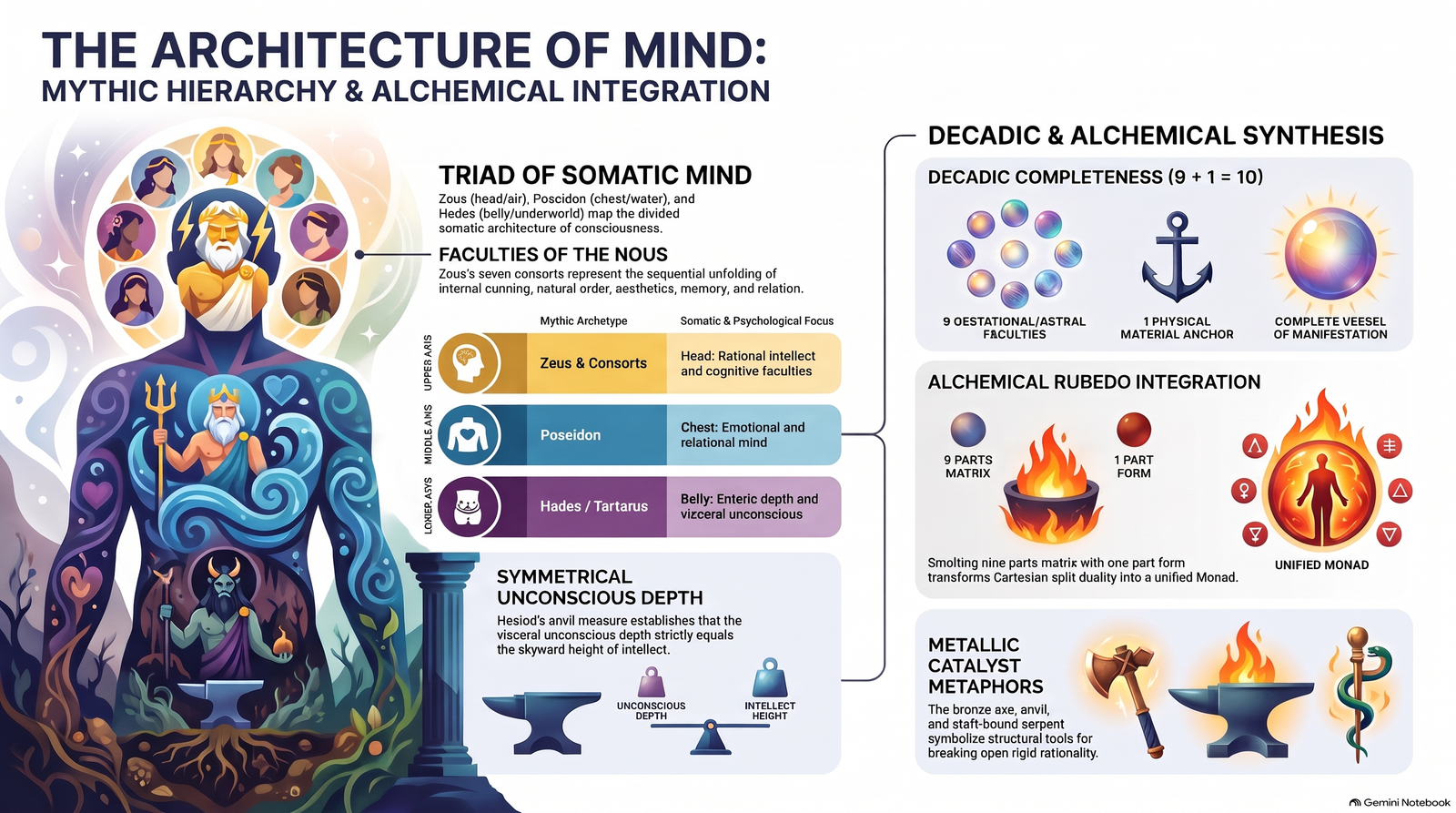
The hosts open with a question about spiritual escape and then picture the mind as a high-rise. Zeus, in the penthouse, makes plans. Poseidon deals with feeling and relationships on the middle floors. Hades keeps the boiler running underground. The comedy makes a serious point. From the penthouse, the forms of life that keep the building going can look incidental. Plato’s division of the soul in the Timaeus supplies an ancient comparison, while Plotinus’s different reading of Kronos and Zeus reminds us how readily the same myths can serve another philosophy.
In the hosts’ account of Zeus’s seven consorts, intelligence gradually takes on capacities that a plan alone cannot supply. Metis gives it practical resourcefulness, and Themis gives judgement limits. Eurynome opens it to grace and beauty. Demeter and Persephone make room for grief, and Mnemosyne makes memory a source of art and meaning. Leto brings clarity into contact with instinct, while Hera makes commitment a matter of living with someone who can answer back. Then Dionysus enters through Semele, outside the sequence, and unsettles the assumption that a well-ordered mind has made room for everything.
The question of order becomes a question about evidence. Do recurrences of ten reveal a pattern in the texts, or in the way we count? Hesiod’s two falls of a bronze anvil give the discussion an image of equal reach towards heaven and Tartarus. The hosts place that image beside Metatron’s enlargement in 3 Enoch. Bronze then changes the terms of the inquiry. An alloy gives the hosts a way to imagine what thought, feeling and appetite can do together. The axe, the anvil and the serpent take that idea from the head into the depths and back to the body as a whole.
When the serpent becomes an object of devotion, its destruction supplies a test for the episode’s own map. Can we set down an image once it starts to govern what we see? Rubedo, Part Four of A Course in Modern Alchemy, brings that test into the ordinary work of living with hunger, disappointment, affection and the need to repair harm. The closing turn to artificial intelligence asks what our machines inherit when we define intelligence by the work Zeus does in the penthouse.
Argument map
Question the impulse to escape
The hosts use the gods’ division of the cosmos to picture a mind whose intellect imagines it can run life from the top floor.
Give reasoning company
Zeus’s seven consorts bring practical judgement, limits, grace, grief, memory, instinct and commitment into view, while Dionysus pushes at the limits of self-command.
Ask what the numbers can carry
The pattern of ten looks persuasive until the hosts consider how easily a favoured number can dictate what gets counted.
Give aspiration a depth as well as a height
Hesiod’s two falls and Metatron’s enlargement let the hosts ask which parts of life an upward spiritual ambition overlooks.
Bring the parts into relationship
Bronze alloying and the images of axe, anvil and serpent help the hosts picture how thought, feeling and appetite might work together.
Let the symbol lose its authority
Hezekiah’s destruction of the serpent leads into Rubedo and a test of integration in ordinary acts of receiving, grieving and repairing harm.
Ask what intelligence leaves out
The closing turn to AI asks what a model of intelligence built around reasoning leaves out when grief, relationships and bodily needs drop from view.
Chapters
Chapter links open the recording at the selected point on YouTube in a new tab.
- 00:00Why does spirituality so often promise escape?
- 04:00Reading the Greek gods as a map of mind
- 10:50Zeus’s seven consorts: capacities beyond logic
- 18:40Dionysus and the limits of self-command
- 19:50The number ten: pattern or projection?
- 24:10Hesiod’s falling bronze anvil
- 25:35Metatron and the image of a cosmic body
- 27:25A proposed Mesopotamian connection
- 29:10Bronze as a metaphor for integration
- 34:30Athena’s axe and the weight of the anvil
- 36:55The bronze serpent, wood and the body
- 40:15When a helpful symbol becomes an idol
- 41:15Rubedo and inhabiting ordinary life
- 45:10Artificial intelligence and the missing body
Glossary
Somatic map
Somatic means relating to the body. In the episode’s reading, Zeus signifies thought in the head, Poseidon feeling and relationship in the chest, and Hades appetite and visceral experience below the diaphragm. Plato’s Timaeus supplies a philosophical precedent for a bodily division of the soul. The gods and the modern psychological associations are the episode’s own pairing.
Nous
A Greek philosophical term often translated as intellect or mind. Its scope depends on the author. In Plotinus it can refer to divine Intellect, with a wider meaning than reasoning step by step. The episode uses Zeus for organising, rational intellect and notes that Plotinus associates Kronos with Intellect and Zeus with Soul.
Metis and Athena
In Hesiod, Zeus swallows Metis, his first wife, and later gives birth to Athena from his head. The hosts read Metis as adaptable intelligence and Athena as strategic judgement. The axe belongs to other tellings of the birth. In the episode its blow dramatises a break in the hold of a fixed way of thinking.
Semele and Dionysus
Semele is Dionysus’s mortal mother. In the version retold by the hosts, Zeus carries the unborn Dionysus in his thigh after Semele’s death. Coming after the consort sequence, this story gives the hosts an image of what exceeds the control of a highly educated mind. The mythic image carries no instruction to pursue intoxication or ecstasy.
Decad and tetractys
A decad is a group of ten. The Pythagorean tetractys arranges the first four numbers as rows of one, two, three and four, making ten in all. The hosts compare this pattern with other appearances of ten. Aristotle’s counter-earth example shows how a commitment to numerical completeness can influence what the interpreter posits.
Hades and Tartarus
Hades names the god associated with the underworld and can also name the realm of the dead. Tartarus is the abyss beneath the earth in Hesiod’s anvil passage. The episode brings them close together in its imagery of depth. The distinction matters because the poem’s distance to Tartarus describes a mythical cosmos.
Metatron and Shiʿur Qomah
3 Enoch, a work associated with Hekhalot or heavenly-palace literature, describes Enoch transformed into Metatron and enlarged to the world’s length and breadth. Shiʿur Qomah, commonly translated as ‘measure of the stature’, names a related tradition concerning divine dimensions. The hosts’ heaven-to-abyss figure combines the imagery interpretively.
Sefirot and Malkhut
The ten sefirot are understood in classical Kabbalah as aspects or emanations of divine manifestation, with differences of interpretation across texts and schools. Malkhut, ‘kingdom’, is commonly named as the tenth in that scheme. Its use as the bodily or material anchor of the episode’s nine-plus-one pattern is a contemporary analogy.
Bronze and alloying
Tin bronze is an alloy of copper and tin. Historical copper alloys vary in composition and in their properties. Alloying combines metals, while smelting extracts metal from ore. The hosts use a nine-to-one mixture to imagine how capacities in relationship might acquire qualities different from those of each capacity considered alone.
Nehushtan
The name given in 2 Kings 18:4 to the bronze serpent attributed to Moses. Numbers 21 describes a bronze serpent set on a pole and looked upon by those who had been bitten. In Kings, Hezekiah breaks the object after people make offerings to it. The episode uses the two passages to follow the change from aid to object of devotion.
Rubedo
The Latin term means ‘reddening’ and names a stage in some Western alchemical schemes. In A Course in Modern Alchemy, Rubedo is Part Four. The episode gives it a practical reading through the ability to receive care or pleasure, bear disappointment and repair harm while living with the ordinary demands of a body and of other people.
Related reading
- The Garden in Your Body: Eden and Appetite
The Eden episode gives appetite and embodiment a central place in its reading of another myth.
- Prometheus, Chiron and the Divided Self
An earlier Greek comparison explores what fire and the wounded healer disclose about a divided self.
- Can Hercules Teach Us the Limits of Willpower?
The labours return here as a numerical example. Episode 08 gives them more room as a study of the limits of force and self-command.
- 1.1.4. The Symbols and their Meanings
The Nigredo chapter gives the course’s own framework for how symbols acquire and carry meaning.
- The Serpent
A site essay for following the serpent image beyond the two biblical passages discussed here.
- Rubedo and the Red Work of Ordinary Life
This Citrinitas bonus takes the transition into Rubedo as its main subject and follows it into the demands of daily life.
External reference points
- Hesiod, Theogony
Compare the two falls of the anvil at lines 720–725 and the consorts at 886–923.
- Aristotle, Metaphysics I.5
The account of counter-earth gives the episode’s clearest ancient example of fitting a model to a preferred number.
- Andrei A. Orlov, Metatron as the Mediator of the Divine Name
Orlov discusses the enlargement in 3 Enoch 9 and distinguishes angelic and divine forms of measurement. His study of Enochic secrets discusses the separate comparison with Enmeduranki.
- From Land’s End to the Levant (Antiquity)
Archaeological research places tin bronze in the context of metal supply, alloying and changing compositions.
- Numbers 21:4–9 and 2 Kings 18:4 (NRSVUE)
Read the healing narrative and the destruction of the serpent side by side.
Question to carry forward
Think of one ordinary decision that keeps returning to you. What have you already reasoned through, and what would you know about it only by attending to a bodily need or listening to someone else involved?