
Nigredo · Subject · Chapter 46
First Steps
A breakthrough may alter the direction of a life without removing its ordinary demands. The first work is to let insight become patient, ethical and inhabitable.
Watch the chapter discussion
The World Is the Same. You Are Not.
Interpretive context
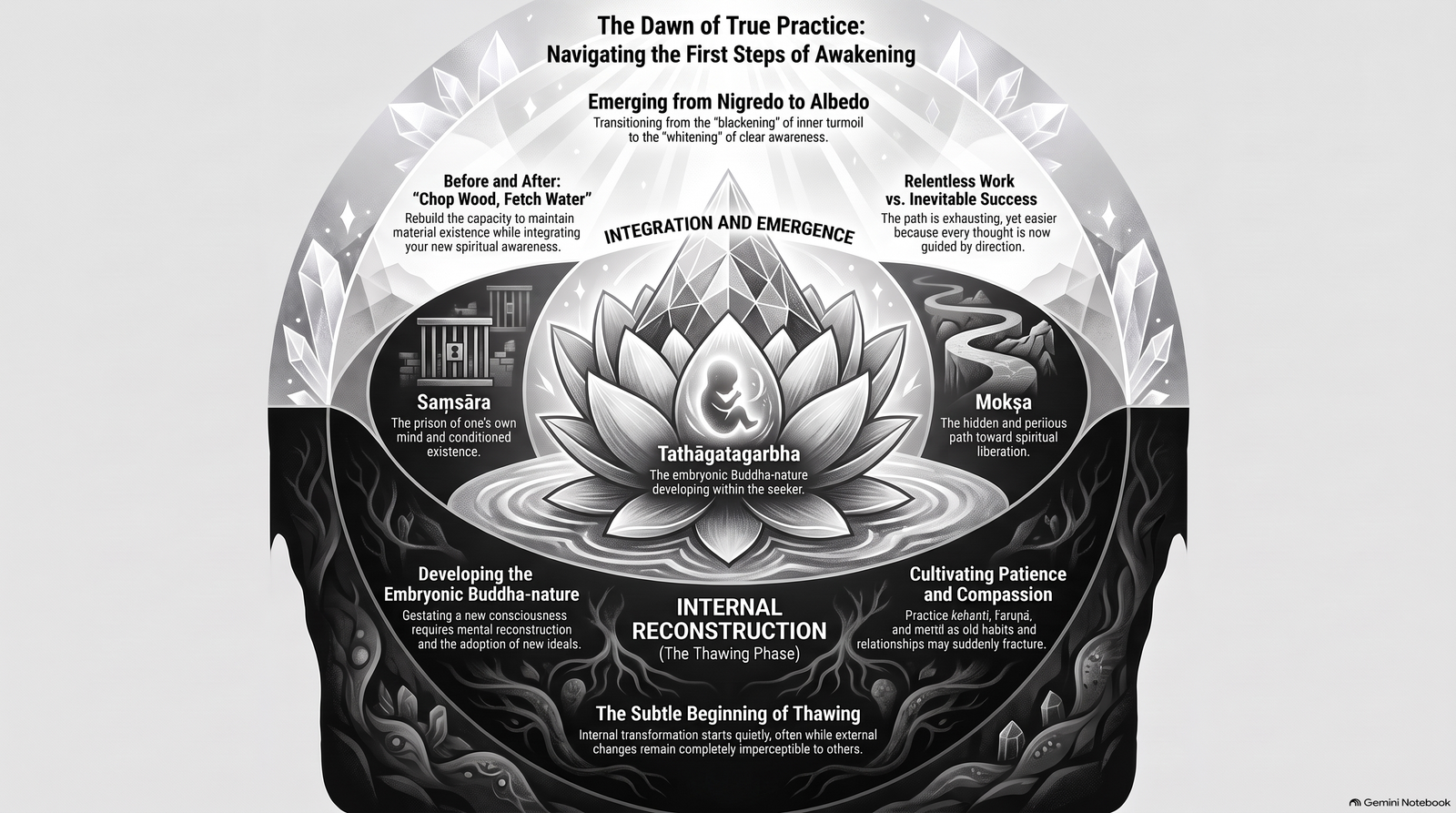
The recording asks what happens on the morning after a decisive insight. It moves through the images of prison, thawing, gestation, ordinary work, fractured relationships, mud and dawn. These images form an interpretive account of spiritual integration, not a universal clinical sequence. Distress, withdrawal, altered experience or impaired functioning should not automatically be treated as evidence of awakening.
Brief book orientation
The beginning after the breakthrough
The written chapter describes a delicate period in which a glimpse beyond familiar identity has supplied direction but not yet a stable way of living. The inner movement may be profound while outward life appears unchanged. Dr Robinson calls this a thawing: old structures loosen, a new orientation gestates, and the seeker gradually regains the capacity to meet material responsibilities.
The chapter joins Buddhist vocabulary, Zen imagery, alchemical stages and autobiography within a single map. Its practical centre is modest: return to the work immediately before you, meet relational strain with patience and care, and allow transformation to become visible through conduct rather than declaration.
The central question
How do you return to Tuesday?
Insight changes orientation
The glimpse functions as a beacon: familiar ambitions and assumptions can no longer be inhabited quite as innocently as before.
Life keeps its demands
Work, food, money, family and care do not disappear. The recording therefore treats integration as a practical reconstruction rather than an escape from embodiment.
Others may not understand
Changes in values, habits or attention can unsettle relationships. Patience and compassion matter, but they do not require passivity, unsafe exposure or the abandonment of appropriate boundaries.
Practice becomes less dramatic
The test is not whether the world looks new, but whether the same ordinary actions are met with less compulsion, resentment and self-protection.
The recording’s argument
From revelation to ordinary practice
See the morning after
Culture celebrates the illuminating moment; the recording begins where that story usually ends, with disorientation and the need to function again.
Recognise the bars
Saṃsāra becomes an image for inherited scripts, compulsive reactions and the conditioned mind. Seeing the pattern is not yet freedom from it.
Permit a slow thaw
Ice, chrysalis and gestation describe change that is largely invisible at first. The emphasis is on patience rather than forcing a premature new identity.
Chop wood and fetch water
Re-entry means rebuilding ordinary capacity. The task may remain the same while the quality of attention and the reason for acting begin to change.
Meet relational friction ethically
Kṣānti, karuṇā and mettā name patience, compassion and goodwill. They interrupt the temptation to turn insight into superiority.
Continue without applause
The image of wading through mud captures effort without obvious reward. Direction may sustain practice, but confidence does not guarantee a fixed outcome or remove the need for correction.
Enter the first light
The movement from Nigredo to Albedo symbolises a transition from breakdown and obscurity towards clarification. The chapter calls this not completion but the dawn of true practice.
Pick up the pencil
Van Gogh’s recommitment to drawing returns the argument to a concrete act. Transformation becomes credible when it permits renewed, sustained engagement with life.
Sources and boundaries
What each layer contributes
| Layer | Contribution | Boundary to retain |
|---|---|---|
| The written chapter | A concise map of reorientation after insight: thawing, returning to material life, relational strain and the emergence of direction. | It is an interpretive and autobiographical map, not a universal prognosis or proof that hardship must produce awakening. |
| Buddhist vocabulary | Saṃsāra, nirvāṇa, mettā, karuṇā and kṣānti give ethical and contemplative language to conditioning, release and the qualities cultivated in response. | The terms come from varied Indian Buddhist contexts. Tathāgatagarbha is especially associated with Mahāyāna traditions and should not be collapsed into a single pan-Buddhist doctrine. |
| Zen saying | “Before enlightenment, chop wood, fetch water; after enlightenment, chop wood, fetch water” makes continuity of ordinary activity the measure of integration. | The saying is widely circulated as Zen wisdom, but its frequent attribution to Layman Pang is not securely established. Its use here is illustrative rather than historical evidence. |
| Alchemy | Nigredo and Albedo provide a symbolic grammar for dissolution, clarification and the appearance of a new practical direction. | The transition is a course metaphor, not a standard psychological stage model or a claim about laboratory alchemy. |
| Psychological analogy | Prison, chrysalis, gestation and thawing help describe alienation and gradual reorganisation after a powerful experience. | Metaphor cannot distinguish spiritual development from depression, trauma, mania, dissociation or other causes of distress. Context, safety and functioning still matter. |
| The present recording | The 47:08 discussion expands the chapter through modern work, relationships, nervous-system vulnerability, Van Gogh’s recommitment and the difference between changing circumstances and changing one’s relation to them. | Its language of inevitability and necessary fracture is rhetorical. Outcomes vary, relationships may need boundaries, and persistent distress warrants suitable support rather than automatic spiritual interpretation. |
Video chapters
Navigate the discussion
- 00:00The Morning After Awakening
- 03:10Crystals, Lotus and Inner Reconstruction
- 06:20Seeing the Prison of Saṃsāra
- 11:25Thawing and Embryonic Buddha-Nature
- 15:05Returning to Ordinary Life
- 20:30Fracture, Patience and Compassion
- 25:15Spiritual Direction and Wading Through Mud
- 30:40From Nigredo into Albedo
- 34:40The Dawn of True Practice
- 38:25Van Gogh and Picking Up the Pencil
- 43:50When the World Is No Longer a Prison
Working vocabulary
Terms used in the chapter
Integration
Saṃsāra
Mokṣa
Tathāgatagarbha
Kṣānti
Karuṇā
Mettā
Nigredo and Albedo
“Chop wood, fetch water”
Dawn of true practice
Continue within the course
Related pathways
- 1.4.9. No-SelfThe preceding Subject chapter explores the loosening of self-identification and the risks of rebuilding identity around spiritual experience.
- Chapter 47: When the Path Starts to Flow NaturallyThe next course recording turns from first re-entry towards the gradual establishment of a way of practice.
- 1.2.8. SaṃsāraProvides the wider Nigredo account of conditioned existence used as the recording’s central prison metaphor.
- 1.1.12. The Seed of NirvāṇaDevelops the symbolic image of an awakening potential emerging within the conditions that appear to imprison it.
- 1.3.2. The Trees of ConsciousnessPlaces development and transformation within the course’s broader maps of consciousness.
- 1.2.12. The Eightfold Noble PathReturns inspiration and direction to a practical framework of understanding, conduct and cultivation.
Reference points
For careful further reading
- Stanford Encyclopedia of Philosophy: YogācāraAcademic context for the later Buddhist development of Buddha-nature thought and its relationship to models of consciousness.
- SuttaCentral: The Discourse on Loving-Kindness (Snp 1.8)An early Buddhist source for mettā as disciplined goodwill rather than sentiment or passive agreement.
- SuttaCentral: The Simile of the Saw (MN 21)A demanding early Buddhist teaching on patience, non-hatred and the training of the mind under provocation.
- Van Gogh Letters: To Theo van Gogh, Cuesmes, 24 September 1880The authoritative online edition of the letter in which Van Gogh describes recovering his energy, taking up his pencil again and returning to drawing.
- SuttaCentral: Rolling Forth the Wheel of Dhamma (SN 56.11)A primary source for the early Buddhist framing of suffering, its origin, cessation and the path, useful when distinguishing nirvāṇa from the recording’s broader language of liberation.
A grounded experiment
Pick up the pencil
Choose one small ordinary task you have postponed: wash one cup, answer one necessary message, prepare one simple meal or put one object back in its place. Before beginning, notice the story attached to it: resentment, dread, the wish to be elsewhere or the demand that the action prove something about you. Then complete only the task, at an unhurried pace, without turning it into a spiritual achievement. Afterwards ask: did the world need to change, or only my manner of meeting this moment? If withdrawal, sleeplessness, fear, confusion or altered experience is persistent or disrupts daily life, seek appropriate professional or trusted support rather than assuming it is a required stage of practice.
Course navigation