
Nigredo · Object · Chapter 27 of 48
1.3.3 The Golden Middle Path
If choosing what is right and choosing what is wanted can both preserve the divided self, what would it mean to move beyond the dilemma rather than win it?
Watch the chapter discussion
Why You Can’t Escape the System
The book
The chapter in brief
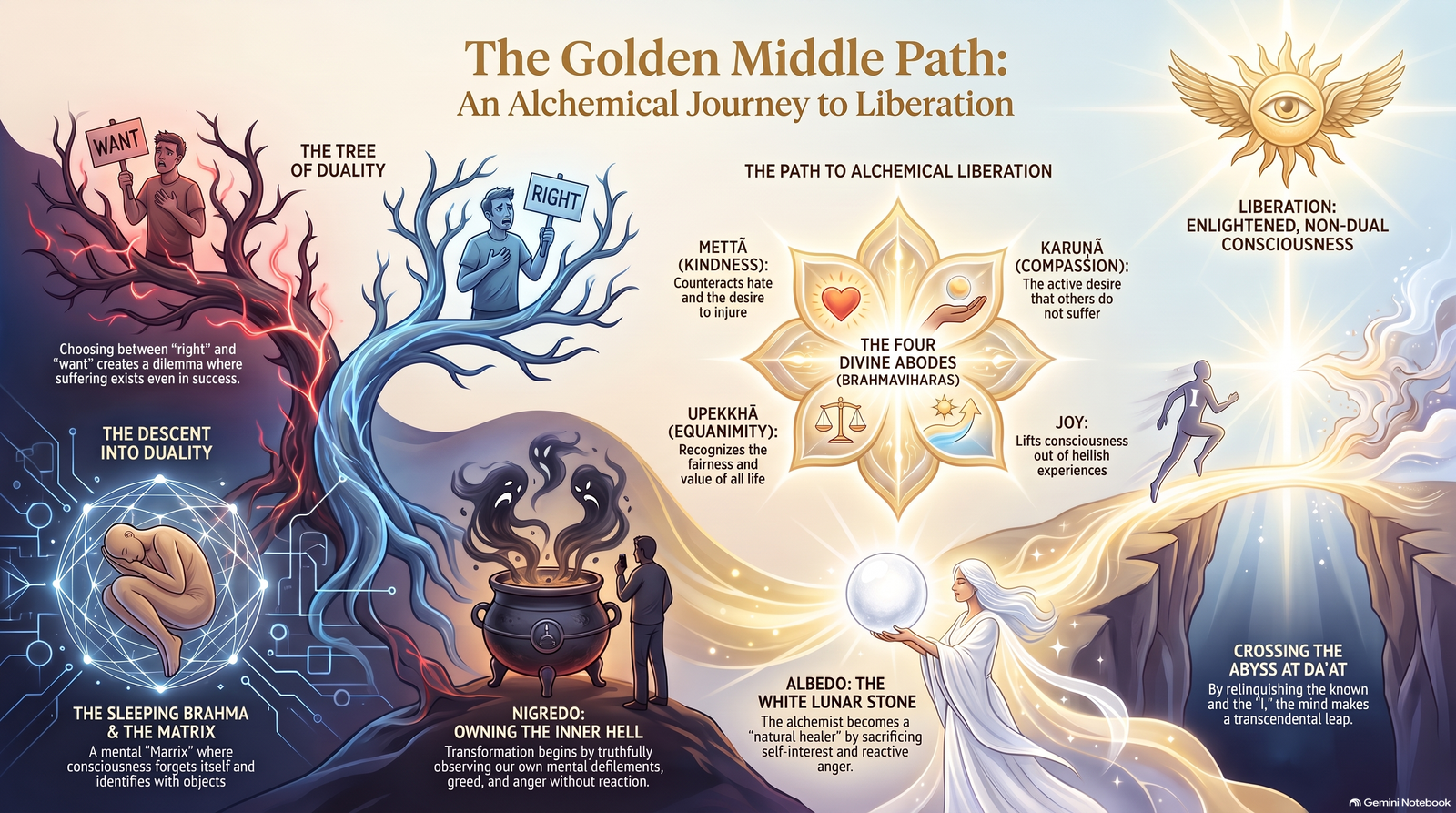
This chapter moves from the large-scale Trees of Consciousness towards the practical problem of divided experience. It describes an apparent conflict between what the self wants and what it judges to be right, then asks why both indulgence and self-denial can continue to organise life around that same self. Nigredo becomes the work of recognising reactive habits without immediately repeating them; the four brahmavihāras provide an ethical counterweight, while Da’at, the Abyss and Albedo symbolise more radical changes in identification.
The result is Dr Robinson’s cross-traditional alchemical map. It draws upon Buddhist path language and later Western esotericism, but neither its exact sequence nor its equivalences constitute a standard teaching shared by those traditions.
Visual orientation
From divided choice to a path beyond division
Video guide
Can any choice made by the divided self end its division?
The recording opens by turning ordinary perception into a problem. A room and its objects feel self-evidently external, yet the speakers use the chapter’s layered-consciousness model to suggest that what we know directly is a constructed field of experience. From there, the “system” of the title is not primarily a political institution or computer simulation. It is conditioned experience organised around an apparently separate “I”: a self that prefers, defends, explains and then mistakes its own representation of the world for the world itself. “Matrix” and “sleeping Brahma” are the video’s governing metaphors, not empirical descriptions of perception or proof that physical reality is literally mental.
The central dilemma appears with the Tree of Duality. One side says “I want”; the other says “this is right”. Acting selfishly may strengthen greed, anger or deception, but acting virtuously for the sake of becoming good, secure or rewarded can still keep the same self at the centre. The video therefore shifts from choosing the better pole to examining the machinery of reaction itself. Nigredo means owning the anger, guilt, shame and self-deception present in experience without discharging them automatically into another deed. This is where the four brahmavihāras enter: loving-kindness, compassion, appreciative joy and equanimity become qualities that loosen hostility, cruelty, envy and partiality.
The recording then translates Buddhist path terminology into the chapter’s esoteric landscape. Da’at and the Abyss mark a surrender of familiar explanations; “path consciousness” and stream-entry name an irreversible change in relation to conditioned experience; Albedo describes a quieter phase in which attachment and ill will have weakened. The video’s most important tension is also its most delicate one: it links awakening with feeling “unhinged” from ordinary reality and discusses addiction, depression and mental distress around the dark night. Such experiences do not establish spiritual attainment, and a contemplative interpretation never excludes psychological, psychiatric, social or medical causes. Distress, loss of function or danger deserves appropriate professional support.
The final movement passes through the Veil of Isis towards the dissolution of subject and object. The claim that one can “see the programming as well as the program” is contemplative and metaphysical language, not a scientifically verified perception of reality’s code. Read carefully, the practical challenge is more modest and more immediate: can a difficult impulse be known without being obeyed, suppressed or recruited into a superior spiritual identity? The Golden Middle Path is presented not as a lukewarm compromise, but as release from the compulsive structure that keeps producing opposed sides.
Keep the languages distinct
What the chapter brings together
| Source language | How the recording uses it | Editorial boundary |
|---|---|---|
| Early Buddhist teaching | The Middle Way, karma, the brahmavihāras, path and fruit consciousness, stream-entry and release from clinging | These terms belong to specific textual and doctrinal settings. The video’s complete alchemical sequence is not a canonical Buddhist map. |
| Theravāda Abhidhamma | Momentary citta, resultant consciousness and the claim that mental factors give experience its ethical quality | This is a later analytical tradition rather than contemporary neuroscience, and other Buddhist schools analyse mind differently. |
| Hermetic Qabalah | The Tree of Duality, a central path, Da’at, the Abyss and movement between levels of consciousness | The Abyss-centred initiatory reading is characteristic of later Western esotericism and should not be treated as a neutral account of Jewish Kabbalah. |
| Alchemy | Nigredo as confrontation with reactive material and Albedo as whitening, purification and a more harmonising presence | The psychological and contemplative interpretation is modern and symbolic; historical laboratory alchemy had its own material practices and varied meanings. |
| The course synthesis | A single journey from the divided Tree, through non-reaction and divine abodes, across an Abyss and towards non-dual liberation | This proposed correspondence is Dr Robinson’s interpretive architecture, not historical proof that all the traditions describe one mechanism. |
Argument map
How the recording develops
Question the solid world
The opening uses ordinary objects to ask whether experience presents reality directly or through layers of conditioned consciousness.
Locate the apparent chooser
Ten viewpoints are said to stack into an “I” that forgets its own construction and identifies with the world it experiences.
Expose the dual bind
“What I want” and “what is right” become opposing branches that can both preserve a self seeking gratification, innocence or reward.
Descend into Nigredo
The work begins by owning anger, greed, guilt and deception without immediately projecting, suppressing or repeating them.
Cultivate four counterweights
Loving-kindness, compassion, appreciative joy and equanimity weaken hostility, cruelty, jealousy and partiality.
Risk relinquishing the known
Da’at and the Abyss symbolise a threshold where inherited explanations and the demand to secure the self can no longer complete the work.
Reframe liberation
Albedo and the lifted veil point towards less reactive participation and, ultimately, a non-dual account in which subject and object are no longer absolute.
Book, video and context
Four layers of the discussion
The written chapter
Summarises the layered Tree, develops the bind of duality, introduces the four divine abodes and carries the alchemist from Nigredo through Da’at towards Albedo and the Veil of Isis.
The video’s expansion
Adds the room and coffee-cup opening, an extended account of the “self-made Matrix”, objections about abandoning goals, and practical examples of reacting to ordinary friction.
The traditional inheritances
Buddhist vocabulary supplies karma, the divine abodes and path terms; Hermetic Qabalah supplies the Abyss and central Tree imagery; alchemy supplies blackening and whitening.
The original synthesis
The exact equivalence between Trees, Buddhist stages, mental layers and alchemical colour changes is the course’s proposal rather than a consensus shared by the source traditions.
Recording outline
The route through the video
All ten supplied chapter markers fall within the stated 49:09 final runtime.
- 00:00Opening: The Inescapable System
- 02:20The Illusion of Choice
- 06:10The Structure of Duality (Two Sides of Self)
- 10:40Why Good and Bad Both Bind You
- 15:20The Experience of “Hell” Explained
- 20:30Owning the Shadow and Self-Deception
- 25:40Non-Reaction and Breaking Karma
- 30:50The Brahmavihāras (Four Transformations)
- 35:40The First Breakthrough (Path Consciousness)
- 40:10The Middle Path Beyond Duality
Key language
Glossary
Middle Way · Middle Path
Tree of Duality · Tree of Life
Citta
Karma · Kamma
Brahmavihāras
Mettā · Karuṇā · Muditā · Upekkhā
Nigredo
Albedo
Da’at · the Abyss
Path and fruit consciousness
Sotāpanna · stream-enterer
Veil of Isis
“Skandha demons”
Continue into the ideas
Related reading and reference points
Within this course
- 1.3.2 The Trees of ConsciousnessThe preceding chapter establishes the layered Tree that this recording turns into a practical map of division and transformation.
- 1.3.4 The Four Grades of RealisationThe next chapter examines the four Buddhist attainment categories introduced near the end of this discussion.
- 1.2.5 The Mental FactorsProvides the course’s account of the qualities that accompany consciousness, including the four attitudes highlighted here.
- 1.2.12 The Eightfold Noble PathReturns to the Buddhist path explicitly identified as the Middle Way in the first discourse.
- 1.1.11 The Dark Night of the SoulExplores the course’s earlier symbolic treatment of loss, disorientation and the weakening of a defended identity.
- Object — Part Three of NigredoThe section index for the twelve chapters on paths, realisation and the apparent goal.
External reference points
- SuttaCentral — SN 56.11, Setting the Dhamma Wheel in MotionA translation of the discourse that defines the Middle Way between sensual indulgence and self-mortification and sets out the Noble Eightfold Path.
- Stanford Encyclopedia of Philosophy — BuddhaA scholarly overview of suffering, non-self, karma and several senses in which Buddhist reasoning avoids opposed extremes.
- My Jewish Learning — What Are the Sefirot?A concise Jewish introduction to the sefirot as divine emanations, helping distinguish Kabbalistic theology from the course’s psychological Tree.
- Reform Judaism — What Is Kabbalah?Places Kabbalah within Jewish tradition and offers context for the later Western esoteric adaptations used by the chapter.
Grounded reflection
What is the reaction trying to secure?
Choose one small, recent irritation rather than a traumatic or overwhelming event. For a minute, notice three possibilities: what you wanted, what you thought you ought to do, and what each option promised to protect — comfort, approval, control, innocence or something else. You do not need to suppress the feeling or solve the dilemma. Simply ask whether both sides were organised around securing a particular picture of “me”. This is an exercise in description, not an attainment test or treatment.