
Albedo · Mythos · Chapters 1–12 of 48
Mythos — Part One of Albedo
Can the stories that organise suffering be understood without turning clarity into another story about who we are?
Watch the section overview
How the Mind Builds Its Own Hell | Albedo: Mythos
Book orientation
The section in brief
Mythos opens Albedo by examining the narratives through which a person interprets fault, suffering, aspiration and spiritual progress. Its twelve chapters move from the seven deadly sins and Buddhist cosmology through the alchemist, the Moon and the White Stone, towards shame, subtle spiritual identity, inner guidance and the Master of the Temple. The guiding shift is from acknowledging rejected aspects of experience in Nigredo to clarifying the habits that continue to shape response. Christian images, Buddhist models and Western esoteric grades are placed in conversation as part of Dr Simon Robinson’s synthesis. Their correspondences are interpretive rather than established equivalences. This section offers a vocabulary for discernment; it does not provide a diagnostic instrument or a test of attainment.
Transcript-led video guide
When a story becomes a world
The overview asks how a mind can participate in sustaining its own suffering, and why relief from obvious conflict may still leave a subtler attachment to identity. It begins with hell as a recurring loop: experience is interpreted through a threatened self, reaction reinforces the interpretation, and the next encounter arrives already coloured by that pattern. This is an evocative philosophical model of experience. The opening language about a brain generating hell should not be read as an established neurological mechanism or as an explanation of every kind of suffering.
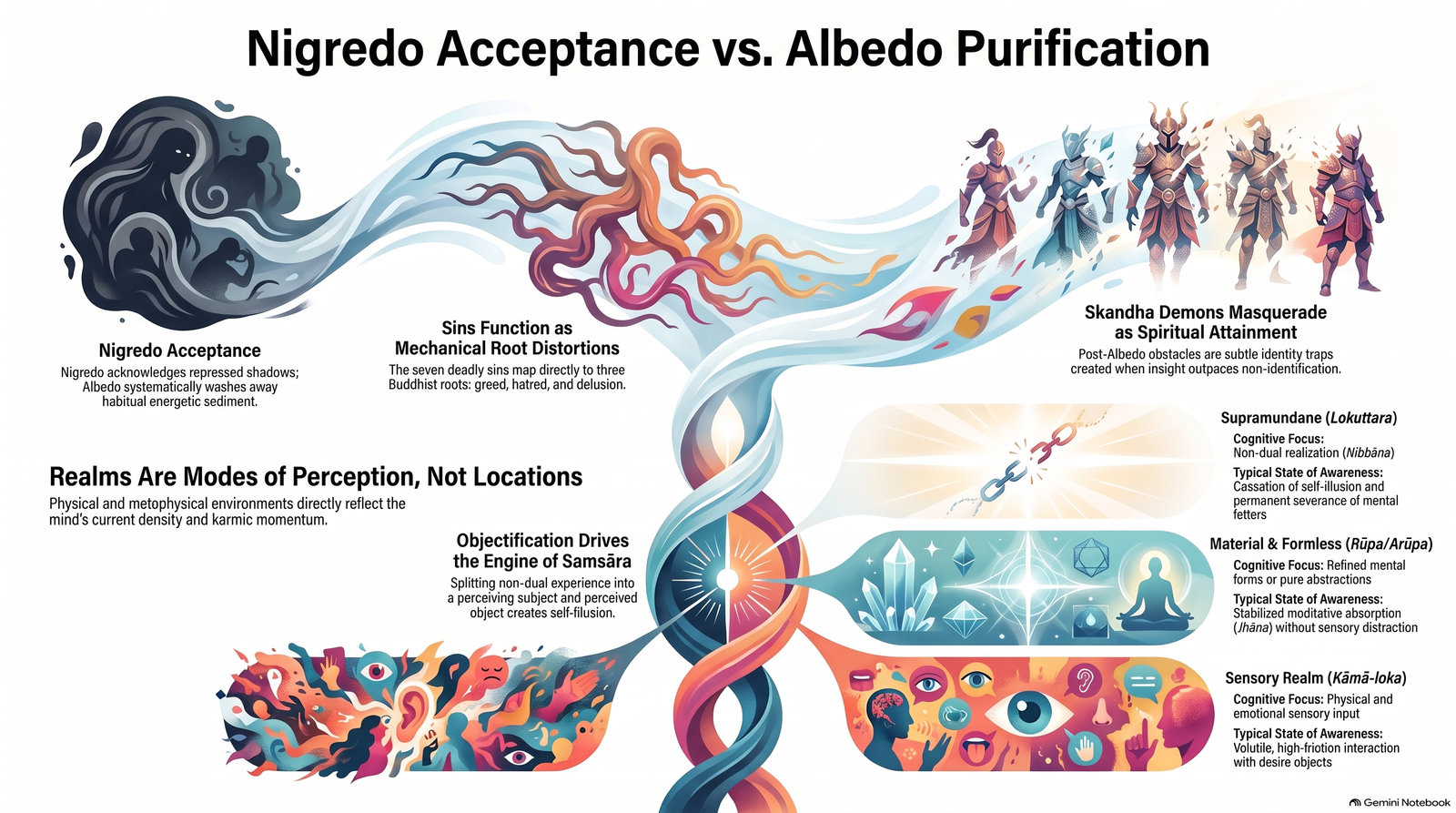
The first movement introduces subject–object division, continuity and intention through the images of a spinning fan and a film projector. Theravāda Abhidhamma terms such as bhavaṅga and javana provide the discussion’s vocabulary, but its carrier waves, microscopic windows and rewritten code are explanatory analogies. The recording then makes the transition from Nigredo’s acceptance of shadow to Albedo’s clarification of habit. Its extended treatment of the seven sins explores comparison, anger, possessiveness, repetitive consumption and resistance. The important editorial distinction is between examining a response and condemning the person who experiences it. Perception mediates anger, but external harm remains real; fatigue and difficulty initiating tasks cannot simply be attributed to spiritual resistance.
The middle widens the view to hell imagery and the sensory, form and formless realms. Its warning is that a refined or pleasurable state need not end clinging. Traditional cosmological claims about rebirth are distinct from using realms as descriptions of present experience. The video’s account of luminous “skandha demons” then turns the warning inward: an experience of clarity can become evidence in a new story of exceptional status. The link to the Theravāda higher fetters is the author’s comparison, not a shared taxonomy accepted across Buddhist traditions.
Finally, the Holy Guardian Angel becomes a symbol of ethical discernment, tested through consequences rather than intensity or flattery. The discussion presents the Master of the Temple and the empty vessel as images of receptivity without ownership, then returns to practical functioning and compassion. These are interpretations of Thelemic material, not clinical descriptions or confirmations of awakening. The practical challenge is to remain answerable to ordinary relationships and responsibilities when an inner experience feels significant. The closing gesture towards Citrinitas looks beyond this overview; Dharma, Object and Subject remain the other sections of Albedo, and Rubedo remains the fourth volume of the course.
Symbol, tradition and evidence
The movement of the recording
A loop becomes a lived world
The opening reframes hell as an image of reaction repeatedly reinforcing a threatened sense of self.
Continuity gives the loop momentum
Projector imagery introduces traditional models of cognition and intention as a way to discuss conditioned response.
Acceptance becomes clarification
The Nigredo–Albedo contrast leads into seven familiar vices examined as patterns rather than fixed identities.
A better state is still a state
The cosmological survey distinguishes refined experience from the traditional claim of liberation from clinging.
Insight acquires an owner
The skandha-demon motif shows how a meaningful experience can be recruited into spiritual status.
Guidance remains accountable
The Guardian Angel discussion asks whether an intuition reduces self-importance and withstands scrutiny.
The vessel returns to daily life
The Temple image closes with conventional functioning and compassion rather than a licence for special authority.
Read the section; use the overview
The book develops the symbols
Twelve separate chapters give room to the Moon, White Stone and grace, as well as cosmology and esoteric grades.
The recording selects a route
The overview concentrates on reactive loops, the seven sins and spiritual identity; it does not give every chapter equal treatment.
This page supplies the distinctions
The guide separates interpretation from doctrine and evidence, while the directory leads to each chapter’s own study page.
An illustrated map of the synthesis
Video chapters
Estimated chapter markers supplied for the finished 44:41 recording. Allow a little room around each transition.
- 00:00The inner hell: introducing the discussion
- 01:25How the mind constructs self and world
- 07:05From Nigredo to Albedo: the work of purification
- 09:45The seven deadly sins as patterns of mind
- 18:05Hell imagery and the seven-headed dragon
- 20:05Planes of consciousness: why bliss is not liberation
- 26:40Spiritual insight and the trap of spiritual ego
- 30:55The Holy Guardian Angel and testing inner guidance
- 36:20Crossing the abyss: the Master of the Temple
- 40:10Identity, everyday functioning and compassion
- 42:10Closing reflections: the empty vessel
Terms worth keeping distinct
Albedo
Objectification and “selfing”
Karma and the unwholesome roots
Bhavaṅga
Javana
Ālaya-vijñāna
Saṃsāra and realms
Jhāna and insight
Lokuttara, path and fruit
Māna and spiritual ego
Skandha demons
Holy Guardian Angel
Master of the Temple and the Abyss
Section directory · 2.1.1–2.1.12
The twelve Mythos chapters
Read in book order, or follow the question that brought you here. Each link opens the existing chapter study page.
- 2.1.1. The Seven Deadly Sins
A comparative reading of vice, motivation and conditioned response.
- 2.1.2. The Cosmos
The section’s account of perception and cosmological categories.
- 2.1.3. Rebirth and Saṃsāra
Continuity without a permanent soul in the author’s framework.
- 2.1.4. Hell and Hell Beings
Hell imagery and the distinction between symbol and rebirth claims.
- 2.1.5. Angels and Gods
Refinement, celestial imagery and the limits of pleasant states.
- 2.1.6. The Alchemist
The alchemist’s purpose, conscience and method of inquiry.
- 2.1.7. The Moon
Reflection, interpretation and the metaphor of karmic echoes.
- 2.1.8. The White Stone
Non-reactivity and the risk of becoming attached to virtue.
- 2.1.9. Grace and the Healing of Shame
Shame, responsibility and the author’s interpretation of grace.
- 2.1.10. A New Kind of Demon
When meaningful experience is claimed as a spiritual identity.
- 2.1.11. The Holy Guardian Angel
Inner discernment, provisional guidance and accountability.
- 2.1.12. The Master of the Temple
The receptive vessel and the limits of comparisons between attainment maps.
Related pathways
- Dharma — Part Two of Albedo | Spiritual Alchemy Course | Dr Simon RobinsonContinue with the mechanics of perception, intention and karma.
- Object — Part Three of Albedo | Spiritual Alchemy Course | Dr Simon RobinsonExplore the section devoted to the nature of reality.
- Mythos — Part One of NigredoReturn to the narrative groundwork of the first volume.
- 2.2.6. The Life ContinuumStudy the Theravāda model introduced by the overview’s projector analogy.
- 2.2.12. The AnagāmīKeep the traditional non-returner map distinct from symbolic esoteric grades.
External reference points
- AN 6.63 · Nibbedhika SuttaṬhānissaro Bhikkhu’s translation provides a canonical reference for intention and karma, while retaining the text’s rebirth context.
- The Abhidhamma in Practice · N. K. G. MendisA Theravāda exposition of consciousness, cognitive processes and mental factors; a traditional account, not neuroscience.
- Yogācāra · Stanford Encyclopedia of PhilosophyScholarly context for storehouse consciousness and the interpretation of mind and appearance; useful for distinguishing this framework from Theravāda Abhidhamma.
- Catechism of the Catholic Church · paragraphs 1865–1869An official Catholic account of capital sins and their ethical context, allowing the course’s reinterpretation to be compared with a source tradition.
- Aleister Crowley · One Star in Sight (1935 reprint, PDF)A primary Thelemic text describing grades, the Holy Guardian Angel and the Master of the Temple; evidence for that system’s claims, not proof of universal attainment.
A question to carry forward
When a moment of clarity feels important, what would show its value in an ordinary relationship: a stronger story about your status, or a greater willingness to listen, check the facts and repair a mistake?
You do not need to interpret the experience or decide on an attainment. Let the question remain grounded in one small, observable act of care.