
Dialogues IV · Episode 18
Why Being a Good Person Is Exhausting | Dialogues IV
When kindness becomes a role that must constantly be defended, care acquires the weight of a second self.
The central question
Can compassion remain alive when the identity of “the good person” is no longer managing it?
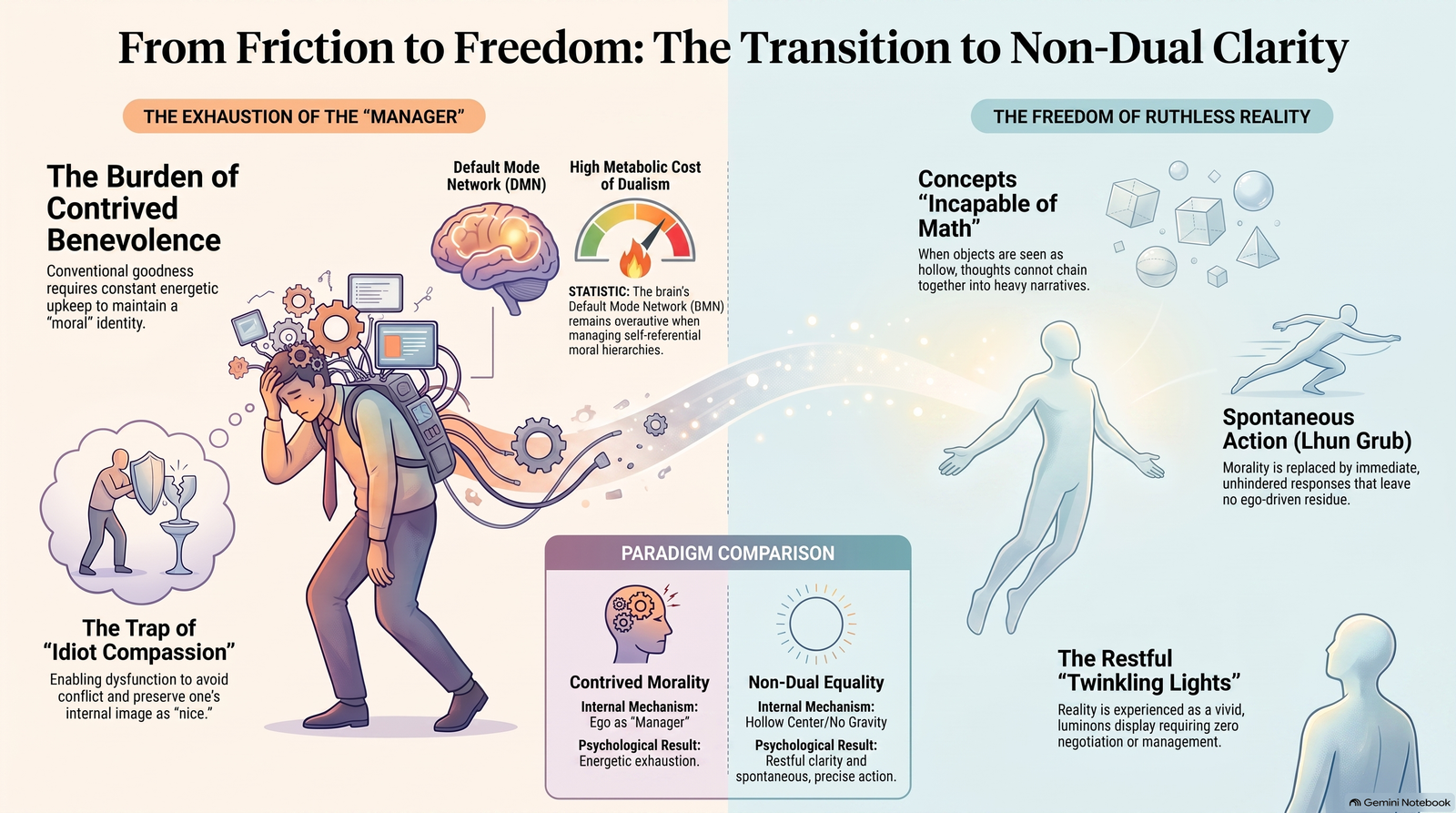
The final regular episode of Dialogues IV begins with a familiar fatigue: the endless work of monitoring one’s conduct, anticipating everyone’s needs and smoothing every difficult edge. It calls this pattern “contrived benevolence”—not to dismiss kindness, but to question the burden created when kindness must continually prove who one is. An inner manager divides the scene into a virtuous self here and a deficient person or broken world there, then assumes responsibility for closing the gap.
The discussion tests that arrangement through conflict avoidance and the provocative phrase “idiot compassion”: care that protects a self-image or evades necessary friction while allowing dysfunction to continue. Its proposed alternative is “ruthlessness”, carefully understood here as unsentimental clarity rather than cruelty. Within the episode’s Dzogchen-inflected interpretation, the “confidence of equality” loosens the hierarchy that makes one thought, fear or identity seem inherently heavier than another. Experiences still arise, but their apparent solidity and authority can be examined.
From there the argument turns towards the mechanics of thought. A mistake becomes incompetence, anticipated rejection and catastrophe because concepts appear solid enough to adhere to one another. The episode links this snowballing to the Buddhist term papañca, then imagines what happens when each thought is recognised as contingent and “hollow-centred”: conceptual Velcro becomes Teflon; the mind cannot build a bridge between clouds. Traditional Dzogchen instructions on leaving view, meditation, appearances and fruition as they are provide a contemplative frame for this release.
Neuroscience enters only as a possible analogy. Research connects the default mode network with self-referential processing and reports group-level differences associated with meditation, while the free-energy principle offers a formal account of perception and action through probabilistic inference. Neither establishes a neural mechanism for Dzogchen, proves that selfhood has been eliminated, or shows that cognition literally “cannot do maths”. The episode’s final challenge is therefore ethical as well as contemplative: whether responsiveness can become cleaner when it no longer has to maintain a benevolent identity.
How to read this episode: “ruthless reality” does not authorise indifference, aggression or abandoning ordinary responsibilities. Dzogchen terms such as equality, spontaneous presence and self-liberation belong to a specific Tibetan Buddhist path and are simplified by the podcast’s psychological metaphors. Likewise, the default mode network is not simply “the ego”, meditation findings do not demonstrate the extinction of a manager-self, and Friston’s free-energy principle is not evidence that non-dual awareness is the brain’s natural endpoint. The argument is an exploratory comparison, not an empirical equivalence or a confirmation of spiritual attainment.
Argument map
Seven movements from moral management to uncontrived response
Goodness becomes administrative labour
Care grows exhausting when every encounter must also preserve a stable identity as helpful, decent and in control.
A hidden hierarchy divides the scene
The “good” self imagines itself acting upon a deficient other, turning relationship into continual diagnosis, intervention and self-reference.
Avoidance can disguise itself as compassion
Smoothing over conflict may protect one’s niceness while enabling the very pattern that a clear boundary or difficult conversation could address.
Equality removes conceptual weight
The episode’s Dzogchen-inflected pivot does not erase differences in consequence; it questions the inherent solidity assigned to fears, desires and identities.
Hollow concepts cannot compound so easily
When a thought is seen as contingent rather than self-grounding, it has less power to recruit memories and predictions into an apparently inevitable story.
Proliferation gives way to luminous events
Instead of being captured and chained into narrative, thoughts are pictured as “twinkling lights”: vivid, momentary and unable to possess the whole field.
Response need not serve a manager
The conclusion asks whether warmth, firmness and practical action can arise without first being filtered through the project of appearing good.
Listen by theme
Chapters
Selecting a chapter opens the published video at that point on YouTube.
- 00:00The Exhaustion of Being Good
- 03:25Contrived Benevolence and the Inner Manager
- 06:50When Compassion Becomes Avoidance
- 09:11The Confidence of Equality
- 12:46Ruthlessness Without Cruelty
- 15:51Finding the Hollow Centre of Thought
- 18:56The Four Ways of Leaving Things Alone
- 21:03Breaking the Samsaric Calculus
- 22:40Papañca: When Thoughts Start to Snowball
- 24:33From Managing Thoughts to Luminous Clarity
- 26:15Compassion Without a Manager
- 27:20Letting the Manager Rest
Terms in context
Glossary
Contrived benevolence
The episode’s term for kindness that requires continual self-monitoring and reinforces a division between a virtuous helper and a deficient recipient. It is not a standard diagnostic or Buddhist technical term. The criticism is directed towards identity-maintenance, control and performance—not towards generosity, ethical discipline or the practical work of caring for others.
“Idiot compassion”
A provocative modern Buddhist expression, especially associated in English with Chögyam Trungpa, for apparently kind behaviour that avoids clarity, boundaries or consequences and thereby enables harm. It should not become a pretext for contempt or harshness. Whether a response is helpful depends on context, power, relationship and foreseeable effects—not simply on how “fierce” it feels.
Dzogchen
“Great Perfection”, a family of teachings and practices especially important within the Nyingma school and Bön. Dzogchen concerns recognition of the nature of mind and includes its own lineages, preliminaries, terminology and safeguards. The podcast borrows from this tradition philosophically; its modern psychological analogies should not be mistaken for a complete presentation or self-sufficient practice instruction.
Confidence of equality — mnyam pa nyid
Mnyam pa nyid can be translated as equality or sameness. In the episode it names confidence that apparently opposed phenomena are equal in empty, luminous nature. This ultimate-level claim does not make pain and pleasure, help and harm, or benevolence and malice interchangeable at the conventional ethical level.
Emptiness — śūnyatā
In Buddhist philosophy, emptiness generally means the absence of independent, intrinsic existence: persons and phenomena arise through conditions, relations and conceptual designation. It does not mean that nothing appears, nothing matters or consequences cease. The episode’s “hollow centre” is an intuitive metaphor for emptiness, not a definition accepted identically by every Buddhist school.
Papañca
A Pāli term commonly rendered as conceptual proliferation or elaboration. In the Madhupiṇḍika Sutta, contact, feeling, perception and thought feed a proliferating process through which a person becomes beset by concepts. The episode’s snowball, Velcro and “samsaric calculus” are contemporary metaphors for this process rather than literal translations of the early Buddhist text.
The four ways of leaving things as they are
A Dzogchen formulation known in Tibetan as cog bzhag bzhi. The four concern view, meditation, conduct or appearances, and fruition or awareness, with explanations varying across texts and lineages. The episode’s mountain and ocean images reflect traditional descriptions, but this compact sequence belongs within advanced practice contexts rather than functioning as a generic instruction to ignore problems.
Trekchö
Often translated as “cutting through” or “thorough cut”, Trekchö is a central Dzogchen approach concerned with recognising and sustaining awareness beyond contrivance. It is not merely relaxation, passive observation or refusing to act. Traditional presentations situate it within transmission, preparation and guidance that the podcast necessarily compresses.
Luminous clarity — gsal ba
Gsal ba may be translated as clarity or luminosity and, in Tibetan Buddhist contexts, points to the knowing or manifest quality of mind rather than physical light. The episode’s “twinkling lights” and fireflies are poetic images for thoughts that appear vividly without hardening into an extended self-story; they are not claims about visual phenomena.
Spontaneous presence — lhun grub
A Dzogchen term referring to qualities or appearances understood as naturally or spontaneously present, rather than manufactured by an egoic agent. The podcast extends it towards immediate ethical responsiveness. That extension needs care: spontaneity alone does not guarantee wisdom, compassion or harmlessness, and “no ego-driven residue” is a doctrinal ideal rather than an observable fact about conduct.
Default mode network
A set of interacting brain regions often studied in relation to internally directed cognition, including autobiographical memory, self-referential processing and mind-wandering. It is not a single “ego centre”. Some meditation studies report differences in its activity and connectivity, but results depend on task, method, experience and comparison group; they do not directly validate Buddhist accounts of liberation.
Free-energy principle
Karl Friston’s theoretical framework proposing that living systems maintain themselves by limiting a formal quantity called variational free energy through perception and action. “Free energy” here is an information-theoretic construct, not ordinary metabolic energy. The episode uses the framework to illuminate predictive management; it should not be treated as a demonstrated explanation of non-dual awareness.
Read further
Connections and reference points
Within this website and course
- Why Escaping the World Never WorksThe previous episode asks whether peace can be found by escaping difficulty; this finale brings the same question inside the identity of the helper
- Why Goodness Becomes the Final AttachmentA direct precursor examining how virtue can become the most refined possession of a self that wants to survive its own undoing
- The Messianic Trap of Saving the WorldAn earlier exploration of the saviour complex and the exhaustion created when reality becomes one person’s project to repair
- The Physics of a Frictionless MindA companion dialogue using scientific language as analogy for action without the felt resistance of a controlling self
- 3.2.5. PapañcaThe course page devoted to conceptual proliferation, the process behind the episode’s images of snowballing thought and sticky concepts
- 3.3.9. Beyond DualityCourse context for the non-dual vocabulary through which the episode questions the division between manager and managed reality
External reference points
- SuttaCentral: Madhupiṇḍika Sutta (MN 18)A modern translation of the early Buddhist discourse connecting contact, perception, thought and the proliferating concepts by which a person may become beset
- Lotsawa House: Four Ways of Leaving Things As They AreA translated traditional explanation of cog bzhag bzhi, showing both the episode’s textual basis and the specialised Dzogchen context it compresses
- Brewer and colleagues: meditation and the default mode networkThe 2011 study invoked by the episode; its findings concern observed group differences in activity and connectivity, not the disappearance of an ego centre
- Friston: The free-energy principleThe influential 2010 review setting out the theoretical framework for action, perception and learning that the episode uses as a limited cognitive analogy
A gentle reflective exercise
Care without the résumé
Recall one small interaction in which you felt responsible for being “the good one”. For a minute, separate three things: what the situation practically required, what the other person may actually have needed, and what your self-image wanted to secure. Do not suppress kindness or force a confrontation. Simply notice whether one modest response—a clear boundary, a useful action, patient listening or doing nothing yet—remains available when it does not have to prove your goodness.
Continue the series