
Dialogues I · Episode 13
Eating the Illusion
What if mental noise is neither an enemy to silence nor a movie from which to escape, but material that can be met, metabolised and returned as ordinary compassionate action?
Central question
Can the mind stop fighting its own static without withdrawing from the world?
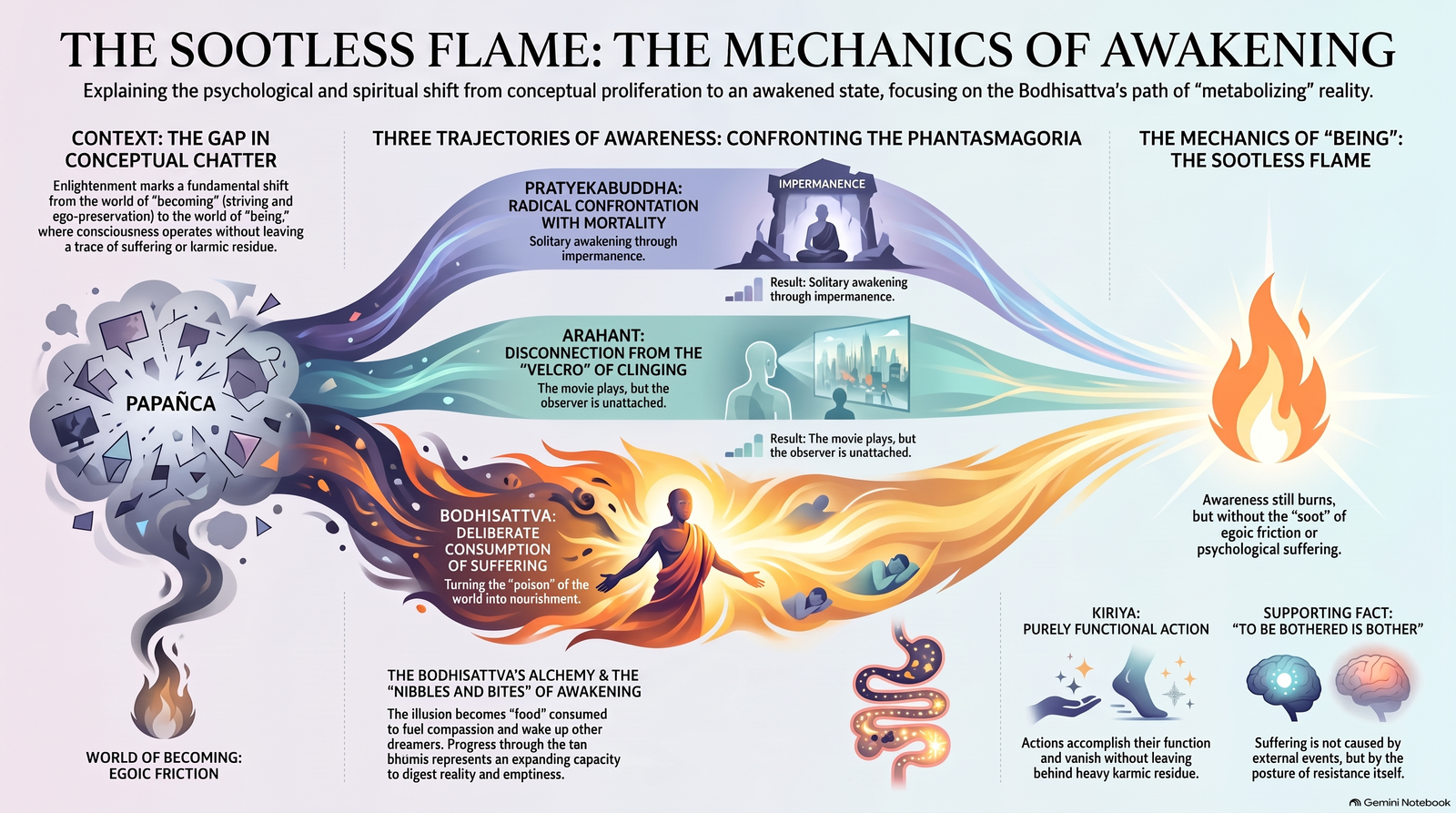
The episode opens at 3 a.m., when a tired mind produces an impossible number of browser tabs: unfinished work, old embarrassments and calculations about how little sleep remains. This familiar cascade becomes an entrance into papañca, the Buddhist term often translated as conceptual proliferation. A perception does not remain a perception; it recruits memory, identity, anticipation and judgement until a whole private world appears.
Against the usual wish for a mute button, the discussion proposes a more radical change in relationship. It presents three stylised encounters with the “phantasmagoria”: the pratyekabuddha sees its impermanence; the arahant no longer clings to its appearances; the bodhisattva makes its suffering into food. The television will fail, the Velcro has been removed, and finally the television itself is eaten. These are vivid interpretive metaphors, not a standard comparative taxonomy shared by all Buddhist traditions.
The metabolic image carries the argument into the ten bodhisattva grounds. Each bhūmi becomes a larger “bite” of the constructed world. Wisdom ascends into emptiness; compassion descends into the dense conditions of ordinary life. The peacock, traditionally imagined as transforming poison into brilliant feathers, supplies the governing image: suffering is not glorified, but its bound energy may become attention, patience and care.
Midway through the episode, the scale changes from cosmic doctrine to intimate phenomenology: “I no longer trust my suffering. I wait for its expiration with sympathy.” The claim is not that pain, danger or fatigue are unreal. It is that the narratives attached to them need not be granted unquestioned authority. Strange neutrality is compared to a stone sinking through water without desire, fear or argument.
The “sootless flame” then answers the fear that non-attachment must end in paralysis. Sensation, thought and action continue, but without the smoke of defensive self-construction. Theravāda Abhidhamma language of kiriya citta, functional consciousness, is borrowed as a metaphor for action that performs its task without producing a fresh identity around the performer. Concepts remain available, but as artistic and practical instruments rather than final descriptions of reality.
The closing movement leaves the zero-stakes cinema and returns to the marketplace. The “eleventh stage” of multiplication is the episode’s alchemical extension beyond the traditional ten bhūmis: rolling up one’s sleeves, helping, answering messages and spinning the plates that still need attention. The result is not an escape from human limits. It is the quieter possibility of acknowledging tiredness without automatically manufacturing despair—while still resting, seeking help and changing circumstances when needed.
Argument map
From proliferating thought to the work of return
A thought becomes a world
The 3 a.m. browser tabs show how perception recruits memory, anticipation and self-judgement. Papañca is presented as the machinery by which one event multiplies into a reality organised around “me”.
The television will not endure
The pratyekabuddha trajectory confronts mortality so completely that grasping loses its imagined future. This is the episode’s compressed portrait, not an exhaustive account of pratyekabuddhahood.
The movie plays without Velcro
The arahant becomes the image of experience continuing without appropriation. Sensation and cognition remain, while the habit of making them “mine” no longer adheres.
The bodhisattva eats the television
The world’s friction becomes material for compassion rather than a contaminant to escape. Peacock feathers give this transformation a deliberately alchemical form.
Capacity expands by nibbles and bites
The ten grounds are imagined as progressively larger capacities to meet constructed reality. The eighth and tenth grounds mark effortless contact and vast responsibility within the episode’s metaphor.
Suffering loses unquestioned authority
Instead of believing every distressed narrative or attacking it, awareness waits beside it. The stone in water represents experience settling without prediction, fear or desire naming the outcome.
Function continues without soot
Thought and action do not disappear. They cease to be used so insistently to defend a self, secure a future or leave behind a psychological residue.
The plot no longer owns the viewer
The lever, trapdoor and zero-stakes cinema describe selective non-engagement. Their freedom depends on discernment: some mental bait can be released, while real responsibilities remain.
Awakening comes home to the plates
Multiplication is interpreted as helping: work, relationship and care after grand explanation has lost its authority. Fatigue remains human; the experiment is not to add an unnecessary tragedy to it.
Source map
Four traditions meet inside one metaphorical furnace
Papañca, arahant and kiriya
The episode draws on early accounts of conceptual proliferation and later Abhidhamma classifications of functional consciousness. Its cinematic and combustion images are modern interpretations, not translations of those technical sources.
Turning, non-abiding and the ten grounds
The turning at the basis, bodhisattva compassion and the ten bhūmis supply the architecture of transformation. The dialogue compresses large and internally diverse traditions into a single experiential arc.
Metabolism, multiplication and Poimandres
Poison becomes plumage; soot becomes clean flame; a proposed eleventh stage becomes return and help. Poimandres enters as a Hermetic emblem, but “shepherd of men” is a traditional interpretation of a disputed name, not settled etymology.
Strange neutrality and spinning plates
The episode’s distinctive centre comes from first-person phrases: losing trust in suffering, concepts becoming artistic, the lever of dismissal and waiting while tired. These reports are neither clinical findings nor proof of a formal contemplative stage.
Watch by chapter
Episode chapters
- 00:00The 3 a.m. Mind and the Noise of Thought
- 03:05Papañca: Conceptual Proliferation Explained
- 06:40Three Ways of Facing the Static
- 09:20The Pratyekabuddha and the Certainty of Impermanence
- 12:30The Arahant: Freedom Without Attachment
- 15:25The Bodhisattva Eats the Illusion
- 18:40Poison, Peacock Feathers, and Spiritual Metabolism
- 22:10Losing Trust in Your Own Suffering
- 25:40Strange Neutrality and the Stone in Water
- 28:20The Sootless Flame and Functional Action
- 31:45The Zero-Stakes Cinema and Not Being Bothered
- 34:20Returning to the World: Spinning Plates
- 37:10Digital Papañca and the Modern Feast of Static
- 39:19Closing Reflection
Glossary
Terms and metaphors used in the discussion
Papañca
A Pāli term commonly rendered as conceptual proliferation or elaboration. In the Madhupiṇḍika Sutta, feeling conditions perception and thought, after which proliferated perceptions and notions beset the person. It is more specific than all thinking, planning or imagination.
Phantasmagoria
The episode’s image for a compelling world assembled through concepts, memory and identification. It does not mean that events have no consequences or that conventional reality can safely be ignored.
Āśraya-parāvṛtti
A Sanskrit Yogācāra term translated as transformation or turning at the basis. It concerns a radical reorientation of the cognitive ground. The episode associates it with a gap in proliferation, but the traditional concept is broader than a temporary absence of discursive thought.
Pratyekabuddha
A “solitary buddha” who awakens without relying on a living Buddha’s teaching and does not establish a dispensation. Traditions connect such awakening with dependent origination and conditions in which the Dharma is unavailable. The episode foregrounds mortality as one phenomenological route.
Arahant
In early Buddhist and Theravāda traditions, one who has completed the path and extinguished greed, hatred and delusion. Mahāyāna literature may evaluate the bodhisattva aim differently; the episode’s claim of incompleteness belongs to that polemical contrast and is not neutral consensus.
Bodhisattva
Broadly, a being oriented towards buddhahood; in Mahāyāna, the path is characterised by wisdom, compassion and the aspiration to awaken for the benefit of beings. “Eating the illusion” is this episode’s alchemical metaphor for engaged transformation.
Non-abiding nirvana
Apratiṣṭhita-nirvāṇa, a Mahāyāna account of liberation that abides in neither samsaric grasping nor an isolated cessation, conventionally associated with wisdom and compassionate activity. The episode dramatises this as ascent and descent.
Bhūmis
The bodhisattva grounds described in Mahāyāna literature, conventionally ten in number. Their virtues, practices and doctrinal detail cannot be reduced to a psychological scale. The “nibbles and bites” model is an original interpretive device.
Peacock and poison
A Buddhist image, especially prominent in Indian and Tibetan mind-training traditions, in which the peacock is said to thrive on poison and transform it into beauty. It symbolises using adverse conditions on the path, not seeking harm or treating suffering as inherently beneficial.
Indra’s net
An image of mutual reflection and interpenetration strongly associated with Huayan Buddhism. The episode uses it to imagine awakening as non-private. It should not be treated as empirical evidence that a realisation is transmitted to every consciousness.
Sootless flame
The dialogue’s metaphor for awareness and activity continuing without the smoke of clinging, defence and identity-building. It is poetic language rather than a traditional diagnostic category or a claim that awakened action has no ordinary consequences.
Kiriya citta
Functional consciousness in Theravāda Abhidhamma: consciousness that performs an activity without generating new karmic result, particularly in an arahant. The episode adapts this precise technical category into a wider metaphor of traceless action.
Zero-stakes cinema
An image for remembering that a mental storyline is a presentation rather than the whole of reality. It can loosen identification, but not every situation has zero stakes: danger, responsibility and the effects of action still call for discernment.
Poimandres
The revelatory figure or divine intellect in the first treatise of the Greek Corpus Hermeticum. “Shepherd of men” is a traditional reading of the name, though its etymology has been disputed. Here Poimandres symbolises guidance and return rather than a Buddhist stage.
Multiplication
In alchemical writing, multiplication concerns an increase in the Stone’s quantity or power. The episode interprets it ethically as returning to human activity and helping. Calling this an “eleventh stage” extends the ten bhūmis; it is not a standard Buddhist enumeration.
Digital papañca
The episode’s analogy between mental proliferation and notification systems, algorithmic feeds and continuous news. Digital environments can amplify distraction and arousal, but describing them as industrialised papañca is a philosophical diagnosis, not a clinical or neuroscientific classification.
Continue within the website
Related pathways
Explores recursive self-reference and the difficulty of locating an observer outside the system it observes. Episode 13 shifts from diagnosing that recursion to asking how its energy might be transformed.
The preceding episode questions the inner manager’s attempt to manufacture release. Eating the Illusion continues that inquiry through non-engagement, functional action and the return to ordinary work.
The course chapter most directly concerned with conceptual proliferation and the way immediate experience expands into self-involving stories, conflict and mental worlds.
Places the bodhisattva within the wider course, providing context for compassion, the delayed personal exit and the decision to work within the conditions of the world.
A later return to ordinary activity as the testing ground of integration, closely echoing this episode’s movement from vast spiritual maps back to fatigue, dishes and spinning plates.
Develops the refusal to treat transcendence as permanent withdrawal. It provides a later companion to the present contrast between private peace and compassionate return.
External reference points
A small reading shelf
A primary early Buddhist source for the sequence linking contact, feeling, perception, thought and proliferated perceptions. It anchors papañca more precisely than the episode’s general image of mental static.
A translation of the Mahāyāna scripture devoted to the ten bodhisattva grounds. Its detailed virtues and practices provide the traditional context behind the episode’s deliberately simplified “bites”.
A systematic presentation of Theravāda Abhidhamma categories, including functional consciousness. It clarifies that kiriya is a technical classification rather than a general synonym for effortless or artistic action.
A scholarly orientation to Buddhist ethical ideals and the historical development of the bodhisattva path. It helps place the episode’s arahant–bodhisattva contrast within traditions that evaluate these goals differently.
Practical clinical context for fatigue that persists, affects daily life or accompanies other symptoms. Waiting sympathetically with a passing state should not replace rest, investigation or appropriate care.
A question for the marketplace
Which plate needs action, and which part is soot?
Choose one ordinary pressure that is present but manageable. Separate the plate from the smoke around it. The plate is the concrete reality: an email to answer, a body that needs rest, a boundary to set, a bill to check or a person who needs a reply. The soot is the proliferating commentary: what this proves about you, how it predicts the whole future, and how perfectly you ought to cope.
Ask two different questions. First: What responsible action does the situation require? Second: What story is being added that performs no useful function? Do not use the second question to dismiss the first. Non-clinging is not neglect, and “zero stakes” is a description of mental theatre, not permission to ignore consequences.
Then take one bounded action or choose deliberate rest. Notice whether the narrative returns, and whether it can be met with sympathy rather than argument. The aim is not to prove that you possess a lever over thought. It is simply to discover whether the plate can keep turning with a little less smoke.