
Sameness
If experience loses its grip on a defended self, what still moves us to care, create and act?
Revised Edition (2026) · Catalogue reference 3.4.4
Watch the chapter video
Why Samsara and Nirvana Are Not Separate | Modern Alchemy
The chapter in brief
The fourth chapter of Subject asks what becomes of a path built around distinctions when phenomena are recognised as empty of an independent self. “Sameness” does not mean that a kindness and an injury have identical consequences. In Robinson’s account, it names a loosening of the personal significance that makes each appearance seem either a possession or a threat.
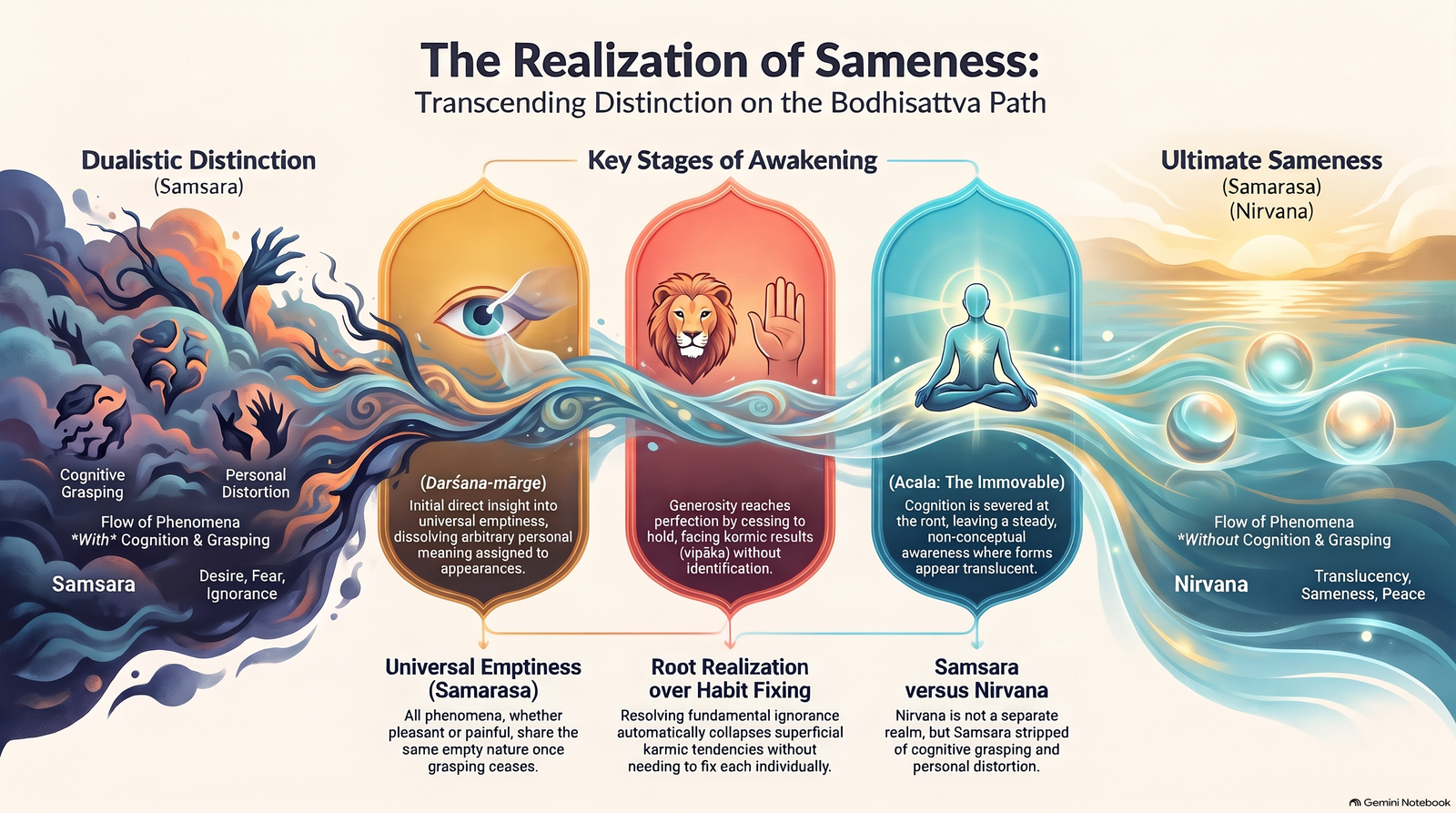
The chapter links the Mahāyāna Path of Seeing with the bodhisattva grounds, generosity and the eighth ground, Acalā. Its central table presents saṃsāra and nirvāṇa as one flow of appearances encountered through grasping or without it. The lion’s gaze and the image of cutting a root describe a change in relationship to habitual patterns. These connections form the author’s contemplative synthesis; they are neither a clinical model nor a test of attainment.
The central question: can sameness remain responsive?
The dialogue opens with the fatigue of a mind that continually sorts weather, messages and encounters into “for me” and “against me”. It places this habit within Robinson’s alchemical sequence, then introduces the Path of Seeing as more than agreement with an idea. Its cinema analogy supplies the first major turn: removing “3D ego glasses” leaves the film vivid while reducing its exaggerated personal threat. This illustrates less possessive interpretation. It does not establish that actual danger is imagined or that Buddhist emptiness means merely removing subjective judgements.
Table 54 then becomes the centre of the inquiry. The same flow of phenomena appears as saṃsāra with grasping and as nirvāṇa without it. The hosts test this against illness and pleasure, using the distinction between pain and added mental struggle. Their “spam filter” extends the argument: previous conditioning can shape how a neutral expression is read. These are explanatory metaphors, rather than established mechanics of perception. The table is Robinson’s schematic account; Madhyamaka discussion of the emptiness of both saṃsāra and nirvāṇa does not reduce liberation to switching off ordinary cognition.
The middle movement turns towards difficulty and giving. The lion’s gaze looks towards a pattern’s source instead of chasing each disturbance. Vipāka supplies the language of karmic ripening, while an unclenched hand reframes generosity as less insistence on ownership. The recording’s suggestion that pain is simply past karma is too broad: the early Buddhist Sīvaka discourse explicitly rejects attributing every feeling entirely to past deeds. Nor should its language about a “victim narrative” discredit someone who has been harmed. Recognising injury, maintaining boundaries and seeking help remain compatible with this inquiry.
Finally, the dialogue contrasts rearranging individual “blocks” with removing their foundation, then describes the eighth bhūmi through a translucent, bubble-like world. This develops the chapter’s root-and-branches image into a claim that habits fall away together. Its caricature of therapy and promise that anxiety collapses are unsupported; contemplative insight does not establish treatment equivalence or superiority. Acalā belongs to a Mahāyāna path account, while literal-looking translucency is the author’s experiential description, not evidence of that ground. The recording ends with a productive unresolved challenge: if joy and pain share emptiness, what sustains art, love and resistance to injustice? Its strongest question concerns responsive participation, rather than withdrawal from a differentiated world.
How the argument unfolds
The sorting facility
Ordinary evaluation becomes exhausting when every event must confirm or threaten a personal identity.
Remove the glasses
The cinema analogy separates vivid experience from the extra drama of possessive interpretation.
One flow, two relationships
The chapter’s table relocates the question of liberation from another place to the manner of meeting appearances.
Face patterns, loosen ownership
The lion’s gaze and the unclenched hand connect non-grasping with difficulty and generosity.
Question the foundation
The root-and-branches analogy asks whether deeper assumptions sustain apparently separate habits.
Return to the question of action
The image of Acalā leads to the closing challenge of what motivates love, creativity and justice.
Book, recording and source traditions
The chapter’s emphasis
A compact account links sameness, a table of saṃsāra and nirvāṇa, generosity and the bodhisattva grounds.
The recording’s expansion
Cinema glasses, a spam filter, two hands and a falling tower make the argument more accessible, while its closing question leaves motivation unresolved.
Distinct textual voices
The chapter juxtaposes Mahāyāna terminology with the Īśā Upaniṣad, Daoist language and the Dhammapada; their different accounts of self and liberation remain distinct.
The author’s synthesis
The alchemical sequence and claims about cognitive roots and translucent forms organise Robinson’s interpretation rather than establish a shared doctrine or physical mechanism.
Explore the video
Supplied chapter starts are timed estimates, not independently synchronised with the final recording. Use them as approximate entry points.
- 00:00 · Opening: The End of Distinction
- 02:10 · When Everything Begins to Look the Same
- 06:20 · The Path of Seeing (Darśana-mārga)
- 10:40 · Saṃsāra and Nirvāṇa Explained
- 15:20 · Cognition, Grasping, and the Matrix of Experience
- 20:10 · The Lion’s Gaze and Facing Karma
- 25:40 · Perfect Generosity and Letting Go
- 30:20 · Cutting the Root Instead of the Branches
- 35:30 · The Immovable (Acala) and Non-Dual Awareness
- 40:10 · Sameness, Peace, and Final Stillness
A visual map of the chapter
Terms for careful reading
Sameness · samarasa
A Sanskrit term often rendered “one taste” or “same taste” in tantric and nondual contexts, with meanings that depend on tradition. Robinson uses it for the shared emptiness of pleasant and painful phenomena. This does not make experiences identical in feeling, value or consequence, and is not a generic name for every Buddhist account of liberation.
Emptiness · śūnyatā
In Mahāyāna philosophy, emptiness concerns the absence of independent, intrinsic existence. Things function through causes, conditions and relationships. It is neither nothingness nor a single hidden substance. The recording’s emphasis on personal projections offers an entry point, but emptiness is more extensive than saying that objects cannot define one’s identity.
Path of Seeing · darśana-mārga
In Mahāyāna five-path presentations, the Path of Seeing concerns direct realisation of reality rather than conceptual understanding alone. It is commonly linked with entry to the first bodhisattva ground. The chapter uses this map to locate a shift in grasping; reading about that shift or recognising an analogy does not establish its attainment.
Saṃsāra and nirvāṇa
Saṃsāra traditionally concerns conditioned wandering and repeated birth under ignorance and craving; nirvāṇa concerns liberation. Their relationship is understood differently across Buddhist traditions. This chapter’s shared-flow table is Robinson’s simplification. It should not replace those traditions’ more developed accounts or suggest that ordinary suffering is already harmless.
Cognition and grasping
Cognition ordinarily includes knowing, recognising and thinking; grasping involves clinging or treating things as independently real or owned. They are not synonyms. The recording slides between these senses. Its language of cutting cognition should therefore be read cautiously, without presenting mental incapacity or the suppression of all thought as liberation.
Bodhisattva and bhūmi
In Mahāyāna Buddhism, a bodhisattva is oriented towards buddhahood for the benefit of beings. A bhūmi is a ground or level; the familiar ten-ground map describes a developed path. It is distinct from Theravāda attainment maps and Robinson’s alchemical stages, rather than a certificate available from a single experience or behaviour.
Generosity · dāna
Giving is a valued Buddhist practice, and generosity is especially associated with the first bodhisattva ground. Mahāyāna discussion also questions fixation on giver, recipient and gift. Robinson’s “ceasing to hold” highlights this less possessive orientation. Concrete assistance still matters, and ordinary generosity need not be dismissed as merely a disguised ego transaction.
Ripening · vipāka
In Buddhist accounts of karma, vipāka names the ripening or result of intentional action. It is not a verified diagnosis of why someone is ill or has been harmed. The Sīvaka discourse rejects explaining all feeling entirely by past deeds. The chapter’s use should not justify blame, passivity or refusing appropriate care.
The lion’s gaze
Here the lion symbolises turning towards the source of a pattern rather than pursuing each disturbance. The dog-and-stick comparison is illustrative, not a zoological claim or an attainment criterion. Studying the metaphor does not require confronting overwhelming pain, remaining in danger or treating all protective responses as spiritual failure.
The Immovable · Acalā
Acalā is the feminine Sanskrit name of the eighth bodhisattva ground, often rendered “Immovable”; the chapter uses Acala. This belongs to Mahāyāna accounts of an advanced path. Robinson links it with the ending of reifying cognition. Translucent appearances, composure or reduced inner speech do not independently identify someone with that ground.
Translucency and nondual awareness
The chapter describes forms as translucent and faintly luminous. This is an experiential description within the author’s framework, not a demonstration that objects become physically transparent. Nonduality likewise need not mean that practical differences disappear. Neither altered visual appearance nor a sense of invulnerability warrants claims of attainment or bodily immunity.
Related pathways
The preceding book chapter investigates the apparent self; its exported public title is shortened.
Places the Path of Seeing within the author’s comparison of path models.
Explores compassion and the orientation towards benefiting beings.
Provides context for generosity among the Buddhist perfections.
Develops the distinction between nonduality and the erasure of everyday differences.
Returns to the broader course and its four sections.
External reference points
- The Ten Bhūmis · 84000, translated by Peter Alan Roberts
A Mahāyāna source for the ten bodhisattva grounds, providing context for the chapter’s selective use of the first and eighth. - To Sīvaka · SN 36.21, translated by Ṭhānissaro Bhikkhu
An early Buddhist counterpoint to the claim that all painful feeling is entirely the result of past deeds. - Nāgārjuna · Stanford Encyclopedia of Philosophy
Scholarly context for Madhyamaka emptiness and the absence of intrinsic nature; background reading rather than a source claimed by the recording.
Question to carry forward
Where might loosening the need to defend an identity help you respond more generously, while still recognising a real difference in needs, consequences or responsibility?