
The Last Sorrow
When the promise of a better future stops driving the search, what keeps us engaged with the life we already have?
Revised Edition (2026) · Catalogue reference 3.4.7
Watch the chapter video
The End of Hope and Fear | Letting Go, Wu Wei & Spiritual Awakening
The chapter in brief
The seventh chapter of Subject takes up the cost of making spiritual progress a project of becoming someone else. Robinson reads the first Beatitude, in Matthew 5:3, as an image of relinquishing grasping. He then asks how habits of interpretation lend the experienced world its familiar shape and how much turmoil comes from the wish to control it. Daoist wu wei gives him a way to discuss the patience that makes timely action possible.
The chapter also sets the arahant and the bodhisattva beside each other in a speculative comparison involving the Tibetan bardo. That comparison belongs to Robinson’s synthesis. The chapter’s title names the sobriety of relinquishing the expectation that a future achievement will redeem the present. Its conclusion asks how such relinquishment might leave room for trust and care.
What happens when seeking loses its reward?
The hosts open with an imaginary mountaineer who has spent years preparing to reach a summit. The surprise is that the summit was a mistaken premise for the whole enterprise. They use that reversal to frame Robinson’s move from seeking to finding and his reading of Matthew’s “poor in spirit” as a poverty of grasping. The Beatitude has its Christian setting in the Sermon on the Mount. The recording borrows it to ask what happens when the desire to become an enlightened person sustains the very striving the seeker hopes to end.
The hosts then picture experience as a film shaped by karmic seeds, with an unconditioned light illuminating the projection. One asks whether this makes another person, even someone we love, a private projection. The reply appeals to a shared source, an interpretive claim that goes beyond the observation that perception is conditioned. An image of mirrors reflecting mirrors introduces a second problem: if the seeker’s shift is supposedly inevitable, what happens to agency? The promise of mechanical certainty belongs to the book’s alchemical model and the hosts’ reading of it. Buddhist stream-entry has a specific doctrinal meaning, and the analogy supplies no evidence that suffering or mistakes automatically produce insight.
A workplace crisis gives the discussion of wu wei a practical test. The hosts picture someone still writing the necessary email and having the difficult conversation, with less anxious interference. They then take the question of intention into the book’s bardo table, where a bodhisattva’s vow is imagined as guiding compassionate return. The recording turns the vow into a force comparable to gravity. This is figurative language, and Table 57 combines frameworks with distinct traditions and aims.
The closing movement asks whether releasing hope would make anyone less willing to care. The hosts distinguish reliance on a saving future from trust in the present, then illustrate the distinction through waiting for a message, a coffee or the end of a commute. The study-guide exercise becomes a thought experiment about ordinary anticipation. The recording supplies no experiment or clinical evidence for its dopamine explanation or its promise of automatic stillness. Its closing appeal to the Daodejing returns the discussion to conduct: can someone act with care even when an outcome cannot be secured? The final question returns to the opening climb by asking who, if anyone, is left to claim the experience.
How the argument unfolds
The summit loses its promise
The imagined climb and the Beatitude expose how easily the search for freedom becomes another form of acquisition.
The projector raises an ethical problem
The model of conditioned appearances prompts the hosts to ask whether other people still matter if experience is understood as projection.
Surrender puts agency in question
The receding mirrors and the image of entering a current bring the hosts to the tension between an “inevitable” path and ordinary choice.
A crisis tests non-forcing
An example from work asks whether restraint can sharpen action while leaving practical duties intact.
The bardo extends the argument
The hosts revisit Table 57 and ask what role compassionate resolve could play in the book’s account of return.
Hope gives way to trust
The peacock image and a debate over despair expose the stakes of the chapter’s claim that hope and fear can lose their grip.
The question comes back to everyday life
Examples of waiting, followed by a reference to the sage’s conduct in the Daodejing, bring the discussion back to action in the present.
Book and recording
On the page
The chapter moves in a single authorial voice from relinquishment through patient action and the bardo comparison to a short study guide.
In conversation
The hosts make the solipsism and free-will objections explicit and spend longer testing non-forcing against an ordinary obligation.
Video chapters · published markers
These markers match the public YouTube chapters. Treat the starts as approximate when looking for a specific line in the discussion.
- 00:00 Opening: The Last Sorrow
- 02:10 From Seeking to Finding
- 06:20 Blessed Are the Poor in Spirit
- 10:30 The Architecture of Illusion
- 15:40 Mind as the Projector of Reality
- 20:20 The Inevitable Choice
- 24:50 Wu Wei and the Mechanics of Rest
- 29:10 The Bardo and the Final Transition
- 33:40 Arahant vs Bodhisattva
- 37:10 The End of Hope and Fear
- 40:20 Resting in the Unfolding of Reality
A visual companion
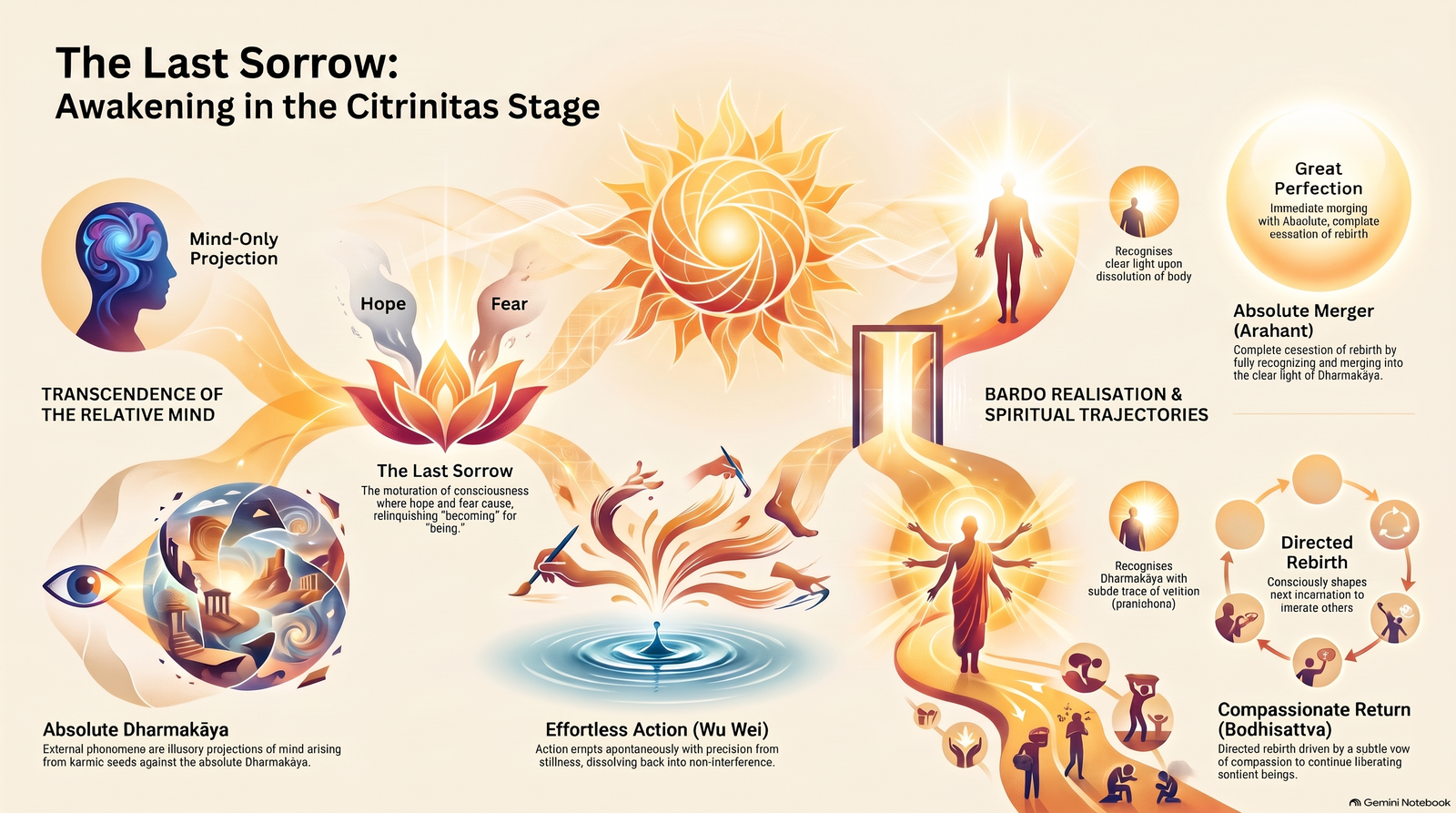
Terms and distinctions
The Last Sorrow
Robinson’s name for the sober loss of a particular kind of striving: the demand that a future state secure or vindicate one’s life. The phrase belongs to his account of Citrinitas. In the recording, the distinction between hope and trust addresses that demand and leaves room for practical care and ordinary grief.
Poverty of spirit
Matthew 5:3 opens the Beatitudes in the Sermon on the Mount. The blessing is expressed within a Christian account of the kingdom of heaven. Robinson’s “poverty of grasping” is his contemplative reading of the verse, used to question the accumulation of spiritual credentials or certainty.
Yogācāra and mind-only
Yogācāra is a tradition of Indian Mahāyāna Buddhist thought. Some of its texts describe experience in terms often translated as mind-only or cognition-only. Scholars disagree about the metaphysical implications. Robinson’s image of a world projected by karmic dispositions gives this family of ideas a particular reading.
Ālayavijñāna and karmic seeds
In Yogācāra, ālayavijñāna is commonly translated as storehouse consciousness. The seed metaphor explains how dispositions conditioned by past actions can bear fruit in later experience. In the recording these seeds become the coloured or scratched film of a projector. The analogy describes conditioning in this model and supplies no grounds for blaming people for what happens to them.
Dharmakāya and clear light
Dharmakāya, often translated as Dharma body, names a dimension of Buddhahood in Mahāyāna accounts. Clear light or luminosity has specific senses in Tibetan contemplative traditions. The dialogue pictures dharmakāya as an unconditioned source illuminating a film. Its light is an analogy for the author’s synthesis, independent of any claim about measurable light.
Stream-entry
In the early Buddhist discourses, stream-entry marks the first of four stages of awakening and is associated with the ending of three fetters, or bonds that sustain the round of rebirth. The chapter borrows the image of entering a stream to express inevitability within the author’s own model.
Wu wei
In classical Daoist thought, wu wei is commonly rendered as non-action or non-forcing. It can describe action freed from coercive or self-serving exertion. The recording applies it to deciding and acting under pressure, where restraint still leaves room for preparation, deliberation and a timely response.
Bardo
The Tibetan term names an intermediate state. The discussion uses it specifically for the interval between death and rebirth as described in Tibetan Buddhist traditions. Robinson’s chapter interprets that interval through its own projector analogy. The hosts’ account of consciousness after death is a metaphysical claim.
Arahant
In early Buddhist and Theravāda usage, an arahant is a liberated person who has ended the causes of future rebirth. The recording’s image of a drop merging with an ocean comes from its comparative model of liberation. Equating arahantship with union with an Absolute or with Dzogchen’s Great Perfection would collapse distinct accounts.
Bodhisattva and praṇidhāna
In Mahāyāna Buddhism a bodhisattva undertakes the path to Buddhahood for the benefit of beings. Praṇidhāna can mean aspiration, resolve or vow. The hosts picture compassionate resolve as giving direction to return. That image draws on traditional ideas of compassionate activity and gives them a speculative role in Robinson’s bardo comparison.
Saṃsāra
In Buddhist contexts, saṃsāra is the continuing round of conditioned existence and rebirth. The chapter uses hope and fear to illustrate how attachment to possible outcomes can perpetuate unease. This offers an everyday way into the author’s argument. Saṃsāra has a wider doctrinal meaning than the cycle of anticipation described here.
Related pathways within the website
Places Subject within Part Three and the wider alchemical course.
Returns to the course’s earlier introduction to the Tibetan intermediate state.
Explores the commitment to awakening for the benefit of beings.
Traces the projector image as a way of thinking about perception and identification.
Develops the theme of compassionate return in Citrinitas’s Dharma section.
Examines what follows when first-person experience becomes the basis of a claim about reality.
External reference points
- Matthew 5, New American Bible, Revised Edition. The first Beatitude in the Sermon on the Mount, with notes on its biblical context.
- Bhagavad Gītā 18.66, Heritage IIT Kanpur. Parallel translations and commentaries on Krishna’s invitation to Arjuna to take refuge.
- Yogācāra, Stanford Encyclopedia of Philosophy. The storehouse model, karmic seeds and the debate over what cognition-only entails.
- Laozi, Stanford Encyclopedia of Philosophy. The range of early Daoist readings of wu wei, including its ethical and social dimensions.
- Auspicious Night (Toh 313), 84000. The translation’s glossary documents one traditional use of the term “intermediate state”.
Question to carry forward
Think of a conversation in which you care about an outcome you cannot guarantee. What would it look like to take the other person’s concerns seriously while allowing for an answer you did not hope for?