
Albedo · Subject · Chapters 37–48 of 48
2.4. Subject
The Lived Experience
An experience can change how the world appears; the harder question is what changes when we return to it.
Section overview video
Why Insight Must Return to Ordinary Life
This two-host, AI-generated discussion interprets autobiographical material from the Subject section. Its accounts of hazardous chemical experiments are retrospective, not instructions. The guide distinguishes the recording’s central inquiry from its stronger medical and spiritual assertions.
Book orientation
The section in brief
Subject is the fourth and final section of Albedo, comprising chapters 37–48. It brings the volume’s account of clarification into lived experience: experiments with altered consciousness, changes in identification, recurring habits, dreams, social estrangement and the return to everyday responsibilities. Its organising concern is integration—whether an insight becomes available in relationships and conduct, rather than remaining a memorable private event.
The early chapters describe the author’s dangerous experiments and their limitations. The later chapters turn towards cultivation, service, boundaries and a less defended kind of confidence. Buddhist attainment maps and alchemical homecoming imagery provide interpretive lenses within Dr Simon Robinson’s personal synthesis. These correspondences are not clinical tests or interchangeable religious achievements. The overview recording concentrates on the opening half of the section; the chapter directory below also leads into the later material it does not discuss in detail.
A guide to the recording
What remains when an extraordinary experience ends?
The recording begins with a familiar picture of consciousness as an on/off switch, then unsettles that picture through the author’s reports of sensory fragmentation. A cinema analogy makes the problem legible: when sound, image and apparent continuity separate, the seamless story becomes visible as an arrangement. The argument’s important turn is that noticing this arrangement does not establish liberation. A disruption of experience and a dependable change in how someone lives are different questions. The hosts’ vivid language about breaking the mind should be heard as rhetoric around a personal account, rather than a measured description of brain injury or of supervised anaesthesia.
From there, the discussion asks about the capacity to notice changing experience. Metanoia and the mirror of awareness introduce a distinction between what appears and the noticing of it. A narrative from the Śūraṅgama Sūtra supplies a traditional point of comparison. The hosts then resist turning the witness into a new, supposedly immortal identity. This is the philosophical centre of the episode: even a useful observing standpoint can become something to possess and defend. Neither the metaphor nor the author’s reports demonstrate awareness independent of the brain.
The inquiry next moves into the less dramatic difficulty of changing habits. Resolve gives way to drift, numbing and renewed commitment; meditation itself can become a refuge from responsibilities. The author’s borderland, city and void name reported experiences, not independently established places or universal stages. Dream stories continue this question of interpretation: an image may carry personal significance without announcing a destiny. The strongest moment of restraint is the willingness not to know what a symbol means. Claims that dreams diagnose attainment or that sleep physiology maps directly onto Buddhist consciousness models need greater caution than the hosts sometimes allow.
The conclusion brings the discussion back to routine, relationships and the author’s gradual return through walking and writing. Its critique of addiction asks whether recovery also needs a meaningful life, but overreaches when spirituality is called the only viable alternative. The practical challenge survives that overstatement: can a striking insight support ordinary care, accountability and steadier participation? Washing dishes is not an attainment test. It is one modest setting in which an idea can meet consequences, other people and the need to begin again.
State, interpretation and integration
Intensity is not a credential. A loss of familiar self-boundaries, a vivid dream or a period of reduced reactivity does not establish stream-entry, jhāna or any other traditional attainment. Addiction and psychological crisis are not prerequisites for awakening. The recording’s descriptions of withdrawal, loss of motivation and collapse do not exclude depression, dissociation or a need for professional assessment.
The clinical language needs limits. Anaesthetics, dissociative substances and psychedelics are not one uniform mechanism. The hosts’ labels “neurological trauma”, “structural transformation” and loss of a “dopamine response” are not demonstrated diagnoses or measurements here. Meditative practice does not guarantee safety or permanent change, and clinical substance-use treatment offers multiple routes to recovery. Meaning and spiritual practice may matter personally without replacing appropriate care.
Symbols are material for reflection. The mirror, city and dream figures belong to the author’s interpretation. Their coherence does not establish supernatural communication, moral infallibility or a universal anatomy of consciousness. A dream about authority is not practical guidance for safeguarding a child.
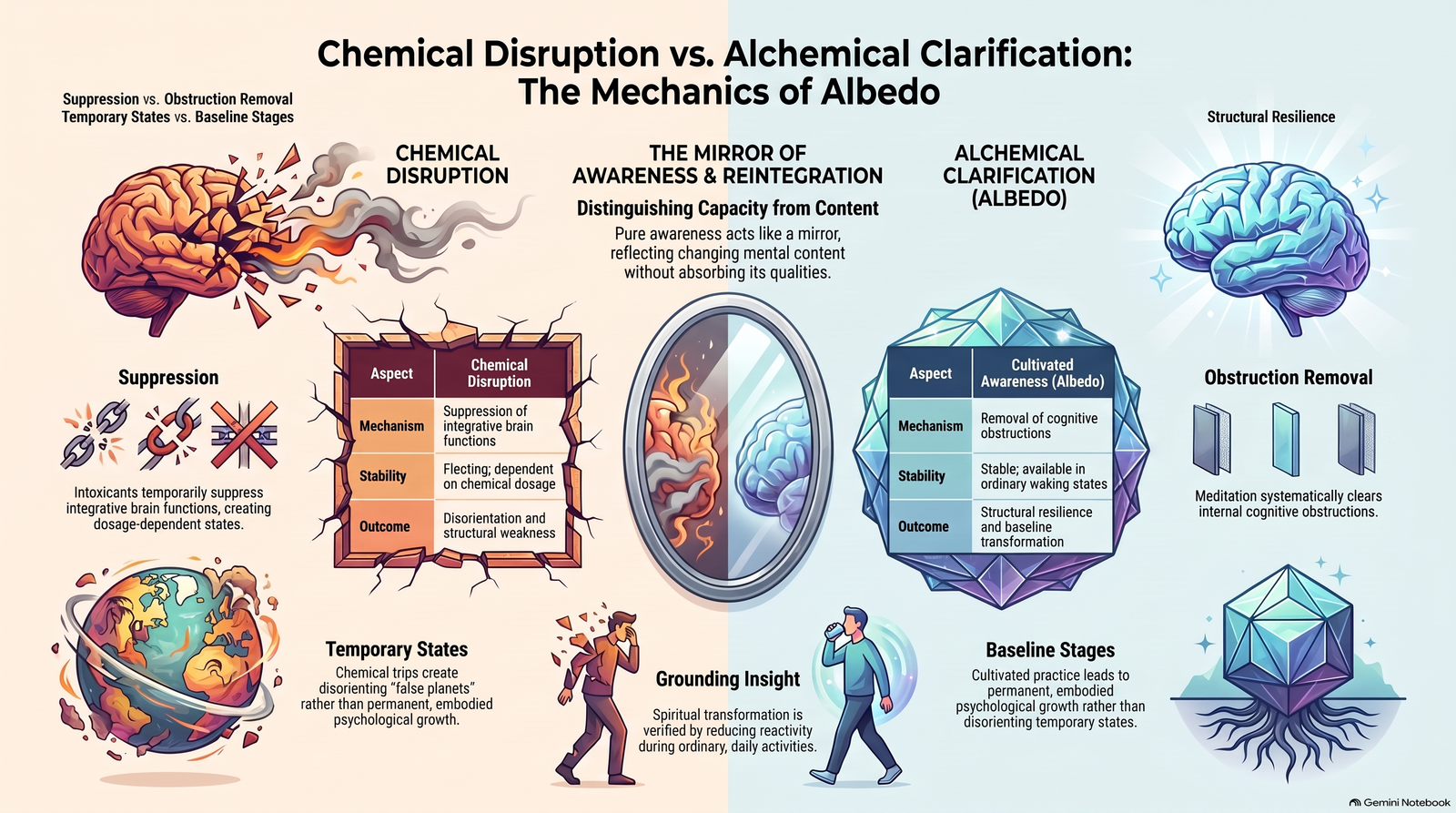
The movement of the argument
From disruption to participation
Question the switch
The opening replaces a binary picture of consciousness with the author’s account of fragmented experience.
Separate disruption from clarification
The cinema and mountain analogies ask why an unusual view is insufficient without dependable integration.
Examine the witness trap
The mirror offers an observing standpoint, then exposes the temptation to make that standpoint a superior self.
Return through the learning cycle
Resolve, drift and numbing bring attention back to habits, including the use of meditation as avoidance.
Hold inner worlds and dreams provisionally
Reported spaces and symbolic dreams invite interpretation while leaving external reality and attainment unproved.
Bring insight into ordinary life
Routine, meaningful recovery and gradual re-entry replace the search for a spectacular final experience.
The book and the overview
The section’s wider arc
All twelve chapters carry the inquiry from Experiment to The Prodigal Self, including social reintegration, the Dojo, Two Roads and confidence. These later chapters deserve their own reading.
The recording’s emphasis
The hosts draw mainly on Experiment, Metanoia, Cycles of Learning, Inner Worlds, Cultivating the Way and Dreams of Destiny, arranging them around the return to ordinary life.
The author’s synthesis
Alchemical whitening, Buddhist maps and autobiographical experience are placed in conversation. The resulting model is an interpretation, not a shared doctrine or clinical research programme.
Video chapters
Explore the 40:02 overview by topic. Each link opens the video at the selected point.
- 00:00Consciousness beyond the on/off metaphor
- 04:39Fragmentation and the cinema analogy
- 07:10Disruption versus lasting clarification
- 10:10Metanoia, awareness and the witness trap
- 17:35Resolve, drift and the cycle of numbing
- 21:09When meditation becomes avoidance
- 22:52Inner worlds and the limits of experience
- 26:18Dreams, symbolism and interpretive restraint
- 32:08Returning to ordinary life: chop wood, fetch water
- 35:30Addiction, disillusionment and renunciation
- 37:08Walking, writing and gradual integration
- 38:32Closing reflections: holding identity lightly
Read in sequence or follow a question
The twelve Subject chapters
Book chapters 37–48 correspond to course pages 2.4.1–2.4.12. Follow the sequence, or choose a chapter that speaks to your question. Each page includes its own chapter recording.
2.4.1. Experiment
The author’s hazardous experiments and the distinction between a disruption of experience and clarification.
2.4.2. Metanoia
Awareness, changing contents and the danger of turning the witness into another identity.
2.4.3. Cycles of Learning
Recurring resolve and drift, with attention to habits and the misuse of concentration as escape.
2.4.4. Inner Worlds
Reported altered-state landscapes and the limits of what their vividness can establish.
2.4.5. Cultivating the Way
Routine, discernment and the author’s gradual movement from disillusionment towards participation.
2.4.6. Dreams of Destiny
Symbolic dream accounts approached with restraint rather than claims of prophecy or status.
2.4.7. The Way In. The Way Out.
The return to relationships and responsibilities as a setting for examining insight.
2.4.8. Alien
Estrangement, the observing standpoint and the need to retain warmth and connection.
2.4.9. Dojo
Daily friction, repair and benevolence with boundaries as the field of practice.
2.4.10. Two Roads
The tension between useful solitude and making escape a condition of peace.
2.4.11. A New Kind of Confidence
Confidence interpreted through steadier conduct rather than certainty, prestige or invulnerability.
2.4.12. The Prodigal Self
The section’s homecoming metaphor and its closing discussion of Buddhist and alchemical maps.
Terms for careful listening
Albedo and Subject
Disruption, clarification and integration
Metanoia
The mirror of awareness and the witness
Śūraṅgama Sūtra and King Prasenajit
Jhāna and formless attainments
Operational confidence and the learning cycle
Phenomenology and evidence
Saṅkhāra and ālaya
High-salience dreams
Renunciation and recovery
Hermetic reflux, multiplication and the Dojo
Traditional attainment and practical change
Related pathways
- Albedo – Part TwoLocate Subject within the four sections of the volume.
- Object — Part Three of Albedo | Spiritual Alchemy Course | Dr Simon RobinsonThe preceding overview examines the appropriation of insight into identity.
- 2.3.9. Chop Wood, Carry WaterRead the neighbouring section’s account of ordinary responsibilities.
- 2.4.2. MetanoiaStudy the witness metaphor and its interpretive limits in greater detail.
- 2.4.6. Dreams of DestinyFollow the dream accounts back to their chapter context.
- 2.4.7. The Way In. The Way Out.Continue from private reflection into relationships and functioning.
External reference points
These reading companions help distinguish the course’s framework from clinical guidance and traditional terminology. Their inclusion does not imply that the recording quotes them.
- NHS · General anaestheticClinical context for the opening: supervised anaesthesia involves assessment and monitoring, and differs from the author’s retrospective account of self-experimentation.
- NCCIH · Meditation and Mindfulness: Effectiveness and SafetyAn evidence overview that discusses research limits and possible adverse effects; a corrective to guaranteed safety or permanent transformation.
- NHS · Drug addiction: getting helpDescribes individual treatment plans, medicines, talking therapies, support and harm reduction; relevant to the recording’s overstatement about recovery.
- LSJ · Metanoia · Scaife ATLASA scholarly Greek lexical entry recording change of mind or heart, repentance and regret, distinct from the course’s specialised interpretation.
- SN 22.59 · The Not-self Characteristic · Thanissaro BhikkhuA translated primary Buddhist discourse treating consciousness, as well as the other aggregates, as impermanent and not-self; a useful counterpoint to an unchanging-witness reading.
A question to carry forward
What would this insight change in one ordinary responsibility—listening to someone, keeping a promise, asking for help or repairing a mistake?
Choose a modest example if one comes naturally. There is no need to revisit distressing experiences, confront your entire history or decide on a spiritual status. A small action, with appropriate rest and boundaries, gives the question somewhere practical to land.
Continue through the course
The preceding overview recording is How Your Ego Turns Insight Into Identity | Albedo: Object · video.