
Nigredo · Object · Chapter 34 of 48
1.3.10. Anāgāmī
What might life become when sensual craving and ill will no longer organise the mind—and how should claims of healing, detachment and non-returning be understood?
Watch the chapter discussion
Beyond Desire and Aversion
The book
The chapter in brief
This chapter introduces the anāgāmī, or non-returner, as the third of the four noble stages in early Buddhist and Theravāda path maps. The five lower fetters—including sensual desire and ill will—are traditionally understood to have been abandoned; after death, the non-returner is said to complete liberation in a Pure Abode rather than return to the sensory realm.
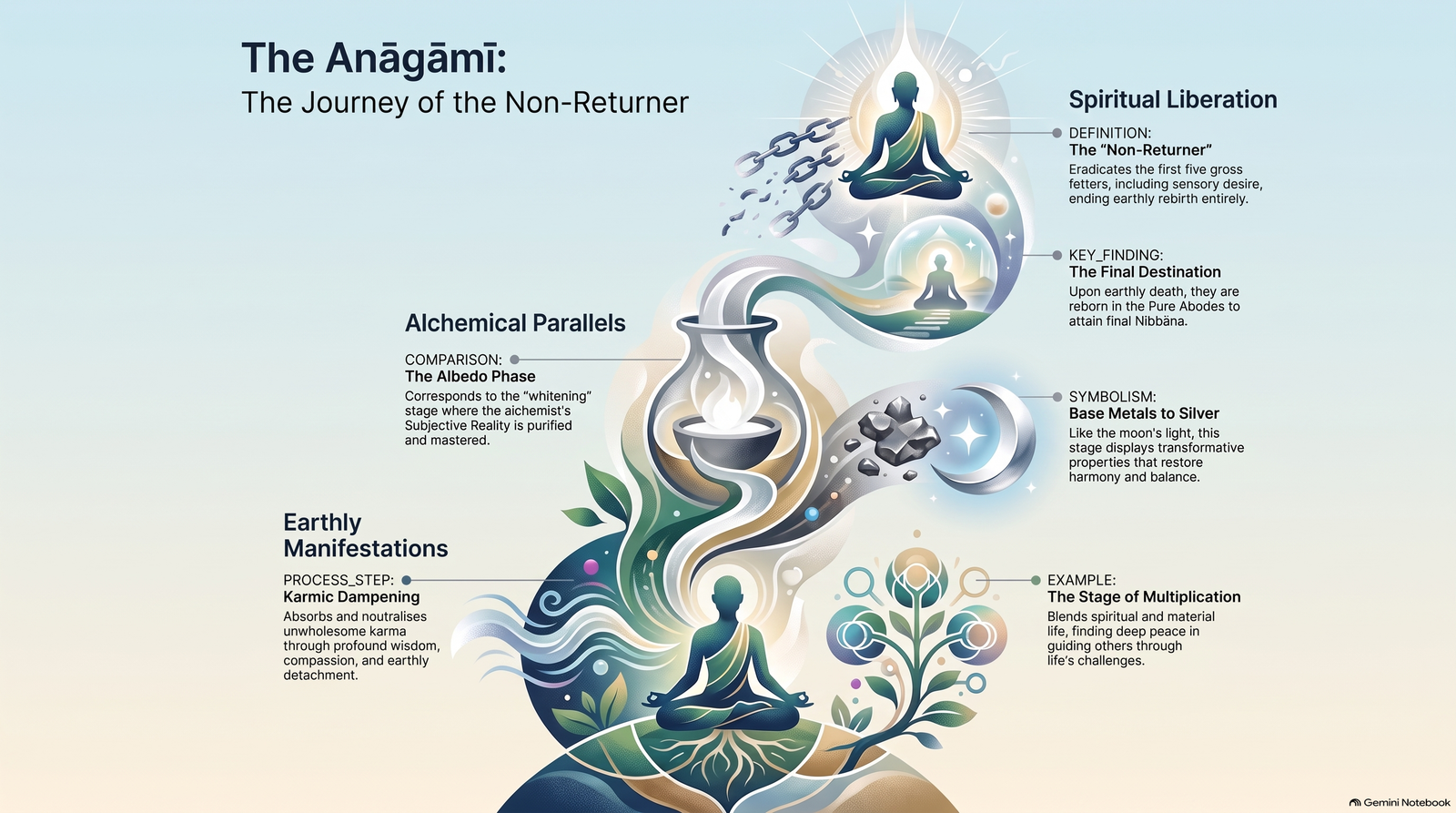
Nigredo places this stage beside Albedo, the whitening of the alchemical stone. Silver and moonlight become images of reflective calm, while “karmic dampening” names a person’s capacity to receive hostility without reproducing it. The correspondence with Albedo, the healing language and the social interpretation of multiplication belong to Dr Robinson’s comparative synthesis; the rebirth account belongs to Buddhist doctrine rather than empirical demonstration.
Visual orientation
The journey of the non-returner
Video guide
From reactive self-protection to non-retaliation
The recording begins with a boundary image: a still figure stands between tangled roots and luminous geometry. The roots represent the lower fetters and the exhausting push and pull of ordinary reactivity; the ordered field represents a mind no longer governed by them. This is a useful visual threshold, provided it is not mistaken for an objective scan of consciousness or a way to identify another person’s attainment.
The doctrinal centre is the abandonment of the five lower fetters. The first three—identity view, doubt and clinging to rites and observances—belong to stream-entry in the standard ten-fetter account. Sensual desire and ill will are weakened at once-returning and abandoned at non-returning. “Abandoned” is a technical claim within a path tradition: it does not mean numbness, the absence of ordinary preference or a personality stripped of warmth. Nor can reduced anger, celibacy or unusual calm by themselves establish the attainment.
The recording renders this change in contemporary psychological language. It contrasts suppression—feeling anger and fighting it—with the claim that the very basis for spontaneous ill will has disappeared. Its stronger phrases about rewriting a cognitive baseline, deleting an operating system, cortisol and the biological incapacity for anger are explanatory metaphors or conjectures. They are not established neuroscience, and the traditional category does not come with a clinical biomarker.
Alchemy supplies the next movement. Albedo, silver and the moon describe a consciousness that reflects light gently rather than overwhelming others. The raw “base metals” of reaction become a quieter, more ordered presence. This is the course’s modern comparative reading of Western alchemical imagery, not a historical Buddhist classification and not evidence that the two traditions describe one independently verified mechanism.
The most practical idea is “karmic dampening.” In a conflict, a defended sense of self can function like a wall from which anger rebounds; non-retaliation removes fuel from the exchange. The image is psychologically intelligible as an account of de-escalation, listening and compassionate restraint. Claims that a non-returner literally absorbs another person’s karma, naturally heals by presence or acts as an invisible “physics engine” between minds go beyond what the recording demonstrates and should remain spiritual or symbolic propositions.
The final movement turns outward. The chapter associates the alchemical operation of multiplication with the former hermit’s reintegration into family and community, and the recording argues that freedom from greed, anger and distraction may support clearer action. The further claim that this state naturally produces success and fortune is not a reliable test of spiritual maturity. Social position, health, wealth and opportunity arise from many conditions; hardship does not imply lesser insight, and prosperity does not certify it.
The non-returner is nevertheless not the end of this map. Five higher fetters remain: passion for form, passion for the formless, conceit, restlessness and ignorance. The recording’s closing “restlessness” points towards Chapter 35, where even refined identity and attachment to exalted states become material for inquiry. In the traditional account, however, non-returning already assures final liberation; continuing practice is not simply a personal contest between earthly contentment and a more heroic goal.
Argument map
How the recording develops
Stand at the threshold
A visual contrast between tangled roots and ordered geometry introduces a mind no longer pushed and pulled by the lower fetters.
Define non-returning
The name is connected to the traditional claim that the five lower fetters are abandoned and rebirth in the sensory realm no longer occurs.
Distinguish ending from restraint
The discussion moves beyond managing desire and anger to the doctrinal claim that their underlying basis has been removed.
Enter Albedo
Whitening, silver and lunar light become the course’s alchemical images for purification, reflection and the restoration of balance.
Explain karmic dampening
Hostility is received without defensive rebound, turning a metaphysical claim about karma into an intelligible model of non-retaliation.
Return to community
Multiplication is read as the integration of contemplative calm with family, work and service rather than withdrawal from the world.
Question worldly success
The recording links diminished self-sabotage with effectiveness and fortune, a plausible possibility that should not become an attainment test.
Look beyond the peaceful state
The five higher fetters remain, carrying the course from sensory freedom towards subtler attachments to identity, existence and knowing.
Book, tradition and interpretation
Four layers in the discussion
Non-returner EARLY BUDDHIST PATH MAP
The five lower fetters are abandoned. Traditional texts say the practitioner does not return from the relevant higher rebirth and completes liberation there.
Pure Abodes TRADITIONAL COSMOLOGY
The Suddhāvāsa are form-realm destinations associated with non-returners. Their existence and post-mortem role are doctrinal claims, not empirically verified geography.
Albedo and silver ALCHEMICAL COMPARISON
Whitening, lunar symbolism and transmutation express purification and reflective balance within the course’s cross-traditional architecture.
Karmic dampening CONTEMPORARY INTERPRETATION
The practical core is de-escalation: understanding, compassion and non-defensiveness interrupt the onward transmission of hostility.
Clarifying the threshold
What the stage does—and does not—mean
| Theme | Careful formulation | What should not be inferred |
|---|---|---|
| Sensual desire | The fetter binding the mind to sense pleasure is traditionally said to be abandoned. | No ordinary preferences, aesthetic enjoyment, bodily needs or affectionate response. |
| Ill will | Hostility and the wish for harm no longer function as binding tendencies in the doctrinal map. | Passivity, inability to set boundaries, or the absence of an immediate protective response. |
| Pure Abodes | Traditional cosmology locates the non-returner’s final rebirth in specific form realms. | A destination established by contemporary observation or measurable evidence. |
| Healing | Calm attention and non-retaliation can reduce escalation and support wiser relationships. | Automatic therapeutic power, immunity from error or the literal absorption of another person’s karma. |
| Material life | Less greed, anger and distraction may support steadier choices and service. | Guaranteed wealth, status, health or favourable circumstances. |
| Recognition | The map can guide personal ethical and contemplative inquiry within a living tradition. | A personality test or dependable basis for assigning spiritual rank to oneself or someone else. |
Listening route
Chapters
- 00:00 — Introducing the Non-ReturnerThe central question: what would remain if sensual attraction and ill will no longer governed experience?
- 02:40 — Standing Between Chaos and OrderThe first image places a stable figure between tangled sensory reactivity and luminous contemplative order.
- 05:20 — Non-Returning, Fourth Jhāna and the Pure AbodesThe recording introduces the traditional destiny of the non-returner and its chapter citation, while moving through the language of meditative absorption.
- 07:22 — The Five FettersIdentity view, doubt and attachment to observances lead into sensual desire and ill will, the final two lower fetters.
- 08:48 — Making the Inner and Outer OneA second image of transmutation is placed beside Saying 22 of the Gospel of Thomas and the course’s cross-traditional thesis.
- 11:35 — When Desire and Ill Will Stop GoverningThe discussion distinguishes managing reaction from the stronger claim that its underlying structure has fallen away.
- 15:04 — Albedo, Silver and Lunar ConsciousnessWhitening, base metals and moonlight become alchemical images of purification, reflection and restored balance.
- 18:29 — Karmic Dampening: Healing Without ForceNon-defensiveness is explored as a way of receiving hostility without returning or multiplying it.
- 22:22 — Multiplication: From Hermit to CommunityThe solitary practitioner returns to family, work and society, where inner stability is imagined as outward usefulness.
- 26:07 — Is Profound Peace the End of the Path?Earthly contentment is set beside the five higher fetters and the possibility of deeper investigation.
- 29:15 — Inner Peace as a Public GoodThe recording gathers its images and asks whether work on one mind can reduce the reactivity of a wider human field.
Key language
Glossary
Anāgāmī · non-returner
Sakadāgāmī · once-returner
Five lower fetters
Kāma-rāga · sensual desire
Vyāpāda · ill will
Five higher fetters
Pure Abodes · Suddhāvāsa
Jhāna
Albedo
Silver and the moon
Multiplication
Karmic dampening
Gospel of Thomas, Saying 22
Continue into the ideas
Related reading and reference points
Within this course
- 1.3.9. SakadāgāmīThe preceding chapter examines once-returning, commitment and the weakening of greed, hatred and delusion.
- 1.3.11. The Subtle FettersThe next chapter turns from the five lower fetters to refined attachments to form, formlessness, conceit, restlessness and ignorance.
- 1.3.4 The Four Grades of RealisationPlaces non-returning within the complete sequence of stream-enterer, once-returner, non-returner and arahant.
- 1.2.11. The Fetters that BindDevelops the ten-fetter framework used to distinguish the four noble stages.
- 1.3.6. Different Worlds and JhānaProvides the course’s earlier treatment of meditative absorption and cosmological realms.
- Object — Part Three of NigredoThe section index for the twelve chapters on paths, realisation and the apparent goal.
External reference points
- SuttaCentral — MN 6, If a Mendicant Would WishAn early-text formulation of the aspiration to become a non-returner and arise spontaneously before becoming extinguished there.
- SuttaCentral — MN 64, The Longer Discourse with MāluṅkyaA primary source on the five lower fetters and the path for giving them up.
- SuttaCentral — AN 10.13, FettersA concise listing of the five lower and five higher fetters used by the course’s developmental map.
- SuttaCentral — AN 4.169, With UrgencyDescribes several modes in which a non-returner is said to reach final extinguishment after death.
- SuttaCentral — SN 12.70, The Wanderer SusīmaThe discourse cited on the introductory book page; it concerns wisdom-liberated practitioners and does not contain the printed composite quotation.
Question to carry forward
What would it mean not to return the force?
Recall a recent exchange in which irritation met irritation. Without denying the original hurt, notice where the reaction acquired a defended “me,” a rehearsed story and the urge to send its force onwards. What boundary or response could remain clear without becoming retaliatory? This is an experiment in non-amplification, not a claim to non-returning.