
Nigredo · Object · Chapter 32 of 48
1.3.8. Sotāpanna
What changes when a path ceases to be merely plausible and becomes, within the Buddhist map, irreversible?
Watch the chapter discussion
The First Stage of Enlightenment
The book
The chapter in brief
This chapter introduces the sotāpanna, or stream-enterer, as the first of four stages of awakening in early Buddhist and Theravāda maps. It centres on the ending of three fetters: identity view, doubt and clinging to rites and observances. Traditional teaching presents this change as irreversible and connects it with freedom from lower rebirths and full awakening within at most seven further lives.
Nigredo translates that map into alchemical language. Stream-entry becomes the discovery of the prima materia: the unworked conditions, reactions and attachments that can now be examined without treating them as a fixed self. The chapter’s claims about rebirth, exact mind moments and attainment remain religious and scholastic claims, while its alchemical parallels are Dr Robinson’s interpretive synthesis.
Visual orientation
Entering the stream
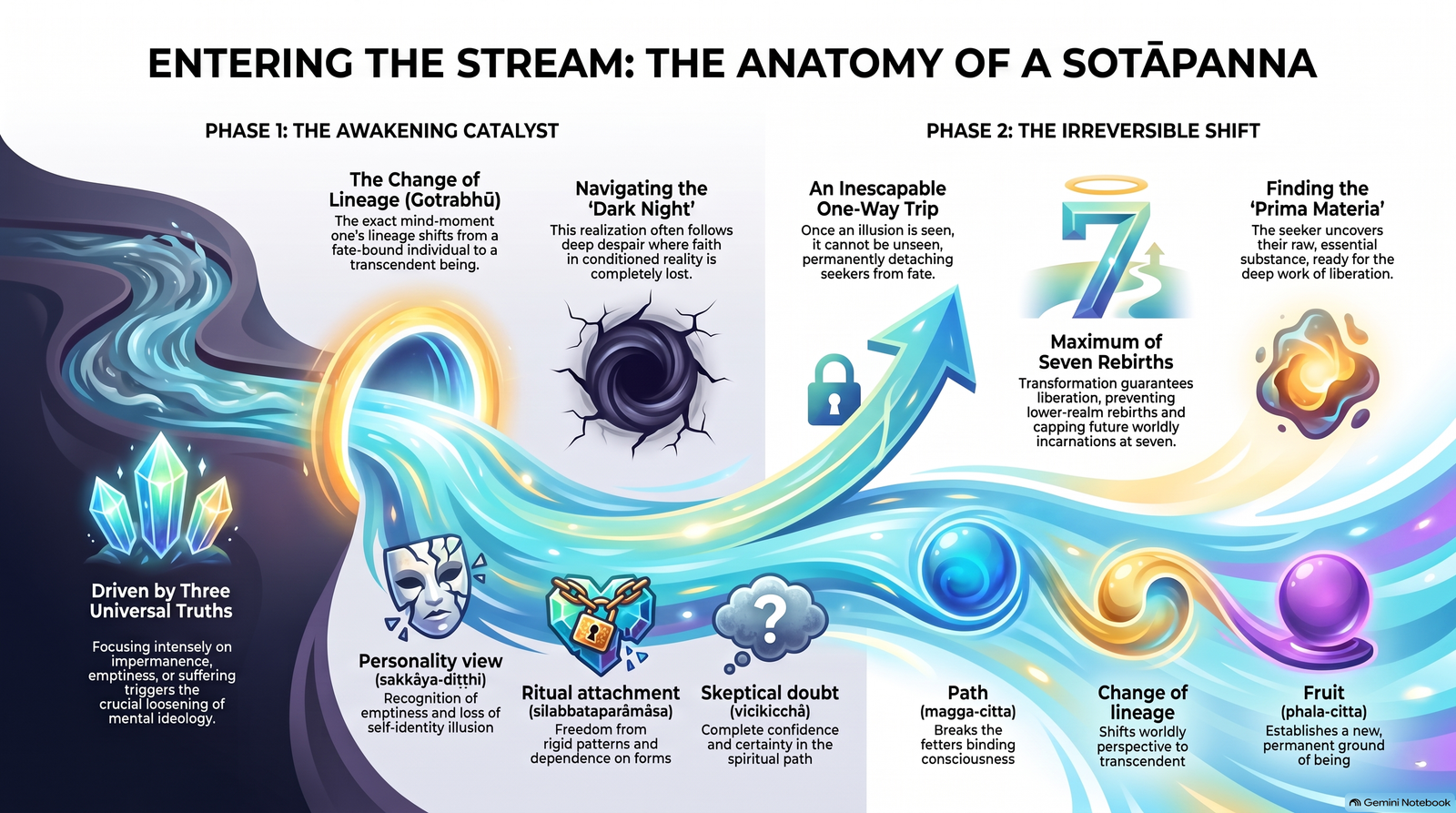
Video guide
Irreversibility, identity and the raw material
The recording sets out to make enlightenment concrete. Its governing image is an illusion that cannot recover its former authority once its mechanism has been seen. Stream-entry is therefore presented as a point of no return: not continuous bliss or the disappearance of personality, but a decisive alteration in how the first three fetters are understood. In the canonical metaphor, however, the “stream” is the Noble Eightfold Path leading to nibbāna—not the ordinary stream of consciousness from which identity is detached.
The central section examines identity view (sakkāya-diṭṭhi), doubt (vicikicchā) and clinging to rites and observances (sīlabbata-parāmāsa). The video usefully treats them as mutually reinforcing structures, but sometimes broadens them too far. Identity view is not the claim that no conventional person exists; doubt is not simply uncertainty about whether any spiritual path exists; and abandoning attachment to observances does not make forms, ethics or communal practices worthless. The early Buddhist frame concerns a mistaken view of self, unresolved doubt regarding the teaching and path, and reliance on rites or rules as sufficient for purification.
The discussion proposes three approaches through impermanence, suffering and emptiness. This makes sense within the course’s synthesis, but the familiar early Buddhist triad is impermanence, suffering and not-self (anicca, dukkha, anattā). Emptiness has important Buddhist uses, yet it should not silently replace not-self or imply that every Buddhist tradition uses the same analytical scheme. Likewise, the Abhidhamma sequence of preparation, change of lineage, one path moment and succeeding fruition moments is a later analytical model. Its precision is textual and scholastic; it is not a laboratory measurement of milliseconds or proof of a permanent neurological event.
The recording then moves into its strongest alchemical register. The stream-enterer has not completed the Great Work but has found its raw material. Reactions can be separated into bodily form, feeling, perception, formations and consciousness rather than condensed into “I am angry” or “this is mine.” The traffic example makes this practical: heat, aversion, image, judgement and impulse can be noticed as conditioned events. This does not require denying responsibility. It offers a less possessive standpoint from which responsibility may become clearer.
Several dramatic suggestions require firm boundaries. The chapter and recording speculate that trauma, addiction, destitution, psychedelics, stroke or mental illness might expose aspects of the first fetters or produce an accidental breakthrough. These possibilities are neither established Buddhist doctrine nor clinical evidence. A stroke is a medical emergency; hallucinations, delusions, disordered thinking or serious loss of function require appropriate assessment. Psychological destabilisation must not be recast as proof that someone is between conventional life and enlightenment.
Argument map
How the recording develops
Replace vagueness with a map
The discussion begins by presenting stream-entry as a specific traditional category rather than a general mood of peace or transcendence.
Make insight irreversible
An exposed illusion supplies the central analogy: once the mechanism has been recognised, the former interpretation cannot simply resume unchanged.
Name the first three fetters
Identity view, doubt and clinging to rites and observances define stream-entry within the early Buddhist and Theravāda scheme.
Approach through three marks
Impermanence, suffering and the course’s language of emptiness become alternative ways of loosening an inherited account of self and world.
Dramatise the danger of disorientation
Trauma, drugs and psychological crisis are invoked as possible disruptions, a speculative move that requires strong clinical and evidential limits.
Describe a change of lineage
The later Theravāda mind-process model supplies path, fruition and gotrabhū as technical language for a decisive threshold.
Question ownership and fate
The recording connects no-fixed-self with karma and free will. This is philosophical interpretation, not a mathematical or scientific demonstration.
Find the prima materia
Alchemy returns the analysis to practice: conditioned experience becomes the raw material for patient observation and ethical transformation.
Book, tradition and interpretation
Four layers in the discussion
Three fetters EARLY BUDDHIST PATH MAP
Stream-entry is associated with ending identity view, doubt and clinging to rites and observances, together with confidence in the path and an irreversible orientation towards awakening.
Path, fruition and lineage THERAVĀDA ABHIDHAMMA AND COMMENTARY
The fine-grained sequence of preparatory consciousness, gotrabhū, path and fruition belongs to a developed analytical tradition rather than a modern instrument reading.
Seven lives and lower realms TRADITIONAL SOTERIOLOGY
Freedom from unfortunate rebirth and full awakening within at most seven further lives are canonical religious assurances, not empirically verified predictions.
Prima materia and the Dark Night AUTHOR’S ALCHEMICAL SYNTHESIS
The raw substance, inward darkness and transformation of conditioned experience translate the Buddhist map into the course’s Western alchemical language.
| First fetter | Traditional focus | What it does not mean |
|---|---|---|
| Sakkāya-diṭṭhi · identity view | Taking the five aggregates as self, belonging to self, contained in self or containing self | The erasure of personality, biography, agency, responsibility or the conventional use of “I” |
| Vicikicchā · doubt | Paralysing uncertainty concerning the Buddha, Dhamma, Saṅgha and training, resolved through direct confidence in the path | Never asking questions, accepting claims uncritically or having faith in any system whatsoever |
| Sīlabbata-parāmāsa · clinging to rites and observances | Taking rules, rituals or observances as sufficient in themselves to purify or liberate | Abandoning ethical conduct, skillful forms, community practices or disciplined training |
Recording outline
The route through the video
- 00:00Opening: The Point of No Return
- 02:10What Is Sotāpanna?
- 05:40The Nature of Irreversible Insight
- 10:20The Three Entry Points: Anicca, Dukkha, Śūnyatā
- 15:10Seeing Through Identity
- 20:00The Fetters as Illusions
- 25:30Change of Lineage Explained
- 30:40Why You Can’t Go Back
- 35:20The Beginning of the End
- 39:10Closing Reflections
Key language
Glossary
Sotāpanna · stream-enterer
Saṃyojana · fetter
Sakkāya-diṭṭhi · identity view
Vicikicchā · doubt
Sīlabbata-parāmāsa · clinging to rites and observances
Anicca · dukkha · anattā
Gotrabhū · change of lineage
Magga-citta · path consciousness
Phala-citta · fruition consciousness
Saṃsāra
Five aggregates · khandhas
Prima materia
Dark Night of the Soul
Continue into the ideas
Related reading and reference points
Within this course
- 1.3.7. Path ConsciousnessThe preceding chapter introduces path, fruition, change of lineage and the limits of trying to manufacture awakening.
- 1.3.9. SakadāgāmīThe next chapter considers the once-returner and the traditional weakening of sensual desire and ill will.
- 1.3.4 The Four Grades of RealisationPlaces stream-entry within the larger four-stage Theravāda structure.
- 1.2.11. The Fetters that BindDevelops the full ten-fetter model used to distinguish the four paths.
- 1.1.11. The Dark Night of the SoulProvides the earlier course context for painful disorientation without making crisis evidence of attainment.
- Object — Part Three of NigredoThe section index for the twelve chapters on paths, realisation and the apparent goal.
External reference points
- SuttaCentral — SN 55.1, A Wheel-Turning MonarchA primary text contrasting worldly sovereignty with the stream-enterer’s ending of three fetters and traditional assurance of awakening.
- SuttaCentral — SN 12.68, At KosambiThe discourse actually cited in the chapter: a discussion of direct knowledge of dependent origination, including the simile of knowing water in a well before reaching it.
- SuttaCentral — AN 6.92, Things That Can’t Be DoneA relevant primary source for traditional claims about actions said to be impossible for a person accomplished in view; it is not the six-item speech-and-conduct list supplied in the recording.
- Stanford Encyclopedia of Philosophy — AbhidharmaScholarly context for Buddhist analyses of momentary consciousness, paths and the limits of treating a scholastic taxonomy as modern psychology.
- NHS — Psychosis overviewGuidance on hallucinations, delusions, disordered thinking and seeking prompt assessment rather than interpreting serious symptoms as spiritual evidence.
Question to carry forward
What changes when a reaction is no longer “me”?
Choose one small, ordinary reaction from today: irritation, defensiveness or the wish to be praised. Without trying to remove it, notice its components—bodily sensation, feeling tone, mental image, story and impulse. Which parts arose from conditions, and what response remains yours to choose? Keep the exercise grounded and brief. It is a way of examining experience, not a test of stream-entry or an invitation to destabilise your sense of self.