
Nigredo · Object · Chapter 33 of 48
1.3.9. Sakadāgāmī
What follows an irreversible glimpse when insight must become commitment, conduct and a less reactive way of meeting the world?
Watch the chapter discussion
The Second Stage of Enlightenment
The book
The chapter in brief
This chapter introduces the sakadāgāmī, or once-returner, as the second of the four noble stages in early Buddhist and Theravāda maps. Having ended the first three fetters at stream-entry, the practitioner is traditionally described as having further weakened greed, hatred and delusion and as returning to the sense realm no more than once before liberation.
Nigredo reads this movement as a deepening resolve: the disorientation following initial insight becomes an active commitment to transformation. Sensual desire and ill will have not disappeared, but their force is diminished as the blackened alchemical matter begins to lighten towards Albedo. The rebirth claims remain matters of Buddhist doctrine, while the Dark Night, Crucifixion and alchemical sequence belong to Dr Robinson’s comparative synthesis.
Visual orientation
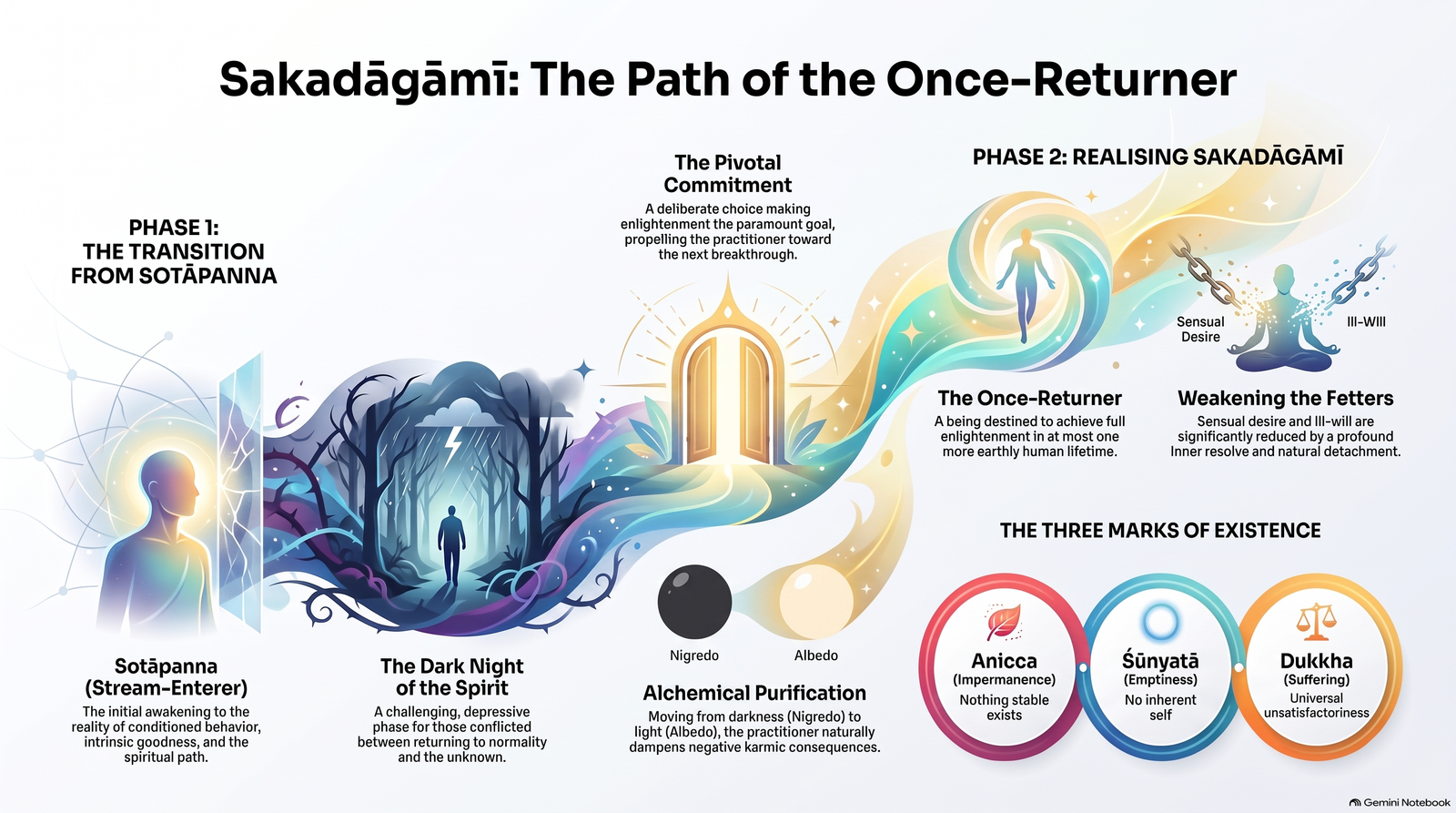
The path of the once-returner
Video guide
From ontological shock to deliberate commitment
The recording begins one stage earlier, reconstructing sotāpanna as a sudden shift in which the apparent solidity of self gives way to conditioned process. It interprets anicca, sīla and saddhā as three dimensions of that change: impermanence and not-self are seen rather than merely believed; ethical conduct becomes less performative; and confidence in the path replaces the hope that conditioned thought can reason its way beyond conditioning. This is a vivid phenomenological account, but it is the recording’s synthesis rather than a standard three-part canonical definition of stream-entry.
A useful distinction then appears between a moment of insight and the much longer work of integration. The video describes the first shift as an almost instantaneous gestalt change whose consequences continue to unfold. Its language of an “indestructible seed”, permanently severed pathways and the impossibility of malicious hatred should be understood as doctrinal or metaphorical, not as established neuroscience. Traditional texts do make strong claims about irreversible changes at stream-entry; they do not thereby provide a laboratory measure of a mind event or an externally reliable test of another person’s attainment.
The central drama is the conflict between a former life and a new orientation. Career, status and familiar attachments may lose their authority, producing alienation, low mood or an urgent wish to recover an earlier self. Nigredo places this within the Christian-mystical language of the Dark Night and Crucifixion, then treats the decision to continue into the unknown as the pivot towards sakadāgāmī. These images can illuminate the course’s comparative architecture, but they are not interchangeable historical doctrines and do not establish that depression or identity disturbance is spiritual progress.
The once-returner is presented as less reactive rather than superhuman. Desire and anger still arise, but they find less fuel and exercise less behavioural authority. The recording’s image of a “karmic dampener” is especially practical: hostility enters an interaction without automatically being relayed onwards. The person can feel an initial spark, recognise the conditions supporting it and decline to complete the chain through retaliation. This is a contemporary ethical interpretation of karma, not the formal canonical definition of the attainment.
Finally, the video uses the three characteristics and the heat of alchemy to explain ongoing refinement. Impermanence, emptiness and unsatisfactoriness loosen the structures that craving and aversion defend; Nigredo begins to whiten towards Albedo; and the practitioner becomes a quieter source of harmony. In early Buddhist formulations, the familiar three characteristics are anicca, dukkha and anattā—impermanence, suffering or unsatisfactoriness, and not-self. Śūnyatā, emptiness, is important across Buddhist traditions, but substituting it for anattā is part of this course’s cross-traditional synthesis and should be labelled accordingly.
Argument map
How the recording develops
Revisit the first breakthrough
Stream-entry is framed as a brief but irreversible alteration in perception, ethics and confidence rather than a gradual accumulation of ideas.
Separate insight from integration
A decisive glimpse may occur quickly, while its psychological, relational and ethical consequences unfold across years.
Enter the conflict with normality
Former ambitions lose their self-evident value, creating friction between inherited identity and a newly perceived direction.
Use cross-traditional images
Dark Night and Crucifixion name disorientation and surrender within the author’s Western mystical and alchemical synthesis.
Make the pivotal commitment
The second stage is organised around deliberate resolve: liberation becomes the governing orientation rather than one interest among others.
Weaken rather than erase
Sensual desire and ill will still arise, but their frequency, intensity and capacity to dictate action are presented as diminished.
Apply the heat of insight
Impermanence, emptiness and suffering expose what reactive patterns cannot securely provide, while the stone lightens from Nigredo towards Albedo.
Become a karmic dampener
The mature ethical expression is the interruption of retaliatory chains: receiving reactivity without automatically transmitting it.
Book, tradition and interpretation
Four layers in the discussion
Once-returner EARLY BUDDHIST PATH MAP
The first three fetters have ended; greed, hatred and delusion are attenuated; and the traditional rebirth claim is a single further return to this world before suffering is ended.
Fourth and fifth fetters THERAVĀDA SYSTEMATISATION
Later summaries often describe sensual desire and ill will as weakened at once-returning and abandoned at non-returning. The early discourses themselves frequently use the broader formula of attenuated greed, hatred and delusion.
Three characteristics BUDDHIST ANALYSIS
Impermanence, unsatisfactoriness and not-self are the familiar early Buddhist triad. The page preserves the course’s emptiness language while marking the cross-traditional substitution.
Dark Night, Crucifixion and whitening AUTHOR’S SYNTHESIS
Christian mystical and alchemical images interpret disorientation, commitment and purification. They do not prove that the traditions describe one identical historical system.
| Movement | Traditional distinction | Course interpretation |
|---|---|---|
| Sotāpanna · stream-enterer | The first three fetters are ended; the path is traditionally said to be irreversible | A sudden gestalt shift exposes conditioned behaviour and destabilises the former identity |
| Sakadāgāmī · once-returner | Greed, hatred and delusion are weakened; one further return to this world is traditionally predicted | Resolve becomes central, reactivity loses force and Nigredo begins to lighten |
| Anāgāmī · non-returner | The five lower fetters, including sensual desire and ill will, are abandoned | The next chapter explores a more complete freedom from sensory attachment and aversion |
Recording outline
The route through the video
The discussion moves from the anatomy of stream-entry into the difficulty of living after a decisive change in perspective. It then turns to the commitment defining the once-returner, the weakening of desire and ill will, contemplation of the three characteristics, the alchemical passage from Nigredo towards Albedo, and the outward ethical image of becoming a dampener of harmful consequences.
Why there are no timestamp links: the supplied chapter markers continue to 39:10, while the stated final video duration is 32:07. They have therefore been withheld rather than altered or presented as exact. The embedded video and canonical YouTube link remain available above.
Key language
Glossary
Sakadāgāmī · once-returner
Sotāpanna · stream-enterer
Anāgāmī · non-returner
Saṃyojana · fetter
Kāma-rāga · sensual desire
Vyāpāda · ill will
Lobha, dosa and moha
Anicca · dukkha · anattā
Śūnyatā · emptiness
Jhāna
Karma · kamma
Nigredo and Albedo
Dark Night and Crucifixion
Continue into the ideas
Related reading and reference points
Within this course
- 1.3.8. SotāpannaThe preceding chapter examines stream-entry, the first three fetters and the claimed irreversibility from which this discussion begins.
- 1.3.10. AnāgāmīThe next chapter turns from weakening sensual desire and ill will to their traditional abandonment at non-returning.
- 1.3.4 The Four Grades of RealisationPlaces once-returning within the complete sequence of stream-enterer, once-returner, non-returner and arahant.
- 1.2.11. The Fetters that BindDevelops the ten-fetter framework used to distinguish the four stages.
- 1.1.11. The Dark Night of the SoulProvides the earlier symbolic context for desolation and disorientation, with important boundaries between spiritual imagery and clinical distress.
- Object — Part Three of NigredoThe section index for the twelve chapters on paths, realisation and the apparent goal.
External reference points
- SuttaCentral — AN 3.86, Training (1st)A primary source defining the once-returner through the ending of three fetters, attenuation of greed, hatred and delusion, and one further return.
- SuttaCentral — MN 6, If a Mendicant Would WishA second early-text formulation of the aspiration to become a once-returner and return to this world once more before ending suffering.
- SuttaCentral — SN 12.70, The Wanderer SusīmaThe discourse named in the chapter epigraph. It concerns wisdom-liberated practitioners and does not contain the printed composite quotation.
- SuttaCentral — Dhammapada 273–289, The PathVerses 277–279 provide a compact early formulation of impermanence, suffering and not-self.
- NHS — Clinical depression overviewGrounded guidance on symptoms, assessment and treatment where sustained low mood or loss of function may otherwise be spiritualised.
Question to carry forward
Where can a reaction end without being passed on?
Recall one ordinary moment of irritation from today. Notice the first bodily signal, the story that tried to organise it and the action it encouraged. Without claiming a spiritual rank or suppressing the feeling, ask where the sequence could have changed direction. What response would neither deny the hurt nor transmit it? This is a small experiment in ethical causality, not a test of once-returning.