
Dialogues I · Episode 14
The Zen of the Most Boring Object
What happens when the search for the least interesting thing becomes interesting enough to expose how relevance, identity and the world are continually assembled?
Central question
Can the most irrelevant object reveal the machinery that makes anything matter?
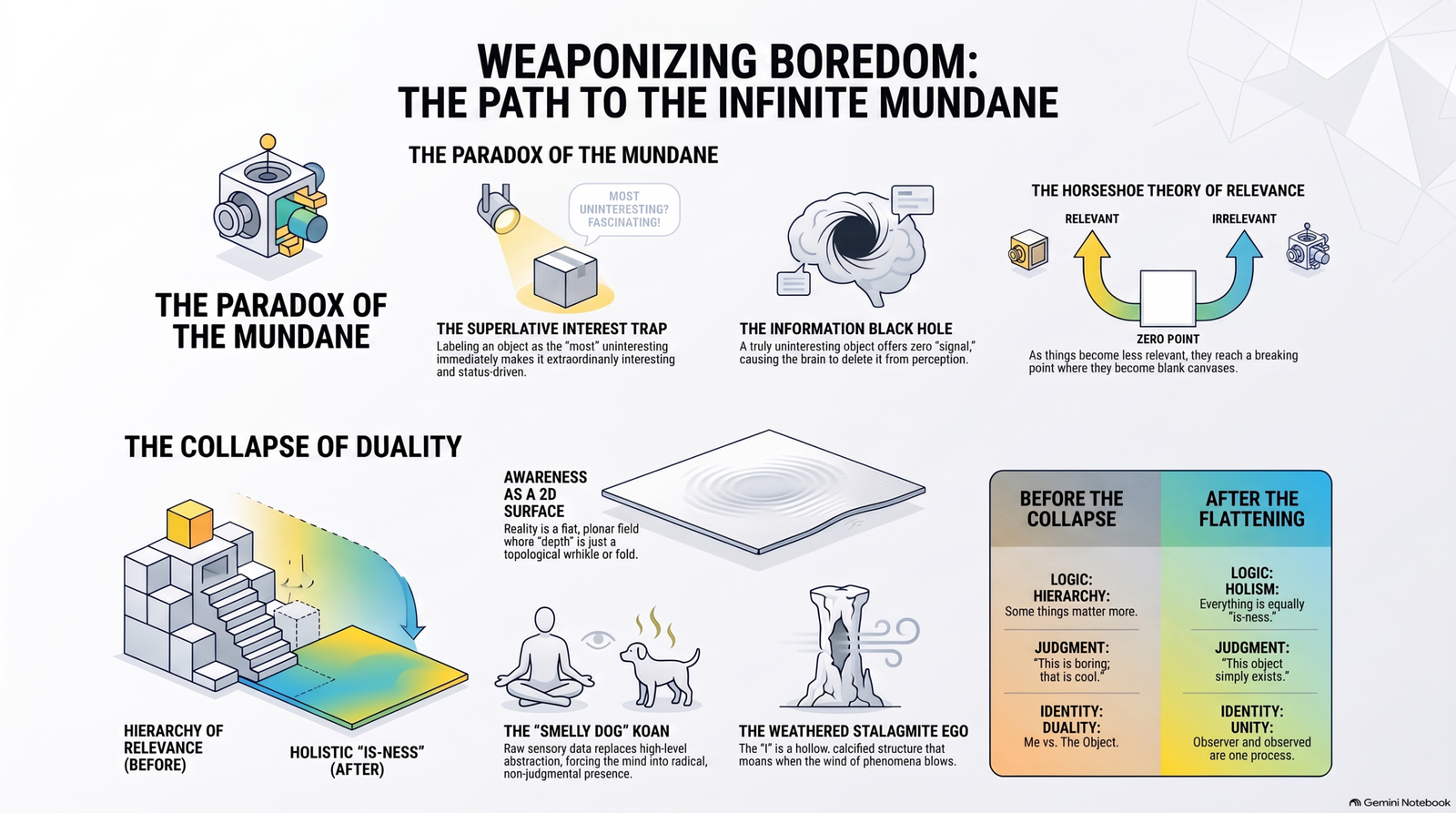
The episode begins with a deliberately impossible search: find the most boring object in the universe. Give any object that superlative title, however, and it immediately acquires a story. The supposedly uninteresting thing becomes remarkable as the winner of boredom. The discussion connects this comic trap with the interesting-number paradox, in which the first number classed as uninteresting becomes interesting for precisely that reason.
From logic, the inquiry moves into attention. A perfectly predictable object is imagined as offering no novelty and therefore disappearing from awareness like the pressure of clothing or a familiar background smell. The exaggeration is useful: perception does filter, adapt and prioritise, but information theory does not define human interest, and an unchanging object is not literally deleted from the brain. The “information black hole” is a metaphor for selective attention rather than a scientific mechanism.
The paradox then bends the line between relevant and irrelevant into a horseshoe. At the imagined zero point, the least meaningful object becomes a blank surface for projection. The mind’s ordinary discriminations—signal and noise, treasure and rubbish, profound and mundane—lose their absolute authority. This is where the dialogue begins to use boredom as a contemplative instrument: not to abolish practical judgement, but to expose the extra hierarchy of identity and narrative placed upon experience.
Thermodynamic equilibrium supplies a second analogy. Physical work requires gradients; when a closed system approaches equilibrium, usable differences diminish. The episode borrows this image for the flattening of preference. Yet psychological equanimity is not heat death, and non-preferential awareness is not the inability to distinguish a tiger from a stone. Conventional discernment remains necessary even when the mind stops converting every distinction into a judgement about self.
The central image is a continuous surface of awareness. The world’s apparent depth becomes a pattern of folds, like a film projected on a screen or activity across a cellular membrane. This is personal phenomenological and philosophical imagery, not an established claim that consciousness is physically two-dimensional. Its purpose is to ask what experience looks like when observer and observed are no longer imagined as wholly separate substances.
Then the high metaphysics is interrupted by a second thought: “My dog smells.” The interruption becomes the episode’s strongest move. Once conceptual proliferation has been clipped, a raw, ordinary sensation can occupy the whole field. The smell is both uniquely itself and no less an appearance than the preceding philosophy. The mundane does not distract from suchness; it becomes its stubborn, comic expression.
The closing movement asks what action can mean when habits continue through momentum. The unplugged desk fan, the weathered stalagmite that moans when the wind is right, and the language of vāsanā and wu wei all point towards conditioned activity without a central controller. Awareness and neglect are not simply identical, however. Attention can illuminate a pattern; neglect can leave harm unattended. The practical question is whether an action is fed by compulsive self-maintenance or arises as a proportionate response to conditions.
Argument map
From the boredom paradox to ordinary suchness
Find the least interesting thing
The thought experiment removes colour, history, novelty and narrative until only a perfectly mundane object seems to remain.
The label restores interest
Calling something the most boring gives it a unique distinction. The attempt to reach zero relevance manufactures a fresh reason to care.
Predictability recedes from notice
Sensory adaptation becomes the model for an object that supplies no new signal. The episode intensifies this into the metaphor of cognitive erasure.
Irrelevance bends back upon itself
At the imagined endpoint, absence of qualities becomes a singular quality. The relevance spectrum curves until its opposites meet.
The hierarchy loses its absoluteness
When profound and mundane are recognised as judgements added to experience, the mind can still discriminate without treating its rankings as reality itself.
Depth becomes a fold
The screen, membrane and hologram imagine senses, mind and world as convolutions of one field. The image describes experience rather than physical anatomy.
The unplugged fan keeps turning
Habitual patterns continue after their authority weakens. Residual motion need not prove a hidden controller or a failed recognition.
The second thought takes the stage
“My dog smells” interrupts the metaphysics. Raw sensation becomes both comic anti-climax and a precise return to the ordinary.
The wind meets the weathered shape
Action is reframed as conditioned occurrence. The remaining test is functional: what cares for conditions without constructing another heroic actor?
Source map
Four languages describe one deliberately unstable experiment
The interesting-number pattern
The episode uses a familiar informal paradox: identifying the first uninteresting number makes it interesting. Its force depends on the vagueness and self-reference of “interesting”, not on a contradiction inside arithmetic.
Signal, adaptation and the unseen familiar
Habituation, sensory adaptation and selective attention ground the intuition that stable input can fade from awareness. “Information black hole” and “cognitive erasure” are the dialogue’s imaginative extensions.
Gradient, equilibrium and planar imagery
Thermodynamic gradients explain the capacity to perform physical work. The episode transfers that language to preference, then adds screens, membranes and holograms as metaphors for non-separation. None is offered as a scientific derivation of consciousness.
Suchness, proliferation and unforced action
Buddhist accounts of conceptual proliferation and suchness meet Daoist language of unforced activity. The smelly dog, spinning fan and moaning stalagmite keep the synthesis grounded in conditional, ordinary life.
Watch by chapter
Episode chapters
- 00:00The Most Boring Object in the Universe
- 03:10The Interesting Number Paradox
- 06:30Information Theory and Cognitive Erasure
- 09:40Boredom, the Void, and the Zen Effect
- 13:00The Collapse of Relevance
- 16:20Heat Death, Whiteout, and Non-Preferential Awareness
- 20:00Reality as a Screen or Surface of Awareness
- 23:30The Desk Fan: Why Habit Keeps Spinning
- 26:00The Smelly Dog Interrupts the Void
- 29:10Papañca: Turning Sensation into Story
- 32:00The Holographic Dog and Suchness
- 34:50Sentimentality, Concealment, and Living the Illusion
- 36:40Hollow Resonance, Wu Wei, and the Weathered Ego
- 38:00The Mundane as the Final Teaching
Glossary
Terms, paradoxes and images used in the discussion
Interesting-number paradox
An informal paradox built from a vague predicate. If there were uninteresting natural numbers, the smallest might become interesting as the smallest uninteresting number. The joke exposes how classification changes the thing classified; it is not a contradiction in number theory.
Information theory
A mathematical framework for quantifying information, uncertainty and communication. Technical information is not identical to personal meaning, novelty or fascination. The episode moves poetically between these senses and should not be read as a formal result.
Sensory adaptation
A reduction in sensory response or conscious salience during sustained or repeated stimulation. Familiar pressure, odour or background sound may fade from notice, though this is not the wholesale deletion of an object from perception.
Ganzfeld effect
Perceptual phenomena that can occur during exposure to a uniform, unstructured sensory field. With little external variation, internally generated patterns may become noticeable. The episode uses this to dramatise a mind deprived of contrast.
Horseshoe of relevance
The dialogue’s analogy for a scale whose extremes bend together: the least relevant object becomes intensely relevant because of its extremity. It borrows the shape of political horseshoe theory without claiming equivalent evidence or explanatory status.
Entropy and equilibrium
In thermodynamics, entropy is a state function associated with the number of microscopic configurations compatible with a macroscopic state. At equilibrium, usable gradients have diminished. These concepts do not mean “boring” in a psychological sense.
Non-preferential awareness
A modern contemplative phrase for awareness that does not automatically divide experience according to attraction and aversion. It does not require losing practical judgement, moral concern or the capacity to respond to danger.
Planar awareness
The episode’s image of experience as one continuous surface whose folds appear as senses, thoughts, self and world. It is phenomenological and metaphysical imagery, not a verified neuroscientific claim about the dimensionality of consciousness.
Hologram
A recording of an interference pattern from which an image can be reconstructed. A fragment of a classical hologram may preserve information from across the scene with loss of resolution or viewing range. The episode uses this as an analogy for the whole appearing through each particular.
Papañca
A Pāli term often translated as conceptual proliferation or elaboration: the process through which immediate experience becomes entangled with interpretation, craving, comparison and identity. It is more specific than all thought or imagination.
Tathatā
“Suchness” or “thusness”: a Buddhist term pointing to phenomena as they are, apart from the conceptual fabrications that turn them into fixed independent essences. Traditions explain its relationship to emptiness and awakening in different ways.
Vāsanā
A Sanskrit term for latent tendencies, impressions or habitual dispositions, especially important in Indian Buddhist and Hindu philosophical traditions. The desk fan translates this complex idea into residual momentum after the apparent source of power has changed.
Stream-entry
Sotāpatti, the first of four stages of awakening in early Buddhist and Theravāda accounts. The episode includes personal language about its emptiness; such first-person interpretation is not externally verifiable and should not be generalised into a diagnostic template.
Wu wei
A Daoist expression often translated as non-action, effortless action or non-coercive action. It does not simply mean passivity or neglect. Its use here describes activity no longer organised around a separate manager forcing the field.
The weathered stalagmite
The episode’s image of “I” as a conditioned shape rather than an autonomous agent. When circumstances supply the wind, the shape makes its characteristic sound. The moan is personality as conditional resonance.
The smelly dog koan
The abrupt statement “My dog smells” is not a traditional Zen koan. Within this dialogue it functions as comic anti-climax, raw sensory datum and the return of the infinite to the thoroughly ordinary.
Continue within the website
Related pathways
The preceding episode asks how conceptual proliferation can be met without withdrawal. Episode 14 takes the next step: once the hierarchy of meaning weakens, the dog’s smell can occupy the same field as the grandest metaphysics.
Explores recursion, self-reference and the impossibility of standing wholly outside the system being observed. The present episode recasts that recursion through boredom, relevance and a self that sounds only under conditions.
Provides course context for the episode’s movement from raw sensory appearance to interpretation, hierarchy and the self-involving story that makes experience personally urgent.
A later companion to the smelly-dog interruption: ordinary tasks do not sit beneath awakening, but expose whether insight can inhabit the repetitive and unremarkable.
Extends the return from abstract transcendence into participation. Its emphasis on embodiment and responsibility helps protect the present episode’s flattening from becoming indifference.
The wider course volume in which illumination, emptiness, constructed experience and the limitations of conceptual thought are developed across a larger architecture.
External reference points
A small reading shelf
A scholarly introduction to self-reference and semantic paradox. The interesting-number puzzle is lighter and depends on a vague predicate, but this provides context for why statements can turn back upon their own classification.
A review of the way behavioural relevance changes visual processing. It supplies a firmer basis for the episode’s signal-and-noise language than the metaphor of total cognitive erasure.
A concise introduction to entropy and the second law of thermodynamics. It helps separate physical equilibrium from the episode’s psychological and contemplative use of flattening.
An early Buddhist discourse whose formula “in the seen, just the seen” offers a classical point of comparison for the episode’s return from proliferation to immediate sensory experience.
A scholarly account of Daoist naturalism, spontaneity and action. It gives historical depth to wu wei and prevents the term being reduced to passive inaction or personal neglect.
A grounded observation
What remains when the ranking is not fed?
Choose one neutral, familiar object that is already present: a mug, a door handle, a patch of wall or the hum of an appliance. For a minute, notice the mind’s attempts to rank it, dismiss it, improve the exercise or turn the object into a spiritual symbol. There is no need to suppress those movements. Let their arrival reveal how quickly bare appearance acquires a hierarchy and a story.
Then include one immediate bodily or sensory fact: pressure beneath the feet, a smell, temperature, fatigue or sound. Ask: What is directly present, and what has been added about its importance? Do not use the question to erase useful meaning. A smoke alarm, bodily symptom, obligation or another person’s need may require prompt action.
Finally, let one proportionate response occur: adjust the chair, open the window, wash the dog, leave the harmless object alone. Notice whether action actually requires a grand internal author. The point is neither mystical blankness nor cultivated indifference. It is the modest discovery that the ordinary can be complete before it becomes important.