
Dialogues II · Episode 03
The Exhaustion of Being Yourself | Dialogues II
How much of tiredness belongs to life itself, and how much to the continuous labour of maintaining a self?
The central question
Does being a person require more energy than simply being alive?
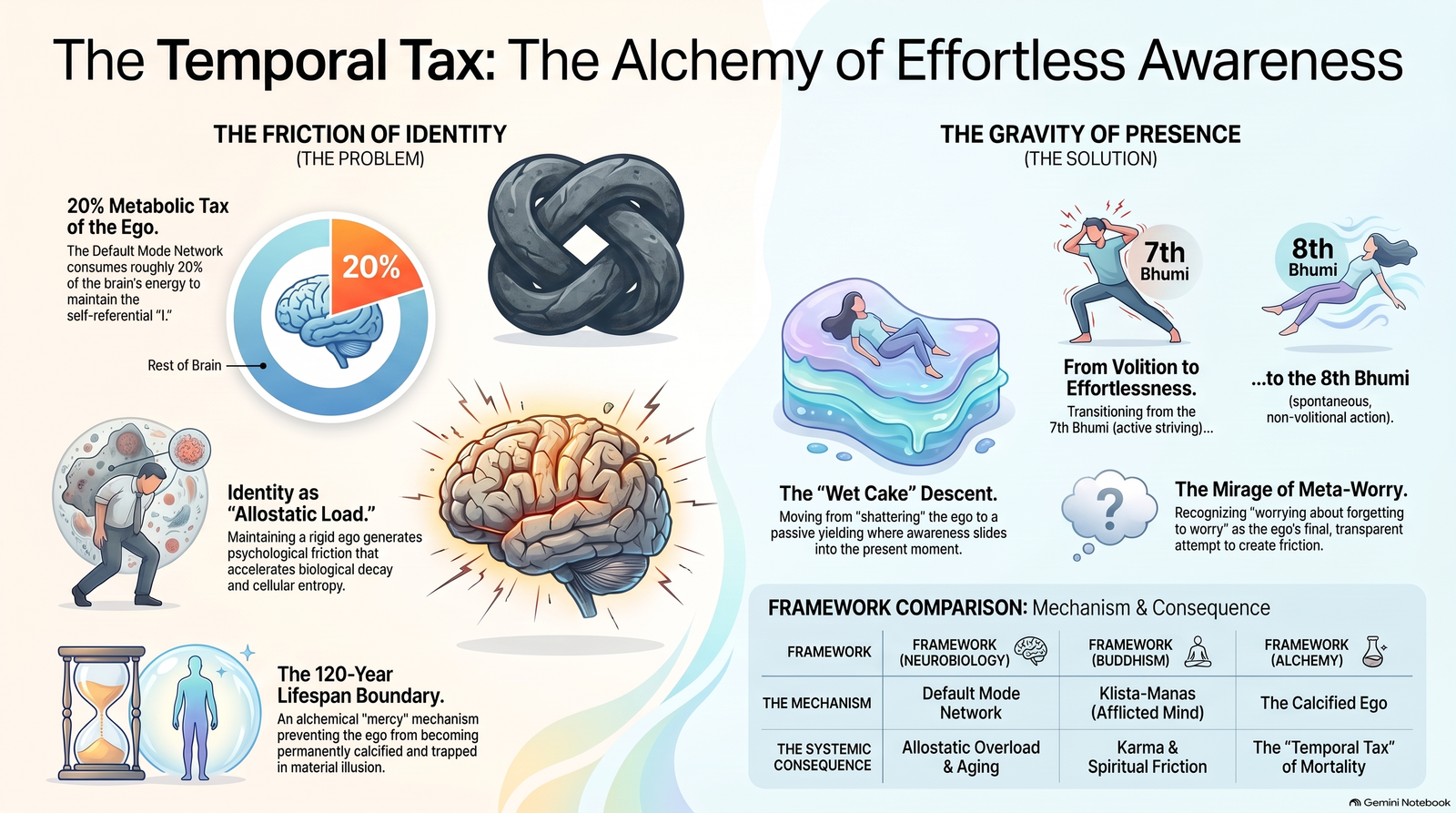
This episode begins with a recognisable fatigue: not the tiredness produced by physical labour, but the effort of continuing to be the person one takes oneself to be. Memory, anticipation, defence and self-explanation can make identity feel like an invisible structure that must be supported throughout the day. The dialogue names this additional burden the “temporal tax” of the ego, then asks whether an evocative psychological metaphor can also illuminate biology, myth and contemplative experience.
The first movement passes through ageing science, allostatic load, the default mode network and predictive processing. These fields do show that living systems expend energy to maintain themselves, that prolonged physiological stress can carry health costs, and that resting brain networks participate in autobiographical memory, future thought and self-referential processing. The episode then takes a speculative step: it imagines a rigid identity as a high-friction predictive model whose resistance to change consumes both attention and vitality. Yogācāra provides a second vocabulary through its account of afflicted manas, the tendency to appropriate experience as “I” and “mine”.
The argument widens into biblical and alchemical imagination. Antediluvian lifespans, the Flood, Genesis’s 120 years, Moses, Enoch and Elijah become images of identity hardening, dissolving and passing beyond ordinary mortality. A memory of gardening then returns the discussion to direct experience: a playful identification with Cain gives rise to an uncanny sense of an audience, followed by humour and surrender. The private image of wet cake sliding from a wall captures the episode’s alternative to heroic self-conquest—awareness yielding to the gravity of the present when the effort to hold itself up relaxes.
The close is both gentler and more exacting. Spontaneous meditation, the eighth bodhisattva ground, Bankei’s Unborn and Dōgen’s being-time are brought into conversation without becoming one doctrine. The final obstacle is the mind’s ability to make even peace into a problem: worrying that one may have forgotten to worry. The practical challenge is therefore not to destroy the self or claim a spiritual rank, but to notice the extra labour added by resistance—and ask whether the next ordinary action requires it.
The movement of the episode
From self-maintenance to the possibility of yielding
Identity feels like labour
Exhaustion becomes the opening clue: a personality may require continuous remembering, predicting, defending and performing beyond the work an immediate situation demands.
Biology supplies a metaphorical ground
Ageing, stress regulation and resting brain activity establish real bodily costs, while the episode ventures beyond them by imagining egoic resistance as an added temporal burden.
The afflicted mind claims experience
Yogācāra’s seventh consciousness reframes the problem as appropriation: changing experience is repeatedly taken to disclose a stable owner called “me”.
Myth enlarges the timescale
The Flood, the 120 years and figures who evade ordinary death become an imaginative study of what happens when identity calcifies, dissolves or becomes transparent.
The garden makes it intimate
Cain appears as a temporary costume before an uncertain audience; humour loosens the role without requiring the unfamiliar sense of presence to become objective proof.
Effort gives way to gravity
The wet-cake image replaces heroic striving with a passive slide into now, until the final trace of control appears as anxiety about no longer being anxious.
How the sources are used
Four lenses with different kinds of authority
Neuroscience and ageing
The default mode network, allostatic load and cellular ageing provide empirical reference points. They support a discussion of self-reference, stress and biological wear, but not a literal equation between ego, metabolism and lifespan.
Biblical and Jewish traditions
Genesis, Moses, Enoch, Elijah and later interpretive traditions supply narratives of longevity, judgement and transformation. The episode reads them symbolically; it does not establish their events as biomedical history.
Buddhist path language
Yogācāra, the eighth bhūmi, Bankei and Dōgen illuminate appropriation and non-exertion. These belong to distinct textual and practice settings and are not interchangeable attainment tests.
Alchemical synthesis
The Flood as solutio, the ego as calcified matter and Rubedo as conscious return form the episode’s interpretive architecture. This is Simon Robinson’s comparative map rather than an established scientific or historical conclusion.
Listen by chapter
The complete 42-minute journey
- 00:00The Exhaustion of Being Yourself
- 03:10Entropy, Aging, and the Biological Cost of Existence
- 06:40The Default Mode Network and the Brain’s Rumination Engine
- 10:20Prediction, Surprise, and the Friction of Ego
- 13:50Yogācāra Buddhism and the Afflicted Seventh Consciousness
- 17:10Karma as Psychological and Temporal Friction
- 19:30Antediluvian Myth, the Flood, and the 120-Year Crucible
- 24:00Moses, Enoch, Elijah, and Symbolic Escape from Death
- 28:00The Garden, Cain, and the Audience of the Absolute
- 31:30Humour, Surrender, and the Dharmakāya
- 34:00Solitary Practice, the Eighth Bhūmi, and Effortless Action
- 37:10Wet Cake, Being-Time, and the Pull of the Present
- 39:20The Final Trick: Worrying That You Forgot to Worry
- 41:00Closing Reflection: What If You Dropped the Oars?
Study notes and routes onward
Terms, distinctions and reference points
Glossary
Temporal tax
The episode’s metaphor for the attention, tension and effort involved in maintaining a defended personal identity across time. It is useful as a phenomenological question—what additional work is being done now?—but it is not a recognised scientific quantity, a metabolic measurement or evidence that ego directly determines lifespan.
Entropy and biological ageing
Entropy has precise meanings in thermodynamics and information theory. Organisms maintain local order by exchanging energy and matter with their environment, but ageing is not adequately explained as entropy alone. Current biology studies interacting processes including genomic instability, epigenetic change, impaired proteostasis, mitochondrial dysfunction, cellular senescence, inflammation and altered intercellular communication.
Default mode network
The DMN is a distributed set of brain regions whose activity is often prominent during wakeful rest and is associated with autobiographical memory, imagining the future, social cognition and aspects of self-referential thought. It is not a single organ or the anatomical location of the ego, and its activity is not inherently wasteful or pathological.
Allostasis and allostatic load
Allostasis is the body’s process of maintaining stability through adaptive change. Allostatic load refers to cumulative strain across physiological systems when demands are repeated, prolonged or poorly regulated. It can help connect life experience with health, but it is broader than worry and cannot justify the claim that every act of rumination directly ages particular cells.
Free-energy principle
Karl Friston’s free-energy principle is a mathematical framework proposing that self-organising systems remain within viable states by minimising variational free energy through perception and action. Its technical “surprise” is not ordinary astonishment and should not be simply equated with thermodynamic entropy. Applying the framework to ego rigidity remains theoretical and interpretive.
Yogācāra and afflicted manas
Yogācāra is a Mahāyāna Buddhist tradition offering detailed analyses of cognition and experience. Its afflicted manas, often counted as a seventh consciousness, persistently takes the store consciousness as self and is associated with self-view, self-confusion, self-conceit and self-love. Comparing it with the DMN can stimulate inquiry but does not make them identical.
Karma
Across Buddhist traditions, karma centrally concerns intentional action and its conditioning consequences, with different schools developing the account in different ways. The episode’s description of karma as psychological friction or metabolic residue is a modern metaphor. It should not replace karma’s ethical and soteriological dimensions or be treated as a measurable physical substance.
Genesis 6:3 and the 120 years
The verse has supported more than one interpretation. Some readers understand 120 years as a human lifespan limit; others, including influential Jewish commentators, read it as the remaining period before the Flood. The episode’s “optimal crucible” for individuation is an alchemical interpretation, not an explicit teaching of Genesis or a biological constant.
Solutio and Rubedo
Solutio names the alchemical operation of dissolving a substance, while Rubedo, the reddening, is commonly presented as a culminating phase of the Great Work. Here the Flood becomes dissolution of a calcified identity and “walking with God” becomes conscious reintegration. That arrangement belongs to the episode’s comparative synthesis rather than one fixed historical alchemical system.
Dharmakāya
In Mahāyāna Buddhism, dharmakāya is the “dharma body” of a buddha, understood differently across texts and traditions. It should not automatically be identified with a personal divine witness, an invisible audience or a particular unusual experience. The garden episode uses it comparatively to explore awareness beyond the performed role.
The eighth bhūmi
Acalā, the “Immovable”, is the eighth of ten bodhisattva grounds in influential Mahāyāna path literature. It is associated with irreversibility and non-exertive activity in an extensive doctrinal progression. Spontaneity, flow or reduced self-consciousness may resemble aspects of its descriptions but cannot independently confirm that someone has reached it.
Solitary practice and pratyekabuddha
A pratyekabuddha is a doctrinal category for one who realises awakening without a buddha’s teaching being available and does not establish a dispensation for others. It is not simply a solitary reader or practitioner. Independent study may reduce some institutional influences, but texts also require interpretation; teachers and communities can introduce blind spots or help expose them.
The Unborn and being-time
Bankei’s “Unborn” points to Buddha-mind before discriminating thought is manufactured. Dōgen’s uji, commonly rendered “being-time”, examines the inseparability of existence and temporality. The episode brings both into the wet-cake metaphor, but they are distinct Zen teachings rather than names for a scientifically observed gravitational pull.
Related reading on this site
- The ‘seventh’ consciousnessBackground on the appropriating function of manas that supplies the episode’s Buddhist account of self-making
- Being, Personality and the SelfA direct companion to the distinction between immediate being and the accumulated structure of personality
- Death and alchemyThe wider alchemical setting for mortality, dissolution and transformation without treating myth as biological evidence
- The Neuroscience of the Narrative EgoA later catalogue study of self-narration, brain networks and the limits of translating neuroscience directly into metaphysics
- Does the Brain Create a Feeling of TimeA later exploration of temporality as lived construction rather than merely a sequence measured by clocks
- When Awareness Stops GraspingA continuation of the episode’s movement from appropriation and effort towards action without an internal owner
External reference points
- A Default Mode of Brain Function — PNASThe foundational 2001 paper describing organised baseline brain activity and task-related decreases, useful for separating the DMN from the episode’s later ego metaphor
- Allostatic Load as a Marker of Cumulative Biological Risk — PNASA longitudinal study of cumulative physiological risk and later health outcomes in older adults
- The Hallmarks of Aging — CellA major biological framework showing why ageing cannot be reduced to entropy, telomeres, stress or one psychological process
- The Ten Bhūmis — 84000 translationA complete scholarly translation of the principal sūtra setting for the ten bodhisattva grounds, including the eighth ground
- Genesis 6:3 with classical commentaries — SefariaThe Hebrew verse, translations and interpretive traditions behind the episode’s 120-year motif
A two-minute observation
Notice the work and the extra work
Choose one safe, ordinary action already required of you: washing a cup, fastening a coat or putting away a book. First notice the simple physical work—movement, contact, weight and sequence. Then notice any extra commentary about the sort of person doing it, whether it is being done properly, what it says about you or what should happen next. Do not suppress the commentary or turn its absence into a goal. Let the action continue and ask quietly: which part of this labour is necessary for the task itself?
Continue the dialogues