
Nigredo · Subject · Chapter 40
Wandering
What happens when the life you worked to build succeeds, yet does not satisfy? This chapter follows the seeker from achievement and disillusionment into restlessness, darkness and the possibility of transformation.
Watch the chapter discussion
Why Success Still Feels Empty
Chapter guide
Follow the edited discussion
- 00:00When Success Still Feels Empty
- 02:20Hermann Hesse and the Seeker
- 05:10Leaving the Safety of the Cave
- 08:15Medicine, Success and Disillusionment
- 12:25The Christmas-Present Cycle
- 14:15The Three Forms of Dukkha
- 18:25Saṃsāra, Nirvāṇa and Restlessness
- 20:45How the Self Sees Desire and Fear
- 22:55Depression, Isolation and the Qliphoth
- 26:05The Shattering of Identity
- 29:45From Success to Transformation
Brief book orientation
When the inherited map no longer works
The written chapter describes a seeker who can no longer accept conventional success as a complete answer to life. Achievement may bring comfort, recognition and genuine opportunities to help others, yet the satisfaction it promises fades. That unresolved friction initiates wandering.
Within the course, wandering is part of Nigredo: the established identity has begun to lose its authority, but a more adequate way of living has not yet become clear. It is an interpretive map of transformation, not a claim that crisis is necessary, desirable or automatically spiritual.
What the recording explores
The restlessness beneath achievement
The seeker distrusts settling
Hesse’s Siddhartha introduces a person who cannot quite abandon the possibility of wonder and meaning for a wholly habitual adult life.
Compromise has a limit
Professional roles, security and approval may coexist with deeper questions, but confining those questions to spare time does not necessarily resolve them.
Success meets disillusionment
A medical career provides the chapter’s lived example: ideals of healing encounter illness, unfairness, bureaucracy and the limits of institutional achievement.
Pleasure cannot remain fixed
The Christmas-present analogy shows anticipation, possession and fading satisfaction repeating through childhood objects and adult ambitions.
Dukkha has several registers
Direct pain, the loss of pleasant conditions and the instability of conditioned existence provide a threefold vocabulary for dissatisfaction.
The constructed self destabilises
The recording moves from desire and fear into the Qliphoth, isolation and the painful shedding of an identity that no longer explains experience.
A symbolic crisis is not a clinical diagnosis
The recording sometimes presents depression, addiction, isolation and identity breakdown as stages through which the seeker passes. They are better treated here as elements of its alchemical narrative. Depression and severe distress have many causes, can involve substantial risk and deserve appropriate professional support; suffering does not become beneficial merely because it can later be interpreted meaningfully.
Argument map
How wandering develops
Reach the promised destination
The seeker gains education, status, security or influence and discovers that attainment does not end dissatisfaction.
Question the conventional map
The fading reward of each achievement makes ordinary assumptions about success increasingly difficult to trust.
Name the structure of suffering
The three forms of dukkha widen the enquiry from obvious pain to impermanence and the instability of conditioned experience.
Recognise the restless observer
Saṃsāra is located not only in external conditions but in a mind repeatedly organised around wanting, fearing and becoming.
Enter the crisis of identity
When the old aims become empty husks and the new orientation remains unseen, motivation, belonging and a coherent sense of self may deteriorate.
Reframe transformation
The final movement turns from acquiring a superior identity towards relinquishing the demand that identity secure permanent fulfilment.
Visual synthesis
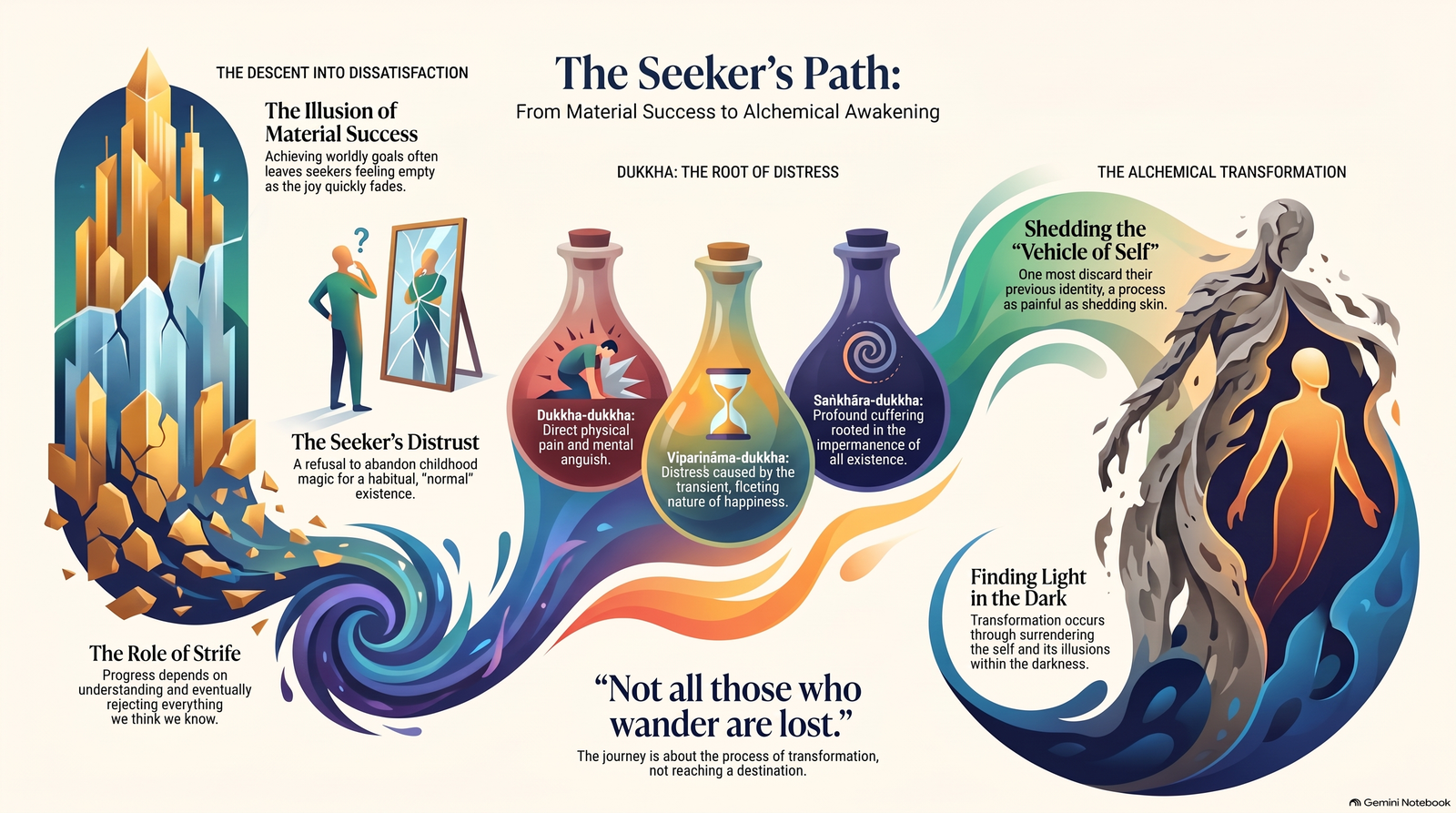
The seeker’s path
The infographic gathers the chapter’s principal movements into one visual field: the instability of material success, distrust of an inherited identity, the three forms of dukkha, the shedding of the “vehicle of self” and the possibility of finding light within darkness. It summarises this chapter’s synthesis rather than establishing a universal sequence of development.
Book and recording
What each layer contributes
| Layer | What it contributes | Boundary to retain |
|---|---|---|
| The written chapter | A concise first-person account of achievement, disillusionment, dukkha, wandering and the eventual surrender of an inadequate identity. | Its sequence is autobiographical and interpretive. It should not be generalised into a developmental law or a prescription to abandon ordinary responsibilities. |
| The AI-generated recording | A fuller narrative using the cave, the Christmas present, the shaking camera, the Qliphoth and the shattering figure to connect the chapter’s themes. | It amplifies the source rhetorically and sometimes treats philosophical interpretations as structural facts about every mind. |
| Buddhist frameworks | The three forms of dukkha, saṃsāra and nirvāṇa provide a vocabulary for pain, impermanence, conditioning and liberation. | Buddhist traditions explain these concepts in different ways; they are not simply labels for career disappointment, depression or a single non-dual psychology. |
| Alchemical and Kabbalistic images | Nigredo, husks, darkness and transformation give symbolic form to the loss of meaning and the dissolution of an established identity. | The Qliphoth belongs to particular histories of Jewish Kabbalah and later Western esotericism. Its use here is comparative and symbolic, not a complete historical account. |
Working vocabulary
Terms used in the chapter and recording
Wandering
Seeker
Dukkha-dukkha
Vipariṇāma-dukkha
Saṅkhāra-dukkha
Saṃsāra
Nirvāṇa
Vehicle of self
Qliphoth
Nigredo
Continue within the course
Related pathways
- 1.4.3. ExileThe preceding Subject chapter explores the inner division that follows the loss of innocence and inherited authority.
- Chapter 41 video: Why You Have to Face YourselfThe next Subject chapter enters the night in which avoidance becomes increasingly difficult to sustain.
- 1.1.3. Evolution of AdulthoodAn earlier examination of maturity, identity and the relationship between social adaptation and inner development.
- 1.1.11 The Dark Night of the SoulPlaces lost meaning and spiritual darkness within Nigredo while distinguishing contemplative metaphor from mental illness.
- 1.2.8 SaṃsāraDevelops the course’s account of repetition, craving, aversion and conditioned wandering.
- 1.2.9 The Four Noble TruthsExamines dukkha, its causes, its cessation and the path beyond it in greater detail.
Reference points
For careful further reading
- SuttaCentral: SN 56.11, Setting the Dhamma Wheel in MotionAn early Buddhist presentation of dukkha, its origin, its cessation and the path.
- Stanford Encyclopedia of Philosophy: BuddhaA scholarly orientation to the Buddha’s teaching, including suffering, impermanence, no-self and liberation.
- The Tolkien Estate: WritingAn authoritative orientation to Tolkien’s work, from which the chapter takes its image of wandering without necessarily being lost.
- Encyclopaedia Britannica: KabbalaGeneral historical context for Jewish mystical traditions; the recording’s treatment of the Qliphoth should be read as a selective esoteric comparison.
- NHS: Depression in adultsClinical context for a real health condition that should not be reduced to dissatisfaction, ego dissolution or a necessary stage of awakening.
Question to carry forward
What did the achievement promise?
Choose one goal that mattered deeply and has now been reached. Write down what it genuinely gave you, what you expected it to settle permanently and what remained unresolved. Then ask whether the next goal addresses that unresolved need or merely repeats the same promise in a new form. The exercise is an enquiry into expectation, not an argument against ambition, gratitude or ordinary responsibility.
Course navigation