
Albedo · Dharma · Chapter 24 of 48
2.2.12. The Anagāmī
The non-returner is presented here as a decisive change in relationship: sensation remains, while the binding force of sensual craving and ill-will is traditionally said to have ended.
Chapter video
When desire and anger no longer need suppressing
Book orientation
The chapter in brief
This final Dharma chapter examines the Anāgāmī, the “non-returner” of early Buddhist and Theravāda maps. The first three lower fetters are understood to have ended at stream-entry; non-returning is defined by the further abandonment of sensual desire and ill-will. The chapter distinguishes the aggregates that make experience possible from the fetters that bind the mind to experience, then contrasts forced suppression with the traditional claim that coarse craving and hostility no longer arise. Body care remains functional, while bodily identity, vanity and existential investment are said to loosen. The course reads this transition as a decisive Albedo purification. That alchemical correspondence is the author’s interpretive synthesis, not a historical identity between Buddhist and Western alchemical traditions, and the attainment itself is a doctrinal category rather than an empirically verifiable psychological diagnosis.
Transcript-led guide
What would structural freedom mean?
The recording begins with the “gravity” of kāma-loka: the sensory world experienced through attraction and aversion. Earlier stages are described as weakening this pull, but the non-returner marks a stronger traditional claim. Sensual desire and ill-will are not merely controlled more successfully; the bonds are said to be cut. The video’s language of dismantled machinery and exhausted fuel makes this difference vivid. It is a contemplative metaphor for a doctrinal transformation, not a neuroscientific account of a mechanism located or measured in the brain.
The five aggregates clarify what does not disappear. Form, feeling, perception, formations and consciousness still occur; cold can feel unpleasant, food can taste pleasant and a sudden noise can trigger a bodily startle. What is said to end is the adhesive movement that turns sensation into possessive craving or sustained hostility. The discussion therefore distinguishes reflexive physiology from the resentment, blame and narrative proliferation that may follow it. It also contrasts disciplined restraint with release: restraint can be ethically essential, but an urge held down by effort is not identical to a fetter traditionally understood as abandoned.
The final movement considers embodiment and what remains unfinished. Caring for the body need not imply identifying with it, just as the absence of vanity does not license neglect. Anger is not required for clear protection, resistance to harm or compassionate action. Lightness and laughter may accompany relief, but they do not prove a spiritual grade. The five higher fetters—passion for refined form existence, passion for formless existence, conceit, restlessness and ignorance—remain in the ten-fetter map. Non-returning is therefore decisive without being the end of the path.
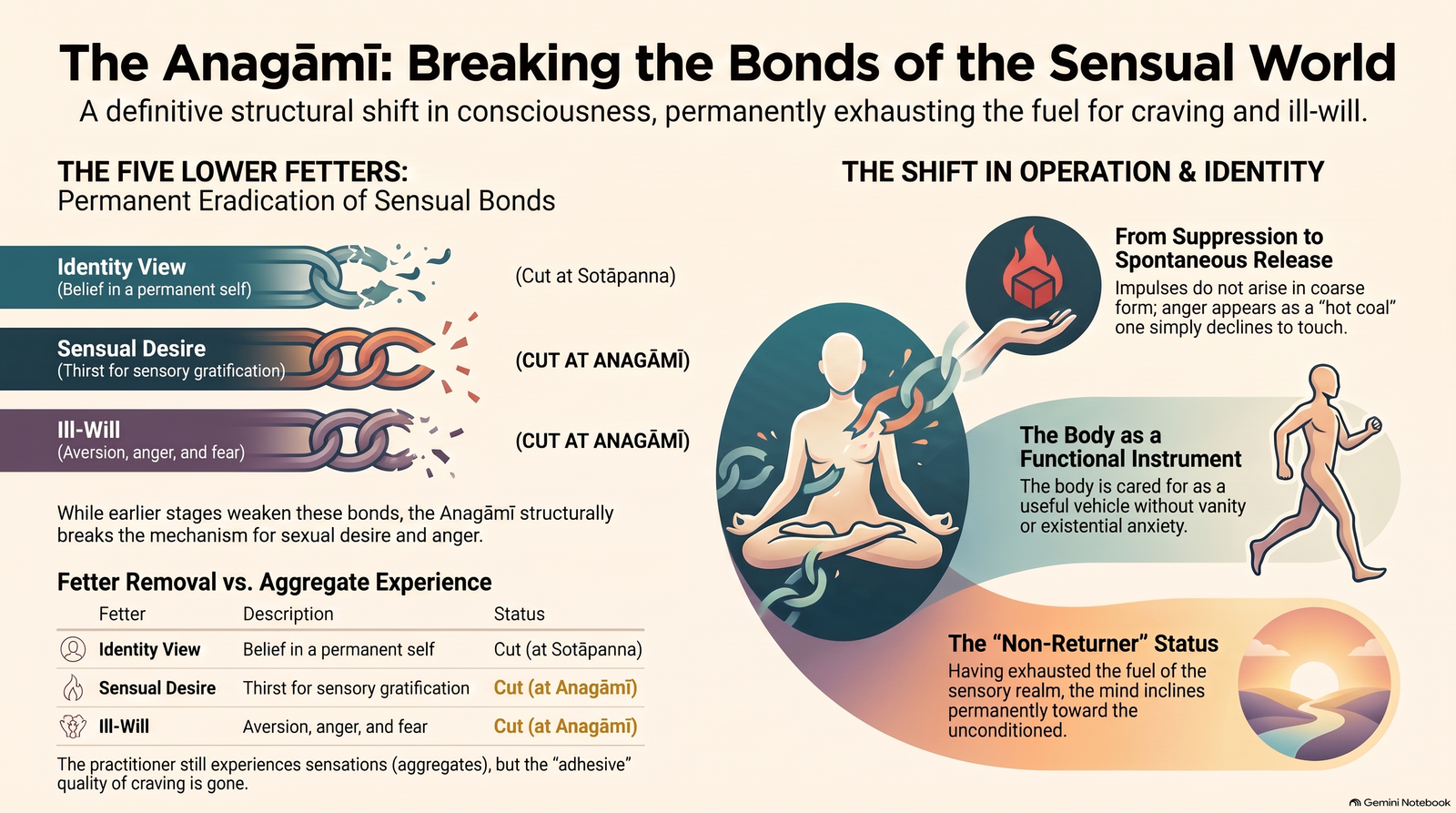
| Fetter | Concise meaning | Traditional status |
|---|---|---|
| Sakkāya-diṭṭhi Identity view | Taking one or more of the five aggregates as self or as belonging to self; more specific than denying conventional personhood. | Abandoned at stream-entry. |
| Vicikicchā Doubt | Uncertainty that obstructs commitment to the Buddha’s path; not honest inquiry or evidence-based questioning. | Abandoned at stream-entry. |
| Sīlabbata-parāmāsa Grasping at observances | Treating rules, vows or rites as sufficient in themselves for purification; not a rejection of ethics or disciplined practice. | Abandoned at stream-entry. |
| Kāma-rāga Sensual desire | Binding passion for the pleasures of the senses and the sensory realm, rather than every pleasant feeling or ordinary preference. | Weakened at once-returning; abandoned at non-returning. |
| Paṭigha / vyāpāda Aversion and ill-will | Hostility, resistance or the wish that another suffer; distinct from a bodily startle or firm action that prevents harm. | Weakened at once-returning; abandoned at non-returning. |
| Experience | What occurs | Why the distinction matters |
|---|---|---|
| Sensation or reflex | Pleasant or unpleasant feeling, pain, startle and autonomic arousal can arise in a living body. | The aggregate of feeling is not itself a fetter or a moral failure. |
| Ethical restraint | An urge arises, but speech or action is deliberately guided away from harm. | Restraint is valuable practice even when the underlying tendency remains. |
| Suppression | An impulse is pushed out of awareness, denied or held down while conflict continues. | Outward calm alone cannot show whether the mind is free, frightened, numb or tightly controlled. |
| Abandonment | In the traditional attainment claim, the relevant fetter no longer supplies the basis for sensual craving or ill-will. | This is a soteriological claim within a path model, not an inference made from mood, appearance or self-description. |
Argument map
How the recording develops its inquiry
Name the threshold
The non-returner is introduced as a structural and irreversible shift within a traditional four-stage map.
Distinguish weakening from cutting
The once-returner’s attenuation of desire and ill-will is contrasted with their claimed abandonment at non-returning.
List the lower fetters
Three bonds already ended at stream-entry are joined by sensual desire and ill-will to complete the lower five.
Separate experience from adhesion
The aggregates remain operative while craving and aversion no longer bind consciousness to passing sensation.
Contrast restraint and release
The dry bone and hot coal images suggest clarity that removes attraction rather than willpower that fights it.
Keep the body functional
Instrumental care is placed between vanity-driven identification and aversive neglect of bodily needs.
Recognise what remains
Relief does not complete the path: the five higher fetters still organise subtler forms of becoming and self-measurement.
Book, video and interpretive frame
Three layers of the lesson
The chapter establishes
Non-returning through the five lower fetters, the aggregates-fetters distinction, functional body care and the remaining higher fetters.
The recording expands
Gravity, a frayed rope, exhausted fuel, the dry bone, the hot coal and the “bloom” of reactivity make the claimed inner transition concrete.
The page clarifies
Doctrinal attainment is separated from repression, numbness, physiology, clinical interpretation and claims about another person’s status.
Video chapters
Navigate the discussion
Key language
Glossary
Anāgāmī
Saṃyojana
Kāma-loka and kāma-rāga
Paṭigha, vyāpāda and dosa
Five aggregates
Suppression, restraint and abandonment
Pure Abodes
The five higher fetters
Albedo
Related pathways
Continue within the course
- 2.2.11. Transcendental ConsciousnessThe preceding chapter introduces the four stages, the ten fetters and the developed Theravāda path-fruition architecture.
- 2.3.1. HollownessThe next course chapter enters the Object section and examines the unsettled clearing left as familiar structures of identity lose force.
- 1.2.11. The Fetters that BindProvides the earlier full treatment of the lower and higher fetters and the course’s alchemical reading of their progressive abandonment.
- 1.3.4 The Four Grades of RealisationPlaces non-returning within the sequence of stream-enterer, once-returner, non-returner and arahant.
- 1.3.10. AnāgāmīReturns to the same stage through Nigredo’s account of the Pure Abodes, non-retaliation and the transition towards Albedo.
- Albedo · Dharma — The Mechanics of RealityReview all twelve Dharma chapters, from the Crystal Universe to the non-returner.
Reference points
Sources for context and comparison
- Aṅguttara Nikāya 10.13 · FettersA compact early-discourse list of the five lower and five higher fetters behind the chapter’s structural map.
- Majjhima Nikāya 64 · The Greater Discourse at MāluṅkyāputtaA discourse on the five lower fetters and the path directed towards their abandonment.
- Saṃyutta Nikāya 48.15 · In DetailA concise classification of noble disciples, including the non-returner who has ended the five lower fetters.
- A Comprehensive Manual of AbhidhammaBhikkhu Bodhi’s edited guide to the Abhidhammattha Saṅgaha, useful for consciousness rooted in aversion, supramundane paths and the four stages.
- Stanford Encyclopedia of Philosophy · AbhidharmaA scholarly overview of Abhidharma as a family of systematic Buddhist analyses rather than a single modern psychological or scientific theory.
- NHS · Dissociative disordersGrounding context for experiences of detachment or disconnection that should not be assumed to demonstrate spiritual non-attachment.
A two-minute observation
Where does sensation become a story?
Choose one mild, ordinary moment of friction—not trauma, severe pain or an unsafe situation. Notice the first bodily data: heat, pressure, tightening, quickened breath. Then notice any next movement: blame, rehearsal, grasping, avoidance or the wish to make the feeling define “me.”
- Name the sensation without diagnosing a spiritual stage.
- Separate the body’s signal from the story forming around it.
- Choose the least harmful truthful response available.
- Let restraint count as practice; do not imitate indifference or force the feeling away.
The exercise illustrates the chapter’s distinction between experience and adhesion. It is not a test for non-returning and should not replace protection, treatment, boundaries or professional support.