
Citrinitas · Mythos · Chapter 7 of 48 · Catalogue 3.1.7
The Heart Sutra
If every appearance is empty of an independent essence, why do compassion, choices and the world still matter?
Watch the chapter discussion
The Heart Sutra Explained | Form Is Emptiness & No Self
Open the video on YouTube ↗This two-host, AI-generated interpretation of the chapter is a companion to the book, not an authoritative translation or Buddhist teaching.
The chapter in brief
Chapter seven of the 2026 revised Citrinitas turns to the Heart Sūtra, a short scripture in the Mahāyāna Perfection of Wisdom tradition. It examines how the five aggregates conventionally described as a person are empty of an independent, permanent nature. The chapter approaches paradox through everyday examples of naming, especially a spoon whose identity depends on material, shape and use. It also connects the scripture to the author’s alchemical language of dissolving fixed categories, then introduces Dzogchen terms to compare confused and recognised awareness. Those cross-traditional links belong to Robinson’s interpretive framework, not to the sūtra’s original doctrinal vocabulary. Its most important safeguard is that emptiness is not nihilism: the absence of intrinsic essence does not cancel relationships, suffering or the consequences of actions.
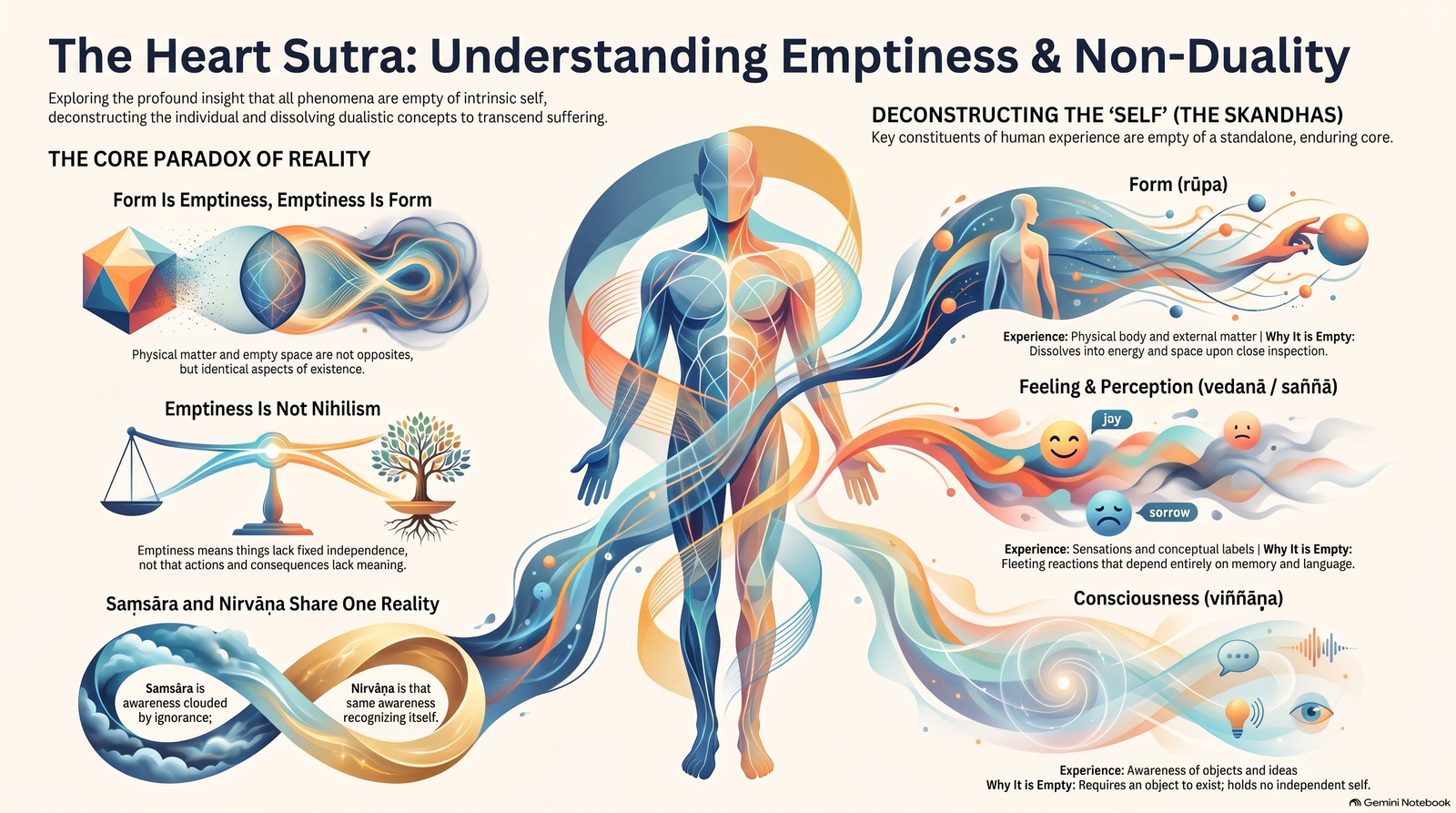
Video guide: what is emptied?
The recording begins by asking how a mind that depends on categories can understand a scripture that challenges them. Its speakers describe schemata as useful maps of experience, then worry that abandoning them could be unsettling. Avalokiteśvara, the scripture’s compassionate bodhisattva, is recast as an image of wisdom that does not leave compassion behind. This is a modern symbolic interpretation of a figure with a much wider devotional and textual history. The conversation sometimes urges viewers to discard logic; a more careful reading is to recognise the limits of reifying concepts, not to suspend ordinary judgement or safety.
The central examples make the problem tangible. The speakers melt an imaginary spoon, dismantle a Lego house and compare social identities to arrangements of parts. A name can remain useful without denoting an enduring substance. They then turn the same argument towards the five aggregates: body and form, felt tone, recognition, volitional formations and consciousness. Their watch and machine analogies suggest a changing assemblage rather than a fixed inner operator. The speakers invoke atoms, quantum physics and predictive processing with more certainty than the evidence warrants. Neither atomic structure nor a theory of perception demonstrates the Madhyamaka doctrine of emptiness; these are illustrative comparisons across different kinds of inquiry.
Next, the video contrasts everyday functioning with ultimate analysis, before introducing saṃsāra and nirvāṇa as two ways of relating to appearances. Its language of rigpa and marigpa draws on Dzogchen, rather than directly translating the Heart Sūtra. The claim that an arahant stands at one fixed level below a bodhisattva likewise reflects the author’s synthesis, not a universally shared Buddhist hierarchy. The dialogue’s strongest correction arrives when it rejects nihilism: understanding dependent existence cannot excuse indifference, harm or abandonment of conventional responsibility.
The final portion turns towards the sūtra’s negations of attainment, the gate gate mantra and an inquiry into the spaces between thoughts. The transcript briefly proposes a close attentional exercise; this page treats it as a reported feature of the discussion, not an instruction to repeat it. In closing, the speakers enlarge their question from personal labels to institutions, wealth and collective compassion. This societal transformation is a thought experiment, not a demonstrated effect of Buddhist insight. What remains useful is the ethical challenge: can we hold identities less tightly while responding more carefully to other people?
How the argument unfolds
The map meets its limit
The dialogue begins with the paradox of using useful concepts to investigate the concepts themselves.
A compassionate entry
Avalokiteśvara becomes a figure for wisdom joined to compassion, rather than proof of a universal psychological archetype.
The spoon is not its label
A melted spoon, a Lego house and everyday identity labels illustrate dependence on parts and conventions.
The supposed owner is examined
The five aggregates shift attention from external objects to the changing processes ordinarily called a self.
Two views, not two worlds
The discussion contrasts grasping and freedom, borrowing Dzogchen language but crossing distinct Buddhist interpretive frameworks.
The ethical test of emptiness
The dialogue rejects the inference that empty phenomena or persons make harm inconsequential.
Even attainment is not possessed
The mantra, the critique of achievement and the final societal thought experiment ask what compassionate action looks like without fixed identities.
Video chapters
These chapter points are supplied timed estimates, not independently checked against the edited video. They are useful for orientation but may be approximate.
- 00:00Opening: The Paradox Begins
- 02:10What Is the Heart Sutra?
- 06:00Form Is Emptiness Explained
- 10:40The Five Skandhas (No Self)
- 15:20The Collapse of Concepts
- 20:30Emptiness vs Nihilism
- 25:40Nirvāṇa and Saṃsāra
- 30:20Rigpa and Marigpa
- 35:10Beyond Attainment
- 39:00The Mantra: Gone Beyond
- 42:10Closing Reflections
Glossary
Heart Sūtra
A brief Mahāyāna Perfection of Wisdom scripture centred on the emptiness of the aggregates and other phenomena. Versions and textual histories differ; this chapter uses the author’s own rendering, not a critically established new translation.
Prajñāpāramitā
Literally the perfection of wisdom in Mahāyāna Buddhism. Prajñā concerns discriminating wisdom; pāramitā is a perfection or virtue brought to completion. The title is not simply an instruction to abandon rational thought.
Śūnyatā (emptiness)
In Madhyamaka philosophy, the absence of independent intrinsic nature. It does not mean that objects, people, suffering or causal consequences do not exist conventionally.
Svabhāva
An independently existing or intrinsic nature whose absence is central to many Madhyamaka accounts of emptiness. English glosses vary, and different Buddhist schools analyse the issue differently.
Skandhas (five aggregates)
The Buddhist categories of form, feeling tone, perception, volitional formations and consciousness. They help analyse experience without presupposing a permanent owner; they are not established anatomical components.
Avalokiteśvara
A bodhisattva closely associated with compassion and a central speaker in versions of the Heart Sūtra. The chapter additionally interprets this figure as a symbolic mirror of compassionate wisdom; that is the author’s reading.
Two truths
A distinction, especially prominent in Madhyamaka discussions, between conventional descriptions and ultimate analysis. Useful naming is not simply false, and ultimate analysis does not make everyday responsibilities disappear.
Dependent arising
The Buddhist teaching that phenomena occur in dependence on conditions. Its precise relationship with emptiness varies by tradition; it is not identical to a modern scientific causal model.
Anātman (no-self)
The Buddhist denial of an enduring, autonomous self as ordinarily imagined. It does not entail that persons do not matter or that ethical and legal responsibility can be discarded.
Saṃsāra and nirvāṇa
Saṃsāra refers to conditioned cyclic existence and suffering; nirvāṇa to liberation or cessation. Their nonduality receives specific interpretations in Mahāyāna traditions, not a blanket assertion that suffering is illusory.
Rigpa and marigpa
In Dzogchen, rigpa names knowing or recognition of the nature of awareness, while marigpa indicates non-recognition or ignorance. This is distinct from the Heart Sūtra’s original vocabulary and is not a proven neurological switch.
Dharmakāya
The truth or reality body in Mahāyāna Buddhist accounts of buddhahood. Dzogchen and other traditions interpret related language in particular ways; it is not a physical field or demonstrated universal consciousness.
Gate gate mantra
The concluding Sanskrit formula conventionally transliterated gate gate pāragate pārasaṃgate bodhi svāhā. Translations vary; the formula belongs to the scripture’s ritual and doctrinal setting, not a scientifically defined sound mechanism.
Related pathways in the course
- 3.1.6. Sudden Methods including Traumatic EnlightenmentThe preceding Mythos chapter; read its difficult material critically.
- 3.1.8. The BardoThe following book chapter, on Tibetan accounts of transitional states.
- 3.1.5. The Path of InsightEarlier treatment of insight and the assumptions it investigates.
- 3.1.11. The Diamond Sutra (Part One)A related Perfection of Wisdom text; this retains the older public page title.
- Mythos — Part One of CitrinitasThe published Mythos section index.
- Citrinitas — Part ThreeThe broader course landing page.
External reference points
These are resources for checking the textual and philosophical setting, not assertions that each source was cited in the recording.
- 84000: The Heart of the Perfection of Wisdom, the Blessed MotherDharmachakra Translation Committee’s Tibetan-canon translation with introductory scholarship.
- Lotsawa House: Heart SūtraAdam Pearcey’s 2019 translation, useful for comparing wording.
- Stanford Encyclopedia of Philosophy: NāgārjunaScholarly context for emptiness, intrinsic nature and Madhyamaka interpretation.
- Journal of Indian Philosophy: Not Even AbsentA scholarly discussion illustrating live interpretive debate about emptiness and the two truths.
A question to carry forward
Where might treating a label as a permanent identity make another person harder to understand? What changes if the label remains practically useful but ceases to be the whole account of that person?